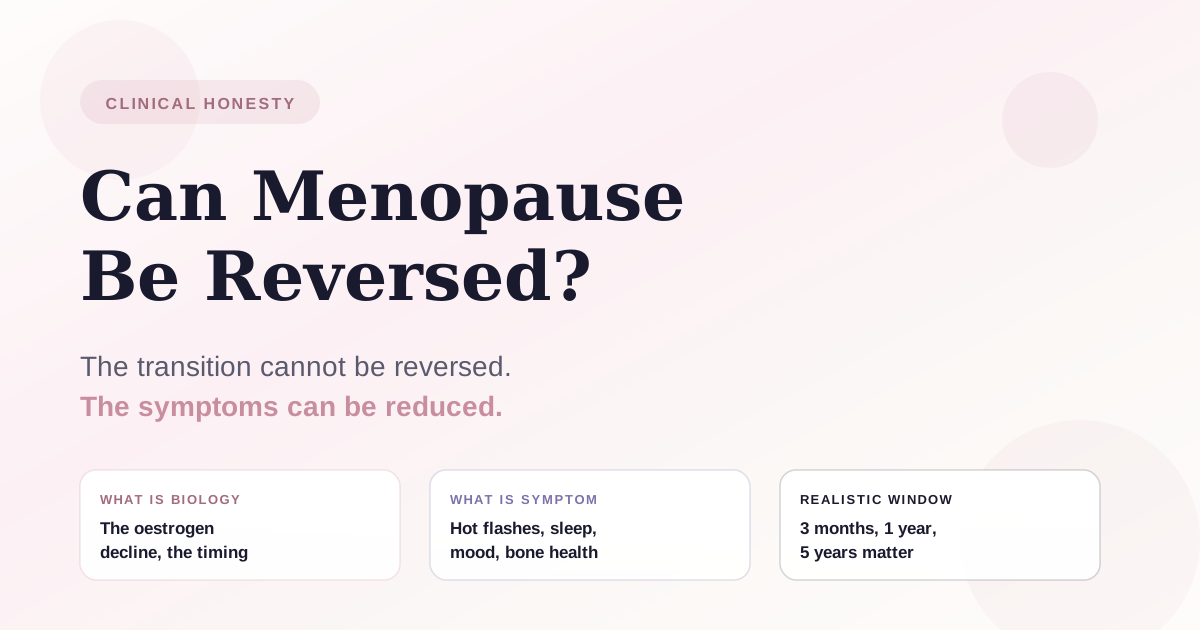
Can menopause be reversed? No. Menopause is the permanent end of ovarian oestrogen production, and no diet, supplement, or hormone treatment available today can rebuild the ovary’s follicle pool or restart it. What can be reversed, often substantially, are the symptoms it causes: hot flashes, broken sleep, brain fog, low mood, joint pain, vaginal dryness, and the weight that arrives where it never used to. The transition is permanent; the suffering is largely treatable.
“My friend’s coach says she reversed her menopause.”
A woman in her late forties said this to me last month, half hopeful, half suspicious. She had been losing sleep for three years. Her joints ached in the morning. Her cycles had stopped almost a year ago. She wanted to know if reversal was real, and whether she should buy the programme her friend was on.
The straight answer is the one no one is selling. Menopause itself cannot be reversed. It is not a disease. It is the permanent end of ovarian oestrogen production, set by genetics, accelerated slightly by smoking, and otherwise not something diet or supplements can roll back. What can be reversed, often substantially, is the suffering it produces. Hot flashes, broken sleep, low mood, brain fog, vaginal dryness, joint pain, and the weight that suddenly arrives where it never used to are all responsive to the right plan.
The wellness industry conflates the two. The clinical literature does not. This post walks through the distinction in plain language, names what is biology and cannot be changed, names what is symptom and can be changed, and shows what the evidence actually supports.
This post covers:
- Why “reversing menopause” is a category error, not a clinical possibility
- What HRT does (and does not) actually do
- What lifestyle can change, and how much
- Whether menopause can be delayed or postponed
- The realistic timeline: 3 months, 1 year, 5 years
- Why the framing matters for your own decision-making
The short answer in one paragraph
Menopause is the permanent end of ovarian oestrogen production. It happens when the finite pool of follicles a woman is born with falls below a threshold the ovaries need to function. That decline is set mostly by genetics and modestly affected by smoking and certain medical exposures. No diet, no supplement, no exercise, and no hormone protocol available today can rebuild the follicle pool or restart ovarian function. Menopause cannot be reversed. What is unambiguously reversible, and is well-supported by NICE NG23, British Menopause Society 2022 guidance, and International Menopause Society 2024 consensus, is the symptom load that the oestrogen decline produces. Hot flashes, sleep disturbance, mood changes, brain fog, joint pain, weight composition shifts, and genitourinary symptoms all respond to treatment.
For the broader picture of what menopause is and how it is staged, our complete menopause guide covers the diagnostic criteria and timeline in depth.
Why “reversing menopause” is a category error
A reversal implies a process that can be run backwards. Bacterial pneumonia is reversible: kill the bacteria, the lung heals. Iron deficiency anaemia is reversible: replace the iron, the haemoglobin rises. Diabetic ketoacidosis is reversible: insulin and fluids, the metabolism rebalances.
Menopause is not in this category. It is the natural endpoint of a finite biological resource. A woman is born with roughly one to two million ovarian follicles. By puberty she has around 300,000. By the time perimenopause begins, in the early-to-mid forties for most Indian women (Ahuja 2016, Journal of Mid-Life Health), the count is in the low thousands. Menopause itself is reached when so few follicles remain that the ovary can no longer reliably ovulate or produce meaningful oestrogen. The process is gradient, not switchable.
This is the same reason puberty cannot be reversed once it happens. Both are major life transitions encoded in the body’s developmental program. We do not call the end of puberty a “disease.” We should not call menopause one either.
The word that gets misused is the noun. “Reverse” attached to “menopause” is the over-claim. “Reverse” attached to “hot flashes” or “brain fog” or “joint pain” is something the evidence does, in fact, support.
What HRT does (and does not)
Hormone replacement therapy is one of the most evidence-based interventions in midlife medicine, and also one of the most misunderstood. It is worth being precise.
What HRT does: It replaces some of the oestrogen (and usually progesterone, if a woman still has a uterus) that the ovaries no longer make. This significantly reduces hot flashes and night sweats, improves sleep, eases vaginal dryness and urinary symptoms, slows bone loss, and for many women improves mood and brain fog. The evidence is strongest for vasomotor symptoms and bone protection (NICE NG23; British Menopause Society 2022; Stuenkel 2015 Endocrine Society Clinical Practice Guideline).
What HRT does not do: It does not restart ovarian function. It does not restore fertility. It does not undo menopause. It does not last forever in unchanged form; doses are typically reassessed every year or two. Stopping HRT does not return a woman to her pre-menopausal state; she returns to her menopausal physiological baseline plus whatever changes have accumulated since.
The decision is personal and risk-adjusted. HRT is well-suited to women with bothersome symptoms, no contraindications (active hormone-sensitive cancers, unexplained vaginal bleeding, active liver disease, prior thromboembolism), and a preference for active management. For women whose symptoms are mild, who prefer non-hormonal approaches, or who have contraindications, the lifestyle and non-hormonal medication toolkit is broad enough that good outcomes are still achievable.
Working with your gynaecologist on the HRT question, not around her, is the right model. Menolia adds the lifestyle, nutritional, and mental-wellness layer to whatever the medical decision turns out to be.
Want to understand what is actually realistic for your symptoms, and what the options look like for your specific picture? A ₹399 online consultation with Dr. Suganya walks through your symptom pattern, your overall risk profile, and what an honest plan would look like for you. No reversal promises. Just the honest version. Message Dr. Suganya on WhatsApp to start.
What lifestyle can change, and how much
This is the part where the evidence is genuinely encouraging, and where the wellness industry’s instinct to over-claim is hardest to resist. The accurate version is striking enough on its own.
Hot flashes. Cognitive behavioural therapy for menopause reduces hot flash bother and frequency, often by 30 to 50 percent (Mann et al. 2012 Lancet Oncology). Avoiding personal triggers (often caffeine, alcohol, very spicy food, hot rooms) helps within weeks. Phytoestrogen-containing foods (flaxseeds, soy, til, dals) reduce vasomotor symptoms in some women (Pruthi 2012, Menopause). Stopping smoking reduces both severity and remaining duration.
Sleep. CBT for insomnia (CBT-I) has effect sizes comparable to or larger than sleeping medications and is recommended first-line for menopausal sleep disturbance (American College of Physicians 2016). Strength training improves sleep architecture independently of weight loss.
Bone density. Strength training and adequate protein meaningfully slow age-related bone loss. Adequate calcium and vitamin D matter. None of these prevent post-menopausal bone loss entirely, but they shift the trajectory. For a deeper guide to bones at this stage, see how to prevent osteoporosis.
Weight and body composition. The weight that arrives around perimenopause is partly oestrogen-driven (favouring visceral fat), partly muscle-loss-driven, and partly cortisol-driven. Strength training rebuilds muscle and improves insulin sensitivity. Adequate protein matters more in this life stage than at any earlier one. For the full picture see exercise during menopause: what actually helps.
Mood and brain fog. Regular exercise, structured sleep, social connection, and where indicated SSRIs or CBT are all effective. The cognitive symptoms of menopause are real, well-documented, and largely transient through the transition (Greendale et al. 2009, Neurology). They do not predict dementia in the way some women fear. See menopause memory loss, dementia or hormones for the full distinction.
Vaginal and urinary symptoms. These do not improve with lifestyle alone. They are responsive to local vaginal oestrogen (a low-dose topical treatment with minimal systemic absorption, considered safe for most women including many who cannot take systemic HRT) and to non-hormonal moisturisers and lubricants. The condition has a name: genitourinary syndrome of menopause. See genitourinary syndrome of menopause for what helps.
None of these “reverse menopause.” All of them substantially reduce the symptom load that menopause produces. That is the difference worth understanding.
Can menopause be delayed or postponed?
This question gets asked separately from “can it be reversed,” and the answer is similar but worth its own paragraph.
The age of natural menopause is set mostly by ovarian reserve, which is determined by genetics. The strongest known modifiable factor is smoking, which advances menopause by an average of 1 to 2 years (Mishra et al. 2013, Menopause). Beyond that, the effect sizes of any intervention available today are negligible. Diet, supplements, “anti-ageing” protocols, and lifestyle in any form have not been shown to meaningfully postpone the timing.
Surgical removal of both ovaries causes immediate menopause regardless of age. Certain cancer treatments (chemotherapy, pelvic radiation) often induce menopause earlier than it would have happened naturally. These are downward shifts, not upward ones.
What is genuinely achievable is changing how the years between now and natural menopause are spent. Stronger bones at 55. Better cardiovascular fitness. More muscle mass. Improved insulin sensitivity. Lower symptom severity if and when symptoms arrive. These are large effects on quality of life and long-term health, and they are entirely within reach.
The realistic timeline: 3 months, 1 year, 5 years
If you start active management today, here is what is genuinely realistic.
Three months. Symptom intensity for vasomotor and sleep issues typically reduces meaningfully if HRT or a non-hormonal medication is started, or if CBT and lifestyle work are consistent. Mood often stabilises within this window. Brain fog usually shows some improvement. Vaginal symptoms respond to local oestrogen within 6 to 12 weeks. Weight composition shifts are early and slow.
One year. Bone density changes start being measurable on a repeat DEXA. Cardiovascular fitness gains are well-established if regular exercise is in place. Body composition has typically shifted toward more muscle and less visceral fat. Sleep is durable. Hot flashes that respond to treatment are well-controlled. Women on HRT typically have their first formal review at the 12-month mark.
Five years. This is when the cumulative effect of the work shows. Women who managed symptoms actively and continued strength training, sleep care, and nutrition are typically in a measurably better metabolic and bone profile than women who tried to wait the transition out. Vasomotor symptoms have either resolved (for most women, by year 7 to 10 from onset; Avis et al. 2015 JAMA Internal Medicine) or are controlled. The years are not a loss; they are a window in which long-term health is shaped.
This is what “reversal” actually means in clinical practice. The transition still happens. The symptoms it would otherwise have produced are reduced enough that the years through it are livable, sometimes very good.
Practical takeaways
- Stop looking for menopause reversal. It does not exist as a clinical category. Look for symptom relief, which does exist and is well-supported by evidence.
- Be wary of any program that uses the words “cure” or “reverse” attached to menopause itself. It is a credibility signal. Programs and clinicians that say “we reduce hot flashes, sleep loss, and bone loss” are describing what is actually achievable.
- Investigate HRT as one option, not as the only option. If your symptoms are bothersome and you have no contraindications, it is a powerful tool. If you prefer non-hormonal management, the toolkit is broad enough that good outcomes are achievable.
- Invest in the years through the transition, not in delaying biology that is not delayable. Strength training, sleep, protein, and stress care during perimenopause and the first post-menopausal years shape long-term bone, heart, and brain health more than almost any other window of life.
- Vaginal and urinary symptoms need their own conversation. They do not improve with lifestyle alone. Local vaginal oestrogen and non-hormonal options are both effective and under-discussed.
If you want to talk through your specific picture, message Dr. Suganya on WhatsApp for a ₹399 online consultation. She will walk through your history, your symptom pattern, and what an honest plan looks like for you.
FAQ
Can menopause be reversed?
No. Menopause is the permanent end of ovarian oestrogen production, set by the depletion of the finite follicle pool. No diet, supplement, exercise protocol, or hormone treatment available today rebuilds the follicle pool or restarts ovarian function. What can be reversed, often substantially, are the symptoms menopause produces. The distinction is medical, not marketing.
Is HRT a way to reverse menopause?
No. HRT replaces some of the oestrogen the ovaries no longer make, which significantly reduces hot flashes, sleep disturbance, vaginal symptoms, and bone loss. It does not restart ovarian function or restore fertility. It is a powerful symptom and protection tool, not a reversal.
Can lifestyle changes stop or delay menopause?
Largely no. The strongest known modifiable factor is smoking, which advances menopause by 1 to 2 years. Beyond that, diet, supplements, and “anti-ageing” protocols have not been shown to meaningfully postpone the timing. What lifestyle does change powerfully is symptom severity and long-term bone, heart, and metabolic health through the transition.
What menopause symptoms can be reversed?
Hot flashes and night sweats, sleep disturbance, mood changes, brain fog, weight composition shifts, and joint pain all respond meaningfully to a combination of HRT, non-hormonal medication (where indicated), CBT, strength training, sleep work, and targeted nutrition. Vaginal and urinary symptoms respond well to local vaginal oestrogen. Bone loss is slowed (not stopped) by strength training and adequate protein, calcium, and vitamin D.
How long do menopause symptoms last on their own?
Hot flashes and night sweats last on average 7 to 10 years from onset (Avis et al. 2015, JAMA Internal Medicine), with substantial individual variation, and they do eventually fade for most women. Vaginal and urinary symptoms do not fade with time and usually progress without treatment. Sleep, mood, and cognitive symptoms vary. Waiting them out is reasonable for some women; for others active management makes the years they are present substantially more livable.
If menopause cannot be reversed, why see a doctor for it?
Because the symptoms are treatable, the long-term health risks (bone loss, cardiovascular disease) are reducible, and the quality of life is substantially shaped by what happens in the first few years after the transition. Menopause itself is not a disease, but it is a window in which active care produces large differences in how the next 30 to 40 years look and feel.
What is the difference between “managing” menopause and “reversing” it?
Managing means reducing the symptoms and protecting long-term health while the underlying transition runs its natural course. Reversing would mean restarting ovarian function and returning a woman to her pre-menopausal hormonal state, which is not currently possible. Honest programs offer the first. Programs that promise the second are over-claiming.
A final word
Menopause is one of the most over-promised areas in women’s health. It is also one where the truth is genuinely good news. The transition is not stoppable, but the suffering is largely treatable. The years through it are not a loss; they are a window in which long-term health is shaped. The right combination of medical, lifestyle, and mental-wellness work makes a substantial difference.
If you have been searching for a “menopause reversal” and feeling something is off about the claims you find, that instinct is worth listening to. The honest version is available, and it works.
Message Dr. Suganya on WhatsApp for a ₹399 online consultation that walks through your specific picture, what is realistic in 3 months, in a year, in 5 years, and what an honest plan looks like for your body.
The honest version is always available. You just have to ask for it.