You sat across from your gynaecologist, described the night sweats and the sleep that will not come, and left with “this is just menopause, it happens to everyone” ringing in your ears. Nothing was explained. Nothing was offered. You are not imagining that the appointment felt too short for what you needed to say.
I am Dr. Suganya Venkat, an OB-GYN with over 15 years of practice, and I built Menolia because this exact gap keeps showing up in my consultations: women who have been living with symptoms for months, sometimes years, before anyone asks them the right questions about it. Some of that gap is your doctor’s time. Some of it is that menopause care simply is not standardised the way, say, antenatal care is. Almost none of it is because your symptoms do not matter.
This guide is about closing that gap from your side of the desk: what to bring to the appointment, what to ask, and how to ask for more help if the first answer does not feel like enough.
Why the Conversation Often Falls Short
Two things are working against you in a typical consultation, and neither is personal.
The first is time. A widely cited systematic review of primary care consultations across 67 countries found that consultation length varies enormously worldwide, and that roughly half the world’s population gets five minutes or less with their doctor per visit (Irving et al., BMJ Open, 2017, PMID 29118053). India was not the best-represented country in that data, but the pattern will be familiar to anyone who has sat in a busy OPD queue: a full menopause history, in five minutes, is difficult even for a doctor who wants to give it the time it deserves.
The second is that menopause training and menopause-specific care pathways are inconsistent. A 2026 UK study on women trying to access support for menopause-related cognitive symptoms like brain fog found that many described the clinicians they saw as under-informed or dismissive about menopause specifically, alongside long waits and little follow-up (Fordham et al., Post Reproductive Health, 2026, PMID 42741851). That was the UK, with a dedicated menopause service model. In India, where a woman’s first stop is often a busy general OPD or a family physician rather than a menopause-specific clinic, the same gap can be wider.
None of this means your gynaecologist does not care. It means the system around the appointment is not built to draw out a slow-building, cumulative story like menopause on its own. That part is on you to bring in, ready-made.
What to Track Before the Appointment
You do not need a perfect diary. You need a pattern your doctor can act on in under two minutes of reading.
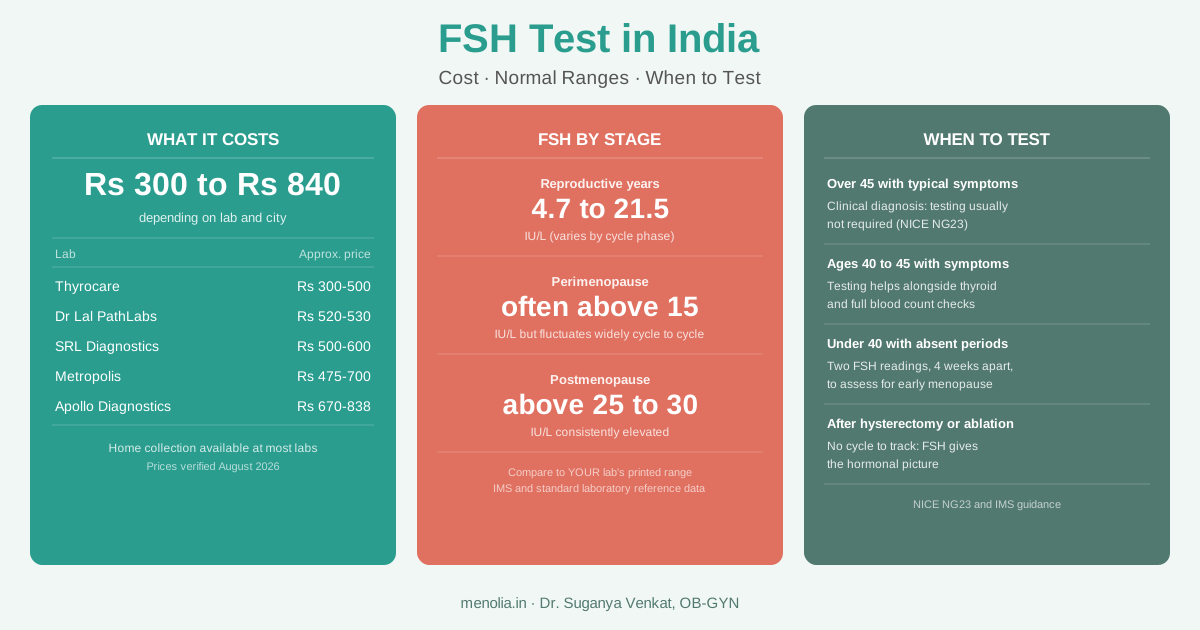
There is no single blood test that confirms perimenopause. Hormone levels like FSH swing so much during the transition that one reading can look completely normal even while your symptoms are unmistakable. What is far more useful to a doctor is your own record of what has changed. For the full explanation of why testing alone falls short, see our perimenopause test guide.
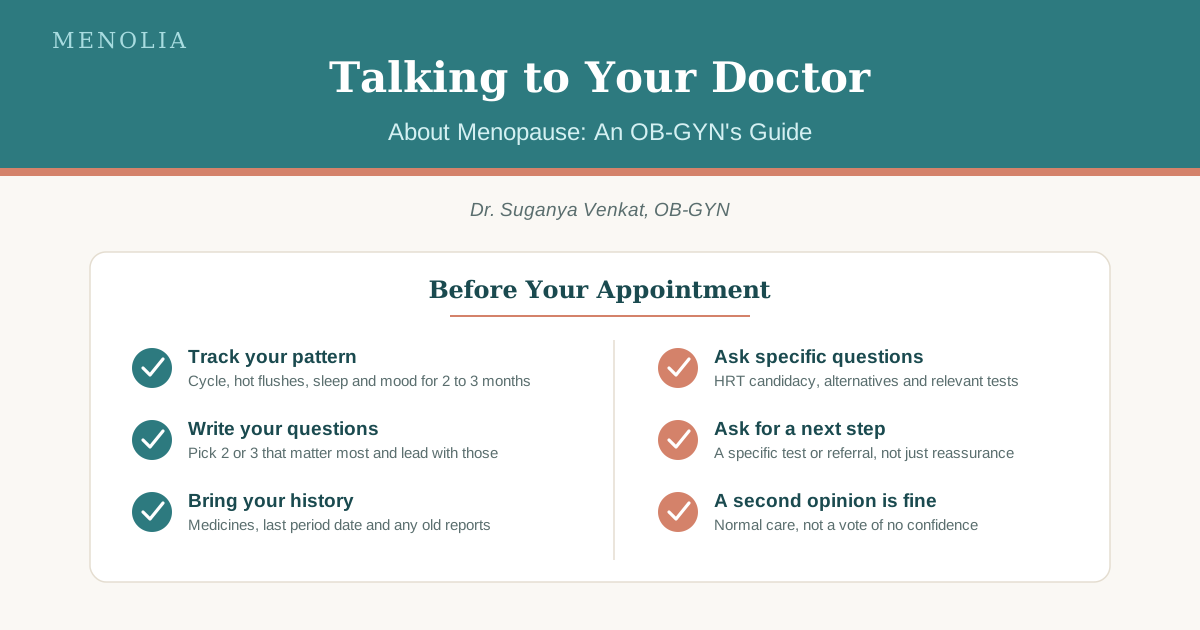
Track these for 2 to 3 months if you can, even just on your phone’s notes app:
- Period pattern. Shorter, longer, heavier, lighter, or skipped cycles, with dates
- Hot flushes and night sweats. Roughly how many a day or night, and how disruptive
- Sleep. Trouble falling asleep, waking repeatedly, or waking too early
- Mood. New irritability, anxiety, or low mood, and whether it tracks with your cycle
- Anything unusual. Joint pain, brain fog, heart palpitations, vaginal dryness, or changes in bleeding
Bring a current list of medicines and supplements, your last period date if you know it, and any previous reports. If you have a family history of early menopause, osteoporosis, or heart disease, write that down too. A rushed appointment cannot cover ground you have not laid out in advance.
If any of what you are tracking looks less like ordinary menopause and more like something needing urgent attention, our menopause red flags guide covers which symptoms need prompt in-person assessment rather than a routine appointment.
The Questions Worth Asking
A vague “is this menopause” question tends to get a vague answer. Specific questions get specific answers. Here is what I actually want women to ask me.
On diagnosis and testing:
- “Based on my symptom pattern, do you think I’m in perimenopause, or could something else explain this?”
- “Is a blood test actually going to change what we do next, or can we treat based on symptoms?”
- “What conditions should we rule out that can look like menopause, thyroid problems, anaemia, or low vitamin D or B12?”
On treatment options:
- “Am I a reasonable candidate for HRT, and what would that involve?”
- “What are the non-hormonal options if I’d rather not start with HRT, or if I’m not a candidate?”
- “How long would we try an approach before deciding it isn’t working?”
On the bigger picture:
- “What does this mean for my bone and heart health going forward, and is that something we should be checking?”
- “What symptoms would mean I need to come back sooner rather than waiting for my next review?”
You will not get through all of these in one visit, and that is fine. Pick the two or three that matter most to you right now and lead with those.
A decision about HRT in particular benefits from this kind of structure. A 2025 trial found that women who went through a structured shared decision-making process, being walked through the options with a decision aid rather than given a single recommendation, ended up more confident in their choice and had less regret about it afterward (Ghehi et al., BMC Women’s Health, 2025, PMID 40394544). Asking your doctor to actually walk through the “why” behind a recommendation, not just the recommendation itself, is a reasonable thing to ask for. If HRT does come up, our complete guide to HRT in India is a good page to read before the appointment, so the conversation starts from a shared baseline rather than from zero.
If you’d rather talk this through with someone first: message Dr. Suganya for an online menopause consultation. We can go through your symptom pattern together and help you walk into your next appointment with clarity on what to ask.
If You Feel Dismissed: Asking for a Second Opinion
“This is normal, just push through it” is sometimes true and sometimes a sign the conversation ended too early. You are allowed to want more than that, without assuming your doctor was wrong or careless.
Here is how to ask for more, without it becoming confrontational:
- Name what you need, not what you think they did wrong. “I’d like to understand this a bit more before we leave it at that” lands very differently from “you’re not taking this seriously.”
- Ask for a specific next step. “Could we check my FSH and thyroid levels, or is there someone you’d suggest I see for a more detailed review?” A concrete ask is easier to act on than a general complaint.
- It is completely reasonable to see a second doctor. You do not need your first doctor’s approval to do this, and you do not owe them an explanation. A second set of eyes on a slow-building, symptom-heavy condition like menopause is a normal part of good care, not a vote of no confidence.
- Bring your tracked symptoms to the second opinion too. This is exactly why the tracking in the earlier section matters: it means the second conversation does not start from zero either.
Most of the time, everyone in the room wants the same outcome, you feeling better. A single short visit is often just not enough time to get there. Asking for more is how you close that gap.
When a Specialist Referral Makes Sense
Your gynaecologist is usually the right first stop for menopause care, but some symptom patterns are genuinely better served by another specialist working alongside them, not instead of them.
- Persistent low mood, anxiety, or symptoms that feel bigger than your hormones alone explain may be worth a psychiatry review, particularly if you have a history of depression or the symptoms are affecting your daily functioning
- Joint pain, or a flare of an existing autoimmune condition like rheumatoid arthritis or lupus, is worth discussing with a rheumatologist alongside your menopause care, since the two can genuinely interact
- Bone density concerns, especially with a family history of osteoporosis or an early menopause, may need an endocrinologist’s input on top of routine screening
- Heart palpitations, chest discomfort, or new blood pressure changes always deserve their own cardiac workup rather than being filed away as “just hormones”
Asking your gynaecologist “would a referral make sense here” is a normal question, not a demand. A good doctor treats a referral as one more tool, not as a failure on their part.
What This Looks Like in Practice
At Fertilia and Menolia, our online consultations are built around exactly this problem: giving women the time a first, rushed in-person visit often cannot. When a woman comes to me with two months of tracked symptoms already written down, the conversation moves faster and goes deeper, because we are not spending the first ten minutes reconstructing a history from memory.
You do not need a perfect record. You need enough of a pattern that the next thirty minutes of anyone’s time, mine or your local gynaecologist’s, get spent on answers instead of on getting started.
Frequently Asked Questions
My doctor said my symptoms are “just menopause” and didn’t offer anything. What should I do?
Ask a direct follow-up: “What are my options, even if we decide not to use any of them right now?” If that still does not get you a concrete answer, it is reasonable to seek a second opinion, ideally with your tracked symptoms in hand.
How long should I track my symptoms before seeing a doctor?
Two to three months gives a pattern that is genuinely more useful than a single visit’s memory of “it’s been bad lately.” If something feels urgent, do not wait for a full tracking period, see our red flags guide for what needs faster attention.
Is it rude to ask for a second opinion from my gynaecologist?
No. It is a normal part of managing your own care, especially for a condition as individual as menopause. You do not need to justify it, and a good doctor will not take it personally.
Do I need a blood test to know if I’m in perimenopause?
Usually not as the first step. Your symptom and cycle pattern is often more reliable than a single hormone reading, since levels like FSH fluctuate through the transition. Blood tests are still useful to rule out look-alikes like thyroid problems, anaemia, or vitamin deficiencies. Our perimenopause test guide explains this in more detail.
What if my doctor doesn’t bring up HRT at all?
You can ask directly: “Am I a candidate for HRT, and what would you want to know before recommending it either way?” Read our HRT in India guide beforehand so you know what questions to raise.
Should I see a gynaecologist or a general physician for menopause symptoms?
A gynaecologist is usually the right starting point since menopause care sits within their specialty, but a general physician is a reasonable first contact if that is who you can access most easily, especially for ruling out non-hormonal causes. Either one can refer you onward if a specific symptom needs a different specialist.
What should I bring to my first menopause consultation?
A written symptom pattern from the past 2 to 3 months, your last period date, current medicines and supplements, and any previous test results. This turns a rushed conversation into a focused one.
Menopause deserves a conversation that actually gets somewhere, whether that happens with your regular gynaecologist, a specialist, or with us. If you would like help preparing for that conversation, or want to start it directly, message Dr. Suganya for an online consultation. You do not need to have all the answers before you reach out, that is what the consultation is for.