One of the most common questions I receive from women in their early forties goes something like this: “I got my first period at 11. Does that mean my menopause will come early too?”
It is a logical question, and I understand where it comes from. If periods start earlier, surely they also stop earlier? The idea has a kind of intuitive tidiness, and enough women have heard it from mothers or aunts, or read it somewhere, that it arrives in the consultation as a settled fact.
It is not. The relationship between your first period and your last is more complicated than a fixed clock, and in most cases the folk belief points in the wrong direction. I’m Dr. Suganya Venkat, an OB-GYN with over fifteen years of clinical practice, and this is one of those questions where the evidence genuinely changes the picture.
The “Early Start, Early Finish” Belief
The popular belief rests on a specific model of how the female body works: that reproduction runs on a fixed internal clock, and the only variable is when the clock starts. Under this model, a woman who got her period at 11 instead of 14 has simply shifted her entire reproductive timeline three years earlier. Her menopause follows the same shift.
This model is intuitive. It is also not well supported by how ovarian biology actually works.
Age at menarche and age at menopause are both biological events shaped by genetics and environment, but they are not controlled by the same mechanisms. The factors that bring on the first period and the factors that end the last one overlap only partially.
What the Research Shows
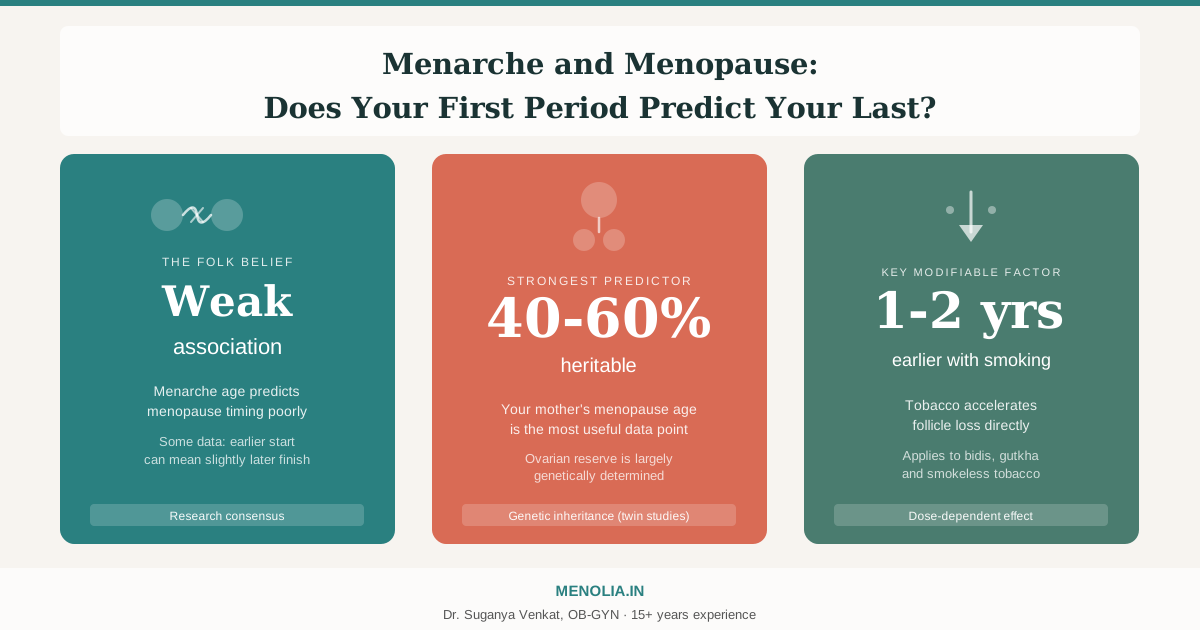
Multiple studies have examined the association between age at first period and age at final period directly. The findings are consistent: the correlation is weak.
Where a link shows up at all, it runs in the direction the folk belief expects, but it is small. In the British 1946 birth cohort, there was some evidence that an early first period was associated with a slightly earlier start to the perimenopause (Hardy R, Kuh D, Am J Epidemiol, 1999, PMID 10192308). A large pooled analysis of cohort studies found that women whose periods began at 11 or younger had a higher relative risk of premature menopause (before 40) and early menopause (40 to 44) than women who started at 12 or 13 (Mishra GD et al., Hum Reprod, 2017, PMID 28119483). The absolute numbers stay small, though: across the whole group in that analysis, 2% of women had a premature menopause and under 8% an early one, the median age at the final period was 50, and most women with early menarche reached menopause at the usual age.
So the arithmetic model of “start earlier, finish earlier” is not exactly wrong. It is far weaker than the belief assumes. Menarche age nudges the odds at the margins rather than setting a schedule, and on its own it says very little about when any individual woman will reach menopause.
The concept of reproductive span makes this concrete. The reproductive span is simply the number of years between your first period and your last. If the folk belief were correct, reproductive span would be nearly fixed across individuals. A woman who started at 11 and one who started at 14 would both have approximately the same span, say 36 years, making their menopause ages 47 and 50 respectively.
But reproductive span varies widely between individuals, from under 30 years to over 45 years, and menarche age accounts for only a small fraction of that variation. The span itself is not fixed. What determines it lies elsewhere.
What Predicts Menopause Age
If your first period is a poor guide to when your last one will be, what is a better one?
Your mother’s menopause age
The strongest single predictor of your menopause timing is when your close female relatives, particularly your mother, went through theirs. Twin studies have established that approximately 40 to 60 percent of the variation in menopause timing is heritable (Snieder H et al., J Clin Endocrinol Metab, 1998; Murabito JM et al., J Clin Endocrinol Metab, 2005). The age at which your ovarian reserve declines to the menopausal threshold is substantially shaped by the genes you inherited.
This has a practical implication. If your mother reached menopause at 42, that is more clinically relevant to your personal timeline than the fact that your periods started at 11. Conversely, if your mother continued her cycles into her early fifties, that is reassuring context for you, regardless of when your own menarche was.
If your mother’s records are not available, maternal aunts and grandmothers carry useful information. The inheritance pattern for ovarian reserve runs through the maternal line.
Smoking
After genetics, smoking is the most consistently documented modifiable influence on menopause timing. Women who smoke reach menopause an average of one to two years earlier than non-smokers, and the effect is dose-dependent: heavier and longer smoking accelerates the timeline further.
The mechanism is direct. Certain chemicals in cigarette smoke, particularly polycyclic aromatic hydrocarbons, are toxic to ovarian follicles. They accelerate follicle loss, bringing the menopausal threshold earlier.
This applies to bidis and smokeless tobacco products. Gutkha, pan masala, and chewing tobacco preparations expose the body to overlapping compounds, and their use is common in parts of India. Second-hand smoke exposure contributes as well, though with a smaller effect than active smoking.
If you currently smoke, stopping is the most meaningful lifestyle choice you can make for your menopause timeline. The follicle damage from years of smoking is not reversible, but further acceleration is.
Parity
Women who have had pregnancies tend to reach menopause slightly later than women who have not, on average, across multiple studies. The hypothesis is that ovulation pauses during pregnancy, so each pregnancy temporarily slows the rate of follicle depletion, preserving the pool a little longer.
The effect is modest and individual variation is large. This is not a reason to make family planning decisions on the basis of delaying menopause. It is simply one factor in a complex picture.
Body composition
Fat tissue contains an enzyme called aromatase. Aromatase converts androgens into oestrogen outside the ovaries, producing a background level of oestrogen that does not depend on ovarian activity. Women with higher body mass index carry more aromatase-producing tissue and therefore more peripheral oestrogen, which can sustain hormonal activity in the menstrual cycle for longer.
This is one reason higher body weight is associated, on average, with later menopause. Very low body weight or significant chronic energy restriction is linked in some studies with earlier menopause, though the evidence is less consistent than for smoking or genetics.
Surgery and medical treatments
Bilateral removal of the ovaries (bilateral oophorectomy) causes menopause immediately, regardless of age. This is surgical menopause, and because the transition from hormonal activity to none happens over days rather than years, the symptoms are often more abrupt and intense than in natural menopause.
Chemotherapy and pelvic radiation can damage the ovarian follicle pool and may trigger premature or early menopause depending on the treatment type, dose, and the woman’s age at the time. If you have had cancer treatment, this conversation should have been part of your care, and is worth revisiting with your gynaecologist if it was not addressed clearly.
If you would like to understand your own menopause timeline, including what your family history implies or whether checking your ovarian reserve makes sense at your age, message Dr. Suganya on WhatsApp for a video consultation. She sees women across India online.
The Indian Picture
For Indian women, the average age of natural menopause is 46 to 48 years, compared to the global average of approximately 51 (Palacios S et al., Climacteric 2010, PMID 20690868) (Ahuja M, J Midlife Health 2016, PMID 27721640). Perimenopause typically begins in the early to mid-forties, sometimes the late thirties.
This earlier average is sometimes explained by pointing to earlier menarche in Indian girls, but the relationship is not straightforward. Average menarche in India has trended toward 12 to 13 years in recent decades. Compared to the global menarche average of around 12 to 13, the difference does not explain a five-year gap in menopause timing.
The contributing factors for earlier menopause in Indian women are multiple: genetic variation, patterns of parity, nutritional history, body composition, and probably others not yet fully characterised. Attributing it to menarche age alone oversimplifies the picture.
For you personally, what this means is that the signs of perimenopause may start in your early forties, or even late thirties, and that is within the normal range for Indian women, not a sign that something is wrong. Irregular cycles, changes in period heaviness, disrupted sleep, and mood shifts at 41 or 42 are worth paying attention to rather than dismissing as too early. Our guide on average menopause age in India covers the full perimenopause to post-menopause sequence in detail.
The Question Worth Asking
Rather than asking how old you were when your periods started, the question worth exploring is: at what age did your mother go through menopause?
If the answer is before 45, that is relevant context. If it was before 40, meaning premature ovarian insufficiency, it warrants proactive attention. A family history of early menopause is one of the stronger individual predictors for experiencing the same, and it makes sense to check your ovarian reserve with an anti-Müllerian hormone (AMH) test in your late thirties, rather than waiting for symptoms.
Our guide to premature menopause covers what to watch for and what steps to take if this applies to you.
Equally, if your mother and grandmother had their last periods in their mid-to-late fifties, that is a good sign for your own timeline, and the relevant question shifts toward the health checks that matter more when menopause comes later. Our post on late menopause covers that picture.
What You Can Act On
Of the predictors above, most are not in your control once you have reached adulthood. You cannot change your genetics, your birth order, or the ovarian reserve you inherited.
Two things are within reach.
Stopping smoking. If you smoke or use smokeless tobacco regularly, this is the single most effective step you can take for your menopause timeline. One to two years may not sound like much, but the difference between menopause at 45 and 47 matters for bone density, cardiovascular health, and how you feel during the years that follow.
Checking your ovarian reserve early if the family history warrants it. AMH testing is available through most diagnostics labs in India. A test in your late thirties gives you a baseline, and if your level is low for your age, it allows you to plan: contraception if pregnancy is not intended, earlier attention to bone and heart health if it seems menopause is not far away. It is not a crystal ball, but it replaces uncertainty with information.
Frequently Asked Questions
Does getting your first period early mean menopause will come early?
Not reliably. Studies that have examined the correlation between age at menarche and age at menopause consistently find it to be weak. Where an association exists, an early first period (11 or younger) is linked to a modestly higher chance of an earlier menopause, but most women with early menarche still reach menopause at the usual age. Your first period age is a poor predictor of your last period age.
I got my period at 11. Should I be concerned about early menopause?
Not based on that alone. The factors that genuinely raise concern are: a mother or maternal grandmother who went through menopause before 40 or 45, a history of autoimmune conditions, prior cancer treatment, or symptoms that suggest perimenopause is beginning before your late thirties. An early menarche without any of these additional factors is not a clinical warning sign.
What is the most reliable predictor of when I will reach menopause?
Your family history, particularly your mother’s menopause age. Twin studies estimate that roughly 40 to 60 percent of the variation in menopause timing is genetic. After family history, smoking is the most significant modifiable predictor, advancing menopause by one to two years on average.
Can I check when I am likely to reach menopause?
No test gives a precise date. However, an anti-Müllerian hormone (AMH) test in your late thirties can indicate how your ovarian reserve compares to age-matched norms. A lower than expected AMH for your age suggests the follicle pool is declining faster than average. It is a useful planning tool, not a prediction.
My mother had early menopause at 43. What should I do?
Take this seriously. Talk to your gynaecologist about AMH testing in your late thirties. Be alert to early signs of perimenopause, including irregular cycles, sleep changes, and mood shifts, beginning in your late thirties or early forties. If you are not planning pregnancy, review your contraception choices, since fertility may decline before symptoms appear. Our guide to premature menopause covers the full picture.
Does having children delay menopause?
There is modest evidence across multiple studies that women with more pregnancies reach menopause slightly later on average. The hypothesis is that ovulation pauses during pregnancy, slowing follicle depletion. The effect is small and should not influence family planning decisions. It is one variable among many.
What is the average gap between first period and last period?
The average reproductive span is roughly 35 to 40 years. For Indian women, who tend to have menarche around 12 to 13 and menopause around 46 to 48, the span often falls between 33 and 36 years. But individual variation is wide, from under 30 years to over 45. The span is not the same for everyone, and menarche age does not reliably determine it.
If you would like to understand your perimenopause and menopause timeline, or if your family history raises questions worth exploring, talk to Dr. Suganya on WhatsApp. Video consultations are available pan-India.