Many women leave a menopause consultation having been told to “try CBT” and come away with no clear sense of what that means in practice. It is not a scan or a tablet with a set dose. It is a structured set of techniques for changing how the mind and body respond to certain experiences, and for menopausal symptoms, particularly hot flushes, night sweats, low mood, anxiety, and sleep disruption, it is one of the few non-drug approaches with enough evidence to earn a firm recommendation from the National Institute for Health and Care Excellence (NICE).
This post covers what CBT for menopause actually involves, what the clinical trials show, who it is most suited to, and how to access it in India, where the gap between a NICE recommendation and practical availability is real.
What NICE says about CBT for menopause
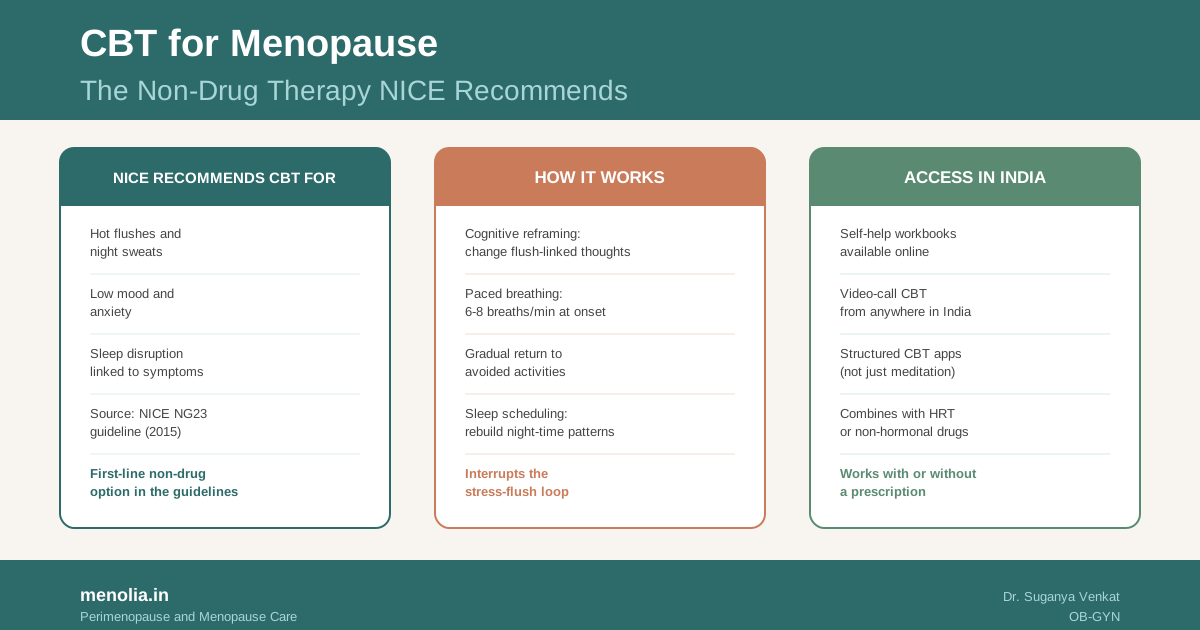
NICE guideline NG23, “Menopause: identification and management” (updated November 2024, nice.org.uk/guidance/ng23), lists CBT as a recommended option for three groups of symptoms:
- Vasomotor symptoms, meaning hot flushes and night sweats
- Depressive symptoms associated with the menopause transition
- Sleep problems, such as night-time waking, associated with menopause
This is not a tentative footnote. The guideline’s wording for vasomotor symptoms is to consider menopause-specific CBT “in addition to HRT, or for people for whom HRT is contraindicated, or those who prefer not to take HRT.” For women who cannot take HRT (those with a history of hormone-receptor-positive breast cancer, or those who choose not to for personal or medical reasons), CBT is one of the few non-drug approaches the guideline explicitly recommends considering.
The recommendation is based on a body of research built over two decades, primarily from Professor Myra Hunter’s group at King’s College London. The NICE committee reviewed this evidence and judged it strong enough to include CBT in the clinical guideline, not as a last resort, but as a front-line option for the women most likely to benefit.
Why hot flushes respond to a talking therapy
This is the question most women ask, and it deserves a direct answer.
A hot flush is a physical event: a rapid rise in skin temperature, sweating, and often a fast heartbeat. How does a psychological approach change something that is happening in the body?
The explanation comes from the cognitive perceptual model developed by Hunter and colleagues. The model describes a feedback loop in which the hot flush itself is not the whole problem. The problem is what builds around it: the way the mind notices a flush arriving, the thoughts it triggers (embarrassment at work, dread of another sleepless night, fear of losing control in a meeting), and the physiological stress response those thoughts set off. Anxiety raises the body’s temperature set-point in the hypothalamus and lowers the threshold at which a temperature rise triggers a flush. In short, the stress response to hot flushes can make the flushes more frequent and more intense.
CBT does not talk away the flush. It interrupts the loop. When the cognitive and emotional reaction to a flush becomes less intense, the downstream amplification of the symptom decreases too. This is a physiological process with a psychological entry point.
What CBT for menopause involves
CBT for menopause typically runs over six to eight sessions and draws on three groups of techniques.
Cognitive techniques
A therapist (or a structured workbook, for self-help CBT) works through the thoughts that arise during or around a hot flush. Common patterns include catastrophising (“this will never stop, everyone can see me sweating”), anticipatory dread (“I won’t sleep again tonight”), and all-or-nothing thinking (“my body has completely changed”). Cognitive restructuring examines these thoughts, looks at the evidence for them, and builds more accurate alternatives. Not empty reassurance, but a specific, accurate reframe: this flush has happened before and passed; the discomfort is real and temporary; the situation is manageable.
Behavioural techniques
Avoidance is a common response to frequent flushes: avoiding social situations, avoiding exercise because it can trigger a flush, reducing intimacy. Avoidance reduces discomfort in the short term but increases the overall impact on life over time. CBT addresses avoidance patterns gradually, through small planned steps that rebuild confidence in situations that had become difficult.
Sleep scheduling and stimulus control are the evidence-based sleep components used when night sweats have disrupted sleep patterns over months. These techniques, borrowed from CBT-I (cognitive behavioural therapy for insomnia), rebuild the association between the bedroom and sleep, rather than the bedroom and wakefulness and repeated waking. They address the pattern that persists even on nights when the sweating itself is less severe.
Paced breathing
Slow controlled breathing at around six to eight breaths per minute is taught as a technique to use at the onset of a flush. It activates the parasympathetic nervous system and reduces the sympathetic arousal that can amplify the symptom. The evidence for paced breathing used alone is more modest than for the full CBT package, but it is a practical, portable tool that most women find useful to have even within a broader programme.
The MENOS trials
The two landmark randomised controlled trials in this area are known as MENOS 1 and MENOS 2.
MENOS 1, published in The Lancet Oncology in 2012, enrolled 96 women who had been through breast cancer treatment and were experiencing menopausal symptoms. This group cannot take systemic HRT in most cases, which makes the question of alternative evidence particularly important. The trial found that CBT significantly reduced the problem rating of hot flushes and night sweats, and improved mood and quality of life, compared to usual care (Mann E, Smith MJ, Hellier J, et al. Lancet Oncol. 2012;13(3):309-318. PMID: 22340966). The CBT intervention used one 90-minute group session a week for six weeks.
MENOS 2, published in Menopause in 2012, addressed naturally menopausal women (not cancer survivors) and compared group CBT, self-help CBT using a workbook, and a waiting-list control group. Both CBT formats significantly reduced the problem rating of hot flushes and night sweats compared to the waiting list. Self-help CBT produced outcomes comparable to the group sessions (Ayers B, Smith M, Hellier J, Mann E, Hunter MS. Menopause. 2012;19(7):749-759. PMID: 22336748).
A finding worth noting from both trials: CBT did not reliably reduce the objective frequency of flushes recorded by a skin conductance monitor. What changed was how much the flushes were perceived as a problem: their impact on sleep, daily function, mood, and confidence. For most women, that reduction in impact is the meaningful outcome.
Talk to Dr. Suganya about CBT and your menopause options
Who CBT suits most
CBT for menopause works well in several situations.
Women who cannot take HRT. Those with a history of hormone-receptor-positive breast cancer, or certain cardiovascular or clotting histories, often cannot take systemic HRT. CBT is one of the few interventions with a comparable evidence base to the non-hormonal prescription options (SSRIs, SNRIs, gabapentin) but without the drug side effects. The guide to non-hormonal hot flash treatments sets out those prescription options for comparison.
Women who prefer non-drug management. Some women have manageable flushes but significant disruption to sleep, work, or mood, and prefer to start without a prescription. Self-help CBT is a reasonable first step and carries no interaction risks with other medications.
Women whose anxiety or low mood is the main problem. When anxiety or low mood leads the picture and hot flushes are part of a wider pattern, CBT addresses the mood directly. NICE recommends it for depressive symptoms associated with menopause alongside its recommendation for physical symptoms. The menopause and anxiety guide covers the mood-hormone connection in more detail.
Women with entrenched sleep disruption. When poor sleep has become a pattern beyond the night sweats themselves (the mind wakes from habit, or the bedroom has become associated with wakefulness), the sleep component of CBT addresses that pattern specifically. The menopause sleep guide covers the sleep-specific picture.
CBT is not the right primary approach when hot flushes are severe, multiple, and affecting safety or daily function significantly. In that situation, starting with an effective treatment (HRT where medically appropriate, or a non-hormonal prescription) and using CBT alongside it makes more clinical sense. CBT is not a rapid fix: most women notice meaningful change after four to six weeks of regular practice, with gains continuing to build over three months.
Accessing CBT for menopause in India
This is the real gap in this recommendation. The guidance comes from a UK context, and the infrastructure it assumes (publicly funded talking-therapies services, CBT practitioners accessible in primary care, licenced therapists on referral) does not exist in the same form in India. Most gynaecologists will refer to a psychiatrist or psychologist if a patient requests CBT, but wait times, availability, and cost are genuine barriers, particularly outside major cities.
The practical routes available in India at present are:
Self-help workbooks. MENOS 2 demonstrated that self-help CBT using a structured workbook produces outcomes comparable to therapist-led sessions for hot flushes. The techniques are not therapist-dependent. “Managing Hot Flushes and Night Sweats: A Cognitive Behavioural Self-help Guide to the Menopause” by Hunter and Smith (Routledge, 2nd edition 2020) is one resource available through online bookstores. Working through it in sequence, one to two modules per week over six to eight weeks, mirrors the evidence-based approach. The MENOS 2 workbook model is particularly important for India because it removes the therapist-access barrier entirely.
Online tele-therapy. Several platforms now connect women in India with CBT-trained psychologists and counsellors via video call. This approach removes the travel and wait-time barriers that make in-person therapy impractical for many women. I am Dr. Suganya Venkat, and in the Menolia program, women across India access psychological support through online consultations for exactly this reason. If you need guidance on finding a CBT-trained therapist who understands the menopause context, a consultation can help map out a practical plan.
Structured digital CBT programmes. A small number of digital programmes apply the CBT framework to hot flush management through structured modules. The evidence base for apps is thinner than for workbook or therapist-led CBT, but for women with mild to moderate symptoms who cannot access a therapist, a well-structured programme is a reasonable starting point. The key distinction is to look for programmes that include thought records, cognitive reframing exercises, and paced breathing practice, not just general relaxation or meditation content, which addresses a different mechanism.
General CBT with a therapist. A therapist without specific menopause training but with solid CBT competence can still work effectively with flush-related thoughts, anxiety patterns, and sleep disruption. The menopause-specific framing matters less than the quality of the CBT itself.
Where CBT fits in the broader picture
CBT does not replace HRT or non-hormonal prescription medication for women who need them. It is a layer in the treatment plan, one that addresses the cognitive and behavioural patterns around symptoms that medication alone often does not reach. HRT or a non-hormonal drug addresses the physiological trigger; CBT addresses what the trigger sets off in daily life.
Understanding the role of cortisol in worsening menopausal symptoms connects directly to why CBT is effective. When stress reactivity decreases, the hypothalamic set-point becomes less sensitive. The cortisol and menopause guide explains that connection in detail.
For the complete picture of available treatments for hot flushes, from lifestyle through to HRT and non-hormonal prescription options, the hot flash treatment guide maps where each option fits and how they can be combined.
Frequently asked questions
Is CBT available for free in India for menopause? There is no free NHS-style referral pathway in India. Options include self-help workbooks (available through online bookstores, imported from the UK), online tele-therapy platforms with varying fee structures (many offer sliding-scale pricing), and government hospital psychiatry outpatient clinics where fees are minimal but waiting times can be long. The workbook route is the most accessible for most women in India.
How many sessions does CBT for menopause take? MENOS 1 used one 90-minute group session a week for six weeks; MENOS 2 compared group CBT with a guided self-help workbook over a similar span. Individual therapy typically takes six to eight sessions of around 50-60 minutes each. Self-help CBT via workbook is designed around six to eight weeks of structured practice, working through one to two modules per week.
Does CBT reduce the number of hot flushes, or only how they feel? The MENOS trials found that CBT did not reliably reduce the objective frequency of flushes recorded by skin conductance monitors. What changed significantly was the problem rating: how much the flushes disrupted daily life, sleep, confidence, and mood. For most women, reducing the impact of the flushes is the more meaningful clinical outcome, and that is where CBT consistently delivers.
Can CBT be combined with HRT? Yes. NICE NG23 recommends considering menopause-specific CBT “in addition to HRT” as well as for women who cannot or prefer not to take it. Women who start HRT and also work through a CBT programme often report better outcomes on mood and daily functioning than either approach produced alone. The two work through different mechanisms and do not interfere with each other.
Can CBT help with menopause anxiety and low mood as well as hot flushes? Yes. The November 2024 update of NICE NG23 makes separate recommendations for CBT for depressive symptoms and for sleep problems associated with menopause, independent of its recommendation for hot flushes. CBT is a recognised first-line treatment for anxiety and depression in its own right. Applied to menopause, it addresses both the flush-specific loops and the broader emotional picture.
How is CBT different from mindfulness or meditation? CBT is structured, problem-focused, and involves active work on specific thought patterns and behaviours. Mindfulness is a practice of non-judgemental awareness of the present moment. Both are useful and compatible with each other. The MENOS trials used CBT, not mindfulness. Some women find that combining both works better than either alone, but the two should not be confused: they work through different mechanisms, and the evidence base for menopause-specific CBT is substantially stronger than for mindfulness programmes applied to the same symptoms.
What if I have tried CBT before for anxiety and it did not help? The menopause-specific CBT protocol applies the same core techniques but focuses them on hot flush triggers, night sweat-related sleep disruption, and the adjustment process of the menopause transition. If general CBT for anxiety was not effective, it may be worth discussing whether the focus, the therapist match, or the timing were factors, and whether the menopause-specific model would address your situation differently. A consultation is a good place to work that out without pressure.
If you are working out where CBT fits in your menopause care and whether it makes sense alongside what you are already doing, a video consultation gives you the space to think it through.