You may have been on the pill for years. Perhaps it was started for heavy periods, for PCOS, or simply to keep your cycle predictable, and it has done that job quietly ever since. Now you are in your late forties, a friend has started HRT, and your gynaecologist has mentioned that the pill should come to an end around 50. The obvious question follows: if both contain hormones, why can’t the pill simply carry on, and what happens to your body when you change from one to the other?
I’m Dr. Suganya Venkat, an OB-GYN with over 15 years of clinical experience, and this switch is one of the most practical conversations I have with women in their late forties. Most of the worry around it comes from not knowing what the steps are. Once the steps are clear, it is usually a calm, planned change.
This post covers the mechanics of the switch itself: why the pill and HRT are built for different jobs, the common routes doctors use to move from one to the other, how the type of HRT is chosen, and what the first three months tend to feel like. If your question is which contraceptive suits you in perimenopause in general, or exactly when you can stop contraception, that is covered in Contraception in Perimenopause: What’s Safe & When to Stop.
Why the Pill and HRT Are Built for Different Jobs
Both contain an oestrogen, and the combined pill also contains a progestogen, so it is natural to assume they are interchangeable. They are designed for two different purposes.
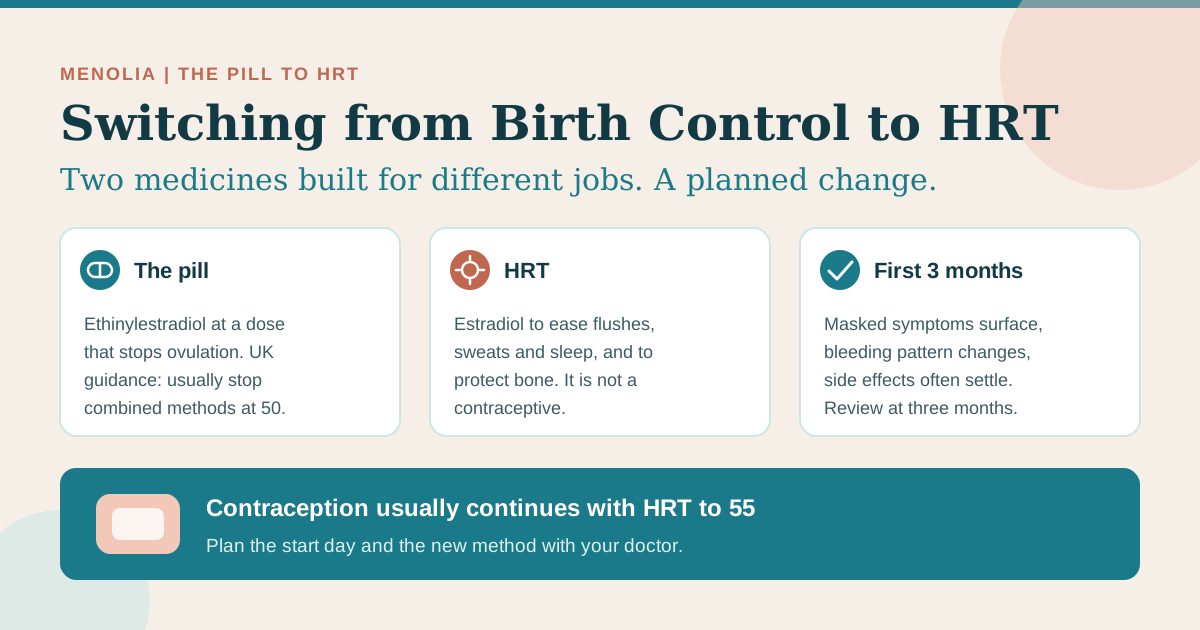
The combined pill is built to stop ovulation. Most combined pills use ethinylestradiol, a synthetic oestrogen, at a dose strong enough (together with the progestogen) to switch off the monthly release of an egg. That is what makes it a contraceptive.
HRT is built to replace falling oestrogen. It usually uses estradiol, the same oestrogen your ovaries make, at doses chosen to ease symptoms like hot flushes, night sweats, poor sleep and vaginal dryness, and to protect bone. It is not designed to stop ovulation, and it does not reliably prevent pregnancy.
The difference in strength is easy to underestimate. In a randomised trial in healthy women aged 18 to 35, a pill containing 0.03 mg ethinylestradiol raised sex hormone binding globulin (a protein made by the liver that responds to oestrogen) by 385%, while a pill containing 2 mg estradiol valerate raised it by 56% (Haverinen A et al., J Clin Endocrinol Metab, 2022, PMID 35279718). A related analysis from the same trial found that over nine weeks the ethinylestradiol pill changed 121 serum proteins or protein families, most affecting the complement system, acute-phase response, metabolism and coagulation, compared with 5 for the estradiol valerate pill (Kangasniemi MH et al., Hum Reprod, 2023, PMID 36416543). These were small studies in young women taking contraceptive regimens, but they illustrate how 0.03 mg of ethinylestradiol can affect liver-made proteins far more than 2 mg of estradiol valerate.
This is why the two are prescribed differently, and why the combined pill comes with its own age limit and list of risk factors.
Why Around 50 Is the Usual Point to Switch
The UK guidance that patients and doctors both use points to the same age.
- The Women’s Health Concern factsheet on contraception for women over 40 (the patient arm of the British Menopause Society, reviewed December 2025, womens-health-concern.org) says combined hormonal contraception is suitable until 50 as long as there are no health risks such as smoking, obesity, high blood pressure or migraine with aura. It adds that current UK guidance is to stop combined hormonal contraception at 50, switching to a non-hormonal or progestogen-only method.
- The NHS page on when to take HRT (nhs.uk, last reviewed January 2023) states that you cannot take HRT at the same time as the combined pill, and that a GP may recommend continuing the combined pill until 50 and then switching to HRT.
Both sources were checked in October 2026.
So if you are under 50, healthy, a non-smoker, and the pill suits you, there is often no rush. The same factsheet notes that the combined pill can manage heavy or irregular periods, may help maintain bone density, and can relieve some hot flushes and night sweats. The NHS also notes you may be advised to take the pill continuously, without the monthly break; whether that suits you is a decision for your prescriber.
An earlier switch usually makes sense when a new risk factor appears: raised blood pressure, a migraine with aura, a new diagnosis that raises clot risk, or weight gain into a higher BMI range. Your doctor will weigh these with you.
The pill hides where you are in the transition
There is one practical catch. While you are on the combined pill, the monthly bleed is a withdrawal bleed caused by the pill-free week, not a natural period. So you cannot tell from your bleeding whether your own periods have slowed, become irregular or stopped. The Women’s Health Concern factsheet also notes that blood tests are unreliable and not recommended while on combined hormonal contraception, because the pill suppresses FSH (in the Haverinen trial above, the ethinylestradiol pill lowered FSH by 64%). If you want to read more on what FSH can and cannot tell you, see the FSH test guide.
This is why the switch is usually planned around age and history rather than a blood result.
The Common Routes From the Pill to HRT
There is no single “correct” way to do this. Which route fits depends on your age, whether you still need contraception, your bleeding pattern and your risk factors. These are the routes your doctor is most likely to discuss.
Route 1: Mini-pill for contraception, plus full HRT
You stop the combined pill and move to a progestogen-only pill (often called the mini-pill) for contraception. HRT is then added alongside it. The NHS notes that if you are taking the progestogen-only pill, you can usually take HRT alongside it.
One point that often surprises women: the mini-pill is there for contraception. It is not counted as the womb-protecting part of HRT. So if you still have a uterus, your HRT will normally include both an oestrogen and its own progestogen. The British Menopause Society’s HRT Guide for clinicians (reviewed February 2026, thebms.org.uk) lists oestrogen-only HRT for women who have had a hysterectomy or who have a 52 mg levonorgestrel IUD in place; everyone else with a uterus takes oestrogen plus progestogen. The reason for this rule is explained in Why HRT Needs Progesterone.
Route 2: Hormonal IUD plus oestrogen
You stop the combined pill and have a 52 mg levonorgestrel IUD fitted (Mirena is one brand available in India). The Women’s Health Concern factsheet describes this as doing double duty: it provides contraception and can serve as the progestogen part of HRT, so you only add oestrogen as a patch, gel or tablet. The same factsheet notes that when the device is used as part of HRT, it needs replacing every 5 years. It also tends to make periods much lighter, which many women with heavy perimenopausal bleeding welcome.
Route 3: No hormonal contraception, then HRT
Some women prefer a copper IUD or barrier methods for contraception and then start HRT. This is entirely reasonable. The copper IUD can make periods heavier, so it is a less comfortable fit if heavy bleeding is already a problem.
A word on timing
Whichever route you take, ask your doctor two specific questions before your last pack of combined pills: on which day should the HRT start, and from which day is the new contraception effective? The answers depend on the method you are moving to, so follow the plan you are given rather than leaving a gap of your own choosing. A self-directed stop, followed by a few unprotected weeks while you “see what happens”, is the easiest part of the switch to get wrong, and the easiest to avoid.
Thinking about moving from the pill to HRT? Bring the name of your current pill, how long you have been on it, your blood pressure readings and any migraine history, and we can plan the switch together, alongside your own gynaecologist. Message Dr. Suganya on WhatsApp for a Rs 399 video consultation.
How the Type of HRT Is Chosen
Once you are off the combined pill, two decisions shape your HRT.
Sequential or continuous combined
The British Menopause Society HRT Guide maps the choice to menopausal stage: sequential HRT (which gives a planned monthly bleed) for women who are perimenopausal, and continuous combined HRT (designed to be period-free) for women who are postmenopausal. If you have a 52 mg levonorgestrel IUD in place, oestrogen alone is added and this choice does not arise.
Because the pill has hidden your own cycle for years, your doctor may not know at first which stage you are in. They will use your age and history to choose a starting regimen, and may change it later as the picture becomes clearer.
Patch, gel or tablet
The same guide lists situations where oestrogen through the skin (patch, gel or spray) is preferred, including a personal or family history of blood clots, a BMI above 30, variable blood pressure, migraine, and gall bladder disease. A large UK study of more than 80,000 women with venous thromboembolism found that oral HRT was linked to a higher clot risk (adjusted odds ratio 1.58), while transdermal HRT was not associated with increased risk (Vinogradova Y et al., BMJ, 2019, PMID 30626577). For a fuller comparison of routes, see HRT Patch vs Gel vs Pill.
HRT Does Not Replace Your Contraception
This is the single most important thing to carry into the switch. The Women’s Health Concern factsheet is direct about it: HRT is not a method of contraception. Women whose periods have not stopped before starting HRT should use contraception as well, and because some HRT products produce regular monthly bleeds, it can be hard to know when contraception can stop. The factsheet’s advice is to continue contraception alongside HRT until 55, when it is no longer needed.
A 2018 review in Menopause summarised the guidelines the same way: midlife women without medical contraindications can use contraception until menopause, at which point they may consider moving to systemic hormone therapy (Miller TA et al., Menopause, 2018, PMID 29462093).
What the First Three Months Tend to Feel Like
This is the part women most want to know, and it helps to expect a settling-in period.
Symptoms you did not know you had may appear. The NHS notes that the combined pill can mask or improve menopause symptoms, because it contains oestrogen. When you stop it, hot flushes, night sweats, sleep changes or low mood that were being held back can surface. That is usually your own baseline showing for the first time, and HRT is there to manage exactly these.
Your bleeding pattern will change. On the combined pill you had a predictable withdrawal bleed. On HRT, the NHS describes two patterns:
- On sequential HRT, a withdrawal bleed at the end of each course of progestogen is normal.
- On continuous combined HRT, irregular bleeding or spotting is common in the first 4 to 6 months.
The NHS also notes that irregular bleeding or spotting is common in the first few months of any HRT and usually settles within 6 months. For more on which bleeding patterns are expected, see Breakthrough Bleeding on HRT.
Mild side effects usually settle. The NHS lists breast tenderness, headaches, nausea, leg cramps and mood changes among the common side effects of oestrogen and progestogen, and says these often go away after a few weeks. It suggests continuing for at least 3 months where possible, since side effects can be similar to menopause symptoms themselves. Our guide to HRT side effects goes through each one.
Expect a review at three months. The British Menopause Society HRT Guide recommends a review three months after HRT is started or changed, then at least once a year. At that first review your doctor will look at symptom relief, side effects and your bleeding pattern, and adjust the dose, route or progestogen if needed.
When to contact your doctor sooner
The NHS advises speaking to a doctor if:
- irregular bleeding continues for more than 6 months after starting HRT
- your bleeding becomes heavier
- you have bleeding after a stretch of no periods
- side effects are severe or last longer than 3 months
Separately, whichever hormone you are taking, pain or swelling in one calf needs a medical assessment the same day, and sudden breathlessness or chest pain needs emergency care straight away (go to the nearest emergency department or call an ambulance).
A Simple Checklist for Your Switch Appointment
Taking these into the consultation makes the plan quicker and clearer:
- The exact name of your current pill and how long you have taken it
- Why it was started (contraception, heavy periods, PCOS, cycle control)
- Recent blood pressure readings, your weight, and whether you smoke
- Any migraine, especially with aura, and any personal or family history of clots
- Which symptoms you notice in the pill-free week, if any
- Whether you still need contraception, and what you would prefer to use
- Your preference for patch, gel or tablet
At Menolia, Dr. Suganya Venkat uses a list very like this one with women across India over video consultations, because the switch goes smoothly when these answers are on the table from the start.
Frequently Asked Questions
Can I take HRT and the combined pill together?
No. The NHS states that you cannot take HRT at the same time as the combined pill. The pill already contains oestrogen, so adding HRT would double up. A doctor will usually either keep you on the pill until around 50 or move you to a different contraceptive plus HRT.
Do I need a break between stopping the pill and starting HRT?
That depends on which route you are taking and is decided by your doctor. Ask for the exact start day for HRT and the day your new contraception becomes effective, and follow that plan rather than choosing your own gap.
Will HRT stop me from getting pregnant?
No. HRT is not a contraceptive. If your periods had not stopped before you started HRT, you need contraception alongside it. The Women’s Health Concern factsheet advises continuing contraception with HRT until 55.
Why did my hot flushes start only after I stopped the pill?
The combined pill contains oestrogen, which can hide or ease menopause symptoms. Once it stops, you see your body’s own level of symptoms, which may have been building for a while. HRT is designed to treat these.
Is spotting normal after switching to HRT?
Yes, in the first few months. On continuous combined HRT, irregular spotting is common for the first 4 to 6 months; on sequential HRT, a monthly withdrawal bleed is expected. Tell your doctor if bleeding continues beyond 6 months, gets heavier, or returns after a stretch with no periods.
Can a blood test tell me if I am in menopause while I am on the pill?
Not reliably. The pill’s oestrogen suppresses FSH, so blood tests are not recommended while you are on combined hormonal contraception. This is one reason the switch is usually planned around age and history.
Can I switch from the pill to HRT before 50?
Yes, if there is a reason to, such as a new risk factor for the combined pill or symptoms the pill is not controlling. You would move to a contraceptive that suits your age and add HRT. Your doctor will help you weigh the timing.
Moving from the pill to HRT is a planned change, and it usually goes well when the contraception, the HRT type and the timing are decided together. If you would like help working out the route that fits you, I see women across India online.
Chat with Dr. Suganya on WhatsApp
Related reading: HRT in India: What an OB-GYN Recommends · HRT and Blood Clots