The question comes up far more often than doctors tend to acknowledge. A woman in her late 40s or early 50s waking at two in the morning with the sheets soaked through starts to wonder: is this menopause, or is it something I should be more worried about?
It is a reasonable thing to ask. Night sweats and unexplained flushing appear on lists of potential cancer symptoms, and typing either phrase into a search engine returns results that are easy to misread. Knowing whether your hot flashes need cancer investigation is genuinely useful information, and you deserve a clear answer rather than a vague “probably not” followed by nothing more.
This post gives you that answer. It explains what the ordinary menopause pattern looks like, describes the specific pattern that is different and does warrant a medical review, and addresses a third situation that some women are in: hot flashes caused by cancer treatment itself.
The short answer for most women in their 40s and 50s
For a woman going through perimenopause or menopause, hot flashes and night sweats are almost certainly hormonal. They are the most common vasomotor symptom of the menopause transition, affecting an estimated two-thirds to three-quarters of women in the perimenopause years, and they have a well-understood cause: falling oestrogen levels alter the sensitivity of the hypothalamus, the brain’s temperature regulator, so that the body triggers its cooling response at the wrong moment. The result is a sudden wave of heat, sweating, and often a chill afterward.
This is not a situation that requires cancer investigation on the basis of hot flashes alone. It is a physiological response to a hormonal shift that has been studied in detail in tens of thousands of women, most comprehensively through the SWAN study (the Study of Women’s Health Across the Nation), which followed women through the menopause transition for many years and confirmed that vasomotor symptoms are the central feature of this stage of life for the majority of women.
The full explanation of what hot flashes are and why they happen is worth reading if you want the detail. The short version: in a woman at the age and life stage of natural hormonal transition, a hot flash is nearly always hormonal. No further investigation is needed to account for it.
That said, there is a pattern of symptoms, distinct from the ordinary menopause experience, that does warrant a medical review. Knowing what it looks like is more useful than a general instruction to see a doctor if worried.
What the ordinary menopause hot flash looks like
Before describing what raises a different question, it helps to be clear about the typical menopause pattern, so you can place your own experience within or outside it.
A menopause hot flash is a sudden wave of heat that tends to begin in the chest and spread upward to the face and neck. A single episode lasts one to five minutes, with most lasting around two to three minutes. Night sweats can be significant, soaking through nightwear and bedding. Flushing of the face and upper body, palpitations during the episode, and a chill afterward are all common features. Frequency varies widely between women, from one or two episodes a day to several an hour.
What places this clearly in the menopause picture is the broader context: age and life stage, changes to the menstrual cycle (irregular periods, heavier or lighter flow, or periods that have stopped), and other symptoms that often accompany the transition such as sleep disruption, mood shifts, or vaginal dryness.
If your experience fits this description in this context, your hot flashes are not a reason to investigate cancer. They are a reason to think about management, which is a genuinely different kind of conversation. The hot flash treatment guide covers the range from lifestyle approaches through to HRT.
The specific pattern that warrants investigation
There is a distinct symptom combination that shifts the clinical picture. These are not subtle differences, and recognising them gives you a better basis for deciding whether to seek medical review.
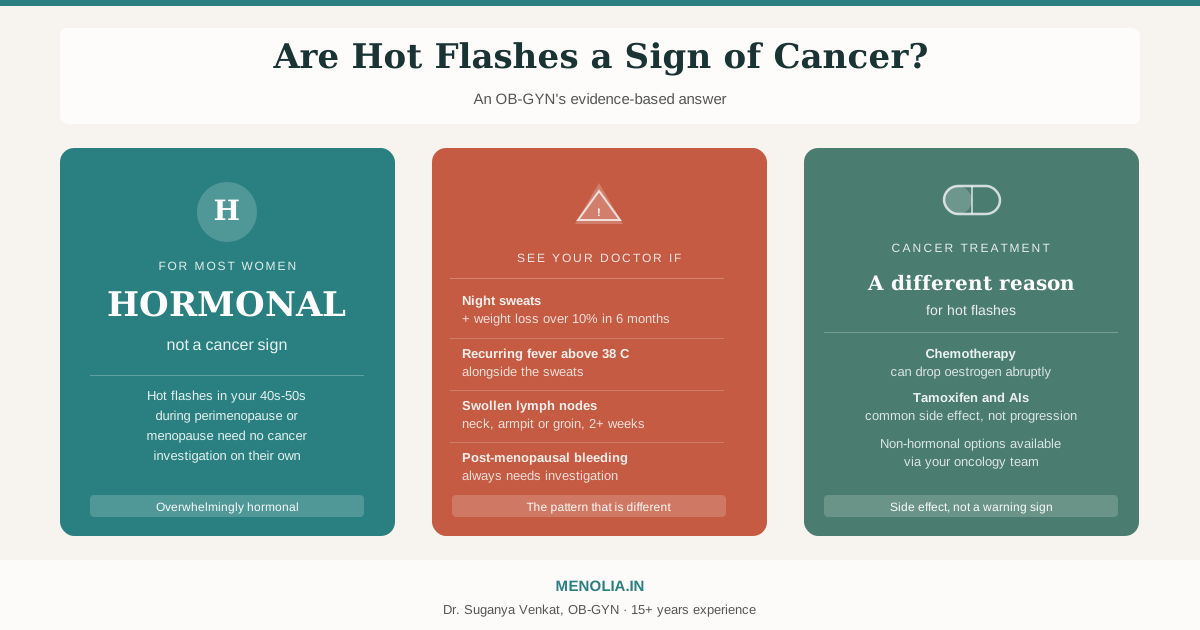
Drenching night sweats with significant unexplained weight loss. If you have lost more than 10% of your body weight over the past six months without deliberately changing your diet or activity level, and you are also experiencing persistent night sweats, that combination warrants prompt investigation. Loss of this scale alongside night sweats is one of the B symptoms, a clinical term for the constellation that haematologists look for when evaluating lymphomas. The weight loss matters as much as the sweats. Night sweats alone, in a woman in her 40s or 50s, are not a B symptom.
Recurring fever alongside the sweats. A genuine fever, a measurable temperature above 38 degrees Celsius that recurs, is not part of the menopause picture. Feeling hot during a flash is different from measuring a temperature and finding it consistently elevated. If you have both recurrent sweats and a recurrent fever, that combination needs a clinical assessment.
Swollen lymph nodes. If you have noticed a lump in your neck, armpit, or groin that has been present for more than two or three weeks and has not resolved on its own, it needs to be examined, regardless of whether you also have hot flashes. Persistent lymph node enlargement is an independent reason to seek review.
New post-menopausal bleeding. If you have not had a period for twelve months or more and you experience any vaginal bleeding, including what might look like spotting, this always needs investigation. Post-menopausal bleeding has many causes, most of them benign, but the cause cannot be assumed. The one time to act promptly rather than watch and wait.
Flushing that does not follow the menopause pattern. A rare condition called carcinoid syndrome, caused by a type of neuroendocrine tumour, produces episodic flushing. The flushing in carcinoid typically affects the face prominently, lasts longer than a menopause hot flash, and is commonly accompanied by diarrhoea or wheezing. This is uncommon, but it is what clinicians think of when a woman’s flushing does not fit the menopause presentation and comes with other unusual features.
The practical distinction: menopause hot flashes belong to a recognisable hormonal transition and do not arrive packaged with fever, significant unexplained weight loss, or gland changes. If you have those additional features alongside the night sweats, a prompt doctor’s appointment and clinical assessment is the right step.
For the full set of symptoms that always warrant medical attention during the menopause years, the menopause red flags guide covers what each means and when to act.
If something about your hot flashes or night sweats does not feel like the ordinary menopause pattern, a direct conversation is the clearest way to sort it out.
Connect with Dr. Suganya Venkat on WhatsApp to discuss your specific situation.
When cancer treatment is causing the hot flashes
There is a third situation, separate from the two above, that affects a specific group of women: those already receiving cancer treatment who are experiencing hot flashes as a direct result of that treatment.
This is not a warning sign. It is a known and documented side effect, and distinguishing it from the cancer itself is important.
Certain chemotherapy regimens can affect ovarian function, causing an abrupt drop in oestrogen. When this happens, the transition into menopause is sudden rather than gradual, and the hot flashes that follow can be intense and frequent. In younger women, the effect on ovarian function is sometimes temporary; in women approaching natural menopause, it may be permanent. Your oncology team can give you a clearer picture of what to expect in your specific situation.
Tamoxifen, a selective oestrogen receptor modulator widely prescribed for oestrogen-receptor-positive breast cancer, commonly causes hot flashes through its effect on oestrogen activity in the hypothalamus. This is one of the most frequently reported side effects, and it is the reason for the hot flashes, not a sign that the cancer is progressing.
Aromatase inhibitors (letrozole, anastrozole, exemestane) reduce oestrogen production in post-menopausal women and similarly produce hot flashes, joint aches, and vaginal dryness as side effects while they are being taken.
If you are in this situation, your oncology team is the right first point of contact for managing these symptoms. Systemic HRT is usually not an option with hormone-receptor-positive tumours, but non-hormonal approaches, including certain antidepressants at specific doses and gabapentin, have a reasonable evidence base and can make a meaningful difference. Vaginal moisturisers help with local dryness. The non-hormonal hot flash treatment guide covers what the evidence shows for these options, which are also the options used in the cancer treatment context.
What this means in practice
I am Dr. Suganya Venkat, an OB-GYN with fifteen years of clinical experience, and the question “could this be something more serious?” comes up regularly in my consultations, including in online sessions at Menolia. The concern is not irrational, and I take it seriously rather than dismissing it.
The evidence-based answer for most women reading this: hot flashes and night sweats in the context of perimenopause or menopause, without the specific additional features I described above, are hormonal. They do not require a cancer investigation based on the hot flashes alone.
If you have the features described, specifically significant unexplained weight loss alongside night sweats, recurring fever, swollen glands, or new post-menopausal bleeding, those need a clinical assessment. Not necessarily because cancer is the likely explanation, but because the pattern is different enough that leaving it unexamined is not the right call.
And if your hot flashes are the result of tamoxifen or chemotherapy, that attribution is almost certainly correct. The conversation then shifts to managing them as well as possible within your treatment plan.
Understanding which situation you are in is what matters, and a video consultation is often the clearest way to do that.
Speak with Dr. Suganya Venkat on WhatsApp for a direct assessment of your symptoms.
FAQ
Are hot flashes a symptom of cancer?
In most women in their 40s and 50s, hot flashes are a symptom of the hormonal shift of perimenopause or menopause, not cancer. The pattern that warrants investigation is clearly different: drenching night sweats alongside significant unexplained weight loss (more than 10% of body weight over six months), recurring fever above 38 degrees Celsius, or swollen lymph nodes. Hot flashes alone, in a woman at the age of natural hormonal transition, do not require cancer screening.
What is the difference between menopause night sweats and cancer night sweats?
Menopause night sweats come in episodes, track with hormonal fluctuation, and belong to a recognisable transition. They can be severe without any accompanying weight loss or fever. The night sweats associated with lymphomas and some other cancers are classically drenching and appear as part of the B symptoms constellation: more than 10% weight loss in six months, recurring temperature above 38 degrees Celsius, and visible swollen glands. The combination of features is what drives a clinical decision to investigate, not the night sweats alone. For more on what to look out for at night specifically, the night sweats guide covers the menopause presentation in detail.
Kya hot flashes cancer ka sign hota hai?
40 se 55 saal ki umar mein hot flashes aana zyaadatar menopause ki hormonal badlaav ki wajah se hota hai, cancer ka sign nahin. Jo pattern alag hota hai aur doctor ke paas jaane ki zaroorat hoti hai woh yeh hai: raat ko bahut zyaada pasina ke saath bina wajah wajan girnaa (6 mahine mein 10% se zyada), baar baar bukhaar, ya gardan, baaghon ya kankhon mein gaanthen. Agar aap mein sirf hot flashes hain aur yeh dusri cheezein nahin hain, toh yeh akele cancer ka sign nahin hai.
Can chemotherapy or tamoxifen cause hot flashes?
Yes, and this is one of the most common side effects of both. Certain chemotherapy regimens affect ovarian function and cause an abrupt drop in oestrogen, producing hot flashes that can be sudden and intense. Tamoxifen causes hot flashes through its effect on oestrogen activity. Aromatase inhibitors used in post-menopausal breast cancer treatment also commonly cause hot flashes, joint aches, and vaginal dryness. In all three cases, the hot flashes are a known side effect of the treatment, not a sign that the cancer is progressing. Your oncology team can advise on non-hormonal management options.
Should I see a doctor about my hot flashes and night sweats?
If your symptoms fit the ordinary menopause pattern, the conversation to have with a doctor is about management options, not cancer investigation. A prompt medical review is warranted if your night sweats are accompanied by significant unexplained weight loss, recurring fever, new lumps or swollen glands, or any vaginal bleeding more than twelve months after your last period. Those combinations need clinical assessment rather than watchful waiting.
What cancers cause night sweats or flushing?
Lymphomas, particularly Hodgkin’s and non-Hodgkin’s lymphoma, are the cancers most classically linked to drenching night sweats, as part of the B symptoms criteria. Leukaemia and certain solid tumours can also produce constitutional symptoms including sweating. Carcinoid tumours, a type of neuroendocrine tumour, can cause episodic flushing that differs from a menopause hot flash in duration, distribution, and the accompanying symptoms of diarrhoea or wheezing. These presentations are uncommon and typically accompanied by other features that are clearly distinct from the menopause picture.
How do I tell whether my hot flashes are hormonal or something else?
The clearest indicators that your hot flashes are hormonal are: you are in your 40s or 50s, your periods have changed, and your symptoms follow the episodic pattern described above with no accompanying unexplained weight loss, fever, or gland changes. If any of those additional features are present, or if something simply does not fit the picture of the menopause transition, a clinical review is the right step. A video consultation can help establish whether what you are experiencing fits the hormonal pattern or warrants further investigation.