Most women come to me with hot flashes at two separate points. The first is early, when they are trying to understand what is happening to their body. The second is months or years later, after they have adapted as best they can, and the question has shifted: when does this end?
This post answers that second question. Not how hot flashes work, and not what to do about them (those are covered in the guides linked throughout). This is specifically about duration: how long a single flash lasts, how long the overall experience typically runs, and what the evidence tells us about the factors that shape your individual timeline.
The answers are specific and, in some cases, longer than women have been told to expect. But the core point is this: how long hot flashes last and how much they disrupt your life are two separate things. Duration is partly determined by biology. Disruption is considerably more within your control.
How long a single hot flash lasts
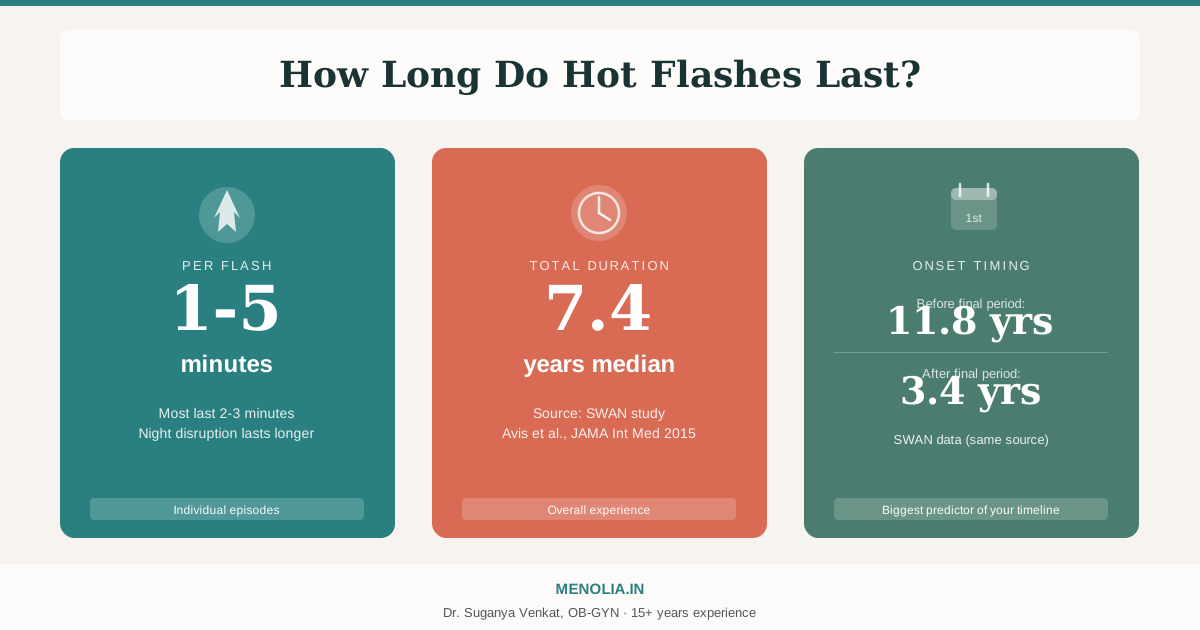
A single hot flash typically lasts one to five minutes. Some women experience brief episodes of thirty seconds to a minute. Others describe episodes that run ten minutes or more. The centre of the range, for most women, is around two to three minutes.
For a detailed explanation of what happens during those minutes at the physiological and neurological level, the What Are Hot Flashes? guide covers the thermoregulatory mechanism, the hypothalamic thermostat theory, and common triggers in full.
One thing worth noting here: the episode itself ends quickly. The disruption it causes, especially at night, can last much longer. A three-minute hot flash at 2 am often means thirty minutes or more of being fully awake, trying to cool down, and then struggling to fall back asleep. When women describe how hot flashes affect their daily functioning, it is rarely the two minutes of the flash itself. It is the sleep disruption, the brain fog the following day, and the unpredictability of not knowing when the next one will arrive.
The total picture: what the SWAN study found
For how long the overall experience lasts, the most rigorous data comes from the Study of Women’s Health Across the Nation, known as SWAN. This is a large, multi-site longitudinal study that followed women through the menopause transition over many years and tracked their vasomotor symptoms, meaning hot flashes and night sweats, with the kind of detail needed to give reliable duration estimates.
The key finding, published by Avis and colleagues in JAMA Internal Medicine in 2015, is this: the median total duration of frequent vasomotor symptoms was approximately 7.4 years.
That is the median, so half of women in the study experienced frequent symptoms for longer, and half for shorter. The range is wide: some women have hot flashes for two or three years, and others for twelve or more.
Seven years is longer than many women are led to expect. When a doctor says “these usually settle down after a few years,” they are sometimes drawing on older, smaller studies, or on clinical experience rather than longitudinal data. The SWAN finding gives us a more accurate picture of what a large, well-followed population actually experienced across the full menopause transition.
The single biggest predictor: when they start
This detail changes the picture entirely, and it is not yet as widely known as it should be.
The SWAN study did not only look at duration overall. It looked at when women first developed frequent vasomotor symptoms and whether that timing predicted how long the experience lasted. The finding is clear and clinically meaningful.
Women who began experiencing frequent hot flashes before their final menstrual period, meaning while still cycling (even irregularly), had a median total duration of approximately 11.8 years.
Women who first developed frequent hot flashes after their final menstrual period had a median total duration of approximately 3.4 years.
This is not a small difference. The early-start group experienced hot flashes for more than three times as long as the late-start group. And because Indian women have their final period at a median age of 46 to 48 years, roughly four years earlier than the global figure of 51 (Palacios S et al., Climacteric 2010, PMID 20690868) (Ahuja M, J Midlife Health 2016, PMID 27721640), many Indian women who are noticing their first hot flashes in their early to mid-forties are already in that early-start category. Their symptoms may follow a longer course than the overall 7.4-year median suggests.
Knowing which group you fall into does not change what you can do about your symptoms. But it changes how you frame the timeline, and it prevents a specific frustration: expecting symptoms to be “nearly over” when there is still a significant course ahead.
If you have had hot flashes for two years and you are 45 with a still-irregular cycle, your symptoms have not started late. They have started early. That framing leads to different decisions about how you manage them.
The arc: not a flat line across the years
A common misunderstanding is that hot flash frequency stays constant across the years they are present. It does not.
For most women, vasomotor symptoms follow a recognisable arc. They tend to begin gradually, often at lower frequency, during perimenopause. They intensify in the one to two years around the final menstrual period, peaking in severity and frequency. They then gradually reduce in the years after the final period, though the pace of that reduction varies considerably between women.
This matters because seven years of hot flashes does not mean seven years of the most intense version of what you are currently experiencing. Most women move through a peak and then a slow reduction, not a sustained plateau. The two to three years around the final period are typically the most disruptive. The years on either side of that peak, while still involving symptoms, are often more manageable.
That said: a proportion of women do experience persistently high-frequency symptoms across a longer stretch, and some continue to have frequent flashes well into the post-menopause years. The arc toward gradual improvement is the common pattern, not a guarantee.
What influences how long yours last
Beyond the early-start timing factor, several other variables are associated with longer or shorter duration in the research literature. Some are fixed. Others are modifiable.
Associated with longer duration:
Anxiety and psychological distress. The SWAN data found that women with higher levels of anxiety and psychological distress had longer vasomotor symptom courses. The link is physiological: the sympathetic nervous system plays a role in triggering hot flashes, and chronic anxiety keeps that system in a state of higher reactivity. Managing anxiety, through whatever realistic means fit a woman’s life, is not a minor detail in this picture.
Higher body weight. Adipose tissue has a complex relationship with menopausal symptoms. The SWAN data found that overweight and obese women tended to have more persistent vasomotor symptoms, likely related to how body fat affects heat regulation and thermoregulatory thresholds.
Smoking. Smoking is associated with both earlier menopause and longer vasomotor symptom duration. Women who smoke at the time of the menopause transition tend to have more frequent and longer-lasting hot flashes. This includes regular bidi use and significant passive smoke exposure over time.
Surgical menopause. Women who enter menopause via bilateral oophorectomy (removal of both ovaries) experience an abrupt oestrogen drop rather than the gradual hormonal shift of natural menopause. Vasomotor symptoms after surgical menopause are typically more intense and can follow a prolonged course. The Surgical Menopause guide covers this in detail.
Associated with shorter duration or lower severity:
Later symptom onset. As above: women who develop frequent hot flashes after the final menstrual period tend to have a shorter overall course.
Regular physical activity. Observational data consistently associates regular aerobic exercise with reduced vasomotor symptom severity. The randomised trial evidence is mixed, but most women who remain physically active through the transition report symptoms that are more manageable.
Lower baseline stress. A woman who is sleeping adequately, managing her stress load, and maintaining physical activity will generally experience the same frequency of hot flashes in a quite different way from one who is not. The goal is not only to shorten how long they last; it is to reduce how much they disrupt the years they are present.
I am Dr. Suganya Venkat, and over fifteen years of working with women through the menopause transition, the modifiable factors have mattered consistently, not because addressing them guarantees a shorter course, but because they change the experience substantially during whatever course runs. That shift in daily functioning and sleep quality is real and worth pursuing, independent of whether it changes the total duration.
If you would like to talk through your specific pattern and where you are likely to sit in this picture, you can reach me on WhatsApp. A brief conversation often gives women a clearer sense of their timeline and what is worth prioritising.
Message Dr. Suganya on WhatsApp
What the data means for Indian women
The SWAN study was conducted in the United States across several ethnic groups: African American, Hispanic, Japanese-American, Chinese-American, and non-Hispanic White women. Direct data on Indian women is limited, but two things from the SWAN ethnic-group analysis are relevant.
First, Asian women in the SWAN sample (primarily Japanese-American and Chinese-American) had somewhat shorter median vasomotor symptom duration compared to the overall median, around 5 to 6 years. Whether that applies to Indian women specifically is not certain, given differences in diet, lifestyle, and genetic background, but it suggests the 7.4-year median may not be the upper bound for all groups.
Second, and more practically: India’s earlier median menopause age (46 to 48) means the timing of symptom onset relative to the final period differs from Western data. A woman in her early forties with an irregular cycle and early hot flashes is in the early-onset category. A woman who reaches her final period at 47 and notices her first hot flashes at 48 is in the late-onset category. The same total age can mean a different duration profile depending on this sequence.
The cultural dimension also matters. Many Indian women manage hot flashes without mentioning them, either because menopause is not openly discussed in their household or community, or because they assume it is simply something to be tolerated. The result is that women often navigate the most disruptive years of the vasomotor course with no support or intervention, when there are well-studied options available. The duration is what the biology determines. The experience during that duration is not fixed.
You do not have to wait these years out
There is a substantial difference between knowing that hot flashes typically last seven years and living through seven years of poorly managed hot flashes. Treatment, both hormonal and non-hormonal, is effective and well-studied. It does not determine when symptoms eventually stop; it determines how much they disrupt you while they are present.
The Hot Flash Treatment guide gives a full overview of what is available, from lifestyle approaches to HRT. Non-Hormonal Hot Flash Treatment covers the evidence for SSRIs, SNRIs, and gabapentin for women who cannot or do not want to use hormones. Fezolinetant (Veozah) covers the newest non-hormonal option now available in India.
On the dietary side, 9 Indian Foods That Reduce Hot Flashes covers the evidence-backed food choices that reduce vasomotor symptom frequency, with Indian kitchen staples throughout.
For most women, the years when hot flashes are most frequent, the peak around the final menstrual period and the two years following, are also the years when the right support makes the biggest practical difference to sleep, mood, cognitive function, and quality of life. That window is worth acting in.
Talk to Dr. Suganya about your hot flash pattern
Frequently Asked Questions
How long does a single hot flash last? A single episode typically lasts one to five minutes, with most falling around two to three minutes. Some women have brief flashes of thirty seconds; others experience longer episodes. The flash itself ends quickly. The downstream effects, particularly sleep disruption from night-time flashes, can last considerably longer.
How long do hot flashes last in total? The most reliable estimate comes from the SWAN study (Avis et al., JAMA Internal Medicine, 2015), which tracked women through the menopause transition longitudinally. The median total duration of frequent vasomotor symptoms was approximately 7.4 years. Half of women had symptoms for longer, half for shorter. Women who began experiencing frequent hot flashes before their final menstrual period tended to have a longer overall course (around 11 to 12 years), while those whose symptoms began after their final period tended to have a shorter one (around 3 to 4 years).
Do hot flashes peak before they improve? Yes, for most women. Vasomotor symptoms typically intensify in the one to two years around the final menstrual period, then gradually reduce in frequency and severity in subsequent years. The two to three years centred on the final period are usually the most disruptive. The years before and after that peak tend to be more manageable for most women, though there is considerable individual variation.
What makes hot flashes last longer? The SWAN research found several factors associated with longer vasomotor symptom duration: starting symptoms early (before the final menstrual period), higher levels of anxiety or psychological distress, higher body weight, and smoking. Surgical menopause (bilateral oophorectomy) typically produces more intense symptoms and may be associated with a prolonged course. Later symptom onset and regular physical activity are both associated with shorter duration or lower severity.
Hot flash kitne saal rehte hain? SWAN study ke anusar, hot flashes ya garmi ki lahrein (गर्मी की लहरें) aam taur par lagbhag 7 se 8 saal tak rehte hain. Jo mahilayein menopause se pehle hot flashes anubhav karti hain, unhe zyada samay tak in symptoms ka samna karna pad sakta hai (lagbhag 11 to 12 saal). Jo mahilayein menopause ke baad pehli baar hot flashes shuru karti hain, unhe aam taur par kam samay mein rahat milti hai (lagbhag 3 to 4 saal). Dono hi sthitiyon mein treatment se symptoms ko sambhala ja sakta hai.
Will my hot flashes last as long as my mother’s did? Maternal history gives a rough guide to menopause timing overall (your mother’s age at menopause is one of the better predictors of yours). Vasomotor duration specifically has less clear maternal inheritance data. The timing of when your symptoms started relative to your final menstrual period is a more reliable predictor of your individual course than family history of duration. Modifiable factors, particularly anxiety management, activity level, and weight, play a meaningful role regardless of family pattern.
Can hot flashes come back after stopping HRT? Some women find that vasomotor symptoms return when they stop hormone therapy, particularly if it is stopped abruptly after long-term use. Tapering gradually reduces the likelihood of this. If you are thinking about stopping HRT, the How to Stop HRT Safely guide covers the evidence on tapering approaches and what to expect in the weeks that follow.