She came to me at 58 for what she called a “routine check.” Her periods had stopped fourteen months ago, so by definition she had reached menopause in her mid-fifties. She was in good health, no major complaints. But she had one question that had been sitting with her for a while.
“All my friends finished with this in their late forties. I kept going until fifty-six. Is something wrong with me?”
The answer was no. But I understood why she was asking. When something about your body diverges from the people around you, it is natural to wonder whether it means something bad. In this case, it mostly does not.
Late menopause is a recognised, well-studied biological variant. Most of what it means for your health is good news. There are two things worth keeping an eye on through routine screening, but neither of them is a reason to be alarmed. This post will walk you through the full picture.
What Is Late Menopause?
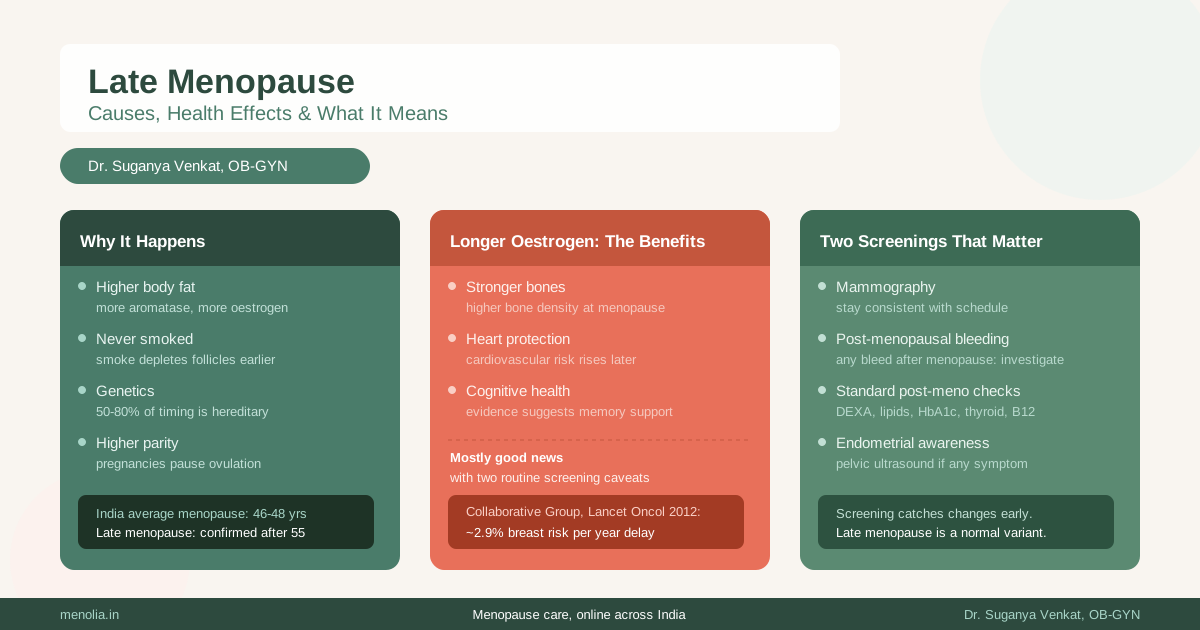
Menopause is confirmed when you have had twelve consecutive months without a period. The average age of menopause in India is 46 to 48 years (Palacios S et al., Climacteric 2010, PMID 20690868) (Ahuja M, J Midlife Health 2016, PMID 27721640). Globally, the average sits closer to 51.
Late menopause refers to menopause occurring at or after age 55. To be clear about scope: it is about timing, meaning the periods themselves continued into the mid-to-late fifties before finally stopping. A woman who went through menopause at 48 but had severe symptoms for a decade has not had late menopause. The term describes when menopause was confirmed, not how long the transition lasted.
The clinical opposite of late menopause is premature menopause (before 40) or early menopause (40 to 44). Premature menopause carries a specific set of health implications that need active management. Late menopause sits at the other end of the spectrum, with a broadly different health picture.
Why Some Women Reach Menopause Later
Menopause timing is not random. Three well-established factors are linked to a later menopause.
Body Composition and Peripheral Oestrogen
Adipose (fat) tissue contains an enzyme called aromatase. Aromatase converts androgens, which the adrenal glands and ovaries produce, into oestrogen. This process happens outside the ovaries, in the fat cells themselves, throughout the body.
Women with a higher body mass index carry more aromatase-producing tissue. This means they have a naturally higher background level of circulating oestrogen even before the ovaries stop working. That extra peripheral oestrogen can sustain the hormonal environment that supports menstrual cycles for longer.
This is not a disorder. It is a physiological mechanism, and it explains why body composition is one of the more consistent predictors of menopause timing across research studies.
Never Smoking
Cigarette smoke contains chemicals, particularly polycyclic aromatic hydrocarbons, that are directly toxic to ovarian follicles. Women who smoke reach menopause on average one to two years earlier than non-smokers, and the effect is dose-dependent (the more cigarettes, the earlier the timing, on average).
The reverse follows: women who have never smoked tend to keep their follicle pool intact for longer. This is one reason the range of menopause timing is wide even within the same family.
Genetics and Family History
Menopause timing has a strong hereditary component, with studies suggesting that genetic factors explain roughly 50 to 80 percent of the variation between women. If your mother or an older sister reached menopause on the later side, you are meaningfully more likely to do so as well.
Specific gene variants involved in follicle development, DNA repair in egg cells, and immune regulation all influence how quickly the ovarian follicle pool is depleted. This is not something you can change; it is something that is simply true of your biology.
A Note on Parity
Some research suggests that women who have had more pregnancies reach menopause slightly later, because pregnancy and breastfeeding pause ovulation and therefore preserve follicles that would otherwise be used up. The effect is small and not consistent across all studies, but it is worth knowing as a background factor.
The Health Picture: What Late Menopause Does and Does Not Do
This is where women most want clarity. The picture has two sides, and they are worth understanding in proportion.
What Late Menopause Does Well
Bone density. Oestrogen is the primary protector of bone mass. Every year of continued oestrogen exposure means a further year of bone protection. Women who reach menopause later typically enter their post-menopausal years with higher bone mineral density than women who went through menopause earlier. This translates to a lower baseline risk of osteoporosis and fracture. It does not eliminate that risk, which is why bone screening still matters after menopause for everyone. But the starting point is better.
Cardiovascular protection. Oestrogen keeps blood vessel walls flexible, supports healthy HDL levels, and counteracts the rise in LDL that tends to follow menopause. Women who go through menopause early, particularly before 45, have a measurably higher risk of cardiovascular disease later in life compared to women who menopause at the usual time. For women with late menopause, that protective window extends further. The cardiovascular changes that come after menopause arrive later.
Cognitive health. There is growing evidence that longer oestrogen exposure during the reproductive years supports cognitive function, particularly memory. This is an area where research is still developing, so it is not a firm clinical conclusion in the way that bone and cardiovascular findings are. But it points in a broadly positive direction.
Two Things to Be Aware Of
These are worth knowing because they inform specific routine screening decisions, not because they are causes for anxiety.
Breast cancer risk. Longer exposure to naturally cycling oestrogen and progesterone from the ovaries does modestly increase breast cancer risk. The Collaborative Group on Hormonal Factors in Breast Cancer published a large meta-analysis in The Lancet Oncology in 2012 (PMID 23084519) drawing on data from 117 epidemiological studies. They found that breast cancer risk increases by approximately 2.9 percent for each year of later menopause, relative to a reference age.
To put that in perspective: a woman who reached menopause at 57 instead of 51 has had six additional years of ovarian hormone exposure, contributing perhaps a 15 to 18 percent increase in relative risk over her individual baseline. Relative risk numbers can sound alarming; absolute risk remains the number that matters for a specific individual, and for most women it stays in a range where the difference is detectable in studies of many thousands of women but modest in terms of her personal lifetime probability.
What this means practically is not that late menopause is dangerous. It means that regular mammography is worth doing consistently, and worth discussing with your doctor if you have not been.
Endometrial cancer. The lining of the uterus (endometrium) is stimulated by oestrogen throughout each menstrual cycle. More menstrual years mean more cumulative oestrogen stimulation of the endometrial cells. This is associated with a modestly higher risk of endometrial cancer over a lifetime.
The reassuring part: endometrial cancer, when detected early, has a good prognosis. And the primary signal that something needs attention is unexpected bleeding after menopause. Any vaginal bleeding after twelve months without a period is always investigated. A pelvic ultrasound measuring endometrial thickness is usually the first step (Karlsson B et al., Lancet 1995 established the reference threshold of 4mm for transvaginal ultrasound in post-menopausal women). This applies to every post-menopausal woman, but it applies with particular clarity for those with late menopause.
If you have reached menopause and have questions about what your timing means for your particular health picture, a one-to-one conversation gives you a far more personalised answer than any article can.
Talk to Dr. Suganya via WhatsApp
What Screening Looks Like After Late Menopause
The two points above lead directly to two screening priorities. These are additions to the standard post-menopause health checks, not replacements for them.
Mammography. Most gynaecological guidelines recommend regular mammography starting from age 40 to 45. If you have reached menopause late and therefore have a modestly higher relative breast cancer risk, consistency with this schedule matters. Discuss the frequency that is right for your personal and family history with your gynaecologist.
Endometrial awareness. You do not need special endometrial surveillance unless you develop symptoms. The symptom to act on is unexpected vaginal bleeding, or any spotting, after menopause has been confirmed. Do not wait to see whether it resolves. A pelvic ultrasound is straightforward and non-invasive as a first step.
The full range of post-menopause health checks, including bone density (DEXA scan), fasting lipid panel, HbA1c and blood sugar, thyroid panel, and vitamin D and B12, applies to all women regardless of when menopause occurred. A post-menopause health checklist covers these in detail.
For bone health specifically, the bones of a woman with late menopause are usually in a better position at the time of menopause than they would be if she had stopped earlier. That does not mean bone monitoring can be skipped; it means the starting position is stronger. See the Menopause & Bone Health guide for what to eat and do to protect density through the post-menopausal years.
HRT and Late Menopause
If menopausal symptoms are present and HRT is being considered, late menopause does not fundamentally change the eligibility conversation. The same individual risk-benefit assessment applies.
One nuance worth knowing: because endometrial exposure is a consideration with late menopause, women with an intact uterus who take oestrogen-based HRT will also be given progestogen to protect the endometrial lining. This is standard practice for all women with a uterus on combined HRT, not something specific to late menopause. The HRT in India guide explains how this decision is made and what the different forms involve.
If the breast cancer risk dimension is a concern, the HRT and breast cancer risk post covers what the evidence says about exogenous hormones, including how route and type of HRT affect the risk picture. Your gynaecologist can factor your personal menopause timing into that conversation.
Late Menopause in India: What It Looks Like on the Ground
India’s average menopause sits roughly four years earlier than the global average, between 46 and 48 years. A woman who keeps having periods into her mid-fifties here is genuinely running later relative to her peers than a woman with the same timing would be in Europe or North America.
This sometimes creates social dissonance. Friends and colleagues going through menopause at 47 or 48 while you are still having regular periods at 54 can feel odd. Some women find it reassuring (a sense that the body is still cycling normally). Others worry that something is wrong. And some simply find it inconvenient.
None of those feelings are wrong. But the biology is clear: late menopause in India is a normal variant, running at the higher end of a range that is wider than most people realise.
For context, when menopause typically starts in India covers the full age range and the factors that influence it across different regions and body types.
FAQ: Late Menopause
What age counts as late menopause? Late menopause is generally defined as menopause confirmed at age 55 or older. Given that India’s average is 46 to 48, reaching menopause at 55 or beyond places you on the later end both by global and Indian standards.
Is late menopause normal? Yes. It is less common than menopause in the late forties or early fifties, but it is a well-recognised biological variant, not a disorder or a sign that something went wrong. It reflects normal differences in body composition, genetics, and lifestyle factors such as never smoking.
Why did my periods continue so much later than my friends’? Likely a combination of factors: higher body mass index (which increases peripheral oestrogen production through aromatase in fat tissue), never having smoked, family history of later menopause, and genetic variants that slow the depletion of the ovarian follicle pool. Any one of these can be enough; more than one reinforces the effect.
Does late menopause protect against osteoporosis? It reduces baseline risk at the time of menopause, because longer oestrogen exposure supports higher bone mineral density going into the post-menopausal years. It does not eliminate the need for bone screening, calcium and vitamin D attention, and strength training after menopause. Think of it as a better starting position, not permanent protection.
Does late menopause increase breast cancer risk? It modestly increases relative risk. The Collaborative Group’s 2012 meta-analysis found approximately 2.9 percent increased risk per year of later menopause. This is real, and it is a reason to stay consistent with mammography. It is not a reason to feel that late menopause was harmful. The absolute risk for most women remains in a range where routine screening catches changes early.
Do I need different cancer screening after late menopause? The standard post-menopause health checks apply. The two to pay particular attention to are mammography (consistent schedule, discuss frequency with your gynaecologist based on your full history) and immediate evaluation of any post-menopausal bleeding (a pelvic ultrasound to check endometrial thickness is the first step). Any vaginal bleeding after menopause is always investigated.
Can I still take HRT if I had late menopause? Yes. Late menopause does not make HRT ineligible. The standard individual risk-benefit conversation with your gynaecologist applies. If you have an intact uterus, combined oestrogen and progestogen will be prescribed (as it is for all women with a uterus on HRT). The breast cancer risk and endometrial considerations are factored in alongside everything else about your personal health picture.
If you are approaching or have recently reached menopause and want to understand what your timing, your symptoms, and your health history mean for the years ahead, an online consultation with Dr. Suganya gives you a clear plan.
Book a consultation via WhatsApp
Dr. Suganya Venkat is an OB-GYN with 15+ years of clinical experience. DNB OB-GYN (GKNM Hospital, Coimbatore), MD Pathology (CMC Vellore), MBBS with 5 Gold Medals (SRMC). She consults online across India via video call.