She was sitting across from me with the kind of quiet confidence that comes from having thought carefully before booking an appointment. Mid-fifties, twelve months without a period, sleeping better now than she had been two years earlier. She had one specific question, and she asked it directly.
“Doctor, I keep finding these hairs on my chin. Two or three a week. I have started checking in the car mirror every morning. Is this something I should be worried about?”
I hear this more often than most women imagine. The answer, in most cases, is no. But the explanation matters, because when you understand why this is happening, it stops feeling like a betrayal of your own body and starts feeling like biology doing something entirely predictable.
This post is for every woman who has wondered why her chin, upper lip, or lower jaw has started growing hair that was not there before.
Why Menopause Changes Your Body Hair
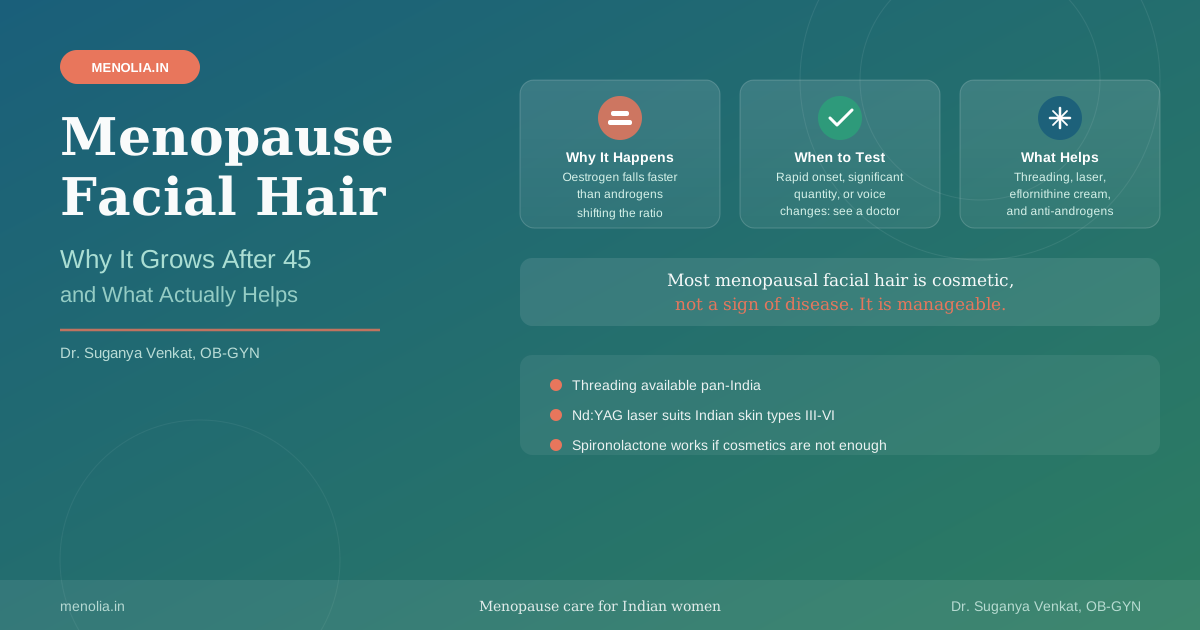
To understand facial hair in menopause, you need to understand one relationship: oestrogen and testosterone do not decline at the same rate.
During your reproductive years, your ovaries produced both oestrogen and androgens, including testosterone. They maintained a ratio that kept your hormone profile in a particular balance. When menopause begins, ovarian oestrogen production falls sharply. But androgen production does not fall at the same rate. The ovaries continue producing testosterone and androstenedione from their stromal cells for years after menopause. The adrenal glands contribute DHEA and DHEAS throughout. Adipose tissue converts androgens to oestrogens via an enzyme called aromatase, but this conversion runs in both directions.
The result is a shift in the ratio. Not an absolute rise in androgens, but a relative one. You may have similar testosterone levels to what you had at forty, yet you have far less oestrogen to counterbalance it. That shift is enough to change what your hair follicles do.
Your skin contains an enzyme called 5-alpha reductase. This enzyme converts testosterone into dihydrotestosterone, or DHT, inside the hair follicle itself. DHT is a more potent androgen, and it has a particular effect on the pilosebaceous unit: it can convert fine, pale vellus hairs into thicker, darker terminal hairs. On the face, specifically the chin, upper lip, and lower jaw, this means hair that was previously invisible or light-coloured becomes coarser and more visible.
This mechanism is well-established. Research published in the Lancet Diabetes and Endocrinology (Davis SR, Wahlin-Jacobsen S, 2015, PMID 26358173) confirms that androgens continue to play a meaningful physiological role in women after menopause, and that the shift in the oestrogen-to-androgen ratio has real consequences for skin, hair, and other tissues. The chin and upper lip are among the follicle sites most sensitive to this shift.
Where It Appears and What It Looks Like
Menopause-related facial hair has a characteristic distribution. It tends to appear on:
- The chin, particularly around the lower lip and jawline
- The upper lip (the faint shadow many women wryly call a menopause moustache)
- The lower jaw and sideburn area in some women
The hairs are typically terminal hairs: coarser and darker than the fine downy hair that covers most of the face. They usually grow slowly, one or two at a time, and become more noticeable over months rather than weeks.
This is distinct from the scalp hair thinning that also happens during menopause. Both can occur together, and both stem from the same hormonal shift, but they affect different follicle types in different ways. Scalp follicles and facial follicles respond to DHT quite differently. Menopause hair loss and thinning on the scalp is a companion to this story, but a separate one.
What Is Normal, and What Needs a Blood Test
Most menopause-related facial hair is purely cosmetic. It is not a sign of disease, and it does not need an urgent investigation. But there are circumstances where checking your androgen levels is the right step.
See your gynaecologist if you notice any of the following.
Rapid onset. If significant facial hair appeared over fewer than six months, rather than gradually over a year or two, this warrants investigation. A slow, gradual increase over the perimenopause and post-menopause transition is expected. A rapid change is not.
Significant quantity. A few hairs on the chin or upper lip is within the range of what menopause typically causes. A pattern covering larger areas of the face or appearing across multiple body sites alongside the facial hair is different and should be evaluated.
Associated changes. Voice deepening, clitoral enlargement, or pronounced sudden-onset acne alongside new facial hair growth can indicate androgen excess beyond the typical post-menopausal ratio shift. These are uncommon in simple menopausal change.
If your doctor recommends a blood test, the panel is usually free testosterone, DHEAS (which comes mainly from the adrenal glands), and sometimes 17-hydroxyprogesterone (to rule out late-onset congenital adrenal hyperplasia). A significantly elevated free testosterone or DHEAS level warrants further investigation, including imaging, to rule out an androgen-secreting tumour. This is rare, but it is the reason the threshold for testing exists.
In the vast majority of women who come to me with this question, onset is gradual, quantity is small, and blood tests are entirely normal. The answer is reassurance and a practical plan for the cosmetic aspect.
A Note on DHEA Supplements
Some women take oral DHEA supplements hoping to address low energy or low libido during menopause. DHEA is a precursor to both oestrogen and testosterone in the body, and because it is available without prescription in some markets, it is sometimes taken without medical guidance.
Worth knowing: oral DHEA increases androgen levels and can worsen facial hair growth. If you are experiencing menopausal facial hair and are also taking oral DHEA supplements, this is worth discussing with your doctor. There is an important difference between vaginal DHEA (prasterone), which has evidence for vaginal atrophy and acts locally, and oral DHEA, which has systemic androgenic effects. Our detailed guide to menopause supplements covers this distinction and helps you navigate what is evidence-based and what is not.
If you would like to talk through your hormone picture, including what is driving your symptoms and what the right investigations might be, Dr. Suganya is available for a video consultation. WhatsApp her at +91 99402 70499. The initial consultation is available by video call from anywhere in India or abroad: Rs. 399 in India, US $20 from outside India.
What Actually Helps: Your Practical Options
Once you have clarity on whether investigation is needed, the focus shifts to managing the cosmetic concern. You have several options, and they are not mutually exclusive.
Hair Removal: What Works in India
Threading remains the most widely available and affordable option across India, from metro cities to smaller towns. For chin and upper lip hair specifically, threading is effective, relatively fast, and can be done by any experienced beautician. It removes hair at the root and gives three to six weeks of regrowth-free time. For women who develop only a few hairs and want a low-maintenance routine, this is often enough.
Waxing works for larger areas, though it carries a higher risk of skin sensitivity for mature skin. Post-menopausal skin tends to be thinner and more reactive, so a patch test beforehand, and using cold wax or soft wax formulations, is sensible.
Laser hair removal is worth considering if you are dealing with persistent facial hair and find the ongoing maintenance of threading or waxing burdensome. For Indian skin types (Fitzpatrick III to VI), the Nd:YAG 1064nm laser is the preferred technology because it targets the pigment in the hair follicle without the surface melanin absorption that makes shorter-wavelength lasers riskier on darker skin. IPL (Intense Pulsed Light) is generally less recommended for skin types IV to VI. Results from laser are long-lasting but not always permanent: most women see 60 to 80 percent reduction after six to eight sessions, with maintenance sessions once or twice a year thereafter.
Electrolysis targets individual follicles with electrical current and is the only method classified as truly permanent. It is slower and more expensive than laser, but it works on any hair colour, including fine light hairs that do not respond well to laser. It is available in larger Indian cities.
Topical Treatment: Eflornithine Cream
Eflornithine (available under the brand name Vaniqa in some markets) is a prescription topical cream that slows facial hair growth by inhibiting an enzyme involved in hair follicle cell division. It does not remove existing hair; it is used alongside hair removal to extend the time between sessions. In India, it is available on prescription through a dermatologist or gynaecologist.
Research published in the Journal of the American Academy of Dermatology has found that eflornithine reduces facial hair growth and improves quality of life in women with unwanted facial hair. It works best when used consistently and in combination with laser or threading, rather than as a standalone treatment.
Medical Options: Spironolactone as an Anti-Androgen
Spironolactone is a medication originally used for blood pressure and fluid retention that also has anti-androgenic effects: it blocks androgen receptors in the hair follicle, reducing DHT’s ability to stimulate terminal hair growth. At low doses (25 to 100 mg), it is used by gynaecologists and dermatologists specifically to manage hirsutism and hair-related androgen effects.
In post-menopausal women, spironolactone is a reasonable option when facial hair is more than a few hairs and is affecting day-to-day confidence. The main considerations are blood pressure (it can lower it, which may be welcome or may need monitoring) and potassium levels (it raises potassium, so women with kidney concerns need a check first).
The key principle: this is a conversation with your own gynaecologist, not a self-managed choice. I mention it here because many women do not know it exists as an option and have been managing an ongoing cosmetic concern for years without knowing they could have asked about it. If it sounds relevant to you, bring it up at your next appointment.
Does HRT Help with Facial Hair?
This is a question I hear regularly, and the answer is: sometimes, for some women, yes.
Oestrogen-based hormone replacement therapy restores some of the oestrogen that was lost, which partly restores the original ratio between oestrogen and testosterone. For women who are already candidates for HRT based on their overall symptom picture, this can produce a modest reduction in facial hair as a secondary benefit. It is not a primary reason to start HRT, and it is not guaranteed, but it is a real observation in clinical practice.
If you are considering HRT for other symptoms, this is worth mentioning with your doctor. Our comprehensive guide to HRT in India covers the full picture: what to expect, how the decision is made, and what the research shows for Indian women.
One nuance: HRT formulations that include a progestogen with androgenic activity (certain older combined preparations) may not help and could have the opposite effect. Your gynaecologist can guide you toward oestrogen-dominant regimens if this is a concern for you.
Seeing This in the Wider Context
The facial hair is one part of a broader set of changes that happen when oestrogen levels fall. Low oestrogen symptoms covers the full range of what the shift in the hormone environment can produce, from skin dryness and joint pain to mood changes and sleep disruption.
If you are earlier in the perimenopause transition and still making sense of your symptoms, the perimenopause symptoms overview is a useful map of where you are and what to expect next.
Understanding the mechanism is the first step. Knowing your options is the second. The third is making a plan that fits your life, your skin type, your access to services, and your own priorities.
If you want that conversation with someone who will take the time to look at the full picture, not just one symptom in isolation, I am here.
WhatsApp Dr. Suganya at +91 99402 70499 to book a video consultation (Rs. 399 in India, US $20 from outside India). Available pan-India and to NRIs, by phone or video call.
Frequently Asked Questions
Is it normal to grow facial hair after menopause?
Yes. Mild to moderate facial hair on the chin, upper lip, and lower jaw is a recognised and common result of the hormonal shift at menopause. As oestrogen declines faster than androgens, the ratio changes, and some hair follicles on the face respond by producing thicker, darker terminal hairs. It affects many women to varying degrees and is not in itself a sign of disease.
Why am I getting facial hair in perimenopause, before my periods have stopped?
Because the hormonal shift begins well before the final period. Oestrogen starts declining through perimenopause while androgen levels stay relatively steady, so the oestrogen-androgen balance tilts years before menopause itself. New coarse hairs on the chin or upper lip appearing alongside cycle changes in your mid-40s are the same process described in this article, just starting earlier. The same rule applies: gradual, mild growth is expected; rapid or extensive growth deserves a blood test.
When should I see a doctor about facial hair in menopause?
See your gynaecologist if the hair appeared rapidly (within six months rather than gradually), if it covers large areas of your face or body, or if it is accompanied by voice deepening, sudden acne, or any other signs of significant androgen excess. These warrant a blood test to check free testosterone and DHEAS levels.
What is the best hair removal method for menopausal facial hair in India?
Threading is the most widely available and practical option for most women, particularly for chin and upper lip hair. For women who want a longer-term reduction in hair growth, laser hair removal with an Nd:YAG laser (suitable for Indian skin types III to VI) is more effective than IPL and gives lasting reduction after a course of sessions.
Does HRT reduce facial hair in menopause?
For some women, oestrogen-based HRT partly restores the oestrogen-to-androgen ratio and produces a modest reduction in facial hair as a secondary effect. It is not the primary reason to start HRT, but it is worth noting if you are already considering it for other menopausal symptoms. The formulation of HRT matters: some progestogens have androgenic activity that can work in the opposite direction.
Will my facial hair get worse as I get older?
In most women, the change is gradual and tends to plateau. The biggest shift in the oestrogen-to-androgen ratio happens in the early post-menopausal years. Once the body settles into its new hormonal environment, the rate of change typically slows. Hair removal methods or treatment options such as eflornithine or spironolactone can help manage any continued growth.
Can DHEA supplements cause more facial hair in menopause?
Yes, oral DHEA supplements can worsen facial hair growth because they increase androgen levels in the body. If facial hair is a concern and you are considering DHEA for energy or libido, discuss this with your doctor first. Vaginal DHEA (prasterone) is a different preparation that works locally and has a different side-effect profile.
What foods support hormone balance during menopause?
No single food reverses the hormonal shift of menopause, but several support the overall environment. Phytoestrogen-containing foods such as alsi (flaxseeds), til (sesame seeds), rajma, chana, and moong provide mild oestrogen-like compounds. A diet built around dals, ragi, bajra, dahi, paneer, and seasonal vegetables supports metabolic health and skin integrity. Our post on skin and hair changes in menopause covers the nutritional angle for skin specifically.