Ask most women in their late forties how much protein they eat and the answer is a shrug. Rice, chapati, a bowl of dal, some vegetables, curd at the end of the meal. It feels like a balanced plate, and in many ways it is. But when we sit down and add up the protein in a typical day, the total usually falls well short of what the body needs in the years around menopause.
I’m Dr. Suganya Venkat, an OB-GYN with more than 15 years of clinical practice, and at Menolia protein is one of the first things I look at when a woman tells me she feels weaker, tires on the stairs, or has noticed her arms and thighs getting softer. This post is about two practical things: the number you are aiming for, and how to reach it with the food already in an Indian kitchen.
What This Guide Covers
- Why protein needs rise after 45
- How to work out your own daily target in grams
- How much protein common Indian foods give you
- Why spreading protein across meals matters
- A sample vegetarian day and an egg-inclusive day
- Who needs a different target, including women with kidney disease
Why Protein Needs Rise Around Menopause
Muscle is constantly being broken down and rebuilt. With age, the rebuilding side responds less strongly to the same amount of food, and the drop in oestrogen around menopause adds to that. The result is a slow loss of muscle that most women do not notice until everyday tasks start to feel harder. Our post on menopause and muscle loss explains this process and why it matters for bones too.
Protein does not stop this on its own. Strength training is the other half, and the two work best together. But without enough protein, the muscle has less to build with, however hard you train. If you are starting on the exercise side, our guide to strength training after 45 is the place to begin.
How Much Protein Do You Need?
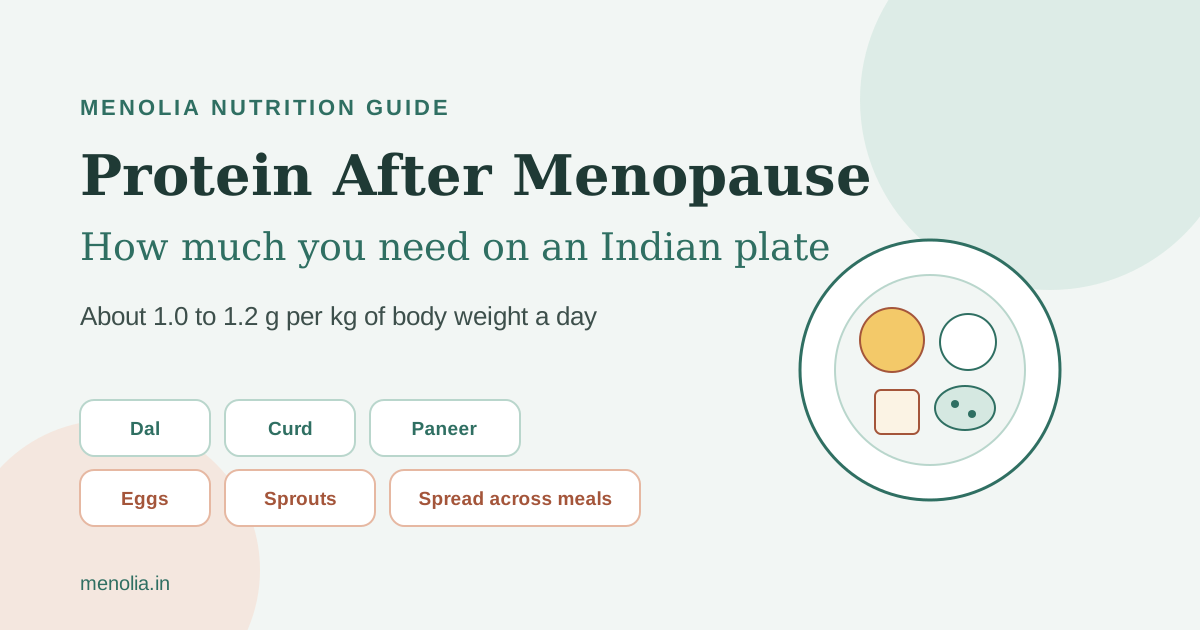
Two expert groups have looked closely at protein for older adults. The PROT-AGE study group recommended 1.0 to 1.2 grams of protein per kilogram of body weight per day for healthy older adults, with more for those who are active or recovering from illness (Bauer J et al., J Am Med Dir Assoc, 2013, PMID 23867520). The ESPEN expert group reached a similar figure, at least 1.0 to 1.2 g/kg/day for healthy older people (Deutz NE et al., Clin Nutr, 2014, PMID 24814383).
Both groups wrote for older adults (the PROT-AGE recommendation is for people over 65), so for a woman of 45 to 55 this is a sensible working target rather than a precise prescription. In practice I use 1.0 g/kg as the floor for most healthy women in this stage of life, moving towards 1.2 g/kg for women who are strength training.
Working out your number
Take your weight in kilograms and multiply:
| Your weight | At 1.0 g/kg | At 1.2 g/kg |
|---|---|---|
| 50 kg | 50 g a day | 60 g a day |
| 60 kg | 60 g a day | 72 g a day |
| 70 kg | 70 g a day | 84 g a day |
| 80 kg | 80 g a day | 96 g a day |
If you are carrying a lot of extra weight, use a weight closer to your healthy range rather than your current weight. Your doctor or dietitian can help you choose the right figure.
How Much Protein Is in Everyday Indian Food?
The figures below are approximate. Protein varies with the brand, how thick the dal is, and how much water is in the curd, so use them as a guide for planning rather than for exact counting.
| Food | Typical serving | Protein (approx.) |
|---|---|---|
| Cooked dal (toor, moong, masoor) | 1 katori (about 150 ml) | 6 to 8 g |
| Cooked chana or rajma | 1 katori | 7 to 9 g |
| Sprouted moong | 1 cup | about 3 g |
| Sprouted chana | 1 cup | 7 to 10 g |
| Paneer | 100 g | about 18 g |
| Curd (dahi) | 1 katori (about 150 g) | 5 to 6 g |
| Milk | 1 glass (250 ml) | about 8 g |
| Egg | 1 whole egg | about 6 g |
| Fish or chicken (cooked) | 100 g | 20 to 25 g |
| Roasted chana | 30 g handful | about 6 g |
| Peanuts | 30 g handful | about 7 g |
| Tofu or soya chunks (cooked) | 100 g | 10 to 15 g |
| Chapati | 1 medium | about 3 g |
| Cooked rice | 1 cup | about 4 g |
Two things stand out. First, a single katori of watery dal gives less protein than many women assume. Second, rice and chapati contribute a little, but not enough to carry the day.
Why Spreading Protein Across Meals Matters
The typical Indian day puts very little protein in the morning: tea with idli, upma or poha. Most of the day’s protein then arrives at lunch and dinner.
That pattern matters. In a study of healthy adults, the same total protein spread evenly across breakfast, lunch and dinner stimulated about 25% more muscle protein synthesis over 24 hours than a day that loaded most of it into the evening meal (Mamerow MM et al., J Nutr, 2014, PMID 24477298). It was a small study in younger adults, but the practical point is simple: aim for a real portion of protein at every main meal, starting with breakfast.
For most women in this age group, that means roughly 20 to 25 g at each main meal, with a small protein snack if needed.
If you are not sure what your own target should be, or how to fit it around diabetes, thyroid or cholesterol medicines, WhatsApp Dr. Suganya to book an online video consultation.
Building the Plate: Simple Upgrades
You do not need special food. Small changes to familiar meals add up quickly:
- Breakfast: add a katori of sprouts or a moong dal chilla instead of plain dosa alone; have curd with your upma; add a boiled egg or two if you eat eggs; besan chilla with paneer filling works well.
- Idli and dosa: pair them with a thick sambar rather than chutney alone. Adding more dal to the batter also raises the protein.
- Lunch: make the dal thicker and have two katoris instead of one; add a chana or rajma side; finish with curd or buttermilk.
- Snacks: swap biscuits for roasted chana, a handful of peanuts, sundal, or a glass of milk.
- Dinner: add paneer, tofu, egg, fish or chicken to the meal rather than relying on vegetables and chapati alone.
Our broader menopause diet guide covers fibre, calcium and the rest of the plate. Here the focus is only on protein.
A Sample Day for a 60 kg Woman (Target 60 to 72 g)
Vegetarian day
| Meal | What to eat | Protein (approx.) |
|---|---|---|
| Breakfast | 2 moong dal chillas with paneer filling (50 g) + curd | 22 g |
| Mid-morning | Sprouted chana sundal, 1 cup | 8 g |
| Lunch | 2 chapatis + 2 katoris thick dal + vegetable + buttermilk | 20 g |
| Evening | Glass of milk + handful of roasted chana | 14 g |
| Dinner | Rice + rajma (1 katori) + curd | 15 g |
| Total | about 79 g |
Egg-inclusive day
| Meal | What to eat | Protein (approx.) |
|---|---|---|
| Breakfast | 2 idlis with thick sambar + 2 boiled eggs | 20 g |
| Lunch | Rice + dal + 100 g fish curry or chicken | 32 g |
| Evening | Handful of peanuts + tea with milk | 9 g |
| Dinner | 2 chapatis + paneer bhurji (75 g) + dal | 22 g |
| Total | about 83 g |
These are examples, not prescriptions. If your total is lower to begin with, increase it gradually over a few weeks so your digestion can adjust, especially with dals and sprouts.
Do You Need a Protein Powder?
Most women can meet their target from food. A powder can be useful if your appetite is small, you are recovering from an illness or surgery, or you strongly dislike dairy and pulses. If you choose one, pick a plain whey or plant protein without added sugar or herbal blends, and treat it as a top-up rather than a meal replacement. Check the label for the protein per scoop, not just the brand claims.
Who Needs a Different Target
Higher protein is not right for everyone.
- Chronic kidney disease: if you have reduced kidney function and are not on dialysis, protein is often limited rather than raised, and the target depends on your stage of disease. If you are on dialysis, you may need more protein, not less. The KDOQI nutrition guideline covers dietary protein in chronic kidney disease (Ikizler TA et al., Am J Kidney Dis, 2020, PMID 32829751). Please do not change your protein without speaking to your nephrologist. Our post on HRT with chronic kidney disease covers other menopause decisions for women in this situation.
- Diabetes: protein is usually helpful at meals, but if you have diabetes ask your doctor to check your kidney function (a urine albumin test and creatinine) before you change your diet much.
- Gout or kidney stones: some protein sources can matter here, so plan the change with your doctor.
For most other women, raising protein to the levels in this post is a sensible, food-first step.
Practical Takeaways
- Multiply your weight in kg by 1.0 to 1.2 to find your daily protein target in grams.
- Aim for 20 to 25 g at each main meal, and do not skip protein at breakfast.
- Make dal thicker, add a second protein to lunch and dinner, and use roasted chana, peanuts or milk as snacks.
- Pair protein with strength training two or three times a week.
- If you have kidney disease, diabetes or gout, agree your target with your doctor first.
Frequently Asked Questions
How much protein does a woman need after menopause?
For most healthy women after 45, a practical target is 1.0 to 1.2 grams of protein per kilogram of body weight per day, based on expert recommendations for older adults. For a 60 kg woman that is about 60 to 72 grams a day.
Can I get enough protein on a vegetarian Indian diet?
Yes. Dal, chana, rajma, sprouts, paneer, curd, milk, peanuts and soya can easily reach 60 to 80 g a day. The usual problem is portion size and timing, especially a low-protein breakfast, rather than a lack of good vegetarian foods.
Is too much protein bad for the kidneys?
For women with healthy kidneys, the amounts in this post are within expert recommendations. For women who already have chronic kidney disease, protein is usually limited, so the target should be set with a nephrologist.
How much protein is in one bowl of dal?
A typical katori of cooked dal gives roughly 6 to 8 grams of protein, depending on how thick it is. Thicker dal, or two katoris, gives more.
Should I eat protein at breakfast?
Yes. Most Indian breakfasts are low in protein. Adding curd, eggs, sprouts, paneer or a moong dal chilla helps spread protein more evenly through the day. In a small short-term study, an even spread stimulated more muscle protein synthesis than loading most of it into dinner, though a long-term gain in muscle has not been proven.
Does protein help with menopause weight gain?
Protein helps you feel full and supports muscle, which helps with body composition. It is one part of a broader plan with movement, sleep and overall portions. Our guide to menopause weight gain covers the full picture.
Do I need protein supplements after 45?
Most women do not. Food can meet the target. A plain protein powder can help when appetite is low or after an illness, but check with your doctor first if you have kidney disease.
A Clear Next Step
Getting your protein right is one of the simplest changes you can make in the menopause years, and it supports your muscles, bones and energy together.
WhatsApp Dr. Suganya to book an online video consultation (₹399 in India, US $20 from outside India).