When a woman with chronic kidney disease (CKD) brings up hot flushes or broken sleep, she often starts with an apology. She already sees a nephrologist, already takes several tablets, already watches her salt and her potassium, and she assumes a question about menopause is one question too many. Many women in this position have been told nothing at all about hormone therapy, so they quietly decide it must be off limits.
It is not automatically off limits. Kidney disease changes how the hormone therapy (HRT) decision is made: which route, how low a starting dose, what gets checked, and who else is involved. It does not, on its own, close the door. I’m Dr. Suganya Venkat, an OB-GYN with more than 15 years of practice, and this is one of the comorbidity questions where I think women deserve a clear account of what we know and, just as importantly, what we do not yet know.
This post covers why menopause often arrives earlier with kidney disease, why the route of oestrogen matters even more here, why the dose usually needs to be lower, where the research is thin, and how your gynaecologist and nephrologist can plan this together. It is written for women with CKD at any stage, including those on dialysis and those who have had a kidney transplant.
How Kidney Disease Changes Menopause Itself
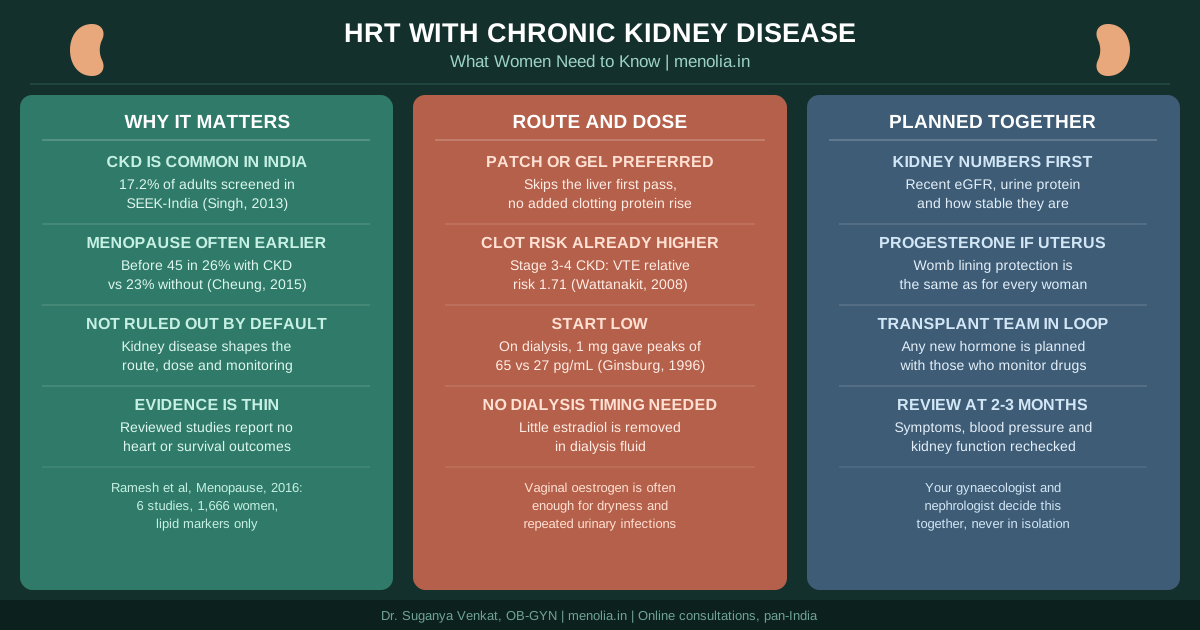
Kidney disease is common in India, and much of it goes unnoticed until a blood test picks it up. The SEEK-India screening study (Singh AK et al., BMC Nephrol, 2013, PMID 23714169) screened 6,120 adults across 13 centres and, among the 5,588 included in the analysis, found CKD in 17.2%, with about 6% at stage 3 or beyond. Diabetes and high blood pressure, both common in Indian women by their late forties, are the usual drivers. So a large number of women reach the menopause conversation with some degree of reduced kidney function already in the background.
Kidney disease also tends to move menopause earlier. In a Women’s Health Initiative analysis of 17,891 postmenopausal women (Cheung KL et al., Menopause, 2015, PMID 25628057), women with CKD were more likely to have reached menopause before 45 (26% versus 23%). The same study found they were less likely to report hot flushes and night sweats (38% versus 46%), which is worth knowing: fewer vasomotor symptoms does not mean your symptoms are imagined, and it does not mean the ones you have are less worth treating.
For women on dialysis, periods can become irregular or stop well before the usual age, and a review of menopause in CKD (Vellanki K and Hou S, Am J Kidney Dis, 2018, PMID 29530509) notes that the standard definition of menopause does not fit neatly at this stage, because menses can return after a kidney transplant or on hormone therapy. If your periods stopped early and you want to understand what that means for your health, our guide to premature menopause covers the wider picture.
Why the Route of Oestrogen Matters Even More Here
Oestrogen taken as a tablet is absorbed through the gut and passes through the liver before it reaches the rest of the body. Oestrogen through the skin, as a patch or gel, skips that first pass. This one difference explains most of why transdermal oestrogen is usually preferred in women with other health conditions, and it applies with extra weight in kidney disease for three reasons.
Clotting risk is already higher with CKD. In the LITE cohort of 19,073 adults (Wattanakit K et al., J Am Soc Nephrol, 2008, PMID 18032796), people with stage 3 or 4 CKD had a higher risk of venous thromboembolism (VTE) even after adjusting for other cardiovascular risk factors, with a relative risk of 1.71. Oral oestrogen adds to clotting risk through its effect on liver-made clotting proteins; transdermal oestrogen at standard doses does not appear to. Our guide to HRT and blood clots explains the route difference in detail.
Blood pressure is often part of the picture. Most women with CKD also manage hypertension, and the same first-pass logic favours transdermal oestrogen there, as covered in our post on HRT with high blood pressure.
Oral oestrogen has been linked with kidney function decline in one large study. In a population study of 5,845 women over 66 in Alberta (Ahmed SB et al., Kidney Int, 2008, PMID 18496507), hormone use was associated with a greater loss of estimated GFR, and this was seen with oral oestrogen but not with vaginal oestrogen, in a dose-dependent way. This was an observational study of older women and it cannot prove cause, and transdermal oestrogen was not separately assessed. But it points in the same direction as everything else: when kidneys are already under strain, the gentlest route and the lowest effective dose make sense.
For practical details on how patches and gels differ day to day, our comparison of patch, gel and pill walks through each one.
Living with kidney disease and wondering whether HRT is possible for you? Dr. Suganya reviews your kidney function, blood pressure and medicines before suggesting a route, and plans it alongside your nephrologist.
Why the Dose Usually Starts Lower
This is the part of the decision that is most specific to kidney disease. The kidneys help clear hormones, and women with advanced CKD also have lower levels of the proteins that bind oestrogen in the blood. Both change how much active hormone circulates from a given dose.
Two small pharmacokinetic studies in postmenopausal women on haemodialysis show this clearly. In the first (Ginsburg ES et al., J Clin Endocrinol Metab, 1996, PMID 8954051), a 1 mg oral estradiol tablet produced a peak blood level of 65 pg/mL in women with end-stage kidney disease, compared with 27 pg/mL in matched women with normal kidneys. The authors concluded that conventional doses may be excessive for women with kidney failure. In the second (Stehman-Breen C et al., Kidney Int, 2003, PMID 12787421), women on dialysis given 0.5 mg of oral estradiol ended up with higher free estradiol levels than healthy women given 1 mg, and the authors suggested roughly half the usual dose. The same study found that very little estradiol was removed in the dialysis fluid, so there is no need to time doses around dialysis sessions.
Both studies were small (six women with kidney failure in each) and both looked at oral tablets, not patches or gels. So they do not give us an exact transdermal dose for CKD. What they do support is a simple, cautious principle: start at the lowest available dose, watch how symptoms respond, and increase only if needed. In practice that usually means an individualised, cautious start with a patch or gel, agreed with your doctors, rather than a set transdermal dose for kidney disease, because the evidence does not provide one.
This caution fits with another observation. Among 482 women starting haemodialysis in Canada (Ramesh S et al., Nephrol Dial Transplant, 2020, PMID 32865207), those with the highest natural estradiol levels had higher all-cause mortality. That study measured women’s own hormone levels, not HRT, and the reason for the link is not known. It is not evidence that HRT is harmful in dialysis, but it is one more reason not to aim for high hormone levels in this group.
What the Evidence Covers, and Where It Stops
The research here is thin. A 2016 systematic review of hormone therapy in women with CKD (Ramesh S et al., Menopause, 2016, PMID 27433866) found only four randomised trials and two cohort studies, 1,666 women in total. None of them reported heart attacks, strokes or deaths. What they did show was LDL cholesterol falling by about 13 mg/dL and HDL rising by about 9 mg/dL (total cholesterol rose slightly), with no change in triglycerides or blood pressure. Cholesterol is a marker, not an outcome, so this tells us HRT does not appear to worsen these measures, not that it protects the heart in CKD.
On the benefit side, a one-year study in younger women on haemodialysis whose oestrogen levels had fallen very low (Matuszkiewicz-Rowińska J et al., Nephrol Dial Transplant, 1999, PMID 10344368) found that transdermal estradiol with a progestogen restored regular periods, improved libido and sexual function, and improved spine bone density compared with untreated women. That matters because bone health is a real concern with kidney disease, and some of the usual bone medicines need extra care when kidney function is low. For the everyday bone-protection steps that apply regardless, see our osteoporosis prevention plan.
The American Heart Association’s 2026 scientific statement on women’s kidney health (Gohar EY et al., Circulation, 2026, PMID 42751780) notes that menopause and ageing accelerate CKD progression in women as estradiol declines, and that women remain under-represented in kidney trials. Both points explain why this question keeps coming up and why there is still no large trial to settle it.
The practical result is that HRT has historically been rarely offered to women with kidney failure. In the HELP study of 238 postmenopausal women on haemodialysis (Kramer HM et al., Am J Kidney Dis, 2003, PMID 12612988), 77% had never used hormones and only 2% said a kidney doctor had ever recommended them. That study’s authors were cautious about HRT given the very high cardiovascular risk in dialysis, and that caution is reasonable. Not every woman with CKD needs HRT or should take it. The decision should rest on her own symptoms and risks, and it deserves a proper discussion rather than being skipped by default.
Progesterone, Vaginal Oestrogen and Bleeding
If you still have your uterus, systemic oestrogen (patch, gel or tablet) needs to be paired with a progestogen to protect the womb lining. Low-dose local vaginal oestrogen generally does not need a progestogen for this. This applies in CKD exactly as it does for everyone else. Micronised progesterone is commonly used, and our post on why HRT needs progesterone explains the options.
If your main symptoms are vaginal dryness, burning or repeated urinary infections, local vaginal oestrogen may be all you need. It acts mainly on the tissue where it is applied, and in the Alberta study above, vaginal oestrogen was not linked with the kidney function decline seen with tablets. Our guide to vaginal oestrogen cream in India covers the types and how to use them.
Unexpected bleeding needs a look. Kidney transplant recipients have higher rates of abnormal uterine bleeding, endometrial hyperplasia and early menopause (Graham ME et al., Clin Transplant, 2026, PMID 42133351). Some light bleeding in the first months of HRT is common, but new or persistent bleeding should be checked, and this matters more if you already have anaemia from kidney disease. Our post on breakthrough bleeding on HRT explains what counts as expected.
On dialysis, after a transplant, or managing CKD stage 3 or 4? Dr. Suganya goes through your latest eGFR, blood pressure, clotting history and current medicines over a video consultation, and suggests a route and starting dose you can take back to your nephrologist. WhatsApp consultation at Rs 399.
Planning It Together with Your Nephrologist
This is always a shared decision. Your gynaecologist looks after the menopause and hormone side; your nephrologist knows your kidney function trend, your blood pressure targets, your fluid and mineral balance, and your full medicine list. Neither should make this call alone. Here is what usually goes into the plan.
Your current kidney numbers. A recent eGFR and urine protein result, and how stable they have been, set the starting point. Stable, moderate CKD is a different conversation from rapidly changing kidney function.
Your clotting and heart history. A previous stroke or established coronary heart disease generally rules out systemic HRT, and non-hormonal treatment is the usual route in that situation. A past clot needs specialist assessment before any systemic hormone is considered. Nephrotic-range protein in the urine also shifts the discussion towards the most cautious options, and sometimes towards non-hormonal treatment instead.
A transplant, if you have had one. Women on anti-rejection medicines should always involve the transplant team before starting or changing any hormone, because they monitor drug levels closely and will want to know about every new medicine.
A low start and a review. A low-dose transdermal start, with a review of symptoms, blood pressure and kidney function after the first two to three months, is a common approach. The dose goes up only if symptoms have not settled.
Non-hormonal options on the table. If HRT is not suitable, or you would rather not take it, there are other ways to ease hot flushes and sleep problems. Many non-hormonal medicines are also cleared by the kidneys and need their own dose adjustment, so these too are best chosen with your nephrologist.
What This Looks Like in Practice
At Menolia, Dr. Suganya Venkat regularly speaks with women who have diabetes, high blood pressure and early kidney changes all at once, and who had assumed menopause treatment was simply not for them. The conversation usually moves quickly to practical questions: which form, how low a dose, and who keeps an eye on kidney function along the way. For many women, those questions have workable answers.
If you have a history of kidney stones rather than chronic kidney disease, the concerns are different, and our post on menopause and kidney stones covers how HRT route affects stone risk. If you have type 2 diabetes as well, our guide to HRT and diabetes adds the glucose side of the decision. And if you are earlier in thinking about HRT in general, start with our complete HRT guide for Indian women.
Frequently Asked Questions
Can I take HRT if I have chronic kidney disease?
Often, yes. Chronic kidney disease is not by itself a reason to avoid HRT, but it does change the plan. Transdermal oestrogen (patch or gel) is usually preferred, the starting dose is usually lower, and the decision is made together with your nephrologist, taking your kidney function, blood pressure and clotting history into account.
Is HRT safe on dialysis?
It can be considered, with extra caution. Small studies show that women on haemodialysis reach higher estradiol levels from the same dose, and one suggested about half the usual oral dose, so the starting dose is usually the lowest available. There are no large trials of heart or survival outcomes in this group, so the decision rests on how much your symptoms affect your life, weighed against your individual cardiovascular and clotting risk.
Why is a patch or gel preferred over tablets with kidney disease?
Transdermal oestrogen bypasses the liver’s first pass, so it does not raise clotting proteins the way tablets do. That matters because CKD already raises clot risk. In one large study of older women, oral oestrogen was associated with faster loss of kidney function while vaginal oestrogen was not; transdermal oestrogen was not separately studied.
Does HRT damage the kidneys?
There is no clear evidence that low-dose transdermal HRT harms the kidneys. One observational study linked oral oestrogen, especially at higher cumulative doses, with a faster decline in estimated GFR in women over 66, but it could not prove cause. This is one reason the lowest effective dose and a non-oral route are preferred, with kidney function rechecked after starting.
Do I need a lower dose of HRT with kidney disease?
Often, yes, especially with advanced CKD or dialysis. In the small dialysis studies, lower levels of the proteins that bind oestrogen meant more free, active hormone circulated from the same oral dose, even though total estradiol clearance was not clearly reduced. Those studies used tablets, not patches or gels, so they do not set a transdermal dose for every stage of CKD. Starting low and increasing only if symptoms persist is the usual approach.
Can I use vaginal oestrogen if I have kidney disease?
In most cases, yes. Vaginal oestrogen acts mainly on local tissue and was not linked with kidney function decline in the one large study that looked at it. It is often a good choice for vaginal dryness, painful sex or repeated urinary infections, but still tell your nephrologist you are using it.
I have had a kidney transplant. Can I take HRT?
It may be possible, but it should always involve your transplant team. Transplant recipients have higher rates of abnormal bleeding and early menopause, and anti-rejection medicines are closely monitored, so any new hormone needs to be planned with the team that manages them.
If you are managing kidney disease and menopause symptoms are wearing you down, this is worth talking through with someone who will plan it alongside your kidney care. Message Dr. Suganya Venkat on WhatsApp to talk it through.