You are 47. Your periods have become unpredictable, sometimes arriving two weeks early, sometimes skipping a month and returning three weeks later. The hot flashes you always assumed would happen to someone else are now happening to you: a wave of heat through your chest, up your neck, and suddenly you are fanning yourself in a meeting. You wake at 2 or 3 in the morning for no clear reason. Your joints feel stiffer than they did a year ago. Your patience runs shorter.
You are searching for what most of my patients at this age are searching for: is this normal? Am I in menopause? How long will this last?
I am Dr. Suganya Venkat, and across fifteen years of OB-GYN practice, 47 is the age I hear most often in this particular question. Not because something has gone wrong, but because the timing is completely on track. This post covers what is happening hormonally at this stage, which symptoms are typical, which warrant medical attention, and how to tell where you are in the transition.
Why 47 is a significant moment
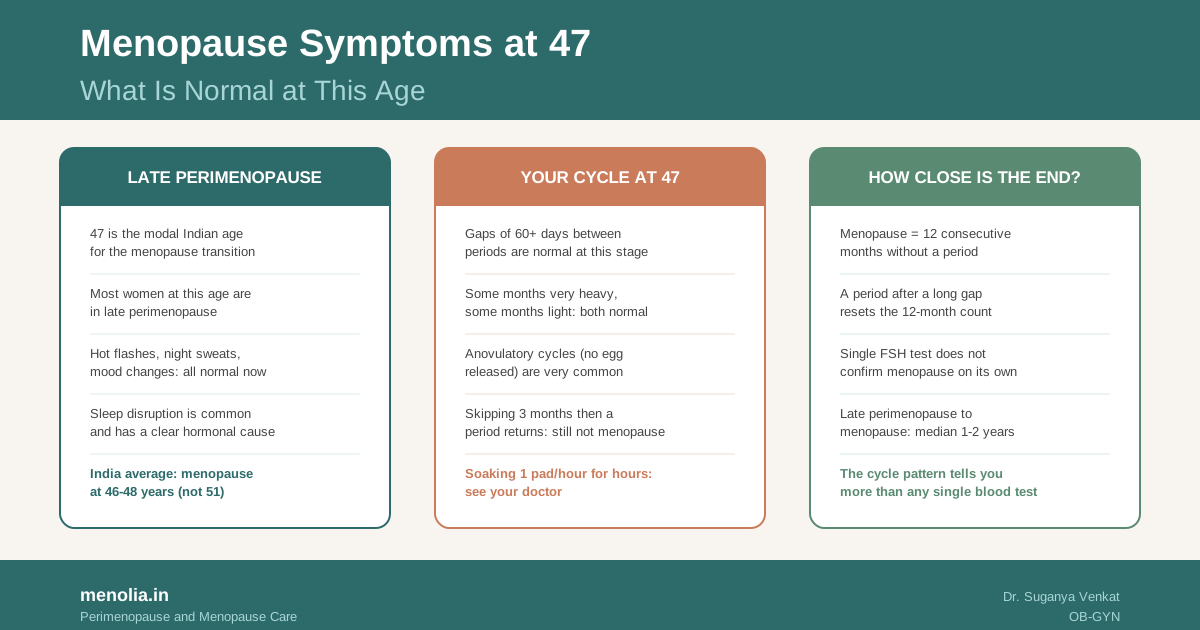
In Western populations, the median age of natural menopause is around 51. But data from Indian women consistently places the transition earlier. Two sources, Palacios et al. (2010, Climacteric, PMID 20690868) and the Indian Menopause Society’s pan-India survey (Ahuja M, J Midlife Health 2016, PMID 27721640), put the average age of natural menopause for Indian women at 46 to 48 years.
47 is the modal age for this transition in India. If you are 47 and noticing marked changes, you are not ahead of schedule. You are at the centre of the curve.
The STRAW+10 framework (Harlow et al., 2012, Menopause) is the clinical standard for staging the menopausal transition. It divides the years around the final menstrual period into early perimenopause (cycle irregularity begins), late perimenopause (cycles consistently 60+ days apart, full symptom constellation peaks), and post-menopause (confirmed after 12 consecutive months without a period).
At 47, most Indian women are in late perimenopause. Menopause itself, the date recognised only in retrospect, is typically one to three years ahead. Understanding which stage you are in changes how you interpret what your body is doing.
For a detailed breakdown of the Indian menopause timeline, see Average Menopause Age in India.
Cycle changes: the most reliable signal
Irregular periods are the most consistent sign of late perimenopause, and at 47 they take a specific pattern.
Unpredictable timing. Cycles that used to follow a reliable rhythm may now range anywhere from 21 to 90 days apart, or disappear entirely for a stretch. This reflects anovulatory cycles: months where the ovary does not release an egg, and the usual hormonal sequence is disrupted. Oestrogen rises enough to build the uterine lining but progesterone does not follow to stabilise it.
Heavier periods mixed with lighter ones. Oestrogen levels swing widely in late perimenopause, sometimes reaching values higher than those of the reproductive years. An oestrogen-dominant anovulatory cycle can produce a notably heavy period. The following cycle may be light and brief. Both are part of the same hormonal flux.
Long gaps, then a period returns. A gap of two or three months does not confirm menopause. Many women at 47 have a 90-day stretch without a period, then bleed again. The count towards confirmed menopause (12 consecutive months) resets with each bleed.
When heavier bleeding needs evaluation. The variation described above is normal. But if you are soaking through more than one pad per hour for several consecutive hours, passing large clots regularly, or bleeding for longer than 10 to 12 days, that warrants a conversation with your doctor. A pelvic ultrasound can quickly clarify the cause. The perimenopause periods guide covers the full range of what is normal versus what needs review.
Hot flashes and night sweats
Hot flashes are the symptom most closely associated with menopause, and at 47 they are common and normal.
A hot flash is a brief, intense sensation of heat, usually beginning in the chest and rising through the neck to the face, often followed by sweating and sometimes a chill as the body overcorrects. They typically last 30 seconds to a few minutes. Some women experience several through the day; others have them mainly at night, where they are known as night sweats.
The mechanism is well understood. Falling oestrogen narrows the hypothalamic thermoneutral zone, the temperature band within which the body neither sweats nor shivers, making the system trigger on smaller temperature fluctuations (Freedman, 2014, Menopause). The result is a vasomotor response to changes that previously went unnoticed.
In the Indian context, practical triggers include spicy food, chai consumed in the late afternoon or evening, heavy evening meals, and warm sleeping environments. Lighter cotton or linen clothing and a cooler bedroom make a meaningful difference for many women. For women whose hot flashes are affecting sleep quality or daily function, there are evidence-based options from dietary approaches through to prescription treatment. The hot flash treatment guide covers these in full.
Sleep, mood, and cognitive changes
Sleep disruption in late perimenopause is nearly universal. The most common pattern is waking between 2 and 4 in the morning, sometimes following a hot flash and sometimes without one. Progesterone, which supports sleep through GABA-modulating pathways, falls significantly in late perimenopause, altering sleep architecture even when temperature is not the primary trigger. The perimenopause sleep guide covers both the mechanism and approaches that genuinely help.
Mood changes at this stage are a direct physiological effect of oestrogen’s role in the limbic system and its interactions with serotonin and GABA. Women who have never had significant mood difficulties often find themselves more irritable or emotionally reactive during this period. Women with a history of mood sensitivity or premenstrual dysphoric disorder frequently find perimenopause amplifies it. Neither reflects a character failing. Both reflect the same hormonal fluctuation.
Cognitive symptoms, most often described as word-finding gaps, a sense of being slower to retrieve names or information, or difficulty holding multiple tasks in mind simultaneously, are also common at 47. The SWAN memory study (Greendale et al., 2009, Neurology) followed women longitudinally and found that processing speed and verbal memory do dip during the perimenopause transition, then generally improve in the post-menopausal years. This is not a sign of early dementia. It is a recognised, transitional effect of hormonal fluctuation.
If the combination of cycle changes, sleep disruption, and mood changes is affecting your daily life and you want a structured assessment of your symptom picture, message Dr. Suganya on WhatsApp. She consults online across India via video call.
Physical changes you may not have connected to hormones
Joint stiffness. Morning stiffness in the hands, knees, or lower back is more common during perimenopause than most women expect. Oestrogen has anti-inflammatory properties and supports the collagen matrix in connective tissue. As it falls, joints that were previously unremarkable can become briefly stiff or mildly aching, particularly in the first hour after waking. This is not the same as rheumatoid arthritis and typically does not worsen continuously.
Weight redistribution. Body composition tends to shift in late perimenopause: weight that previously distributed to hips and thighs begins moving towards the abdomen. Total weight may not change substantially, but the proportion held centrally increases. This is driven by falling oestrogen, rising cortisol sensitivity, and changes in lipoprotein lipase activity in different fat depots. It responds partially to dietary quality and strength training, but not completely to caloric restriction alone.
Skin and hair changes. Skin may become slightly drier and slower to recover from minor irritation. Hair texture can change: some women notice more dryness, others notice a shift in curl pattern. These reflect oestrogen’s role in collagen synthesis and in the maintenance of skin and hair follicle function. They are gradual and manageable rather than sudden.
Vaginal and urinary changes. Some women notice vaginal dryness, reduced lubrication, or a new sense of discomfort with intercourse beginning in late perimenopause. Bladder urgency or increased frequency can also appear at this stage, driven by the same oestrogen receptors that line urethral and vaginal tissue. These are worth mentioning to your doctor because there are highly effective local treatments that do not require systemic hormones.
For a fuller picture of the range of symptoms across the transition, see Perimenopause Symptoms: 34 Signs to Know.
How to tell how close you are to the final period
There is no blood test that tells you precisely how many cycles remain. But there are reliable patterns.
The 60-day gap signal. In the STRAW+10 framework, the transition into late perimenopause is defined by two or more consecutive cycles with gaps of 60 days or longer. If this has started happening for you, you are in the final stage before menopause.
FSH tells you the trend, not the date. FSH (follicle-stimulating hormone) rises as the ovaries produce less oestrogen, but it fluctuates enormously during perimenopause. A single elevated FSH reading at 47 does not confirm menopause; it may simply reflect a particular point in a cycle. A trend of rising FSH over several months, combined with your cycle pattern, is more informative. The blood test guide for menopause explains how to read FSH alongside oestradiol and AMH in context.
The 12-month rule is non-negotiable. Menopause is confirmed only after 12 consecutive months without a period. Many women at 47 and 48 experience a gap of three or four months, then have one more period. The count starts fresh from that last bleed. If you reach a point where 12 full months pass without any period, that date marks your menopause, and you are now post-menopausal.
Average time remaining in late perimenopause. SWAN cohort data suggests the late perimenopause stage (from first 60-day gap to confirmed menopause) lasts a median of one to two years. Women who entered perimenopause earlier tend to have a longer overall transition.
For comparison with how symptoms present earlier in the journey, see Signs of Menopause at 40.
What to do right now
Track your cycles. A simple calendar recording the first day of each period gives you and any doctor you see a concrete picture of your pattern. An app is fine; a notebook is equally useful. The data is more valuable than any single blood test.
If breast discomfort is also part of your symptom picture, our breast tenderness guide discusses how tenderness can vary with the cycle.
Start or maintain strength training. A meta-analysis of controlled trials in pre- and postmenopausal women reported positive effects of resistance training on lumbar-spine bone mineral density overall, and on femur and radius bone mineral density in postmenopausal women (Kelley et al., American Journal of Physical Medicine & Rehabilitation, 2001, PMID 11138958).
Resistance training can also improve strength in older adults. A separate review focused principally on type 2 diabetes reported improvements in insulin sensitivity and glycaemic control (Strasser and Pesta, BioMed Research International, 2013, PMID 24455726).
India foods worth including consistently. Calcium-rich options in the Indian kitchen include ragi (364 mg per 100 g, ICMR-NIN 2017), dahi (around 240 mg per 200 g), til (sesame, around 97 mg per 30 g), and paneer. Alsi (flaxseed) and til both provide lignans, a class of phytoestrogens that bind oestrogen receptors weakly and may reduce mild hot-flash severity (Lethaby et al., 2007, Cochrane Review). Haldi in warm milk or dals provides anti-inflammatory curcumin. Rajma and chana supply plant protein that supports muscle maintenance.
Know the red flags. Most symptoms at 47 are the normal experience of late perimenopause. A few warrant medical review without delay: any bleeding that occurs more than 12 months after your last period, very heavy or prolonged bleeding now that does not fit the irregular-but-manageable pattern, bleeding after intercourse, or any new breast changes. The menopause red flags guide gives clear guidance on which symptoms require same-day versus routine appointment timing.
Frequently Asked Questions
Is it normal to have perimenopause symptoms at 47?
Yes. In India, the average age of natural menopause is 46 to 48 years, making 47 the modal age for the transition. The perimenopause (the years of hormonal change before the final period) peaks in the late 40s for Indian women. Two sources on Indian menopause timing, Palacios et al. (2010, Climacteric) and the Indian Menopause Society’s pan-India survey (Ahuja M, J Midlife Health 2016, PMID 27721640), both confirm this earlier timeline relative to the global average of 51.
How long will perimenopause last from 47?
The total duration of perimenopause varies between women and ranges from 4 to 10 years overall. The final stage, late perimenopause from the first 60-day cycle gap to confirmed menopause, typically lasts one to two years. Women who are already in late perimenopause at 47 are often within two years of their final period. Women in early perimenopause at 47 may have a longer transition ahead.
Can I still get pregnant at 47?
Yes, until menopause is confirmed. Ovulation still occurs in some cycles during perimenopause, even when it is irregular and unpredictable. Pregnancy remains possible until you have had 12 consecutive period-free months. If you are not trying to conceive, contraception is still relevant at 47. The contraception in perimenopause guide covers which methods suit this stage and when it is safe to stop.
My period has been missing for three months. Is that menopause?
A three-month gap is common in late perimenopause but does not confirm menopause on its own. Menopause requires 12 consecutive months without a period. If a period returns after a three-month gap, the count resets. Continue monitoring. If you reach a full 12 months without any bleed, that last date is your confirmed menopause date.
Should I get a blood test at 47 to check my hormones?
A blood test can be useful but is not always necessary for a diagnosis at 47, where the clinical picture (symptoms plus cycle pattern) is often sufficient. FSH and oestradiol fluctuate so much in perimenopause that a single reading can be misleading. A more useful panel at this stage includes thyroid (TSH and anti-TPO), ferritin, vitamin B12, vitamin D, fasting glucose, and HbA1c. These check for conditions that commonly worsen or mimic perimenopause symptoms, including hypothyroidism, iron deficiency, and rising blood sugar. Discuss with your doctor what the right workup is for your particular situation.
Perimenopause ke lakshan 47 saal mein kaun se hote hain?
47 saal ki umra mein perimenopause ke aam lakshan hain: masik dharm (periods) ka aniyamit hona (kabhi jaldi, kabhi bahut late), garmi ke daure (hot flashes), raat ko paseena aana (night sweats), neend mein takleef, chidhchidapan ya mood mein badlav, aur subah ke samay jodon mein akadahat. Yeh sab normal hain is stage mein. Indian mahilaon mein menopause typically 46 se 48 saal ke beech hota hai, aur 47 iss transition ka sabse common saal hai.
When will I know my last period has happened?
You will know only in retrospect. Menopause is officially confirmed when 12 consecutive months have passed without a period. Many women at 47 or 48 go three or four months without a period, then have one more. The count must restart from that last bleed. When 12 full months eventually pass from a given period, that period becomes the final one, and the date it started is your menopause date. There is no way to know in real time which period is the last.
Navigating this stage is much easier when you understand what your body is doing. At Fertilia, I consult online with women across India to assess symptoms, review cycles, and work through what the next year or two of transition looks like for each person specifically.
If you are 47 and want a clear picture of where you are in the transition, message Dr. Suganya on WhatsApp. She consults via video call, online, across India.