Two questions tend to arrive together in this conversation, but they need different answers.
The first is whether you can still conceive in perimenopause. The answer is yes, right up until 12 consecutive months without a period have passed. That question is covered in full in Can You Get Pregnant in Perimenopause?
The second question is: given that, what should you use for contraception, and for how long? That is what this guide covers.
It is a practical decision for a specific life stage. Your forties and early fifties bring a different hormonal landscape than your thirties, and that changes which methods are the right fit. Some methods that worked well earlier carry a higher risk profile now. Others become more versatile in perimenopause than they were in younger reproductive years. And there is a clear set of criteria from clinical guidance for when it is finally safe to stop.
Why irregular cycles do not mean contraception is no longer needed
The perimenopause transition alters the cycle because follicular development becomes erratic, not because it stops. Some months produce a functioning follicle, ovulation, and a potential conception window. Others are anovulatory. Neither pattern announces itself in advance.
A cycle that has become irregular can still produce an egg. Women who stop using contraception because their periods have become unpredictable, or because several months have passed without a period, account for a meaningful proportion of unintended perimenopausal pregnancies. The possibility of ovulation remains real even when cycles are widely spaced or highly variable.
The clinical threshold for confirmed menopause is 12 consecutive months without a period if you are 50 or over, or 24 consecutive months if you are under 50. Until that threshold is met, intermittent ovulation is part of the picture.
The combined pill after 40: when the balance shifts
Many women in their thirties establish a reliable routine with the combined oral contraceptive pill. It regulates cycles, reduces dysmenorrhoea, and offers predictability that suits a busy life. It is a reasonable method at that stage.
After 40, the benefit-risk balance changes.
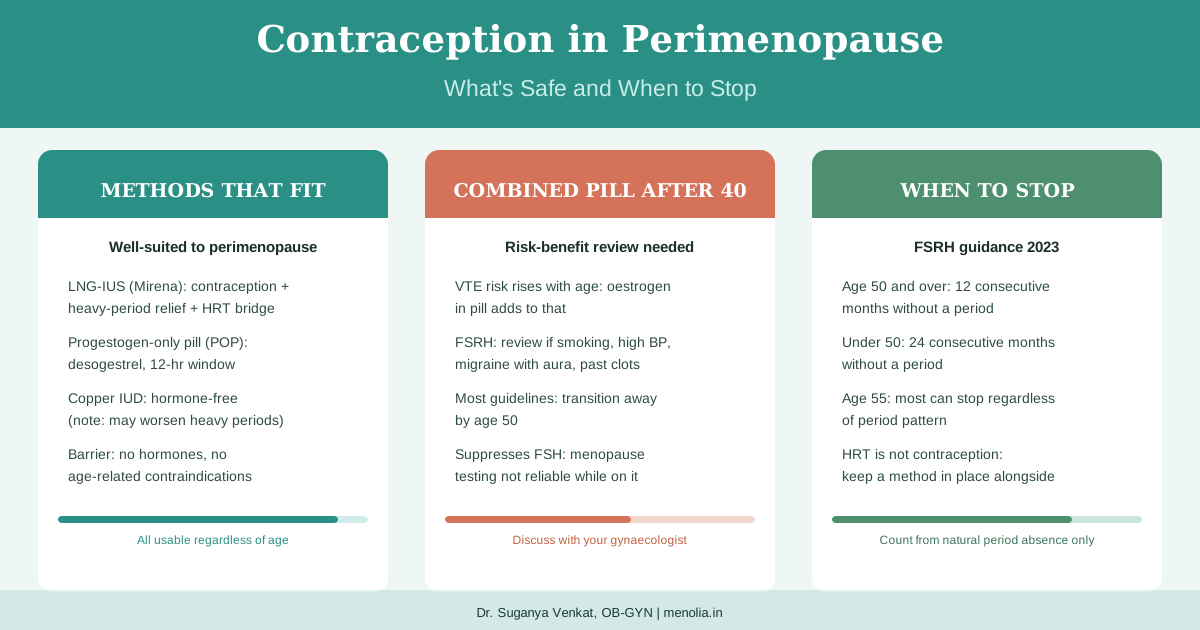
The combined pill contains oestrogen, and oestrogen raises the risk of venous thromboembolism (VTE). Age alone also raises VTE risk. These effects compound. The Faculty of Sexual and Reproductive Healthcare (FSRH) guidance on contraception for women aged over 40 years (2023) identifies several factors that make the combined pill inadvisable in this age group:
- Smoking, including light or intermittent smoking
- High blood pressure
- Migraine with aura
- Personal history of blood clots, stroke, or arterial cardiovascular disease
- Prolonged immobility (post-surgical recovery, long-haul travel that is a regular feature of life)
- BMI above 35
For women over 40 without these factors, the combined pill remains an option, but the prescribing conversation should include an explicit risk assessment. Most guidelines recommend transitioning away from the combined pill by age 50, regardless of risk profile, as the risk-benefit calculation continues to shift with age.
One additional consideration: the combined pill suppresses FSH. This means that women who want to use FSH testing to understand where they are in the menopause transition cannot get a meaningful reading while taking it. That matters for the question of when to stop contraception, which is covered below.
If the reasons you have stayed on the combined pill are cycle regulation and heavy period management, both of those benefits can be achieved through the LNG-IUS, which does not carry the same oestrogen-related risk profile.
The LNG-IUS: the most versatile option for perimenopause
The levonorgestrel intrauterine system (LNG-IUS, commonly known as Mirena) addresses several perimenopausal concerns in a single device, which is why it comes up repeatedly as the most practically useful contraceptive in this life stage.
Contraceptive efficacy is over 99%, comparable to sterilisation. Once fitted by your gynaecologist, it requires no daily attention and is effective for 5 to 8 years depending on the specific device.
It significantly reduces heavy menstrual bleeding, which is one of the most disruptive features of perimenopause for many women. A large UK randomised trial (the ECLIPSE trial, Gupta J et al., N Engl J Med 2013) showed that the LNG-IUS achieved patient satisfaction and blood-loss reduction comparable to endometrial ablation in women with heavy periods. For women whose periods have become heavier during the transition, this is a substantial benefit alongside the contraceptive function.
The third advantage is that the LNG-IUS can serve as the progestogen component of a combined HRT regimen if you later add systemic oestrogen. When oestrogen is prescribed for menopausal symptom relief, women with a uterus need progestogen alongside it to protect the uterine lining. The LNG-IUS fulfils that role, which means that adding a patch, gel, or tablet form of oestrogen creates a complete combined HRT regimen without any additional medication. If you are considering HRT while still needing contraception, the HRT in India guide explains how this combination approach works in practice.
One navigational note: the LNG-IUS typically makes periods lighter or stops them entirely. That means period absence cannot be used as a marker for menopause while the device is in place. How to navigate this is addressed in the section on when to stop.
Progestogen-only pill
The progestogen-only pill (POP) is appropriate for most women over 40, including those with risk factors that make the combined pill unsuitable.
Not all progestogen-only pills work the same way. Older formulations work primarily by thickening cervical mucus and require strict daily timing within a 3-hour window. Desogestrel-containing formulations (the active ingredient in Cerazette and its generic equivalents available in India) reliably suppress ovulation in most cycles and allow a more forgiving 12-hour window. For women in this life stage, the 12-hour window offers practical flexibility.
The POP carries no oestrogen-related VTE risks and is a clear step down in cardiovascular risk from the combined pill for women in their forties who still prefer an oral method.
Copper IUD
The copper IUD is highly effective and entirely hormone-free. It carries no age-related contraindications and suits women who prefer to avoid hormonal methods for personal, medical, or cultural reasons.
The one consideration specific to perimenopause: copper IUDs often make periods heavier and more crampy. For women whose periods are already lengthening or becoming heavier during the transition, this is worth weighing carefully before choosing this option. If heavy bleeding is already a concern, the LNG-IUS is a better fit.
Barrier methods and fertility awareness
Barrier methods carry no hormonal effects and no age-related contraindications. Reliability depends on consistent, correct use. They work well as a standalone method for women who prefer not to use hormonal methods or an intrauterine device, or as an interim method during a contraceptive transition.
Fertility awareness methods (cycle charting, basal body temperature, ovulation predictor kits) depend on cycle predictability to work reliably. In perimenopause, cycle length becomes variable, months alternate between anovulatory and ovulatory, and the hormonal signals that underpin these methods are harder to interpret against the background of perimenopausal hormone fluctuation. These methods are not as reliable at this life stage as they can be during regular cycles.
HRT is not contraception
This point comes up regularly enough in practice that it deserves a dedicated section.
Hormone replacement therapy addresses menopausal symptoms by supplementing declining oestrogen and progesterone. The doses used in HRT are lower than those in contraceptive formulations, and the purpose is symptom relief rather than ovulation suppression. HRT does not reliably prevent conception.
Women who start HRT while still in perimenopause and who do not wish to become pregnant must continue a dedicated contraceptive method alongside it.
The one exception is the LNG-IUS used as the progestogen arm of a combined HRT regimen. In that scenario, the IUS provides both the uterine protection that systemic oestrogen requires and the contraceptive effect. Adding systemic oestrogen alongside an in-situ LNG-IUS creates a complete HRT regimen, with the IUS serving a dual role. This is a recognised and increasingly common clinical approach.
For any other HRT formulation, including combined oral HRT preparations, the prescription is not a contraceptive and a separate contraceptive method is needed.
If you are unsure which method suits your current situation, I am happy to go through the options with you on a video call. You can reach me on WhatsApp at +91 99402 70499. I see women across India online.
When is it safe to stop?
The FSRH guidance on this is clear.
Women aged 50 or over: contraception can be stopped after 12 consecutive months without a period, provided the period absence has a natural cause (that is, it is not masked by hormonal contraception).
Women under 50: contraception should continue for 24 consecutive months without a period. The longer interval reflects the higher probability, in early perimenopause, of an unexpected return to ovulation after a period gap. Waiting 24 months provides a high degree of certainty that ovulation has permanently ceased.
The age-55 consideration: the FSRH notes that spontaneous ovulation is rare enough after 55 that most women can stop contraception at that point regardless of period status. This is sometimes referred to as the age-55 convention.
When contraception is masking periods
Several methods suppress or significantly lighten periods: the combined pill, the LNG-IUS, injectable contraceptives, and certain higher-dose POPs. If the method is responsible for period absence, that absence cannot serve as the starting point for the 12 or 24-month count.
Options in that situation:
Switching to a method that does not suppress periods (such as a copper IUD or barrier methods) for long enough to establish whether natural periods have stopped, then starting the count.
FSH testing: for women on a progestogen-only method (where oestrogen is not suppressing FSH), two FSH readings above 30 IU/L taken at least 6 weeks apart are generally accepted as supporting a decision to stop contraception. FSH levels fluctuate in perimenopause, so a single reading is not sufficient, but two readings above the threshold at appropriate intervals provide a reasonable guide. The Menopause Blood Tests guide covers how to interpret FSH in context.
For women on the combined pill: FSH testing while on the combined pill is not useful. Oestrogen suppresses FSH, producing a falsely normal reading that does not reflect the underlying ovarian picture. The practical approach is to continue contraception until 55, or to switch to a progestogen-only method, allow 6 months for the COC oestrogen to clear, and then test FSH if needed.
Transitioning from contraception to HRT
Many women in their late forties or early fifties want to start HRT for symptom relief before they are ready to stop contraception. These two goals are compatible, and the approach depends on the current contraceptive method.
On the LNG-IUS: adding systemic oestrogen (patch, gel, or oral tablet) creates a complete combined HRT regimen. The IUS handles the progestogen component; you add the oestrogen. There is no gap in either contraceptive protection or symptom management during the transition.
On the POP: systemic oestrogen can generally be added alongside. For women who reach the menopause threshold and want to continue HRT afterward, the transition to a sequential or continuous combined HRT regimen can be planned with your gynaecologist.
On the combined pill: the combined pill does contain oestrogen, which can manage some perimenopausal vasomotor symptoms, but its formulation and dose differ from dedicated HRT, and the VTE risk profile after 50 makes most guidance recommend transitioning away from it. The timing and approach depend on your individual risk factors and symptom picture.
Any transition between contraceptive methods and HRT is worth planning in a dedicated consultation rather than as a self-directed change. The decisions around timing, method sequencing, and monitoring are worth getting right. Your gynaecologist or a menopause-specialist doctor is the right person to work through this with.
Frequently Asked Questions
Can I stop contraception if my periods have become very irregular?
Irregular periods do not confirm that ovulation has stopped. The criteria are based on consecutive period-free months (12 if aged 50 or over, 24 if under 50), not on irregularity alone. Continue using contraception until those thresholds are met.
Is the combined pill safe in perimenopause?
For healthy, non-smoking women without cardiovascular risk factors, it remains an option in the early forties. Most guidelines recommend transitioning away from it by 50. If you have any of the risk factors listed above (high blood pressure, migraine with aura, smoking, history of blood clots), that conversation should happen sooner. This is a decision to make with your prescribing doctor.
Does HRT protect against pregnancy?
No. HRT uses doses that are too low to reliably suppress ovulation. If you are in perimenopause and do not wish to conceive, a dedicated contraceptive method is needed alongside any HRT you are taking.
How do I know if I have reached menopause when my IUS has stopped my periods?
The LNG-IUS often makes periods absent, making the 12-month count impractical. FSH testing (with the limitations described above) or the age-55 convention are the practical routes. A review with your gynaecologist, taking your full clinical picture into account, gives the most reliable answer.
What contraceptive suits someone who cannot use oestrogen at all?
The POP, copper IUD, LNG-IUS, and barrier methods are all oestrogen-free. The LNG-IUS and desogestrel POP are the most effective among these. The choice depends on cycle patterns, period heaviness, tolerance for any hormonal exposure (the LNG-IUS uses a small local dose of levonorgestrel), and personal preference.
Does one high FSH result mean I can stop contraception?
No. FSH fluctuates significantly in perimenopause. A single elevated reading can be followed by a normal ovulation the following month. Two readings above 30 IU/L taken at least 6 weeks apart, in the right hormonal context, are the accepted basis for a stopping decision in women on progestogen-only methods.
Is the LNG-IUS available in India?
Yes. The Mirena IUS is available in India on prescription and is fitted by a gynaecologist. It is worth asking specifically for the LNG-IUS or Mirena by name when discussing options, as it is not always the first method mentioned. Costs vary by city and provider.
Deciding when and what to use for contraception in perimenopause is genuinely more involved than it was in your thirties. The right answer depends on your medical history, your current symptoms, whether you are also considering HRT, and where you are in the transition. If you want a clear, personalised plan, I am happy to go through it with you. You can reach me on WhatsApp at +91 99402 70499 for an online consultation. I see women across India.