Your period has been fairly predictable for most of your adult life. Maybe 28 days, maybe 30, with some variation across the years but broadly the same rhythm you could plan around.
And then, somewhere in your forties, it starts doing things you did not expect.
It arrives a week early. Then again just two weeks after that. One month it is lighter than it has ever been; the next it is heavier than you remember in years. Then it disappears for six weeks, shows up once, and vanishes again. Your cycle app, your calendar, every rhythm you relied on, stops making sense.
This is perimenopause. And while the unpredictability can be unsettling, most of what happens to your periods during this transition is a normal part of a very normal biological process. Understanding what is driving the changes, and what a perimenopausal cycle typically looks like at each stage, can take a great deal of uncertainty out of it.
This post covers the hormonal reasons your cycle changes, what to expect in early and late perimenopause, the specific patterns that do warrant a medical check, and what you can do practically to keep track without it taking over your life.
Why your cycle is changing: what is happening hormonally
In your reproductive years, the menstrual cycle runs on a fairly reliable loop. At the start of each cycle, follicle-stimulating hormone (FSH) from the pituitary gland rises slightly, prompting follicles in the ovaries to develop. One follicle takes the lead, grows to maturity, and releases an egg at ovulation. After ovulation, the empty follicle (now called the corpus luteum) produces progesterone, which stabilises the uterine lining. If pregnancy does not occur, both oestrogen and progesterone fall, the lining sheds, and the cycle begins again.
In perimenopause, this loop becomes less predictable because the number of remaining follicles in the ovaries is declining. As fewer follicles are available, the pituitary has to signal harder to get a response: it raises FSH output. In early perimenopause, this extra FSH often pushes the available follicles to develop faster than they did before. The follicular phase, which is the first half of the cycle from period start to ovulation, shortens. The whole cycle shortens. What was once 28 days may now run at 22 or 24.
In some cycles, ovulation does not happen at all. These are called anovulatory cycles. With no ovulation, no corpus luteum forms, and no progesterone is produced. Oestrogen continues to rise and build up the uterine lining, but without progesterone to balance it and signal shedding at the right time, the lining can grow thicker than usual before eventually shedding in a heavier or more prolonged bleed.
Further into perimenopause, the gaps between cycles grow longer rather than shorter. Fewer follicles respond to FSH, and months can pass with no ovulation and no period at all. When a bleed does occur after a long gap, it often reflects the eventual shedding of a thick lining built up over weeks of unopposed oestrogen.
The staging system clinicians use to describe this transition is called STRAW+10 (Stages of Reproductive Aging Workshop). It describes two distinct phases of perimenopause: an early stage characterised by variable cycle length (differing by more than 7 days from what was previously normal), and a late stage defined by gaps of 60 days or more between periods (Harlow SD et al., Climacteric 2012).
What to expect in early perimenopause
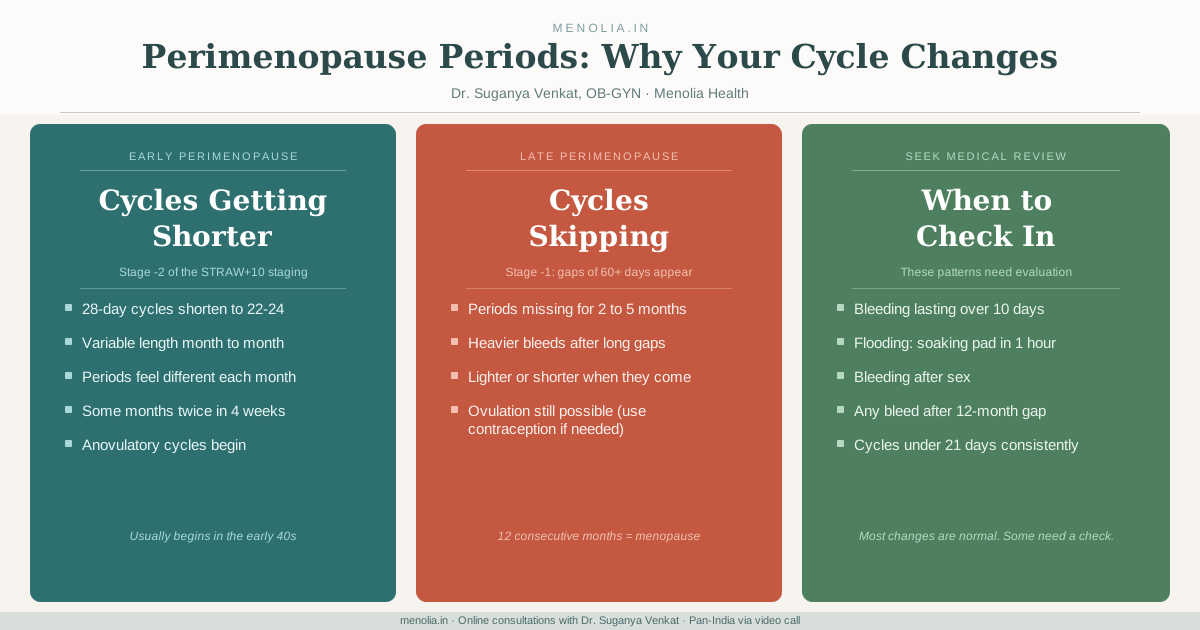
Early perimenopause (STRAW+10 Stage -2) is when most women first notice something has shifted. The signals are often subtle initially.
Cycles that shorten. If your periods were reliably 28-30 days and are now consistently running at 21-24 days, this is one of the earliest signs of the perimenopausal transition. The shortened follicular phase described above is the mechanism. A shorter cycle by itself is not a red flag, even though it can feel alarming when periods start arriving before you expect them.
More variability cycle to cycle. Beyond the general shortening, cycles become less consistent. A 26-day cycle followed by a 31-day cycle followed by a 23-day cycle, all in the same season, is characteristic of this stage. Hormonal output is fluctuating, and the cycle reflects that directly.
Periods that feel different from month to month. Some months heavier, some lighter. Premenstrual symptoms (bloating, breast tenderness, mood changes) may intensify in cycles with higher oestrogen surges, then be mild or absent in others. These are variations on the same underlying theme: the hormonal signal is less regulated than it was, and the cycle changes accordingly.
The “twice a month” pattern. When cycles compress to 14-21 days, it can genuinely feel as if your period is arriving twice in a month. For a woman who has had 28-day cycles her entire adult life, this is often one of the most disorienting changes. In most cases these are simply short but real cycles, a normal feature of early perimenopause. The Perimenopause Spotting guide covers the difference between a short cycle and bleeding between periods, which is a distinct pattern worth distinguishing.
What to expect in late perimenopause
Late perimenopause (STRAW+10 Stage -1) begins when gaps of 60 days or longer start to appear between periods. This marks a shift: ovulation is now occurring infrequently, and the final phase of the transition has begun.
Skipped months. Missing one or two periods, having a bleed, then missing three more, is a completely normal pattern at this stage. Some women find that a cycle after a long gap feels almost normal in terms of duration and flow. Others notice the bleeds that do occur are lighter and shorter than before. Both are within the expected range of late perimenopause.
Heavier bleeds after longer gaps. As explained above, anovulatory cycles with no progesterone can allow the uterine lining to thicken over weeks or months. When that lining eventually sheds, the bleed can be heavier than anything you experienced in your regular cycles. This is a mechanistic consequence of the hormonal changes, not a sign that something has gone wrong, though consistently heavy bleeding does warrant a check as described in the section below.
The final period. Menopause is defined as 12 consecutive months without a period. The last bleed before that 12-month gap is the final menstrual period, but you cannot know it was the last until the year has passed. There is nothing you need to do to mark or track this correctly. Your body is not asking you to get it exactly right.
A note on fertility
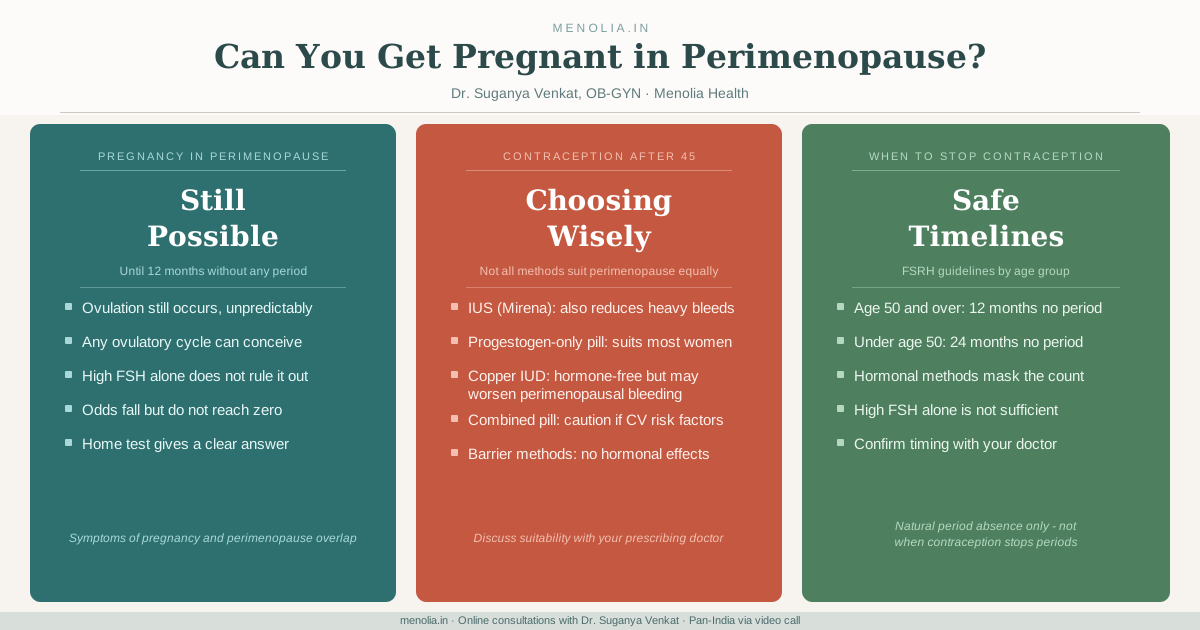
Irregular cycles in perimenopause do not mean ovulation has stopped entirely. Unpredictable ovulation can still happen, including in months where you felt nothing was occurring. If you are in perimenopause and do not want to become pregnant, reliable contraception is important until 12 full months have passed without a period. Your doctor can help you choose an appropriate method for this stage. The Perimenopause Test guide includes a practical section on what perimenopause means for contraception.
If your cycle changes are making it hard to know what is normal for your situation, a consultation can help you make sense of what you are experiencing.
WhatsApp Dr. Suganya for an online consultation. She sees women from across India via video call.
Patterns that need a medical check
Most cycle changes in perimenopause are within the expected range. These patterns are different, and each is worth evaluation.
Bleeding that lasts more than 10 days. A slightly longer bleed is not unusual in perimenopause. Bleeding that continues past 10 days, particularly if it is more than light spotting, is worth checking. Your doctor may recommend a scan to assess the uterine lining.
Flooding. This refers to bleeding heavy enough to soak through a pad or tampon in under an hour for two or more consecutive hours. Flooding at any age warrants investigation. In perimenopause, it is often related to anovulatory cycles building up the uterine lining over time, but it can also reflect fibroids, adenomyosis, or other treatable conditions. The Abnormal & Heavy Bleeding in Perimenopause guide covers what investigations your doctor is likely to suggest and what the treatment options look like.
Large clots, repeatedly. Small clots during a heavier period are a normal feature of fast-flowing blood overwhelming the anticoagulants in the menstrual fluid. Clots consistently larger than roughly a 10-rupee coin, or clots that are frequent enough to be disruptive, are worth raising with your doctor.
Bleeding after sex. Post-coital bleeding is not a normal feature of perimenopause. It needs to be assessed. The Bleeding After Sex in Menopause guide explains the common causes and what the evaluation typically involves.
Any bleeding after 12 months without a period. Once you have gone 12 consecutive months without a bleed, any bleeding that occurs is post-menopausal bleeding and needs medical evaluation. It often has a benign cause, but it cannot be assessed without seeing a doctor. The Post-Menopausal Bleeding guide explains the investigation pathway in full.
Cycles shorter than 21 days, consistently. A cycle or two at 18-20 days is within the range of early perimenopause variability. Cycles consistently running at under 21 days for three or more months are worth checking, particularly to rule out thyroid conditions and other treatable causes of cycle shortening. The Thyroid Changes During Menopause guide explains why thyroid function and menstrual cycle length are connected.
What helps: a simple tracking approach
You do not need to monitor your cycle obsessively. A brief log, even a note in your phone, gives you useful information when you do see your doctor.
The essentials are: the date your period started, roughly how many days it lasted, and a one-word note on the flow. You do not need to track symptoms daily unless something specific is worrying you.
When you speak to your doctor, the most useful things to mention are:
- How long cycles have been running, in days
- Whether cycles are getting consistently shorter or longer, or both unpredictably
- Whether you are having months with no period at all
- Anything about the flow that feels different from your personal normal, particularly flooding or prolonged bleeding
If your doctor recommends a blood test as part of the assessment, the Menopause Blood Tests guide explains what FSH, LH, and oestradiol results mean in this context, and why a single reading is often less informative than it appears.
Perimenopause and your cycle: an India context
Indian women enter menopause at a median age of 46-48 years, which is 2-4 years earlier than the Western average, and perimenopause often begins in the early forties (Palacios S et al., Climacteric 2010, PMID 20690868) (Ahuja M, J Midlife Health 2016, PMID 27721640). This means cycle changes can begin at an age when many women are not yet expecting them, and when other life pressures (caregiving, career, family) may make it harder to attribute the changes to the right cause.
In Tamil, the menstrual period is called மாதவிடாய் (maadhavidaai). The experience of cycles going off-schedule in the years before menopause is sometimes described as “ஒழுங்கற்ற மாதவிடாய்” (ozhunga artha maadhavidaai, irregular periods) or “கோளாறான மாதவிடாய்” (irregular cycle), before eventually arriving at “மாதவிடாய் நிறுத்தம்” (maadhavidaai niruththam, cessation of periods). In Hindi, “maasik dharm mein badlaav” describes cycle changes, and “maasik dharm ka rukna” refers to the stopping of the cycle.
Whatever language you describe it in, the biology is the same. And the same foods that support general hormonal and metabolic health through this transition are worth including in your daily plates: ragi (finger millet) for calcium and sustained energy, dahi and paneer for protein and bone support, palak and methi for iron (particularly useful in months with heavier bleeds), rajma and kala chana for steady blood sugar, and a small daily portion of alsi (flaxseed) for its phytoestrogen content.
Frequently asked questions
Why is my period coming every two weeks during perimenopause? Cycles can shorten significantly in early perimenopause, sometimes running at 14-21 days rather than the usual 28 or 30. This happens because FSH rises as the ovarian reserve declines, which causes the follicular phase (the first half of the cycle) to compress. The cycle as a whole shortens, and it can feel as though periods are arriving twice in a month. This is one of the more startling features of early perimenopause, but it is often a normal variation. If your cycles have consistently been under 21 days for more than two to three months, it is worth mentioning to your doctor to rule out thyroid issues or other causes.
Is it normal to have a very heavy period and then nothing for two months? Yes, this pattern is common in perimenopause. A heavier-than-usual bleed often reflects an anovulatory cycle: oestrogen has been building the uterine lining without progesterone to moderate it, and when the lining finally sheds, the bleed is heavier. The quieter months that follow may be cycles where no ovulation and no significant lining build-up occurred. If the heavy bleed involved flooding or lasted more than 10 days, it is worth getting checked. Otherwise this alternating heavy-then-nothing pattern is a typical feature of the perimenopausal transition.
I missed my period for three months, then had one. Is this menopause? Not necessarily. Three missed cycles, followed by a return, is a feature of late perimenopause rather than confirmed menopause. Menopause is specifically defined as 12 consecutive months without a period. Until that full year has passed, you are still in perimenopause and ovulation can still occur. It is not unusual for a period to return after a gap of two to five months during the years leading up to the final period.
My periods have been irregular for two years. How do I know when menopause actually happens? The count starts from the date of your last period. Once 12 full consecutive months have passed without any bleeding, you have reached menopause. The difficulty is that you cannot know which period is the last until the 12 months have elapsed. During the irregular phase, continue with contraception if pregnancy is not wanted, and seek evaluation for any bleeding that occurs after a 12-month gap without a period.
Can periods stop and then restart after a few months in perimenopause? Yes. This on-and-off pattern is characteristic of late perimenopause. The ovaries are still producing oestrogen intermittently, and when a follicle does develop or when an anovulatory cycle builds and eventually sheds the lining, a period can return after a gap of months. This is expected. The important distinction is that any bleeding occurring after a full 12 consecutive months without a period counts as post-menopausal bleeding and warrants assessment.
My doctor says my FSH is high. Does that confirm perimenopause? A raised FSH is consistent with perimenopause, but FSH fluctuates considerably during the transition, and a single elevated reading can be followed by a normal one in the next cycle. It is a supporting marker rather than a definitive test. The Menopause Blood Tests guide explains how FSH is interpreted alongside symptoms and cycle pattern, and why clinical history often tells you more than a number on a page.
Are there foods that help with irregular cycles in perimenopause? There are no foods that will regularise a perimenopausal cycle, because the irregularity is driven by the hormonal transition itself. What good nutrition does support is the body systems most affected by this stage: bone health (calcium from ragi, dahi, paneer, til), iron stores during heavier bleeds (palak, methi, rajma, dates), blood sugar stability (chana, rajma, millets), and overall hormonal metabolism (adequate protein, healthy fats). This is not a substitute for medical advice when something needs evaluating, but it is a meaningful contribution to how well you feel through the transition.
The cycle changes of perimenopause are real, they are hormonal, and they are a shared experience for every woman going through this transition. Most of what you are experiencing is within the range of normal. A few specific patterns do need medical attention. And if you are not sure which category your situation falls into, that is exactly what a consultation is for.
WhatsApp Dr. Suganya for an online consultation. She sees women from across India via video call and can help you understand what is normal for your stage and what, if anything, needs a closer look.