A woman in her mid-forties wrote to me confused and a little alarmed. She had never had a skin condition in her life, and suddenly there were red, scaly, intensely itchy patches behind her knees and inside her elbows that would not respond to the moisturiser she had always relied on. Her dermatologist told her, almost in passing, that it looked like eczema. “How can I get eczema for the first time at 45?” she asked. “Isn’t that a childhood thing?”
It is a fair question, and one I hear in different forms often at this stage of life. Some women have had mild eczema or psoriasis for years and find it suddenly worse. Others, like the woman above, develop a genuine inflammatory skin condition for the first time in their forties or fifties with no childhood history at all. Both patterns are real, both are tied to the hormonal shifts of perimenopause, and neither means something has gone unusually wrong.
This post covers how eczema and psoriasis differ from the ordinary dryness and itch that come with menopause, why oestrogen decline can trigger a genuine flare or a first-time diagnosis, the India-relevant triggers worth checking, and when this calls for a dermatologist rather than just a better moisturiser.
Why this is a different problem from ordinary dry skin
Menolia has already covered two related but distinct pieces of the skin picture at this age: the general collagen and moisture loss that comes with falling oestrogen (see the menopause skin dryness and collagen loss guide), and the unexplained pruritus that many women get with no rash at all (the menopause itchy skin guide). Eczema and psoriasis are a different category. They are chronic, immune-driven inflammatory skin diseases, not simply skin that has become drier or more reactive.
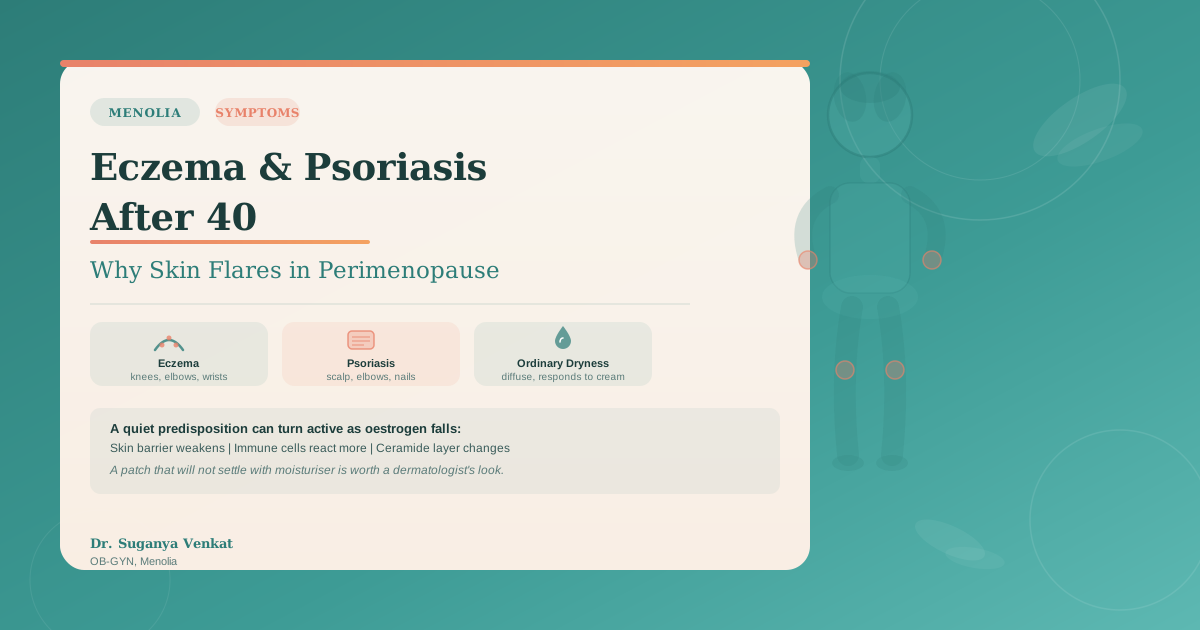
Eczema, medically known as atopic dermatitis, involves an overactive immune response in the skin combined with a weakened barrier. Psoriasis is an autoimmune condition in which skin cells are produced far faster than normal, causing the thick, silvery-scaled plaques that are its hallmark. Both conditions have genetic and immune underpinnings that exist independently of menopause. What changes at this stage of life is that the hormonal environment can tip a predisposition that was previously quiet, or already present, into an active flare.
Research on the role of sex hormones in atopic dermatitis describes oestrogen’s influence on the skin’s immune activity and how the disease’s course can shift alongside a woman’s major hormonal transitions (Kanda N, Hoashi T, Saeki H. Int J Mol Sci. 2019;20(19):4660. PMID: 31547021). A separate review on hormonal effects on allergic and eczematous conditions notes that hormonal changes across a woman’s reproductive life, including the approach to menopause, are associated with changes in eczema activity (Weare-Regales N, Chiarella SE, Cardet JC. J Allergy Clin Immunol Pract. 2022;10(9):2217-2228. PMID: 35436605). Psoriasis shows a comparable pattern: a dedicated review of psoriasis across a woman’s hormonal life stages describes how disease severity can change through puberty, pregnancy, and menopause specifically (Ceovic R, Mance M, Bukvic Mokos Z. Biomed Res Int. 2013;2013:571912. PMID: 24459670).
None of this means oestrogen decline directly “causes” eczema or psoriasis the way it causes hot flashes. It means the immune and barrier environment these conditions depend on is itself hormonally sensitive, so a transition that changes hormones broadly can plausibly move a quiet predisposition into an active one, or intensify a disease a woman has managed for years.
How to tell an inflammatory flare from ordinary menopausal dryness
This distinction matters because the two need different treatment, and the difference is usually visible if you know what to look for.
Distribution pattern. Ordinary menopausal dryness tends to be diffuse: shins, forearms, back, wherever skin is thinnest and least protected. Eczema classically favours specific folds and creases, behind the knees, inside the elbows, the neck, the wrists, and in adult-onset cases, sometimes the hands and eyelids. Psoriasis has its own typical map: scalp, elbows, knees, lower back, and around the nails.
Appearance and scaling. Dry menopausal skin looks flaky and feels tight but is usually a fairly uniform, unbroken surface. Eczema patches are typically red, sometimes weepy or crusted in a flare, and the skin often thickens with repeated scratching over time. Psoriasis plaques have a distinctive raised, well-demarcated edge with a silvery-white scale that ordinary dry skin does not produce.
Itch intensity and pattern. The itch of plain menopausal dryness responds meaningfully to a good moisturiser within days. Eczema itch is often described as unbearable, frequently disturbing sleep, and it tends to persist or worsen despite consistent moisturising. Psoriasis itch is more variable and is often accompanied by tenderness or a burning sensation at the plaque edges rather than itch alone.
Response to a plain, fragrance-free moisturiser. This is the single most useful home test. If a patch responds well to two weeks of consistent moisturising the way the rest of your skin does, it is very likely ordinary dryness. If a patch stays red, scaly, or intensely itchy despite that, or gets worse, it warrants a dermatologist’s opinion rather than a change of lotion.
Talk to Dr. Suganya’s team if you are unsure which one you are dealing with
Why the immune and barrier environment shifts at this age
Oestrogen does quiet, continuous work in the skin: supporting the barrier’s lipid layer, regulating moisture retention, and moderating how reactive the skin’s resident immune cells are to everyday irritants. A study looking specifically at postmenopausal women’s skin found that their barrier response to an irritant challenge, and the behaviour of the immune cells living in the skin, differed measurably from what is seen before menopause (Kiss O, Bahri R, Watson REB. Br J Dermatol. 2024;190(6):895-905. PMID: 38819239). Separately, research on the skin’s outer barrier layer has shown that menopause changes the ceramide composition of that layer, the lipids that hold the barrier together, and that hormone replacement therapy can prevent this shift (Kendall AC, Pilkington SM, Wray JR, et al. Sci Rep. 2022;12:21079. PMID: 36522440).
Put together, this is the physiological backdrop that makes a first-time eczema diagnosis or a psoriasis flare more plausible after 40 than it would have seemed at 25. A barrier that lets more irritants in, alongside immune cells that respond more readily, is a more permissive environment for an inflammatory skin condition to establish itself or resurface, on top of whatever genetic predisposition was already there.
If you already had eczema or psoriasis as a child or younger adult and it had settled for years, this is also the likely explanation for why it has returned now. The underlying tendency did not disappear. The hormonal environment that had been keeping it quiet has changed.
India-relevant triggers worth checking
A few environmental factors common in Indian households and climates make both conditions more likely to flare, and are genuinely worth adjusting before assuming the flare is purely hormonal and untouchable.
Heat and humidity swings. Moving between an air-conditioned room and outdoor heat and humidity multiple times a day is hard on a barrier that is already compromised by falling oestrogen. Sweat trapped against skin in humid weather is a recognised eczema trigger, and heat is a common psoriasis aggravator for many women.
Hard water. Hard water leaves a mineral residue on skin that can worsen barrier disruption and irritation, particularly in cities where groundwater hardness is high. If flares are worse after bathing, this is worth considering alongside soap choice.
Harsh antiseptic soaps. Many Indian households default to strong antiseptic or medicated soaps out of habit, assuming “stronger” means cleaner. For skin that already has a compromised barrier, this strips away protective lipids and worsens both eczema and psoriasis. This is the same soap-habit problem covered from a different angle in the menopause intimate hygiene guide: the underlying principle, that gentler is genuinely better for skin at this age, applies wherever antiseptic soap habits meet a weakening barrier, not only in one part of the body.
Frequent hot showers. Hot water is more aggressive at stripping the skin’s lipid barrier than warm water, and this is compounded for someone with an active inflammatory skin condition. Switching to lukewarm, shorter showers is a small change with a real effect on flare frequency.
When this is a dermatologist referral, and when hormone stabilisation may help
See a dermatologist if:
- A new patch of red, scaly, or persistently itchy skin appears and does not respond to two weeks of consistent, fragrance-free moisturising
- You notice the classic psoriasis pattern: well-demarcated plaques with silvery scale, particularly on the scalp, elbows, knees, or around the nails
- Weeping, crusting, or skin that looks infected develops around a flare
- Sleep is regularly disrupted by the itch of a specific patch, rather than the more diffuse itch described in the menopause itchy skin guide
- You already have a diagnosis of eczema or psoriasis and your usual treatment has stopped working as well as it used to
A dermatologist can confirm the diagnosis and prescribe condition-specific treatment, which may include topical steroids, barrier-repair creams formulated for eczema specifically, or, for psoriasis, treatments aimed at slowing the overactive skin-cell turnover. These are targeted therapies that a general moisturising routine cannot replace.
Where hormone stabilisation fits in: for some women, particularly when a flare has appeared alongside other clear signs of the perimenopausal transition, stabilising the broader hormonal environment through options such as hormone replacement therapy can make the skin’s underlying environment less reactive and support whatever dermatological treatment is being used. It is not a substitute for dermatology-specific care for an active flare, but it can be a genuinely useful part of the picture when both are addressed together. This is a conversation to have between your gynaecologist and your dermatologist rather than something to decide from either side alone, and it is exactly the kind of collaborative approach I encourage women to bring up at both consultations.
A new diagnosis at this age is not unusual
If you are sitting with a new eczema or psoriasis diagnosis in your forties and wondering how this happened for the first time, you are not an outlier. Adult-onset inflammatory skin disease around the perimenopausal transition is a recognised pattern, not a sign that something unusual or alarming is happening in your body. The same is true if a condition you managed easily for years has suddenly become harder to control. Both are explainable by the same hormonal shift that is also behind your hot flashes, your changing periods, and the other symptoms you may already be tracking.
I’m Dr. Suganya Venkat, and this is one of the questions women in Menolia’s perimenopause program raise more than they expect to when they first join, usually assuming it must be unrelated to “the real” perimenopause symptoms. It rarely is unrelated, and it is worth mentioning at a consultation rather than treating as a separate problem to solve on your own.
Discuss your skin changes with Dr. Suganya’s team on WhatsApp
Frequently Asked Questions
Can perimenopause really cause eczema for the first time, even with no childhood history?
Yes, this is a recognised pattern. Eczema depends on an interaction between skin barrier function and immune activity, both of which are influenced by oestrogen. As oestrogen falls during perimenopause, this environment can shift enough for a previously quiet genetic predisposition to become active for the first time, even in women who never had eczema as a child.
Why has my psoriasis, which I’ve had for years, suddenly gotten worse in my forties?
Psoriasis severity is known to change across major hormonal stages in a woman’s life, including the approach to menopause. A worsening in your forties is consistent with this pattern and does not necessarily mean your existing treatment has failed. It is worth discussing with your dermatologist, since a treatment adjustment during this transition is common and reasonable.
How do I know if my itchy patch is eczema or just menopausal dry skin?
The most reliable home test is response to two weeks of consistent, fragrance-free moisturising applied properly. Ordinary menopausal dryness usually improves noticeably. A patch that stays red, scaly, or intensely itchy despite that, especially if it sits in a crease like behind the knee or inside the elbow, is more likely to be eczema and worth a dermatologist’s opinion.
Is it my hot flashes causing the redness on my skin, or is it something else?
Hot flash flushing is transient: it comes with the flash and fades within minutes as your body temperature normalises. A skin condition like eczema, psoriasis, or rosacea produces persistent redness that does not follow the on-off pattern of a hot flash. If the redness is there most of the time rather than coming and going with flushes, it is worth having it looked at separately.
Will treating my perimenopause symptoms with HRT also help my eczema or psoriasis?
It can be a helpful part of the picture for some women, particularly by supporting the skin barrier and reducing the reactive immune environment that makes flares more likely, but it is not a replacement for dermatology-specific treatment of an active flare. The two approaches work well together when your gynaecologist and dermatologist are both aware of what the other is treating.
Are Indian climate and water conditions actually making this worse, or is that just a theory?
They are genuine, practical triggers rather than a theory. Heat and humidity swings, hard water, and habitually strong antiseptic soaps are all recognised aggravating factors for eczema and psoriasis generally, and they are especially relevant given how common they are across Indian households and cities. Adjusting these is a reasonable first step alongside any dermatological treatment.
Should I stop using all my regular skincare products if I think I have a flare?
Not all of them, but simplify. Switch to a plain, fragrance-free moisturiser and a gentle, non-antiseptic cleanser while the flare is active, and avoid introducing anything new until it settles. If you are already under a dermatologist’s care, follow their specific product guidance, since some prescribed barrier-repair creams are formulated to work alongside, not instead of, a simplified routine.
Skin changes are one of the more visible, and more visibly confusing, signs of the perimenopausal transition. Knowing the difference between ordinary dryness and a genuine inflammatory flare means you get the right treatment sooner, whether that is a better moisturising routine, a dermatologist’s care, hormone stabilisation, or, quite often, all three together.
Chat with Dr. Suganya’s team on WhatsApp about your skin symptoms