If you have smoked for most of your adult life, or if you have watched someone close to you do so, you may have wondered whether tobacco affects when menopause arrives. The answer, based on a consistent body of research spanning several decades, is yes. Smoking is one of the few modifiable factors that reliably shifts menopause timing, and the shift is not trivial.
This post explains what the evidence shows, why it happens at the level of ovarian biology, what the picture looks like for Indian women who use products like gutkha or bidi, and what difference stopping smoking can still make.
What the research consistently shows
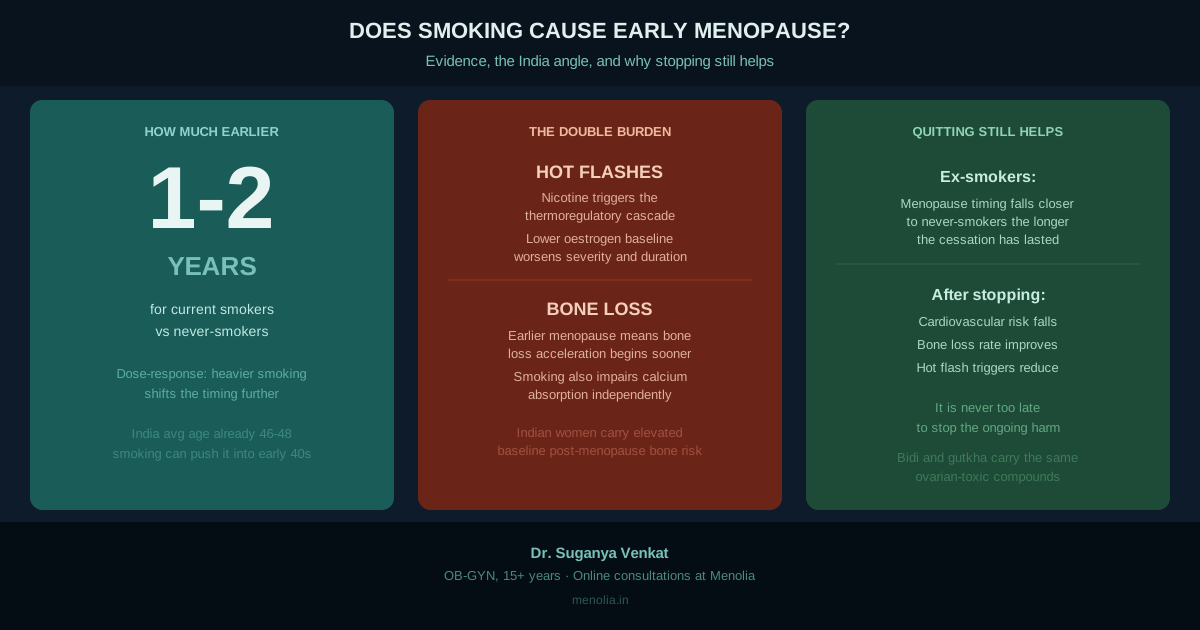
Large cohort studies and pooled analyses tracking women across multiple decades find that current smokers reach natural menopause roughly 1 to 2 years earlier than women who have never smoked. The effect follows a dose-response pattern: women who smoke more cigarettes per day, or who have smoked for more years, tend to fall at the upper end of that range. Women who smoke 20 or more cigarettes a day may see a shift of closer to 2 years; lighter or shorter-duration smokers tend to see less.
The shift does not always sound dramatic on paper, but consider what it means in practice. If your family history suggests you would naturally reach menopause around age 50, smoking for 20 to 30 years could move that to 48. If your genetic trajectory was already pointing toward 47 or 48, and you are Indian (the average menopause age in India is 46 to 48, notably earlier than the global average of 51), smoking can bring that into the early-to-mid 40s. For some women with a combination of genetic tendency and heavy smoking, menopause arrives before 45.
Menopause before 45 is defined as early menopause. Premature menopause, which means menopause before 40, is a different and more serious clinical situation. Smoking is a recognised risk factor for premature menopause as well, though most smoking-related early menopause falls in the 43 to 47 range.
On the other end of the spectrum, women who have never smoked and have certain genetic patterns may reach late menopause, which carries its own considerations.
How smoking affects the ovaries
The ovaries at birth contain a finite number of follicles: the structures that house the eggs and produce the hormones oestrogen and progesterone. Over a woman’s reproductive life, follicles are gradually used up through ovulation and a continuous background process of follicle loss. When the reserve falls below a threshold, oestrogen production declines, periods stop, and menopause follows. The pace of this depletion sets the age at which menopause arrives.
Tobacco smoke contains a group of toxic compounds called polycyclic aromatic hydrocarbons (PAHs), which are formed when any organic material burns. These compounds can cross into ovarian tissue, where research suggests they accelerate the natural process of follicle death. Studies examining ovarian tissue from women who smoked have found evidence of a reduced follicle count at younger ages compared with non-smokers. Smoking also creates oxidative stress throughout the body, including within ovarian tissue, which is thought to compound this effect.
Additionally, tobacco compounds may disrupt the hormonal signalling that governs follicle development and survival. Anti-Müllerian hormone (AMH), a marker of ovarian reserve, has consistently been found to be lower in women who smoke compared with age-matched non-smokers, which reflects this accelerated depletion.
The end result is a smaller reserve arriving earlier, translating into an earlier drop in oestrogen production and an earlier menopause.
The India angle: bidi, gutkha, and passive exposure
Most of the large studies on smoking and menopause timing were conducted in Western populations where the primary product is the factory-made cigarette. The Indian picture is considerably more varied.
Bidi: A bidi is made of loose tobacco rolled in a tendu leaf and burns at a higher temperature with far less filtration than a cigarette. Per stick, bidi smoking delivers higher concentrations of many toxic compounds, including the PAHs linked to ovarian toxicity. A woman who smokes five bidis a day is likely receiving a higher ovarian-toxic dose than the Western study data for “light smokers” would suggest. Bidi smoking is common across many parts of India, particularly in lower-income households and rural areas, and its effects on reproductive ageing deserve more attention than they typically receive.
Gutkha, pan masala with tobacco, and khaini: These smokeless tobacco products also contain high concentrations of PAHs and tobacco-specific nitrosamines, another class of compounds with established links to cellular toxicity. The research on smokeless tobacco and menopause timing is smaller than for smoked tobacco, partly because it is more difficult to study and partly because the assumption that smokeless equals safer has delayed investigation. What evidence exists points in the same direction: earlier reproductive ageing, reduced ovarian reserve markers, and a pattern consistent with accelerated follicle loss. Gutkha is not a safe alternative from the perspective of ovarian health.
Second-hand smoke: If you live in a home where others smoke regularly, particularly in close, enclosed spaces over many years, you are exposed to tobacco combustion products through passive inhalation. The evidence on passive smoking and menopause timing is less robust than for active smoking, and the magnitude of the effect appears smaller. It is not, however, zero. Chronic heavy household exposure over decades is a consideration, especially in multigenerational homes where one or more members smoke indoors. This is a point that rarely comes up in Indian women’s health conversations but is relevant here.
Why hot flashes are often worse for smokers
Women who smoke tend to experience more frequent and more severe vasomotor symptoms (hot flashes and night sweats) during the menopausal transition, and there are two compounding reasons for this.
The first is a direct, short-term effect. Nicotine and other tobacco compounds affect the autonomic nervous system and the thermoregulatory pathways that produce hot flashes. The same narrowing of the thermoregulatory zone that makes any menopausal woman prone to hot flashes is briefly exacerbated by nicotine. Many women in perimenopause notice that smoking a cigarette or bidi can directly trigger a hot flash, particularly as oestrogen levels become more variable.
The second is about baseline oestrogen. Because smoking is associated with a steeper and earlier decline in oestrogen production, women who smoke enter the menopausal transition with lower baseline oestrogen levels. Lower baseline oestrogen at the time of transition is consistently associated with more severe vasomotor symptoms, and with symptoms that last longer.
The two effects together explain why the symptom burden tends to be heavier for women with a smoking history. If you are currently managing hot flashes, the complete treatment guide covers the range of options from lifestyle changes to medical treatment. Reducing or stopping smoking is the one step that addresses both the triggering mechanism and the underlying hormonal baseline.
Talk to Dr. Suganya via WhatsApp
The bone health connection
One of the most significant long-term consequences of earlier menopause is earlier bone loss. Oestrogen plays an active role in slowing the process by which the body breaks down bone tissue (bone resorption). When oestrogen levels drop with menopause, bone resorption accelerates, and bone density can fall by 3 to 5 percent per year in the first few years after menopause.
For a woman who reaches menopause two years earlier because of smoking, that process of accelerated bone loss begins two years sooner. Compounded over the following two to three decades, this translates into meaningfully lower bone density at the ages when fractures cause the most harm.
Smoking compounds this through a second, independent route. Research has consistently found that smoking is associated with lower bone mineral density at any given age, separate from its effect on menopause timing. The mechanisms proposed include impaired calcium absorption in the gut, reduced blood supply to bone tissue, and direct effects on bone-forming cells. The result is that women who have smoked face both earlier bone loss and worse bone loss for a given calendar age.
Indian women already carry above-average risk for bone loss after menopause, due to lower average calcium intake across the population, limited sun exposure in indoor or conservative-dress contexts, and the earlier median menopause age. Smoking adds to a risk profile that is already elevated.
If you are approaching menopause and have a history of smoking, a bone density scan (DEXA scan) is worth discussing with your doctor. The action plan for preventing osteoporosis after menopause covers what the evidence supports for diet, exercise, and when further assessment makes sense.
What stopping smoking still does
I am Dr. Suganya Venkat, and in fifteen years of online consultations at Menolia, this is the question I hear most when the topic of smoking comes up: is it too late?
It is not.
Women who quit smoking have menopause timing that falls between current smokers and women who have never smoked, and the longer they have been quit, the closer their timing tends to move toward the never-smoker pattern. Quitting before the early 40s appears to attenuate much of the timing shift. Quitting later in perimenopause has less effect on the specific age of menopause but continues to matter for nearly everything else.
Stopping smoking at any age reduces cardiovascular risk, and that matters enormously post-menopause: the loss of oestrogen’s protective effects on blood vessels is one of the key reasons heart disease rates rise in women after menopause, and smoking compounds that risk substantially. Quitting reduces the rate of ongoing bone loss, so even if some density has already been lost, the trajectory improves. And it removes the nicotine-specific triggers that are contributing to more frequent hot flashes.
The menopause transition may be closer than you had planned for. That is a reason to act now, not a reason to assume nothing can be changed.
A note specifically for gutkha and smokeless tobacco users
If you use gutkha, pan masala with tobacco, khaini, or similar products and you are in your 40s noticing that your cycles are becoming irregular, or that you are having hot flashes or sleep disturbances consistent with perimenopause, it is worth mentioning your tobacco use to your doctor. The link between smokeless tobacco and earlier reproductive ageing is underrepresented in Indian women’s health conversations, partly because the research is smaller and partly because smokeless tobacco is sometimes assumed to be less harmful than smoking. It is less harmful for the lungs. The evidence on ovarian and reproductive health is less reassuring.
Book a video consultation with Dr. Suganya
Frequently asked questions
Does smoking definitely cause early menopause, or is it just one factor?
Smoking is a genuine and established risk factor for earlier menopause, not merely an associated variable. The research follows the dose-response pattern that is characteristic of a real causal relationship: more smoking, more years of smoking, and earlier menopause. It operates alongside genetic factors (your mother’s menopause age is one of the strongest predictors) and body weight, but smoking is one of the few of these factors that you can change. That is what makes understanding it clearly worthwhile.
I smoke bidis, not cigarettes. Does it affect menopause timing in the same way?
Bidi smoking likely carries at least as much, and possibly more, ovarian-toxic exposure per stick as a factory cigarette, because the tobacco burns hotter and with less filtration. Most of the published research on smoking and menopause was done in populations where cigarettes are the primary product, so a precise one-to-one comparison is not available. What is clear is that the toxic compounds responsible for follicle damage, particularly PAHs, are present in bidi smoke. There is no evidence that bidi smoking spares the ovaries.
Does using gutkha or chewed tobacco also affect menopause age?
The evidence base is smaller than for smoked tobacco, but the trend points in the same direction. Smokeless tobacco products used in India contain both PAHs and tobacco-specific nitrosamines, which have been linked to cellular and reproductive toxicity. Smaller studies examining ovarian reserve markers in smokeless tobacco users have found patterns consistent with accelerated depletion. This remains an area where the research is less complete, but the current evidence does not support the assumption that smokeless tobacco is safe for ovarian health.
क्या smoking से menopause जल्दी हो जाता है? (Does smoking make menopause come earlier?)
हाँ, बड़े cohort studies यही दिखाते हैं कि धूम्रपान करने वाली महिलाओं में menopause औसतन 1 से 2 साल पहले आता है। यह tobacco के toxic compounds (PAHs) की वजह से होता है जो ovaries में follicle loss को तेज़ कर देते हैं। Gutkha और bidi users में भी similar effects देखे गए हैं।
Are hot flashes worse if you have smoked?
Yes, typically. Women with a smoking history tend to experience more frequent and more intense hot flashes during the menopausal transition. Two mechanisms are at work: nicotine directly affects the thermoregulatory pathways that produce hot flashes, and the lower baseline oestrogen associated with smoking history amplifies the severity of vasomotor symptoms overall. Reducing or stopping smoking addresses both.
If I quit smoking five years ago, is the damage already done?
Not entirely. Women who quit smoking before menopause have timing and outcomes that are better than those of women who continue smoking, with the benefit generally scaling with how long they have been quit. Beyond menopause timing, five years of not smoking has already meaningfully reduced your cardiovascular and cancer risk. Bone loss trajectory, which can continue worsening with ongoing smoking, also tends to improve after cessation. The earlier you stopped, the better the outcome, and five years of cessation is not irrelevant.
Can I protect my bone density if I have a long history of smoking?
Yes, and this is worth taking seriously. Adequate calcium and vitamin D intake, regular resistance exercise (specifically weight-bearing activity, not just walking), and avoiding other bone-depleting factors such as very low body weight or excessive alcohol all support bone density maintenance. A DEXA scan gives you your actual baseline, which is more useful than estimating. If you are approaching or in the early postmenopausal years and have a significant smoking history, discussing a scan with your doctor now gives you the most time to act on what it shows.
Dr. Suganya Venkat is an OB-GYN with 15+ years of clinical experience. DNB OB-GYN (GKNM Hospital, Coimbatore), MD Pathology (CMC Vellore), MBBS with 5 Gold Medals (SRMC). She consults online across India via video call.