Two years of cycle changes. Hot flashes starting. The sense that things are winding down. And then a positive pregnancy test.
Dr. Suganya hears some version of this story in her practice more often than most women expect. The short answer to the question in the title: yes, pregnancy is possible in perimenopause. Right up until the point where you have gone a full 12 consecutive months without a period, you are still technically in the reproductive transition, and conception, however unlikely, remains a biological possibility.
For some women reading this, that is welcome news. They are 44 or 46, cycles have been erratic, and they are still hoping. For others, it is a fact that matters for an entirely different reason: they want to know whether they still need contraception, and for how long.
This post is written for both.
Why ovulation in perimenopause is unpredictable, not absent
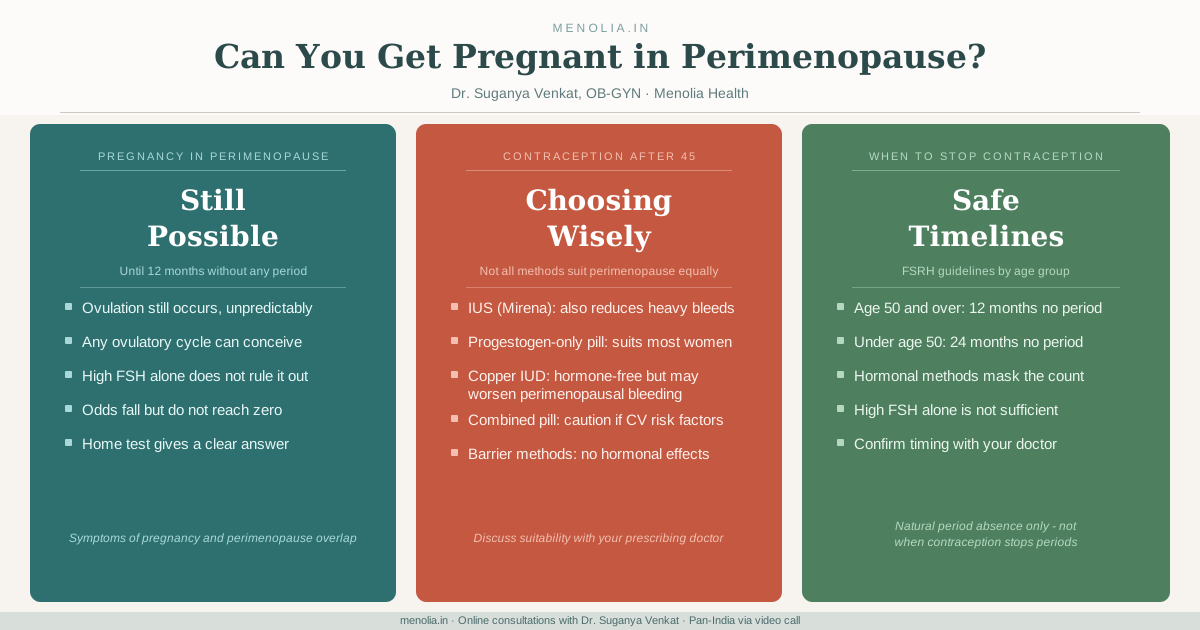
In perimenopause, ovulation does not stop all at once. It becomes irregular. Months can pass with no ovulation at all, and then an unexpected cycle produces a functioning follicle, releases an egg, and a conception window opens with no advance warning.
This differs from the regularity most women experienced in their thirties. In regular cycles, FSH rises in a predictable sequence, a dominant follicle develops, ovulation follows, and the luteal phase closes the cycle on a schedule. In perimenopause, FSH levels fluctuate widely and follicular response varies from one cycle to the next. Some months are anovulatory (no egg released). Others produce a normal ovulation. Neither pattern announces itself in advance.
This is precisely why a single elevated FSH reading cannot be used to conclude that pregnancy is no longer possible. A high FSH on one month’s test can be followed by a normal ovulation the next. The Menopause Blood Tests Explained guide covers in detail why a one-time hormone result does not confirm menopause.
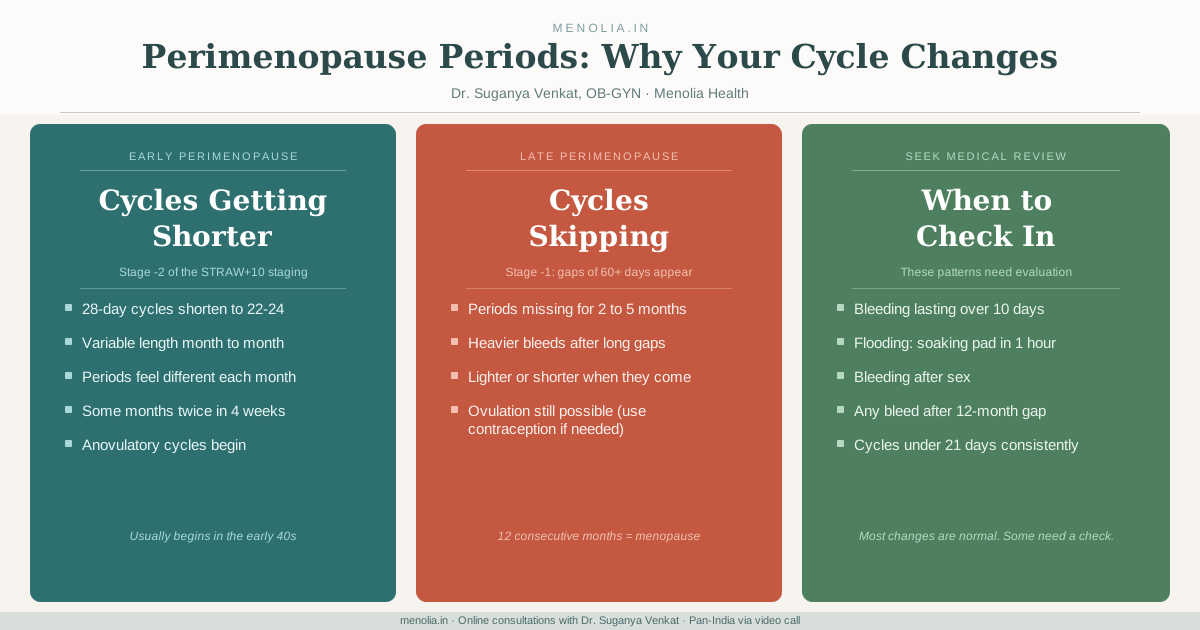
The formal clinical definition of menopause is 12 consecutive months without a period, after the age of 40, with no other cause such as medication or surgery. Until that point is reached, the transition is perimenopause, and intermittent ovulation is part of that transition (Harlow SD et al., Climacteric 2012; STRAW+10 staging criteria). The Perimenopause Periods guide covers how cycle patterns shift across early and late perimenopause, including anovulatory cycles and their hormonal drivers.
The real picture on natural conception after 45
Natural conception does become less likely with age. Egg quality and reserve both decline, ovulation becomes less frequent, and chromosomal abnormality rates in eggs increase. For women in their late forties who are not trying to conceive, this reduction in likelihood does not mean conception is impossible.
The numbers: At 40 to 44, natural monthly conception rates for women without identified fertility factors are estimated at around 5% per cycle, compared with roughly 20 to 25% per cycle at peak fertility in the late twenties (Dunson DB et al., BJOG 2002). By 45 to 49, the per-cycle rate falls further. But it does not reach zero while ovulation is still occurring.
For women who are actively hoping to conceive in perimenopause, early specialist input is valuable. The window is narrow, timing matters considerably, and a fertility workup helps clarify what is genuinely feasible versus what may need IVF or donor-egg support. Fertilia’s fertility program offers online support for women at this stage, including guidance while you are working with a fertility specialist.
For women who are not trying to conceive, these numbers carry a different message: the possibility of pregnancy does not disappear just because periods have become irregular, lighter, or widely spaced.
If you have questions about your cycle, a missed period, or what your options are right now, WhatsApp Dr. Suganya for an online consultation. She sees women across India.
Pregnancy symptoms and perimenopause symptoms overlap considerably
This is one of the most common sources of confusion in this period of life, and the overlap is real enough that distinguishing the two from symptoms alone is not reliable. If you are trying to work out whether perimenopause has started or what your testing options are, the Perimenopause Test guide is a useful companion.
Both pregnancy and perimenopause can cause:
- A missed or delayed period
- Breast tenderness
- Fatigue that feels out of proportion to your sleep
- Nausea or digestive changes
- Mood shifts and sleep disruption
- Bloating and mild cramping
The practical step: if there is any possibility of pregnancy (contraception was not used, or was used inconsistently), take a home urine pregnancy test. These tests detect hCG, a hormone the body produces only in pregnancy. They are inexpensive, available at any pharmacy across India, and highly reliable from the first day of a missed period.
Perimenopause does not affect the accuracy of a pregnancy test. A negative result taken on or after a missed period is dependable. A positive result means a repeat test or a blood hCG is the next step, followed by a consultation with your gynaecologist.
If your cycles have been so irregular that you are unsure when your last period was or whether one was due, a blood test for quantitative beta hCG gives a clearer picture than a urine test alone.
Contraception after 45: which methods suit perimenopause best
The contraceptive needs of perimenopausal women are different from those of younger women, and not all methods are equally well-suited to this life stage. Here is a practical overview.
Progestogen-only pill
Suitable for most women over 40, including those with risk factors that make the combined pill inadvisable (high blood pressure, smoking history, migraine with aura). The progestogen-only pill works primarily by thickening cervical mucus, which prevents sperm from reaching an egg, and in some women also suppresses ovulation. It does not carry the oestrogen-related cardiovascular risks of the combined pill. Daily timing matters: it needs to be taken at the same time each day, within a window of 3 to 12 hours depending on the formulation.
Hormonal IUS (LNG-IUS, commonly known as Mirena)
A particularly useful option in perimenopause for several reasons at once. It provides reliable long-term contraception (effective for 5 to 8 years depending on the device), it significantly reduces heavy menstrual bleeding that often worsens during the transition, and if you later start systemic oestrogen as part of HRT, the IUS can serve as the progestogen component of that regimen. One procedure, carried out by your gynaecologist, addresses several common perimenopausal concerns together. The Heavy Bleeding in Perimenopause guide discusses this option in detail for women dealing with flooding or prolonged periods. If you are considering adding systemic oestrogen alongside the IUS, the HRT in India guide explains how a combined regimen works.
Copper IUD
Highly effective and entirely hormone-free, which suits women who prefer to avoid hormonal methods for any reason. One caution specific to perimenopause: the copper IUD can make periods heavier. For women whose periods are already becoming heavier or longer in perimenopause, that is worth factoring in before choosing this option. Worth a discussion with your gynaecologist in the context of your current cycle pattern.
Combined oral contraceptive pill
The combined pill (oestrogen and progestogen together) is not recommended for women over 40 who smoke, or for those with high blood pressure, migraine with aura, a history of blood clots, or certain cardiovascular risk factors. The risk of venous thromboembolism and arterial events rises with age, and adding oestrogen to existing risk factors shifts the benefit-risk balance unfavourably (Faculty of Sexual and Reproductive Healthcare, Contraception for Women Aged Over 40 Years, 2017). For women over 40 without those risk factors, the combined pill remains an option but the conversation about suitability should happen with the prescribing doctor.
Barrier methods
Condoms, diaphragms, and cervical caps are free of hormonal effects and have no age-related contraindications. Their reliability depends on consistent and correct use. They work well as a primary method or alongside another method during a contraceptive transition.
Cycle tracking and fertility awareness methods
These are significantly less reliable in perimenopause than in regular cycles. When cycle length is variable, months are anovulatory, and BBT or OPK signals are harder to interpret because of background hormonal fluctuation, methods that depend on cycle predictability lose accuracy. This is not a value judgment on these methods in general, but an honest picture of how they perform in the specific context of perimenopause.
When can you safely stop contraception?
This is the question many women in perimenopause most want a clear answer to.
The guidance from the Faculty of Sexual and Reproductive Healthcare (FSRH) is clear:
- Women aged 50 and over: contraception can be stopped after 12 consecutive months without a period.
- Women under 50: contraception should continue for 24 consecutive months without a period.
The reason for the longer period in younger women is that the earlier you are in the transition, the greater the probability of an unexpected ovulation returning after a gap in periods. Waiting 24 months at under 50 gives a high degree of certainty that ovulation has permanently ceased.
This applies to natural periods. Women who are not having periods because of hormonal contraception (such as the combined pill or certain types of injectable contraception) cannot use their period absence as a guide. In those situations, the age-based timeline applies from when contraception is first considered for stopping, with guidance from your prescribing doctor.
If you are using the hormonal IUS as contraception and wondering whether it also confirms menopause: it may mask periods, which makes the 12/24 month count impractical. The FSRH guidance in this case is to use an alternative method to confirm menopause if needed, or to follow age-based guidance with your doctor.
For women on HRT, similar considerations apply. HRT does not reliably re-establish a period pattern in the same way natural cycles work, so the period-count approach is not applicable.
Confused about your specific situation? A one-on-one consultation with a menopause-aware doctor is the most reliable way to get a clear, personalised answer. WhatsApp Dr. Suganya for an online consultation if you want to work this through.
If you are trying to conceive in perimenopause
If you are in your mid-forties and still hoping for a pregnancy, the conversation shifts. Natural conception becomes less likely with each passing year in the mid-to-late forties, but it is not impossible for every woman. The meaningful factors are your AMH and antral follicle count (which give a sense of ovarian reserve), your partner’s semen analysis, your cycle pattern, and the absence of structural factors (fibroids, tubal issues) that would affect implantation.
The honest position: at 44 to 46, some women conceive naturally. Others will need IVF. A small number will benefit from donor eggs if their own reserve is too low to sustain a viable pregnancy. Getting a thorough fertility workup first gives you the information to make that decision with your fertility specialist, rather than waiting months on natural attempts with very low per-cycle odds.
What a 90-day lifestyle period before any assisted reproduction can do is improve egg quality in the cycles remaining, and give your body the best possible conditions if you move into treatment. Your treating fertility specialist is the right person to coordinate your medical care. A program like Fertilia’s fertility support can work alongside that care on the nutrition, lifestyle, and readiness layer.
What this is not: a guarantee, or a substitute for medical fertility assessment. It is one piece of the picture, not the whole thing.
Frequently asked questions
Can I get pregnant in perimenopause if my periods are very irregular?
Yes. Irregular periods in perimenopause mean that ovulation is happening unpredictably, not that it has stopped. Any cycle where ovulation occurs carries the possibility of conception. Until you have gone 12 full consecutive months without any period (at age 50 or over) or 24 months (if you are under 50), contraception is advisable if you do not want to conceive.
How do I know if a missed period is pregnancy or perimenopause?
You cannot reliably tell from symptoms alone, because both cause very similar changes: fatigue, breast tenderness, mood shifts, nausea, and missing a period. The practical step is a urine pregnancy test, which is accurate from the first day of a missed period. If the test is negative and periods remain absent for several months with no other cause, perimenopause is the more likely explanation. If you are unsure, a consultation can help clarify.
When can I stop using contraception in perimenopause?
For more on this, read our guide on Contraception in Perimenopause. The FSRH guidance is: women aged 50 and over can stop after 12 consecutive months without a period. Women under 50 should continue for 24 consecutive months without a period. These timelines apply to natural period absence, not absence caused by hormonal contraception. If you are on a method that stops periods (such as the hormonal IUS or the combined pill), speak with your doctor about the right approach for your situation.
Is the combined pill safe after 45?
It depends on your individual risk factors. The combined pill is not recommended if you smoke, have high blood pressure, have migraine with aura, or have a personal or family history of blood clots. For women over 40 with those risk factors, the risk-benefit balance moves against the combined pill. For women over 40 without those factors, it remains an option but should be discussed with the prescribing doctor. Progestogen-only methods are generally more suitable across the board after 45.
Can the Mirena (LNG-IUS) be used in perimenopause?
Yes, and it is often particularly suitable. It provides reliable contraception, it reduces heavy perimenopausal periods, and it can double as the progestogen component of HRT if you later add systemic oestrogen. It does not establish a regular period pattern, which means the 12/24 month period-count method of confirming menopause does not apply while it is in place. Your gynaecologist can guide you on when to remove it and what to use instead for the menopause-confirmation period.
My FSH is elevated. Does that mean I cannot get pregnant?
Not necessarily. FSH fluctuates considerably in perimenopause. A single elevated FSH reading reflects the fact that the ovaries are working harder to produce a response, but it does not confirm that ovulation has stopped permanently. Women with elevated FSH have conceived naturally and through IVF. FSH alone is not used to decide whether contraception is still needed.
I am 47 and hoping to conceive. What are my options?
Start with a fertility workup: AMH, antral follicle count on Day 2-5 ultrasound, and a semen analysis if you have a partner. These tell you what your ovarian reserve looks like right now. Based on that, your fertility specialist can advise whether natural attempts, ovarian stimulation, IVF with your own eggs, or donor-egg IVF is the most realistic path. A 90-day lifestyle preparation period before any assisted conception cycle can support egg quality and overall readiness. If you would like to talk through what that looks like alongside your specialist’s care, WhatsApp Dr. Suganya for an online consultation.
Dr. Suganya Venkat is an OB-GYN with 15+ years of clinical experience. DNB OB-GYN (GKNM Hospital, Coimbatore). MD Pathology (CMC Vellore). MBBS with 5 Gold Medals (SRMC). She consults online across India via video call and phone.