Heavy periods in your 40s are one of the more quietly exhausting parts of perimenopause. The flooding days increase. The cycle becomes unpredictable. You start declining plans you would otherwise enjoy, not because you are unwell but because you cannot trust the next hour.
When medicines have not worked well enough, or when staying on tranexamic acid and mefenamic acid every cycle starts to feel like an indefinite answer to a problem that needs a real one, your gynaecologist may bring up endometrial ablation. For many women, it is the right next step. For others, it is not yet the right moment, or it is not the right fit at all. Understanding the difference matters before you say yes.
I am Dr. Suganya Venkat, an OB-GYN with fifteen years of clinical experience working with women through perimenopause and menopause, through online consultations at Menolia. This post covers the ablation decision: what the procedure is, who it suits, what must be assessed before any ablation is considered, and what the costs look like at Indian hospitals in 2026.
What endometrial ablation is
The uterus has an inner lining called the endometrium. This lining thickens each cycle and sheds as a period. In perimenopause, oestrogen levels surge unevenly before they fall, which often causes the lining to grow thicker and shed more heavily than it did before.
Endometrial ablation destroys this lining using heat, microwave energy, or electrical current, depending on the device. The lining does not grow back in the same way. Periods become much lighter, or stop entirely.
The uterus itself is not removed. Recovery takes one to two days, not weeks. For women in their 40s who have completed their family but want to avoid major surgery, ablation sits between long-term medication and hysterectomy on the treatment ladder. It is a uterus-preserving option with a short recovery, not a small version of a big operation.
Where ablation fits in the treatment ladder
Most gynaecologists move through a sequence when heavy bleeding does not settle on its own:
- Medication: tranexamic acid, mefenamic acid, combined oral contraceptive pill, norethisterone
- Hormonal IUS (levonorgestrel-releasing, such as Mirena): highly effective, reversible, and the first non-surgical option most gynaecologists try. If you are considering Mirena versus more definitive options, the Fertilia post on Mirena for heavy periods covers that comparison in full.
- Endometrial ablation: when Mirena has not been tolerated, has not worked well enough, or when a woman prefers a one-time procedure over a device she carries for years
- Hysterectomy: when ablation is not suitable, has not worked, or when a woman chooses the definitive option from the outset
Ablation is not the first step and not the last. For the right woman at the right time, it is effective and lasting.
Why the endometrial assessment must come first
No responsible gynaecologist will perform an endometrial ablation without first assessing the uterine lining. This is not a bureaucratic formality. It is a safety requirement.
Before any ablation, two things must be confirmed:
One: the endometrium is normal. Ablation destroys the lining. If endometrial cancer or pre-cancerous change (endometrial hyperplasia with atypia) is present in that lining, ablation will not treat it and will mask its presence afterwards. A pipelle biopsy or hysteroscopy-guided biopsy must be performed first. For women who have any bleeding between periods or post-menopausal bleeding, this step is especially critical before any procedure is booked.
Two: the uterine cavity is a suitable shape. Large fibroids distorting the cavity, uterine polyps, and cavity abnormalities can make certain ablation methods technically impossible or less effective. A transvaginal ultrasound to check the endometrial thickness and cavity, and sometimes a hysteroscopy, will be arranged before the procedure date is set.
This assessment phase typically adds two to four weeks to the process. Think of it as the consultation that makes the procedure safe, not a delay.
Who is a good candidate
Ablation tends to work well for women who:
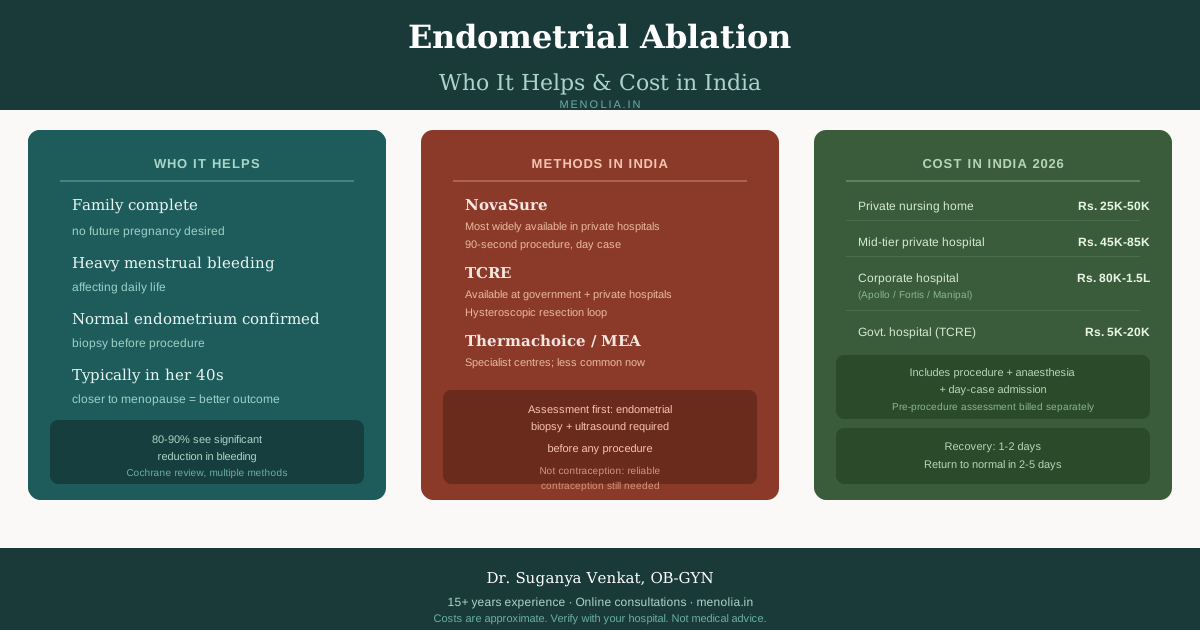
- Have completed their family and have no intention of future pregnancy (this is not negotiable, for reasons covered in its own section below)
- Are experiencing heavy menstrual bleeding that disrupts daily life
- Have had endometrial pathology and significant cavity-distorting fibroids excluded through assessment
- Are in their 40s or early 50s, close enough to menopause that the destroyed lining has limited time to partially regenerate
- Are fit for a day-case procedure under general or spinal anaesthesia
Results are better when a woman is closer to menopause. This is because any endometrial tissue that the ablation does not reach has fewer cycles left in which to regenerate. A 48-year-old is in a better position than a 41-year-old for this reason, all else being equal.
Women who are not suitable candidates at this stage include:
- Those who wish to conceive in the future (the damaged endometrium cannot support a pregnancy reliably)
- Those with endometrial cancer or hyperplasia with atypia (these require a completely different treatment path)
- Those with an active uterine infection
- Those with large submucous fibroids significantly distorting the cavity (hysteroscopic myomectomy is needed first)
- Those with unexplained post-menopausal bleeding that has not yet been fully investigated
Age is not a rigid criterion on its own. A fit 49-year-old with heavy perimenopause bleeding that has not responded to medication and who has finished her family is a reasonable candidate. A 43-year-old who is not certain about future children has a different calculation to make first.
If you are weighing the options for heavy periods and want to think through whether ablation is the right next step for you, a video consultation with Dr. Suganya Venkat at Menolia can help. Message on WhatsApp. Online, pan-India.
Methods available in India
Several ablation technologies exist. What is available to you depends on the hospital and the surgeon’s training.
NovaSure (impedance-controlled global endometrial ablation)
NovaSure is currently the most widely available second-generation ablation device in Indian private hospitals. A fan-shaped bipolar mesh is inserted through the cervix, expanded to fit the uterine cavity, and the ablation takes approximately 90 seconds. No pre-treatment of the endometrium is required, so the procedure can be timed at any point in the cycle.
Most women go home the same day.
TCRE (transcervical resection of endometrium)
TCRE uses a hysteroscope with a surgical resection loop to remove the endometrial lining in sections. It has been performed in India for longer than the newer second-generation devices and is more widely available in government and district hospitals that have hysteroscopy capability. It requires a surgeon experienced in hysteroscopic technique and typically takes 20 to 40 minutes.
Thermachoice (uterine balloon therapy)
An older thermal balloon method. Largely superseded by NovaSure in the private sector but still in use at some centres.
Microwave endometrial ablation (MEA) and hydrothermal ablation
Available at some specialist centres; less commonly encountered in routine practice.
The choice of method is your surgeon’s decision based on the size and shape of your uterine cavity, local equipment availability, and their own experience. You do not need to insist on a specific device. Experience with the chosen method matters more than the method itself.
What to expect: realistic outcomes
The published evidence on endometrial ablation across multiple methods and Cochrane-level reviews consistently shows that around 80 to 90 percent of women experience a significant reduction in bleeding. Complete amenorrhoea (no periods at all) is achieved in roughly 40 to 55 percent of women with NovaSure-type devices in clinical trials. TCRE and balloon methods show lower amenorrhoea rates.
About 10 to 20 percent of women need a repeat procedure or hysterectomy within five years. The reasons include incomplete ablation, partial endometrial regeneration in tissue the device did not reach, or the underlying cause of heavy bleeding (such as adenomyosis deep in the uterine muscle) continuing beyond the lining.
This is worth knowing before you decide. Ablation is not guaranteed to work permanently for every woman. For most, it significantly improves or resolves the problem. For a meaningful minority, it is a bridge rather than a final solution. Discussing your own anatomy, whether adenomyosis is suspected, and your appetite for this possibility is a reasonable part of the pre-procedure conversation with your gynaecologist.
The contraception caveat
This deserves its own section, because it is often not communicated clearly enough.
Endometrial ablation is not a form of contraception.
The procedure destroys the endometrial lining, but it does not prevent ovulation. Pregnancy after an ablation is possible. If this happens, the consequences are serious: ectopic pregnancy is more likely because the damaged uterine lining cannot support implantation, and the fertilised egg may implant in the fallopian tube instead. If a pregnancy does implant in the uterus, abnormal placentation (placenta accreta spectrum) is a significant risk, associated with severe haemorrhage at delivery.
Every woman who undergoes endometrial ablation must use reliable contraception for the rest of her reproductive years.
The most practical options alongside ablation are a progestogen-only implant (Nexplanon), a hormonal injection (DMPA, Depo-Provera), or permanent surgical sterilisation if that is also desired. If you are unsure which contraceptive approach makes sense for your situation, raise this during your pre-operative assessment with the surgeon.
Cost of endometrial ablation in India (2026)
Costs vary significantly depending on hospital tier, city, device used, and whether the procedure is a standalone day case or includes an overnight admission. The ranges below are approximate, based on current private-sector pricing patterns; always ask for a written cost breakdown from your hospital before proceeding.
| Setting | Approximate total cost |
|---|---|
| Private nursing home or small clinic | Rs. 25,000 to 50,000 |
| Mid-tier private hospital | Rs. 45,000 to 85,000 |
| Corporate hospital (Apollo, Fortis, Manipal) | Rs. 80,000 to 1,50,000 |
| Government / public hospital (TCRE where available) | Rs. 5,000 to 20,000 |
These estimates typically cover the procedure, anaesthesia, and a day-case or one-night admission. The pre-procedure assessment (ultrasound, pipelle biopsy, or hysteroscopy) is usually a separate appointment and adds to the overall cost. Ask your hospital to include this in the total estimate.
Corporate hospitals often price NovaSure significantly higher than nursing homes because the cost of the single-use device is the same but the facility fees are layered on top. The clinical outcome of an experienced surgeon in a well-equipped nursing home is not inferior to a corporate hospital. Ask specifically about the surgeon’s ablation caseload when choosing a facility.
Recovery after ablation
Most women are discharged the same day or the following morning. Expect:
- Cramping similar to period pain for one to three days (managed with ibuprofen or mefenamic acid)
- A watery or slightly blood-stained discharge for two to four weeks
- Return to normal activity within two to five days
- No strenuous exercise or intercourse for two weeks
The first few periods after ablation, if they return at all, are usually lighter. The full picture of how well the procedure has worked becomes clearer after two to three cycles. Do not judge the outcome in the first six weeks.
If you experience heavy bleeding, fever, or severe persistent pain in the days after the procedure, contact your gynaecologist promptly. These are not expected parts of recovery.
The bigger picture: what ablation can and cannot do
Endometrial ablation addresses heavy menstrual bleeding caused by the endometrial lining. It does not treat:
- Fibroids in the uterine muscle (intramural or subserosal) that cause bulk symptoms or pressure
- Adenomyosis in the myometrium (the uterine muscle layer) beyond the immediate subendometrial layer
- Endometriosis outside the uterus
- Ovarian cysts or pelvic pain from other causes
If any of these are contributing to your symptoms, ablation alone may not give you the relief you are expecting. This is another reason the pre-procedure assessment matters: it helps your gynaecologist tell you in advance whether ablation is likely to solve most of the problem, or only part of it.
Women who go on to need a hysterectomy after a failed ablation have a slightly more complex procedure because of the scar tissue from the original ablation. This is not a reason to avoid ablation if you are a good candidate, but it is useful context when weighing the decision.
Heavy periods in perimenopause deserve a proper plan, not just another prescription to get through the next few months. If you would like to talk through your options with Dr. Suganya Venkat, including whether ablation is the right next step or whether something else should come first, reach her on WhatsApp. She consults online, pan-India, via video call.
Frequently asked questions
Is endometrial ablation permanent? The procedure destroys the endometrial lining, which does not regenerate fully. For most women this means permanently lighter or absent periods. However, around 10 to 20 percent of women need a repeat procedure or hysterectomy within five years, usually because residual endometrial tissue in areas the device could not reach continues to cause bleeding. Success is more durable the closer a woman is to natural menopause.
How long does the procedure take? The ablation itself takes only a few minutes with second-generation devices like NovaSure (approximately 90 seconds of active treatment). The full operating time, including anaesthesia and set-up, is typically 20 to 40 minutes. Most women are discharged the same day.
Can I get pregnant after endometrial ablation? Technically yes, but it is strongly advised against. Pregnancy after ablation carries a high risk of ectopic pregnancy and severe placentation problems. Reliable contraception is necessary for the rest of your reproductive years after an ablation. The procedure is recommended only for women who have definitively completed their family.
Is ablation an alternative to hysterectomy? For many women, yes. Both achieve a significant reduction in or cessation of heavy bleeding. Ablation is a shorter procedure with faster recovery and preserves the uterus. Hysterectomy is more definitive and carries no risk of needing a repeat procedure, but involves a longer recovery. The right choice depends on the cause of the bleeding, your anatomy, any co-existing conditions such as adenomyosis, and your own preferences.
Will I still go through menopause after an ablation? Yes. Ablation does not change the ovaries or affect the hormonal transition of menopause. You will go through perimenopause and menopause at the same time you would have anyway. You may still experience hot flashes, sleep changes, and other menopausal symptoms. You may not have a period to track anymore, but menopause has still happened once 12 months have passed since the last bleed.
Kya endometrial ablation mein bahut dard hota hai? (Is endometrial ablation very painful?) Procedure ke dauran aap anaesthesia mein hoti hain, isliye koi dard nahi hota. Baad mein ek se teen din tak period jaise cramping hoti hai, jo ibuprofen ya painkiller se control hoti hai. Zyaatar mahilaayen ek ya do din mein apni dincharya mein wapas aa jaati hain. (During the procedure you are under anaesthesia, so there is no pain. Afterwards, cramping similar to a period is common for one to three days, managed with ibuprofen. Most women return to routine within a day or two.)
What is endometrial ablation called in Indian languages?
| Language | Term |
|---|---|
| Hindi | Garbhashay ki aantarik parth ka naash (endometrial ablation) or bhaari masik dharm ke liye utteri ki aantarik safai |
| Tamil Roman | Karbappaiyayin ullpurappai azhithal (endometrial ablation) |
| Common usage | Ablation procedure, uterine lining procedure, bhari periods ka ilaaj |
The procedure is often simply called “ablation” or “NovaSure” in Indian hospital settings regardless of language.
For a broader look at treatment options for perimenopause-related bleeding, including how ablation fits alongside HRT and other approaches, the perimenopause treatment overview at Menolia covers the full picture. If your periods are heavy in perimenopause and you are wondering whether investigation is needed first, the guide to heavy bleeding in perimenopause is a useful starting point.