You go for a routine pelvic scan, perhaps an abdominal or transvaginal ultrasound ordered for something else entirely. The radiologist hands you a report, and somewhere among the measurements is a line about “endometrial thickness” with a number that means nothing to you. It might say 7mm, or 9mm, or 12mm. You are not bleeding. You have not had a period in two or three years. Nobody explained what this number means or what you should do with it.
This is a very common experience. It is also one that generates a great deal of anxious searching, because the information available ranges from “this is completely normal” to “thickening can be serious” without much guidance on what your specific number means in your specific situation.
This post is about translating the number. It explains what the endometrial lining is doing after menopause, where the cut-off figures come from, what the possible causes of thickening are, and when investigation is needed and when it can wait.
What Is the Endometrial Lining After Menopause
The endometrium is the inner lining of the uterus. During reproductive years, it thickens under the influence of oestrogen every month, then sheds as a period. After menopause, oestrogen levels fall, the lining receives no monthly stimulus, and it gradually becomes very thin.
On a transvaginal ultrasound (TVS or TVUS), the lining appears as a thin white stripe. In a woman who has been postmenopausal for a year or more and is not on hormone therapy, this stripe is typically less than 4mm. A lining measuring less than 4mm is, for practical purposes, considered inactive.
When the measurement comes back higher than expected, it raises a question: what is keeping the lining thicker than it should be?
Where the 4mm and 5mm Thresholds Come From
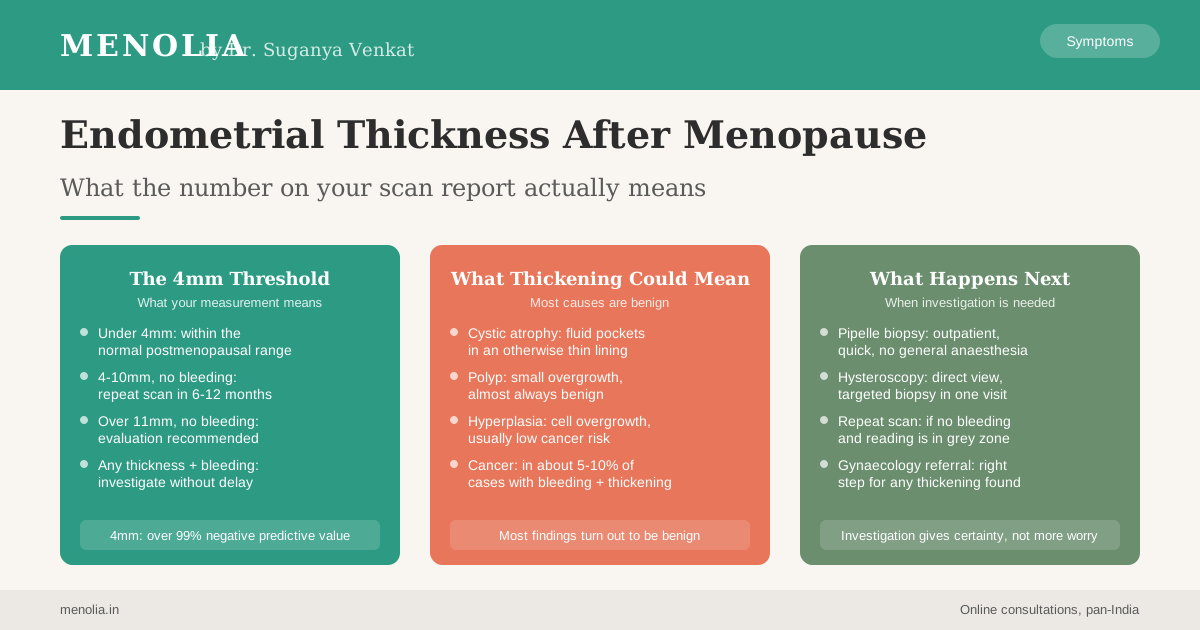
The figure of 4mm did not appear arbitrarily. It comes from a large Nordic multicentre study by Karlsson and colleagues, published in 1995, that looked at transvaginal ultrasound in over a thousand women who had postmenopausal bleeding. The study found that when the endometrial lining measured 4mm or less, endometrial cancer was present in fewer than 1% of those women. A lining of 4mm or less, in a woman with postmenopausal bleeding, had a negative predictive value of over 99% for cancer. This is the figure you will still find quoted in most clinical guidelines today.
A meta-analysis by Smith-Bindman and colleagues, published in JAMA in 1998 (PMID 9809732), examined a threshold of 5mm rather than 4mm. At 5mm, the sensitivity for detecting endometrial cancer in women with postmenopausal bleeding was 96%, meaning that almost no cancer was missed when the threshold was set there.
The clinical meaning of 4mm versus 5mm is essentially the same: a thin lining after menopause is reassuring. A lining above the threshold deserves investigation, especially when there is bleeding.
One detail worth noting: both Karlsson 1995 and Smith-Bindman 1998 were looking at women who had postmenopausal bleeding. If you have no bleeding and your lining was found incidentally on a scan, the threshold for investigation is generally set higher, around 11mm in most current guidance. This is because the risk of cancer in an asymptomatic woman with an incidentally discovered thickened endometrium is considerably lower than in a woman who is actively bleeding.
What Can Cause Thickening After Menopause
There are several reasons the endometrial lining may measure above normal after menopause. Most of them are benign.
Paradoxical cystic atrophy. This sounds alarming but is usually harmless. As the lining atrophies after menopause, it can accumulate fluid in small pockets, making the stripe look thicker on ultrasound than it actually is. The lining itself is inactive. This is one of the most common causes of an apparently thickened endometrium in postmenopausal women who have no bleeding whatsoever.
Endometrial polyp. A polyp is a small, finger-like overgrowth of the lining. It is almost always benign. Polyps can cause spotting or they can sit quietly and be found incidentally on a scan. They are confirmed and removed through hysteroscopy, a minor procedure in which a thin camera is passed through the cervix to look directly at the inside of the uterus.
Simple hyperplasia without atypia. Hyperplasia means an overgrowth of the lining cells. Simple hyperplasia where the cells look normal under the microscope carries a very low risk of progressing to cancer, generally under 1 to 2%. It is usually managed with progestogen treatment and a repeat biopsy rather than surgery.
Complex hyperplasia with atypia. This is where cells show abnormal changes under the microscope. It carries a meaningfully higher risk of progression and is managed more actively, often with surgery. This is uncommon compared to the benign forms.
Endometrial cancer. This is what most women fear when they see the report. It is also one of the most treatable gynaecological cancers when found early. In women with postmenopausal bleeding and a thickened endometrium, cancer is found in roughly 5 to 10% of cases in referral populations, depending on the study. The same figures mean that 90 to 95% of women in that group do not have cancer. Most thickened linings after menopause, even those with bleeding, turn out to be benign.
If you have been found to have a thickened endometrium with no bleeding at all, the cancer risk is considerably lower than those figures suggest.
Your Number and What It Means
This is not a substitute for a conversation with your gynaecologist, but it gives you a starting framework.
Less than 4mm, no bleeding: The lining is within the normal range for a postmenopausal woman. Routine follow-up only.
4mm to 10mm, no bleeding: This is a grey zone. Most guidelines recommend a repeat scan in 6 to 12 months rather than an immediate biopsy, particularly if you are on no hormonal medications. Your doctor may want to consider your other risk factors (see below) before deciding.
More than 11mm, no bleeding: Current guidance generally recommends evaluation in this range even without bleeding. An endometrial sample (a pipelle biopsy) is a straightforward outpatient procedure.
Any thickness, with postmenopausal bleeding: Investigation is recommended regardless of the number. A single episode of spotting, staining, or bleeding after menopause is enough to warrant a proper check. Post-menopausal bleeding needs to be assessed promptly, even when you feel otherwise well.
Risk Factors That Change How Your Number Is Interpreted
The measurement alone does not tell the full story. Your doctor will also consider several factors alongside the number.
Excess body weight. Fat tissue converts androstenedione to oestrogen through a process called aromatisation. Women with central weight gain after menopause have higher circulating oestrogen levels than lean women, which continues to stimulate the endometrium. This raises the risk of hyperplasia and, over time, of cancer. The measurement and the weight need to be read together.
Tamoxifen use. Tamoxifen, used in breast cancer treatment and prevention, has an anti-oestrogenic effect on breast tissue but a weakly oestrogenic effect on the uterine lining. Women on tamoxifen regularly develop polyps and endometrial thickening, and they have a modestly higher risk of endometrial cancer compared to the general postmenopausal population. Annual pelvic scan monitoring is part of standard care for women on long-term tamoxifen.
Diabetes and hypertension. Both are independently associated with higher endometrial cancer risk, partly through insulin and insulin-like growth factor pathways that stimulate cell proliferation in the uterine lining.
Family history. A family history of Lynch syndrome (also called hereditary non-polyposis colorectal cancer, or HNPCC) carries a significantly elevated lifetime risk of endometrial cancer. If this runs in your family, that information should be part of every gynaecological conversation you have.
Not having been pregnant. Pregnancy exposes the uterine lining to sustained progesterone for nine months. Women who have never been pregnant have had less of this protective effect over a lifetime, which modestly raises risk.
If you would like to speak with Dr. Suganya Venkat directly about your scan report, she sees women from across India for menopause and perimenopause concerns. You can reach her on WhatsApp: wa.me/919940270499. Reading a scan report alongside a doctor, with your full history in view, is often the most useful thing a short consultation can do.
When You Are on HRT or Tamoxifen
Hormone replacement therapy directly affects endometrial thickness, and this is by design.
Combined HRT, which includes both oestrogen and progestogen, provides the progestogen component specifically to counterbalance the oestrogen effect on the lining. When progestogen is given in adequate doses and on the correct schedule, the lining stays protected. In a woman on properly dosed combined HRT, a lining of up to around 5mm is expected and does not require further investigation unless there is unexpected bleeding.
Continuous combined HRT, where both hormones are taken every day without a break, typically produces a thin, inactive endometrium over time. If you are on this regimen and your lining is unexpectedly thickened, that is worth discussing with your prescribing doctor. It may reflect the formulation you are on, or it may prompt a review of whether the dose is appropriate.
Oestrogen-only HRT is used in women who have had a hysterectomy. If a woman with an intact uterus were given oestrogen without progestogen, the lining would thicken progressively and unchecked. This is why oestrogen-only therapy is not prescribed to women who still have their uterus.
For a full guide to HRT in India, including which formulations are available and how they are used, see: HRT in India: What an OB-GYN Actually Recommends.
What Investigation Involves
If your doctor recommends investigation, the two main approaches are as follows.
Endometrial sampling (pipelle biopsy). A thin, flexible plastic cannula is passed through the cervix into the uterine cavity, and a small sample of the lining is drawn out. This is done in an outpatient clinic without general anaesthesia, though it causes a few seconds of strong cramping. The sample is sent to a pathologist, who reports whether the cells are normal, atrophic, hyperplastic, or cancerous. This is available at most gynaecology clinics in India.
Hysteroscopy. A thin camera is passed through the cervix to look directly inside the uterus. This is the most accurate way to investigate an irregular or thickened endometrium, because the doctor can see the lining directly and take targeted biopsies from any suspicious area. It is usually done under light sedation as a day-case procedure. A hysteroscopy can also confirm and remove a polyp in the same sitting.
A transvaginal scan shows how thick the lining is and may suggest structural features like a polyp. It cannot reliably distinguish between atrophy, hyperplasia, and cancer. A tissue sample is the only way to know what the cells are actually doing.
What You Can Do Now
If you have a scan report showing a thickened endometrium, these are the practical steps.
Do not leave the report unexamined. The scan identified something that deserves proper interpretation, and that interpretation needs your full clinical history alongside the number.
Take the report to a gynaecologist. General physicians can refer you forward, but reading a TVS report with the full hormonal context, including your HRT status, bleeding history, and risk factors, is a gynaecological assessment.
Be specific about bleeding. If you have had even one episode of any spotting, staining, or discharge that could be blood, mention it clearly. It shifts the threshold for investigation immediately.
If you have no bleeding and a reading between 5 and 10mm, ask whether a repeat scan in six to twelve months is the recommended plan, or whether an endometrial biopsy is being suggested now. Both are reasonable approaches in different situations. Understanding which one is being proposed and why is a fair question to ask.
For related postmenopausal scan findings, see: Ovarian Cyst After Menopause: Why It Always Needs Checking.
For information on discharge after menopause: Discharge After Menopause: What Each Colour Means.
If your report has left you with questions your doctor has not had time to answer, or if you are uncertain about the next step, you are welcome to speak with Dr. Suganya Venkat directly on WhatsApp: wa.me/919940270499. She consults with women across India for perimenopause and menopause concerns, and helping a woman understand her scan report is exactly the kind of conversation that a short online consultation can resolve clearly.
Frequently Asked Questions
What is the normal endometrial thickness after menopause? In a postmenopausal woman not on hormone therapy, a normal endometrial thickness on a transvaginal scan is less than 4mm. A measurement at or below this figure is considered inactive and does not require further investigation unless bleeding is present.
My scan shows 7mm endometrial thickness and I have no bleeding. Do I need a biopsy now? Not necessarily immediately. A reading of 7mm without bleeding falls into a grey zone where guidelines vary. Some recommend a repeat scan in six to twelve months to check whether the measurement is stable or increasing. Others favour earlier sampling, particularly if you have risk factors such as obesity, diabetes, or a relevant family history. This is a decision to make with your gynaecologist rather than from the number alone.
Can endometrial thickening go away on its own? Sometimes, yes. Paradoxical cystic atrophy can fluctuate and the apparent thickening may reduce on a follow-up scan. Simple polyps occasionally resolve, though they generally need to be removed if they are causing symptoms or if the diagnosis is unclear. Hyperplasia can sometimes regress with progestogen treatment. The only way to know what is causing the thickening, and therefore what to do about it, is to investigate properly.
I had postmenopausal bleeding and my scan shows thickening. How urgent is this? Postmenopausal bleeding with a thickened endometrium should be investigated without delay. Most women in this situation turn out not to have cancer, but the investigation needs to happen to establish that. Your next step is a referral for endometrial sampling or hysteroscopy.
Does HRT cause endometrial thickening? Combined HRT, which includes progestogen, is designed to protect the endometrium and generally keeps the lining thin when dosed correctly. Tamoxifen can cause thickening and polyps as a known effect and requires monitoring. If you are on any hormonal medication and your lining is thickening unexpectedly, that is worth a review of the formulation and dose with your prescribing doctor.
My doctor says to repeat the scan in a year. Is that safe? For a woman with no bleeding and an endometrial thickness in the 5 to 10mm range, a surveillance approach of a repeat scan at 6 to 12 months is a reasonable clinical decision, particularly when there are no additional risk factors. This is active monitoring with a clear trigger: if the measurement increases or any bleeding occurs in the interval, the plan changes immediately and investigation should not wait for the scheduled scan.
Scan report me endometrial thickness likha hai, iska kya matlab hai? Endometrial thickness transvaginal scan par uterus ki andar ki parat ki mota’i batata hai. Menopause ke baad yeh 4mm se kam honi chahiye. Agar yeh zyada hai aur bleeding nahin hai, toh doctor usually 6 se 12 mahine mein dobara scan karne ki salaah dete hain. Agar bleeding bhi hai, toh biopsy ya hysteroscopy ke liye turant gynecologist se milein.