Your bangles have always slipped on easily. Lately the ones on your left wrist feel snug by evening, and the left sleeve of your blouse pinches in a way the right one does not. Breast cancer treatment was a few years ago. Since then your periods have stopped, you have put on some weight, and everyone, including you, has put the puffiness down to menopause.
Sometimes that is right. But swelling on one side, the side of your breast surgery, needs a different explanation and a proper look. I’m Dr. Suganya Venkat, an OB-GYN with over 15 years of experience, and when a breast cancer survivor tells me in a video consultation that her arm feels heavy, the first thing I ask is: one arm, or both?
One-sided swelling of the arm, hand, breast or chest wall after breast cancer treatment is often lymphoedema (also spelled lymphedema). It is common, it can begin years after surgery, and the menopause years bring changes, especially weight gain, that make it more likely. It is also manageable, and easier to control when it is picked up early.
What This Post Covers
- What lymphoedema is and why breast cancer treatment causes it
- Why it can start, or get worse, years later around menopause
- How to tell it apart from ordinary menopause puffiness
- Which signs need a doctor the same day
- What helps: compression, movement, weight and skin care
- What the evidence says about blood pressure cuffs, blood tests and flying
- Managing menopause symptoms when you have lymphoedema
If you have menopause or menopausal symptoms after chemotherapy, tamoxifen or an aromatase inhibitor, our guide to menopause after cancer treatment covers the hot flushes, joint pain and bone changes. Periods that stop during cancer treatment do not always mean menopause, so check with your oncology team. This post covers the swelling.
What Lymphoedema Is
Your lymphatic system is a network of thin vessels that collects fluid from the tissues and returns it to the bloodstream, passing through lymph nodes along the way. The lymph from your arm, and from much of your breast and chest wall, drains through the nodes in your armpit.
Breast cancer treatment often involves those nodes. Some are removed to check whether the cancer has spread: a few in a sentinel node biopsy, or many in an axillary node dissection (sometimes called armpit clearance). Radiotherapy to the armpit can also scar the lymph channels. When the drainage route has less capacity, fluid collects in the tissues it serves. That build-up is lymphoedema. If it is left untreated for a long time, the skin and the tissue under it can thicken and feel firmer.
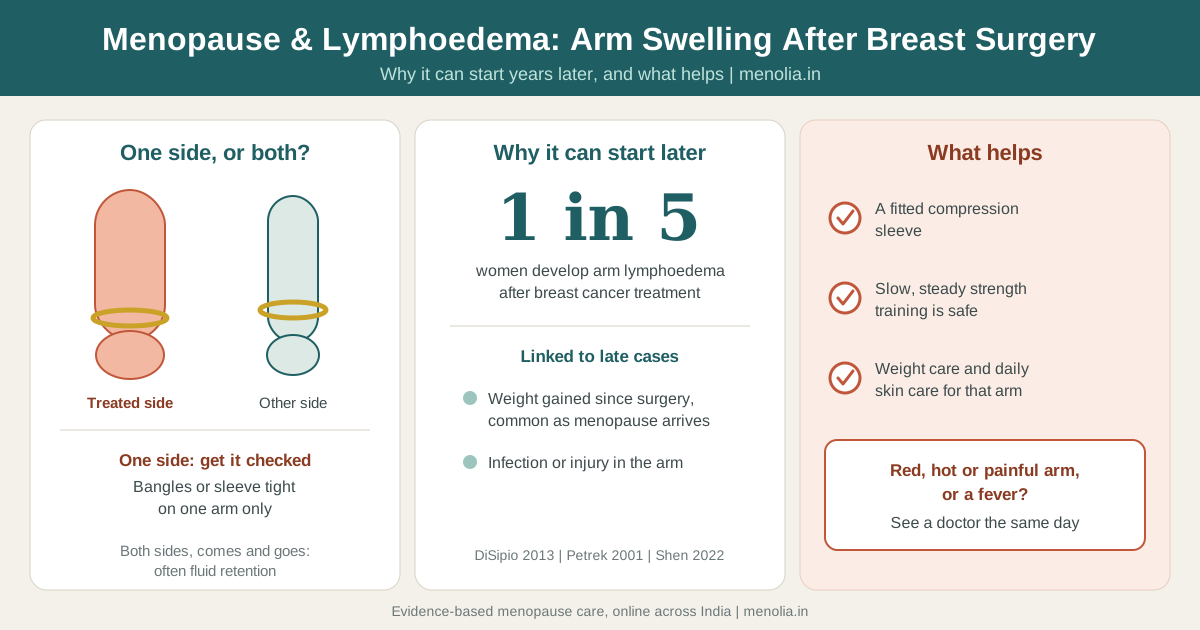
It is common. A 2013 review that pooled 72 studies estimated that 16.6% of women develop arm lymphoedema after breast cancer, and 21.4% in prospective studies, which followed women forward from treatment. Risk was about four times higher after armpit node dissection (19.9%) than after sentinel node biopsy (5.6%). The risk factors with the strongest evidence were more extensive surgery and being overweight or obese (DiSipio T et al., Lancet Oncol, 2013, PMID 23540561).
Indian figures are in the same range or higher. In a study of 300 women treated at a tertiary care regional cancer centre, 33.5% had clinically significant lymphoedema. It was 13.4% in women treated with surgery alone and 42.4% in women who had surgery plus radiotherapy (Deo SV et al., Indian J Cancer, 2004, PMID 15105573).
Lymphoedema most often shows in the arm and hand on the treated side, but the breast itself, the chest wall or the area around the armpit can swell too.
Why Swelling Can Start or Change Years Later
Many women are told to watch for swelling in the first months after surgery, and then stop thinking about it. The risk does not end there.
It can begin late
In a group of 263 women followed for 20 years after mastectomy with full armpit node removal, 77% of those who developed arm swelling first noticed it within three years of surgery. After that, new cases kept appearing at a rate of almost 1% a year. Of 15 possible factors the researchers examined, only two were linked with lymphoedema: an infection or injury in the arm, and weight gained since the operation (Petrek JA et al., Cancer, 2001, PMID 11745212).
These women had their surgery in the late 1970s. Today many women have a sentinel node biopsy instead, and their risk is lower. The part of this study that matters for the menopause years is the long tail of late cases, and the two factors tied to them.
Menopause and weight gain
Weight is where menopause comes in most clearly. In a study of 535 women followed for the first year after a breast cancer diagnosis, 84.1% gained weight. The two strongest independent predictors of that weight gain were chemotherapy and the onset of menopause (Goodwin PJ et al., J Clin Oncol, 1999, PMID 10458225).
A 2022 analysis pooling 84 cohort studies and 58,358 women found that 21.9% developed lymphoedema. Its risk factors included higher body mass index and greater weight gain, alongside treatment factors such as armpit node dissection, chemotherapy and radiotherapy. Age itself was not linked to risk (Shen A et al., Support Care Cancer, 2022, PMID 36513801).
In other words, the risk tracks weight gain rather than age, and weight gain often arrives with menopause, especially a menopause brought on suddenly by treatment. That is useful to know, because weight is something you can work on.
Does oestrogen affect the lymph vessels?
Possibly, but the evidence is early. In a 2018 laboratory study using a mouse model of lymphoedema, oestradiol protected against lymphoedema, and blocking its receptor with tamoxifen made the lymph vessels markedly leakier (Morfoisse F et al., Arterioscler Thromb Vasc Biol, 2018, PMID 29650694). In women, the picture is much less clear. One small follow-up study of 199 breast cancer survivors found a possible link between tamoxifen and lymphoedema that did not reach statistical significance, with the signal strongest in women who were overweight (Das N et al., J Cancer Surviv, 2015, PMID 25913877).
Neither finding is a reason to stop or change your cancer hormone therapy. Tamoxifen and aromatase inhibitors are prescribed to lower the chance of the cancer coming back, and that decision belongs with your oncologist. If you have swelling while taking them, the useful step is to get the swelling assessed and treated, and keep taking the tablet unless your oncologist advises otherwise.
Drier, more fragile skin
After menopause, skin becomes drier and more fragile. Cracked skin on the hands, a cut while chopping vegetables, a burn from a hot kadai or a scratched mosquito bite can let bacteria in. In an arm whose lymph drainage is already reduced, that infection (cellulitis) is one of the factors most closely linked to lymphoedema starting or getting worse. In a study that tracked arm volume over time in women treated for breast cancer, cellulitis was one of the factors significantly linked to arm swelling (Ferguson CM et al., J Clin Oncol, 2016, PMID 26644530). Our post on why skin gets drier after menopause covers everyday skin care that helps.
Lymphoedema or Ordinary Menopause Puffiness?
Hormonal changes in perimenopause and menopause can make you hold on to fluid, so puffy fingers or ankles are common at this age. Lymphoedema behaves differently. The table shows the usual patterns. Use it to describe your swelling to your doctor, not to diagnose yourself.
| Lymphoedema after breast surgery | Menopause-related fluid retention | |
|---|---|---|
| Which side | One side: the side of your surgery or radiotherapy | Usually both sides equally |
| Where | Arm, hand, fingers, breast or chest wall on the treated side | Ankles, feet, fingers, face |
| How it feels | Heaviness, tightness, aching, a “full” arm | Puffiness, tight rings |
| Everyday clues | Bangles, rings, watch strap or blouse sleeve tight on one side only | Tight on both hands, worse after salty food, heat or long hours on your feet |
| Over time | Early on it may settle overnight; later it stays, and the skin can feel firmer | Comes and goes, usually settles with rest |
If your puffiness is on both sides and comes and goes, our guide to menopause water retention explains the hormonal reasons and what eases it. Swelling on both sides can also come from some medicines, vein problems or other health conditions, so get it checked if it is new or does not settle. If it is on one side, and that side is the one that was treated, see your doctor.
New Swelling: See a Doctor Before You Treat It
New swelling on the treated side needs a doctor to examine it before you start any home remedy, tight bandaging or massage. Often it is lymphoedema, and confirming that early means treatment can start while the swelling is easiest to control. The examination also checks for other causes that need different treatment.
Get seen the same day if the arm or breast is:
- Red, hot, painful or tender, especially if the redness is spreading
- Swollen along with fever, chills or feeling unwell
These are signs of cellulitis, which needs antibiotics promptly. It is a known complication in women with lymphoedema: in a review of 2,920 women with breast cancer-related lymphoedema at one centre, 7.9% had at least one episode, and 39% of those had another (Wagner BD et al., Ann Surg Oncol, 2026, PMID 41110022). Prompt treatment matters, because cellulitis can make lymphoedema worse.
Also get seen the same day if:
- The swelling came on suddenly, over a day or two, with pain. This can be a clot in an arm vein, which is more likely if you have, or had, a chemotherapy port or line on that side. If the swelling comes with breathlessness, chest pain or fainting, go to the nearest emergency department straight away.
See a doctor soon if:
- The swelling has appeared for the first time several years after treatment. Your doctor will examine the armpit, neck and chest wall, and may arrange an ultrasound or other scan to make sure nothing new is pressing on the lymph channels. Once other causes are ruled out, treatment for the lymphoedema itself can begin.
At the assessment, your doctor or a lymphoedema therapist will usually measure both arms with a tape at set points, so the swelling can be tracked over time.
If one arm has started to feel heavy or tight and you are not sure what it is, message Dr. Suganya on WhatsApp. She consults online, pan-India, over video call, and can help you work out what needs checking and who to see next.
What Helps
Lymphoedema is usually long-term, but steady care can bring the swelling down and help keep it under control.
Compression does most of the work
A well-fitted compression sleeve (and sometimes a glove) supports the tissues and helps stop fluid from collecting. For more established swelling, a trained therapist may first use a course of multilayer bandaging to bring the swelling down, then fit a sleeve to keep it down. This combined approach is called complete decongestive therapy. It brings together compression, a gentle massage technique called manual lymphatic drainage, skin care and exercises.
A Cochrane review of six small trials found that compression bandaging alone reduced excess arm swelling by 30% to 38.6%, and that adding manual lymphatic drainage gave a further 7.11% reduction in two of those trials. Women with mild to moderate swelling seemed to gain more from the massage. Once the swelling was brought down, women who kept wearing a custom-made sleeve were likely to keep it down at one year (Ezzo J et al., Cochrane Database Syst Rev, 2015, PMID 25994425). In a separate trial of 103 women, daily drainage massage plus bandaging, followed by a sleeve, reduced excess arm volume by 29.0%, compared with 22.6% for compression garments alone, a difference that was not statistically significant (Dayes IS et al., J Clin Oncol, 2013, PMID 24043733).
So compression is the base, and massage is an add-on that may help, mainly when swelling is mild. Ask for your sleeve to be measured and fitted by a trained therapist, and have it rechecked if it digs in, rolls down or leaves deep marks.
Keep using the arm, and build strength
For years, women were told to protect the arm by avoiding anything heavy. The trials point the other way. In a trial of 141 breast cancer survivors with stable arm lymphoedema, twice-weekly, slowly progressive weight lifting over a year did not increase swelling: 11% of the weight-lifting group and 12% of the control group had a swelling increase of 5% or more. Flare-ups were less common with weight lifting (14% compared with 29%), and strength improved. The women wore a well-fitted compression garment while lifting (Schmitz KH et al., N Engl J Med, 2009, PMID 19675330).
The same research group studied 154 women who were at risk of lymphoedema but did not have it. After a year of slowly progressive weight lifting, 11% of the weight-lifting group developed lymphoedema, compared with 17% of the group that did not exercise, so the training did not raise the risk (Schmitz KH et al., JAMA, 2010, PMID 21148134).
This matters at menopause, when strength training also protects bone and muscle. Start with light weights under guidance, increase slowly, wear your sleeve if you have one, and get checked if the arm becomes heavier or more swollen afterwards. Our guide to strength training after 45 explains how to begin at home.
Weight, if you have gained some
In a small trial, 21 women with breast cancer-related lymphoedema were randomly assigned either dietary advice for weight loss or a general healthy-eating booklet. After 12 weeks, the weight-loss group had a significant reduction in swollen arm volume and in body weight (Shaw C et al., Cancer, 2007, PMID 17823909).
This does not need a crash diet. Smaller portions of rice or rotis, more dal, vegetables and dahi, fewer fried snacks and sweets, and a daily walk are a realistic start. Our post on menopause weight gain has a fuller plan.
Look after the skin on that arm
Because infection is so closely linked to lymphoedema, skin care is part of the treatment:
- Moisturise the arm and hand every day, especially in dry or air-conditioned weather
- Wear gloves for gardening, scrubbing vessels with harsh soap or handling hot pans
- Use mosquito repellent and try not to scratch bites
- Wash any cut or scratch on that arm straight away with soap and water, then apply an antiseptic
- Use an electric trimmer rather than a razor for the underarm on that side
- See a doctor quickly if the skin turns red, hot or painful
Other treatments
For some women whose swelling does not settle with these measures, specialist centres offer microsurgery that connects lymph vessels to nearby small veins, or transfers healthy lymph nodes into the affected area. Whether you are a candidate is a question for a lymphoedema specialist or plastic surgeon.
Blood Pressure Cuffs, Blood Tests and Flying
Many women are told never to have blood taken or blood pressure measured on the treated arm, and some worry about flying. In a study that measured arm volume before surgery and across 3,041 later measurements, blood draws, injections and air travel, including flights of 12 hours or more, were not associated with increases in arm volume, and the authors concluded that blood pressure readings may not be associated either. The factors that were linked to arm swelling were a body mass index of 25 or more, armpit node dissection, radiotherapy to the lymph nodes, and cellulitis (Ferguson CM et al., J Clin Oncol, 2016, PMID 26644530).
It is still sensible to use the other arm when that is easy. But if a blood test or reading has to be done on the treated side, the evidence suggests it is unlikely to cause lymphoedema, and on current evidence a flight is not a reason to cancel travel.
Managing Menopause When You Have Lymphoedema
After hormone-receptor-positive breast cancer, systemic HRT is generally avoided. Our post on HRT and breast cancer risk explains why in its section on who needs extra caution. That leaves many women managing hot flushes, poor sleep and aching joints without oestrogen, and there are non-hormonal options to discuss with your doctor and oncology team.
A few points specific to lymphoedema:
- Tell every doctor and nurse which arm is affected, so they can plan where to check blood pressure or place a drip.
- Weight and strength work serve both goals. Managing weight eases menopause weight gain, and losing gained weight reduced arm swelling in a small trial. Strength training protects bone, and in trials it did not raise lymphoedema risk.
- Keep your oncology follow-up. Lymphoedema care runs alongside your cancer follow-up and does not replace it.
Questions to Take to Your Doctor
- Is this swelling lymphoedema, or could it be something else that needs a test?
- How many lymph nodes were removed, and did I have radiotherapy to the armpit? Your discharge summary should say.
- Can I be referred to a lymphoedema therapist for measurement and a fitted sleeve?
- Is it safe for me to start strength training, and how should I build up?
- What should I do if the arm turns red or hot, and who should I contact out of hours?
- Which non-hormonal options suit my menopause symptoms alongside my cancer treatment?
Practical Takeaways
- Swelling on one side, the side of your breast surgery, needs a doctor’s assessment before you put it down to menopause.
- Lymphoedema can start years after treatment. Weight gain and arm infections are the factors most clearly linked to late cases.
- Red, hot, painful swelling or a fever needs a doctor the same day.
- A fitted compression sleeve is the base of treatment. Massage can add to it.
- Slowly progressive strength training is safe and helpful. You do not need to rest the arm.
- Losing weight you have gained can reduce arm swelling.
- Look after the skin on that arm every day.
- Do not stop tamoxifen or an aromatase inhibitor because of swelling. Get the swelling treated and talk to your oncologist.
Frequently Asked Questions
Can lymphoedema start years after breast cancer surgery?
Yes. In a 20-year follow-up of women who had mastectomy with full armpit node removal, about three in four cases began within three years, but new cases kept appearing at almost 1% a year after that. Weight gain since surgery and infection or injury in the arm were the two factors linked to it. Any new one-sided swelling, however long after treatment, is worth getting checked.
Does menopause cause lymphoedema?
Menopause on its own does not cause lymphoedema. Reduced lymph drainage after node surgery or radiotherapy does. But the menopause years can tip the balance. Weight gain is common when menopause arrives, especially after chemotherapy, and higher weight and weight gain are among the best-established risk factors. Drier skin also makes infection, another risk factor, more likely.
How do I know if my arm swelling is lymphoedema or water retention?
Lymphoedema is usually on one side, the side of your surgery or radiotherapy, and may involve the hand, breast or chest wall. Bangles, rings or a blouse sleeve feel tight on that side only. Menopausal water retention usually affects both sides, comes and goes, and settles with rest. But swelling on both sides is not always menopause: it can also come from some medicines, vein problems or other health conditions. Any new or persistent swelling, on one side or both, is worth a doctor’s check, and a doctor can tell which it is by examining you and measuring both arms.
Do tamoxifen or letrozole cause lymphoedema?
The evidence is unclear. A mouse study found that blocking oestrogen receptors with tamoxifen made lymph vessels leakier, and one small study in women found a possible link with tamoxifen that did not reach statistical significance. Do not stop these medicines because of swelling. Tell your oncologist about it and get the swelling assessed and treated.
Can I lift weights or do housework with lymphoedema?
Yes, with a gradual start. In trials of slowly progressive weight lifting, it did not increase swelling in women who already had lymphoedema, and it reduced flare-ups. Wear your compression sleeve if you have one, increase the load slowly, and get checked if the arm feels heavier afterwards.
Can I have blood taken or my blood pressure checked on that arm?
Use the other arm when that is easy. But in a large study that tracked arm volume over time, blood draws, injections and air travel were not linked to increases in arm volume, and the authors concluded that blood pressure readings may not be either. If a test has to be done on the treated side, it is unlikely to cause lymphoedema.
Should I wear a compression sleeve to prevent lymphoedema?
It may help in the first year if you are at higher risk. In a trial of 307 women who had armpit node dissection, those given compression sleeves to wear until three months after finishing their cancer treatment had less arm swelling at one year: 14% compared with 25% when measured by arm volume (Paramanandam VS et al., J Clin Oncol, 2022, PMID 35108031). Whether a sleeve suits you depends on your surgery and your risk, so ask your surgeon or a lymphoedema therapist.
If you have had breast cancer treatment and are dealing with menopause symptoms, arm swelling or both, message Dr. Suganya Venkat on WhatsApp. She consults online, pan-India, via video call, and works alongside your oncology team.