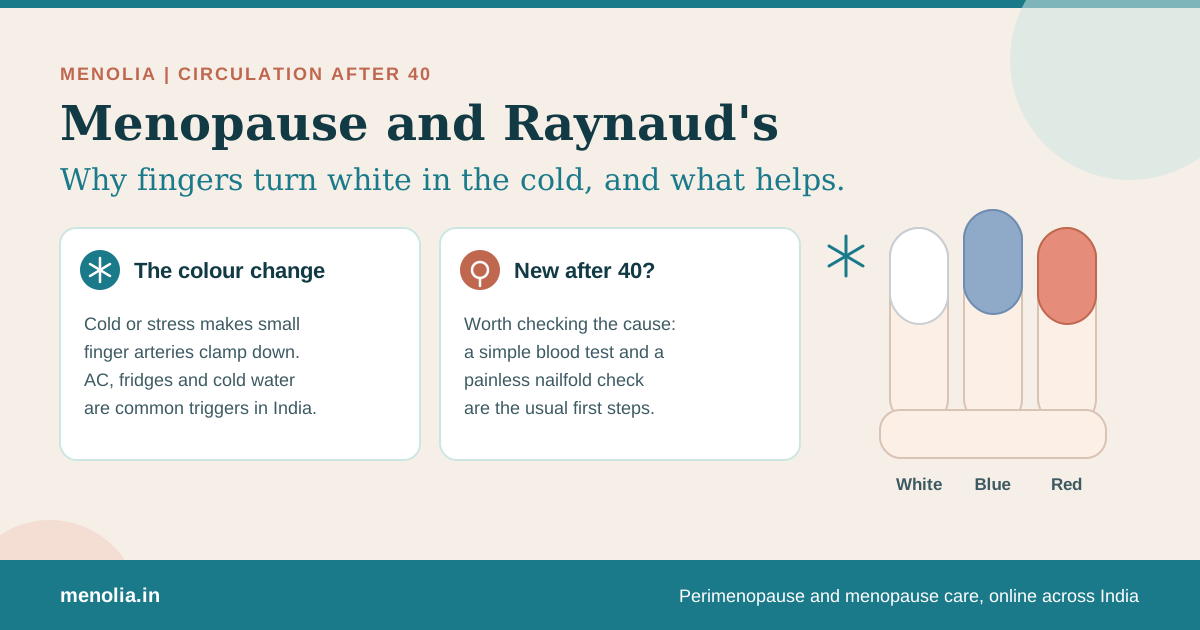
You open the freezer to take out a packet of peas, and a minute later two of your fingers have gone a flat, waxy white, as if someone drew a line across them. They feel numb and clumsy. Then they turn a dusky blue, and as they warm up they flush red, throb and tingle. Ten or fifteen minutes later everything looks normal again.
It might happen when you wash vessels in cold water, sit under the office AC, hold a chilled glass at a wedding, or step out on a January morning in Delhi. Some women have had it since college and simply learnt to live with it. Others notice it for the first time in their forties, at the same time as hot flushes, broken sleep and irregular periods, and quite reasonably wonder whether it is all part of the same change.
That episode has a name: Raynaud’s phenomenon. I’m Dr. Suganya Venkat, an OB-GYN who has spent more than fifteen years looking after women’s health and who now sees women from all over India online through Menolia. In this post I want to explain what Raynaud’s is, what research says about how it connects to oestrogen and menopause, where HRT fits, and which signs mean it is worth a few simple tests.
What This Post Covers
- What Raynaud’s phenomenon is, and the classic colour change
- The oestrogen connection, which runs the opposite way from what most people expect
- HRT and Raynaud’s: what one study found
- Primary and secondary Raynaud’s, and why age of onset matters
- How Raynaud’s differs from cold flashes, ordinary cold hands and varicose veins
- What helps day to day, and what treatment looks like
- When to see a doctor
What Raynaud’s Phenomenon Is
Raynaud’s phenomenon is an exaggerated tightening (vasospasm) of the small arteries in the fingers, and sometimes the toes, in response to cold or emotional stress. The arteries clamp down hard, blood flow to the fingertips drops sharply, and the skin changes colour: pale white (pallor), with blue (cyanosis) and/or red (rubor) (Pope JE, Drugs, 2007, PMID 17352512). The red phase usually comes as blood flows back in. Not everyone goes through all three colours. Many women notice only the white phase, or only white and red.
Everyone’s fingers go cold and a little pale in the cold. That is normal physiology. What separates Raynaud’s is how sharp, demarcated and repeated the change is. In 2014 a panel of twelve experts agreed a three-step approach that doctors use to decide whether a person’s cold-induced colour changes amount to Raynaud’s phenomenon (Maverakis E et al., J Autoimmun, 2014, PMID 24491823). In practice, the diagnosis is made mostly from your description, and a photo of your fingers during an attack is one of the most useful things you can bring to an appointment.
It is common. A systematic review pooling 33 studies and 33,733 participants estimated that primary Raynaud’s affects about 4.85% of the general population. Women were more likely to have it than men, a family history was the strongest risk factor, and smoking and migraine were also linked to it (Garner R et al., BMJ Open, 2015, PMID 25776043). If you get migraines, our post on menopause headaches and migraines covers how they shift through the transition.
I could not find any study measuring how common Raynaud’s is in Indian women. The figures here come mostly from Europe and North America, so read them as a rough guide.
The Oestrogen Connection Runs the Other Way
Here is a part that surprises many women. It would be natural to assume that falling oestrogen at menopause narrows the blood vessels and brings Raynaud’s on. Laboratory research points the other way.
In a 2007 study, oestrogen (17β-estradiol) increased the number of a particular cold-sensitive receptor, the alpha-2C adrenoceptor, in smooth muscle cells taken from human skin arteries. In mouse arteries it also amplified constriction in response to cold. The authors suggested that oestrogen may make cold-triggered narrowing of skin arteries stronger (Eid AH et al., Am J Physiol Heart Circ Physiol, 2007, PMID 17644575). A review of the mechanisms behind Raynaud’s links this to the higher prevalence of Raynaud’s in premenopausal women compared with men of the same age (Fardoun MM et al., Front Pharmacol, 2016, PMID 27899893).
Two cautions. This is cell and animal work, and Raynaud’s involves nerves, blood vessel lining and stress hormones as well, so oestrogen is one input among several. And I could not find a study that followed women with primary Raynaud’s through menopause to see whether their attacks became more or less frequent. Whether your own Raynaud’s settles, stays the same or changes after your periods stop has simply not been measured well.
What the oestrogen link does tell you is useful in a different way. Menopause on its own is not a convincing explanation for Raynaud’s that starts for the first time at 45 or 50. That is the main reason this post spends time on the question of new-onset Raynaud’s further down.
HRT and Raynaud’s: What One Study Found
The clearest human data on hormones and Raynaud’s comes from the Framingham Offspring Study in the US. Researchers looked at 497 postmenopausal women and found Raynaud’s phenomenon in (Fraenkel L et al., Ann Intern Med, 1998, PMID 9696729):
| Group | Women with Raynaud’s |
|---|---|
| Not taking hormone therapy | 8.4% |
| Oestrogen alone | 19.1% |
| Oestrogen plus progesterone | 9.8% |
After adjusting for age, body weight, smoking, alcohol and beta-blocker use, oestrogen alone was linked to about 2.5 times the odds of Raynaud’s. Oestrogen combined with progesterone showed no such link. The authors noted that earlier experiments had found progesterone could prevent oestrogen’s added effect on blood vessel constriction.
How to read this sensibly:
- It is one cross-sectional study. It shows an association at a single point in time, not that oestrogen caused Raynaud’s in these women.
- Most women with a uterus take combined HRT anyway. Oestrogen needs a progestogen partner to protect the womb lining, as our post on why HRT needs progesterone explains. Oestrogen-only HRT is mainly used after a hysterectomy.
- It is not a reason to avoid HRT. I found no trial testing HRT in women who already have Raynaud’s. If you have Raynaud’s and are considering HRT, mention it, so that your doctor can include it in the decision and you both know to watch your fingers after starting. Our guide to HRT in India walks through the wider benefits and risks.
- Do not stop or change HRT on your own because of this study. If you notice attacks starting or worsening after beginning HRT, note the dates and discuss it with the doctor who prescribed it.
Primary and Secondary Raynaud’s: Why Age of Onset Matters
Raynaud’s comes in two forms.
Primary Raynaud’s happens on its own, without any underlying disease. It usually starts earlier in life, and it is often mild enough not to need any medicine (Pope JE, Drugs, 2007, PMID 17352512).
Secondary Raynaud’s happens alongside another condition. The most important are the autoimmune connective tissue diseases, such as systemic sclerosis (scleroderma), lupus and mixed connective tissue disease (Rirash F et al., Cochrane Database Syst Rev, 2017, PMID 29237099). It has also been linked to other non-rheumatological conditions, environmental exposures and certain medicines (Curtiss P et al., J Am Acad Dermatol, 2024, PMID 35809798).
A practical review notes that secondary Raynaud’s should be suspected when onset is at an older age or there are other features of connective tissue disease, and that a history, examination and laboratory tests are then appropriate (Pope JE, Drugs, 2007, PMID 17352512). In a study that followed 236 people diagnosed with primary Raynaud’s for an average of about 11 years, around 1% a year were later found to have an associated disease, and an older age when Raynaud’s began raised that chance (Hirschl M et al., Arthritis Rheum, 2006, PMID 16732585).
I want to put that number in proportion, because it is reassuring: the large majority of people with primary Raynaud’s stayed that way for over a decade. The reason for checking is that a connective tissue disease found early is much easier to monitor and treat.
Midlife brings one more overlap. Autoimmune thyroid disease is common in women around menopause, and a case-control study found autoimmune hypothyroidism more often in people whose Raynaud’s was linked to systemic sclerosis than in people with primary Raynaud’s (Favoino E et al., Clin Exp Rheumatol, 2025, PMID 40183325). Thyroid problems can also make you feel cold all over. If your thyroid has not been checked recently, our post on hypothyroidism, Hashimoto’s and menopause explains which tests help. If you already live with an autoimmune condition, our post on menopause and RA, lupus and Sjogren’s covers how the transition can change it.
What the tests look like
Two simple investigations do most of the sorting:
- Blood tests for autoantibodies, starting with an antinuclear antibody (ANA) test, and if needed more specific antibodies.
- Nailfold capillaroscopy, a painless magnified look at the tiny capillaries at the base of your fingernails. It takes a few minutes and needs no needle.
These two are the key investigations for judging the chance of progression to systemic sclerosis (Ramahi A et al., Curr Opin Rheumatol, 2022, PMID 35699336). In a 20-year study of 586 people referred for Raynaud’s, abnormal capillaries together with a scleroderma-specific antibody at the start meant a high chance of later developing systemic sclerosis. When neither was present, the authors concluded that this outcome was effectively ruled out (Koenig M et al., Arthritis Rheum, 2008, PMID 19035499). So for many women, normal tests are a real answer, and a reason to stop worrying.
Started getting white or blue fingers in the cold after 40, and not sure whether it is menopause, thyroid or something else? Take a photo during the next attack and note when it happens. We can go through it together over a video call, plan the right first tests, and involve a rheumatologist only if the results call for it. Message Dr. Suganya on WhatsApp for a Rs 399 video consultation.
Raynaud’s, Cold Flashes, Cold Hands and Varicose Veins
Midlife women deal with several temperature and circulation symptoms at once, and they are easy to mix up.
| What it feels like | Where | What drives it | |
|---|---|---|---|
| Raynaud’s attack | Fingers go sharply white or blue in a clear patch, then red and tingly | Fingers, sometimes toes, nose or ears | Spasm of small arteries, set off by cold or stress |
| Cold flash | A sudden chill or shiver through the body, often after a hot flush | Whole body | The brain’s temperature control becoming more sensitive in the transition |
| Ordinary cold hands | Hands cool and a little pale, evenly, no sharp colour line | Both hands | Normal response to cold |
| Varicose veins | Heavy, aching, sometimes swollen legs | Legs | Veins struggling to return blood to the heart |
Cold flashes are a recognised menopause symptom, and our post on menopause cold flashes explains them in detail. They chill the whole body. Raynaud’s is local, with a visible colour change confined to the fingers. You can have both.
Varicose veins are a vein problem in the legs, while Raynaud’s involves small arteries in the fingers. “Poor circulation” gets used for both, but they need different care, and our post on menopause and varicose veins covers the leg side.
What Helps Day to Day
Most primary Raynaud’s is managed without medicine. Avoiding cold and stopping smoking are the starting points (Pope JE, Drugs, 2007, PMID 17352512). In an Indian home and workplace, that looks like this:
- Keep your whole body warm, not just your hands. A cold body makes the finger arteries clamp down more readily. A light shawl or cardigan in an air-conditioned office, bus or cinema helps more than you would expect.
- Plan around the AC. Ask for a seat away from the vent, or set the home AC a few degrees warmer. In much of India, the cold your fingers meet is indoors: the AC, the fridge and the tap.
- Handle cold things with a buffer. Use a cloth or tongs for freezer items, hold chilled drinks by a sleeve or in a cup holder, and wear rubber gloves with a cotton lining, or use lukewarm water, when washing vessels or cleaning vegetables.
- Dress for north Indian winters and early mornings. Gloves, warm socks and a cap for morning walks and two-wheeler rides. Warm your hands before you step out.
- Warm fingers gently during an attack. Tuck them under your armpits, swing your arms in circles, or hold them in lukewarm water. Avoid very hot water: numb fingers cannot judge heat and can scald.
- Stop smoking, including bidis. Smoking is linked to Raynaud’s and narrows blood vessels further. Our post on smoking and early menopause covers what quitting still does at this age.
- Work on stress triggers. Emotional stress alone can set off an attack. Slow breathing, a short walk, or our post on why stress hits harder after 45 may help.
- Bring your medicine list to the doctor. Some medicines can trigger or worsen Raynaud’s. Stimulants used for ADHD are one documented example, and in about half the published reports symptoms resolved after stopping the drug (Umair HM et al., Semin Arthritis Rheum, 2021, PMID 34655948). Do not stop a prescribed medicine yourself; ask the prescribing doctor whether an alternative makes sense.
When medicine is needed
If attacks are frequent, painful or interfering with work, calcium channel blockers are the usual first-line treatment and can be started by a general physician (Ramahi A et al., Curr Opin Rheumatol, 2022, PMID 35699336). A Cochrane review of 38 randomised trials found that, compared with placebo, they reduced the number of attacks per week, with smaller effects on how severe each attack was. Benefits appeared somewhat greater in primary than in secondary Raynaud’s (Rirash F et al., Cochrane Database Syst Rev, 2017, PMID 29237099).
Possible side effects include headaches, low blood pressure, ankle swelling and vasodilatation, the widening of blood vessels that some people feel as warmth or flushing (Pope JE, Drugs, 2007, PMID 17352512). In perimenopause, that warmth can be confused with a hot flush, so tell your doctor if flushing starts or changes after a new tablet. The dose and choice of medicine are for your doctor to decide, and if your blood pressure is already low, they will take that into account.
For secondary Raynaud’s, treatment also targets the underlying condition, usually with a rheumatologist leading.
When to See a Doctor
Book an appointment if:
- Raynaud’s has started for the first time after about 40
- Attacks affect only one hand, or only one or two fingers each time
- You notice sores or cracks on your fingertips that are slow to heal
- The skin of your fingers looks puffy, tight or shiny
- You also have joint pain, new rashes, very dry eyes or mouth, difficulty swallowing, or breathlessness on exertion
- Attacks are painful or frequent enough to affect your work or sleep
Please get seen the same day if a finger stays white or blue and painful and does not recover with rewarming, or if a fingertip turns dark. That is uncommon, but it needs prompt care.
A gynaecologist or general physician can usually start the work-up. If the tests point to a connective tissue disease, a rheumatologist takes over that part, and the two can work alongside each other.
Frequently Asked Questions
Can menopause cause Raynaud’s phenomenon?
There is no good evidence that menopause causes Raynaud’s. Laboratory research suggests oestrogen can make cold-triggered narrowing of skin arteries stronger, which fits with Raynaud’s being more common in premenopausal women than in men of the same age. Raynaud’s that starts for the first time after 40 deserves a check for other causes rather than being put down to menopause alone.
Does HRT make Raynaud’s worse?
One study of 497 postmenopausal women found Raynaud’s in 19.1% of those taking oestrogen alone, compared with 8.4% of non-users and 9.8% of those taking oestrogen with progesterone. It showed an association, not cause. Mention Raynaud’s when discussing HRT with your doctor, and do not stop HRT on your own.
Is Raynaud’s a sign of something serious?
Usually not. Most people have primary Raynaud’s, which occurs without any underlying disease. In one long follow-up, about 1% of people a year with primary Raynaud’s were later found to have an associated disease. Older age at onset, one-sided attacks, finger sores or other symptoms are reasons to test, and normal tests are reassuring.
What tests are done for Raynaud’s?
Usually an antinuclear antibody (ANA) blood test and, if needed, more specific antibodies, plus nailfold capillaroscopy, a painless magnified look at the capillaries near your fingernails. A thyroid test is also sensible at this age if you feel cold generally. Your doctor will decide which are needed.
How is Raynaud’s different from menopause cold flashes?
A cold flash is a sudden chill through the whole body, often after a hot flush. Raynaud’s is local: the fingers go white or blue in a sharp patch, then red as they warm. You can have both at the same time.
Does Raynaud’s go away after menopause?
This has not been studied well. I could not find research following women with primary Raynaud’s through menopause, so nobody can say whether attacks usually ease, stay the same or change. Keeping a simple note of attacks over a few months will show you your own pattern.
How can I manage Raynaud’s in an air-conditioned office?
Keep a shawl or cardigan at your desk so your whole body stays warm, sit away from the AC vent, hold cold drinks with a sleeve, and warm your hands gently under your arms if an attack starts. If attacks are frequent despite this, talk to a doctor about medicine.
Raynaud’s can be uncomfortable and unsettling, especially when it appears alongside everything else midlife brings. For most women it is a manageable nuisance, and a short set of tests can tell you which kind you have. If you would like to talk through your symptoms, the hormone side and whether HRT fits, I see women across India by video call.