The tube is small, the box has an applicator you have never seen before, and the leaflet is folded into a square the size of a matchbox. Most women who message me after being prescribed Evalon cream have the same three questions: what exactly is this, how do I put it in, and how long do I have to keep doing it?
This guide answers those questions for Evalon specifically. If you want the wider picture of every vaginal oestrogen cream sold in India (Premarin, estriol and the rest) and how they compare, read our guide to vaginal oestrogen cream in India first. Here we stay with one tube and what to do with it.
What Evalon Cream Is
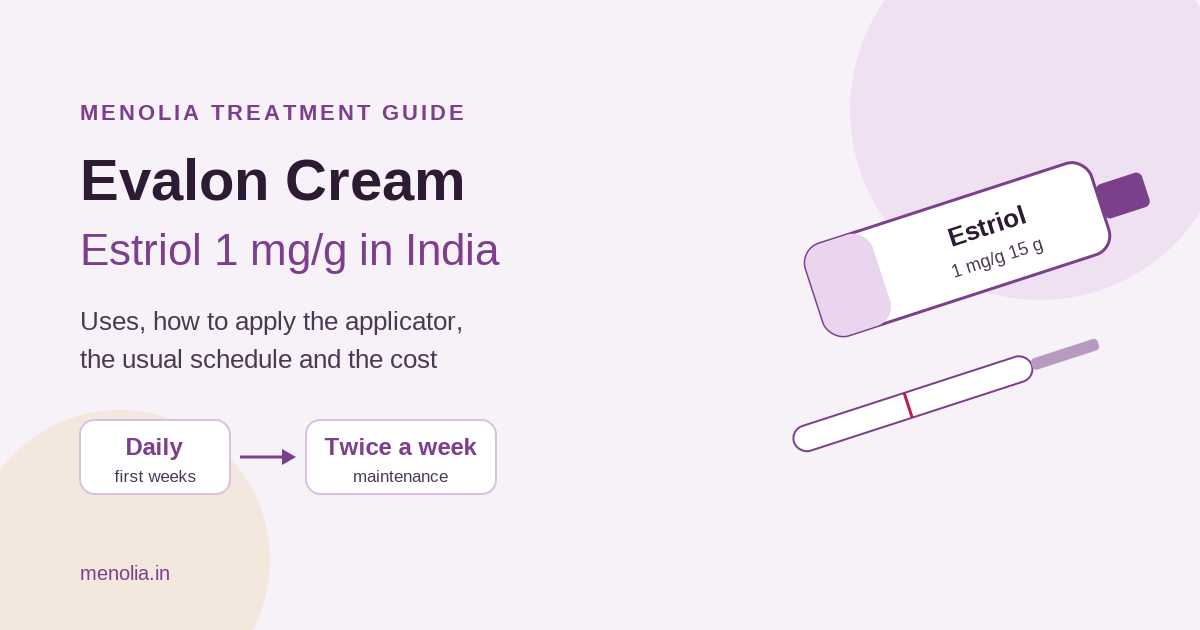
Evalon is a vaginal cream made by Torrent Pharmaceuticals. Each gram contains 1 mg of estriol, and it comes as a 15 g tube with a reusable applicator. It is a prescription-only medicine in India; PharmEasy’s listing (pharmeasy.in, checked 11 November 2026) classifies it as prescription-only and lists its use as vaginal atrophy in postmenopausal women.
Estriol is one of the three oestrogens the body makes naturally, and the weakest of them. Applied inside the vagina, it acts mainly on the vaginal and urethral lining, which is exactly where the change happens after menopause.
If you see “Ovestin” in an international article or on an older prescription, that is the same drug at the same strength (estriol 1 mg/g) under its original brand name. In Indian pharmacies, Evalon is the version you are most likely to be handed.
What It Is Used For
Evalon treats the vaginal and urinary symptoms that come from low oestrogen after menopause. The clinical name for this group of symptoms is genitourinary syndrome of menopause, which we explain in our post on GSM. In everyday terms, it is prescribed for:
- Vaginal dryness, itching or burning that does not settle with lubricants alone
- Pain or discomfort during sex caused by thin, dry tissue
- Burning or urgency when passing urine, when the cause is thinned urethral tissue rather than an infection
- Recurrent urinary infections after menopause, as one part of a prevention plan (our guide to menopause and UTIs covers the rest)
- Preparing the vaginal tissue before prolapse or pelvic floor surgery, when the surgeon asks for it
What Evalon does not do is treat hot flushes, night sweats, sleep or mood. It works locally. If those whole-body symptoms are what bother you most, that is a conversation about systemic HRT, not about a vaginal cream.
Does it work? A Cochrane review of vaginal oestrogen for vaginal atrophy (Lethaby A et al., Cochrane Database Syst Rev, 2016, PMID 27577677) found low-quality evidence that vaginal oestrogen preparations improve symptoms compared with placebo, and no evidence of a difference in effectiveness between creams, tablets and rings. In plain terms: the form matters less than using it regularly.
How to Apply Evalon Cream, Step by Step
The first time takes a few minutes. After a week, it takes less than one. Bedtime is the easiest time, because the cream stays where it is meant to while you lie down.
Step 1: Wash your hands. Before and after, every time.
Step 2: Open the tube. For a new tube, remove the cap and use the pointed end inside the cap to pierce the seal.
Step 3: Attach and fill the applicator. Screw the open end of the applicator onto the tube. Squeeze the tube gently so the cream pushes the plunger back, and stop at the mark that matches the dose your doctor wrote. Unscrew the applicator and put the cap back on the tube.
Step 4: Get comfortable. Lie on your back with your knees bent and apart. Some women prefer standing with one foot on the edge of a stool or the toilet seat. Either is fine.
Step 5: Insert and press. Slide the applicator gently into the vagina, as far as is comfortable without forcing it. Press the plunger slowly until it stops. Remove the applicator.
Step 6: Clean the applicator. Pull the plunger out of the barrel, wash both parts in warm water with mild soap, rinse well and let them dry. Store it in its box.
A few practical points women often ask about:
- A little discharge the next morning is normal. Some cream comes out as the base melts. A thin panty liner helps.
- If it stings in the first week, that is common when the tissue is very thin, and it usually eases as the lining heals. If it keeps stinging past two weeks, tell your doctor.
- If insertion itself is painful, the applicator can be inserted only part of the way. Some women apply cream with a clean fingertip to the entrance as well; ask your doctor whether that suits you.
The Usual Schedule
Your prescription is the schedule that counts. But it helps to know the general shape, because the frequency changes after the start and many women stop too early or never step down.
The UK Summary of Product Characteristics for estriol 1 mg/g cream (medicines.org.uk, checked 11 November 2026) describes it like this: one application a day for the first weeks (no more than four weeks), then a gradual reduction as symptoms settle, down to a maintenance dose such as one application twice a week. On that label, one applicator dose is 0.5 g of cream, which contains 0.5 mg of estriol.
| Phase | Typical frequency | What is happening |
|---|---|---|
| Start | Once daily, usually 2 to 3 weeks (up to 4) | The thin lining begins to thicken and moisten |
| Step-down | Every other day, then less often | Symptoms ease; frequency reduces with them |
| Maintenance | Twice a week (for example, Monday and Thursday) | Keeps the tissue healthy long term |
If you miss a dose: the same label says to use it when you remember, unless it is more than 12 hours late, in which case skip it and carry on as normal. Never use two doses on the same day.
How long until it helps? Many women notice less dryness and burning within a few weeks. Comfort during sex and fewer urinary symptoms usually take longer, often around three months of regular use. If you still have significant symptoms after three months at the right dose, your doctor may adjust the dose or add a vaginal moisturiser alongside it.
Do I have to stop? Not on a timetable. The changes Evalon treats come back when it is stopped, so most women who benefit stay on the twice-weekly dose with a yearly review. That is a decision you make with your doctor, not a deadline.
If you have been prescribed Evalon and are unsure about the dose, the schedule or whether it suits your history, you can talk it through with me over a video consultation (₹399 in India, US $20 from outside India).
WhatsApp Dr. Suganya and we can go through your questions together.
How Much Evalon Cream Costs in India
On PharmEasy (checked 11 November 2026), a 15 g tube of Evalon cream had an MRP of ₹575.95, with an online price of ₹455 after discount. Prices at your local pharmacy may differ slightly, and online discounts change week to week.
What that means in practice, if each application uses about 0.5 g (as on the UK label; your doctor may prescribe differently):
- Starting phase: a 15 g tube gives roughly 30 applications, so the daily start uses most of the first tube.
- Maintenance at twice a week: the same tube lasts around three to four months, so the monthly cost is low, usually less than ₹200.
That makes local vaginal oestrogen one of the lowest-cost menopause treatments there is. Our breakdown of HRT costs in India puts it next to patches, gels and tablets if you are comparing options.
Where to buy: most large city pharmacies and the online pharmacies stock it. You will need a prescription. Check the expiry date when you buy; an opened tube should be used within the time printed on the pack.
Side Effects and Safety
Most women use Evalon without trouble. The side effects listed on the UK label are mostly local and usually short-lived: irritation or itching where it is applied, a burning feeling, breast tenderness, and occasional spotting. More discharge than usual is also common. The label notes that persistent side effects can mean the dose is higher than you need, which is one more reason the dose steps down after the start.
Does it reach the rest of the body? A little, mostly in the first weeks while the lining is thin. As the tissue recovers, absorption falls. A systematic review of vaginal oestrogen safety (Crandall CJ et al., Menopause, 2020, PMID 31913230) found that blood estradiol levels rose from 11 pg/mL at baseline or on placebo to a mean of 30 pg/mL after treatment, were usually highest in the first 12 weeks, and were higher with creams than with inserts or rings. Trials of up to 52 weeks did not clearly show thickening of the womb lining, but the data were limited, and the authors noted that longer trials are still needed. This limited absorption is why Evalon on its own is generally not paired with a progesterone tablet, unlike systemic HRT. Your doctor will tell you if your situation is different.
Who should check carefully before starting? The UK label lists several situations where estriol should not be used, including undiagnosed vaginal bleeding, known or suspected oestrogen-dependent cancers, past or current blood clots, and active liver disease. If any of these apply to you, tell the doctor who is prescribing it.
After breast cancer: this is a decision for your oncologist and gynaecologist together, not something to start on your own. Non-hormonal moisturisers usually come first. We cover the reasoning in our vaginal oestrogen cream guide, in the section on breast cancer.
When to call your doctor: any bleeding or spotting after menopause, whether it began before you started the cream or while using it, should be checked before you continue. It is usually from something simple, and it is quick to assess. Our post on post-menopausal bleeding explains what that check involves.
Using Evalon Alongside Other Care
Evalon works well next to other things that help vaginal comfort:
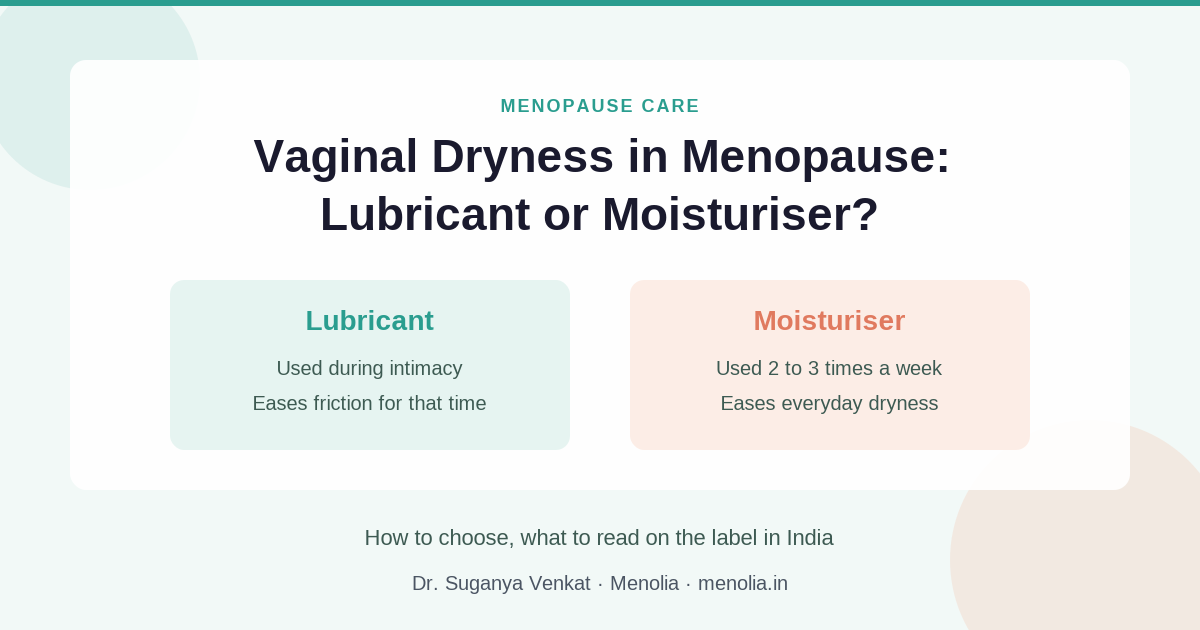
- A water-based lubricant during sex, especially in the first few weeks before the tissue has recovered. Use the cream on a different night or at least a few hours apart from sex, so it is not wiped away.
- A vaginal moisturiser on the days you are not using the cream, if dryness is still bothering you.
- Pelvic floor physiotherapy, if sex has become painful enough that the muscles tense up in anticipation.
If you are already on systemic HRT (tablets, patches or gel) and still have vaginal dryness, ask your doctor about adding a vaginal oestrogen such as Evalon. Some women need a local dose on top of their HRT, and that is common. For the emotional side of a symptom many women never mention, our post on vaginal dryness and breaking the silence is a good read.
When women tell Dr. Suganya Venkat, an OB-GYN with more than 15 years of experience, that Evalon “did not work”, the usual story in her Menolia video consultations is that they used it for ten days, felt little change, and stopped before the tissue had time to respond. Give it the full start phase and a few weeks of maintenance before you judge it.
Frequently Asked Questions
What is Evalon cream used for? Evalon cream (estriol 1 mg/g) is used to treat vaginal dryness, itching, burning, painful sex and some urinary symptoms caused by low oestrogen after menopause. It can also be used before certain vaginal or prolapse surgeries. It acts locally and does not treat hot flushes.
How do I use the Evalon cream applicator? Screw the applicator onto the tube, squeeze until the plunger reaches the dose mark your doctor prescribed, then unscrew it. Lying on your back with knees bent, insert it gently into the vagina and press the plunger. Wash the applicator in warm soapy water afterwards. Bedtime is the best time.
How often should I use Evalon cream? Usually once a day for the first two to four weeks, then reduced gradually to a maintenance dose such as twice a week. Follow the schedule your doctor wrote, because it can vary with your symptoms and history.
What is the price of Evalon cream in India? On PharmEasy in November 2026, the 15 g tube had an MRP of ₹575.95 and sold online for about ₹455. On a twice-weekly maintenance dose, one tube lasts around three to four months.
Is Evalon cream safe for long-term use? For most women, yes, at the lowest dose that controls symptoms, with a yearly review. Some oestrogen does reach the blood, mostly in the first weeks, and trials of up to a year have not clearly shown thickening of the womb lining, though long-term data are limited. Report any bleeding to your doctor promptly.
Can I use Evalon cream if I still get periods? Evalon is licensed for vaginal atrophy after menopause. If you still have periods and have vaginal symptoms, ask your doctor first, because the cause and the right treatment may be different. It is not for use in pregnancy or while breastfeeding.
Can I have sex while using Evalon cream? Yes. Use the cream on a different night, or a few hours away from sex, so it stays in place, and use a water-based lubricant during sex in the early weeks. Evalon is not a lubricant and not a contraceptive.
Evalon is a small, inexpensive treatment that changes daily comfort for many women once it is used the right way. If you would like help working out whether it suits you, or why it has not helped yet, I consult with women across India and abroad online, over video call.
WhatsApp Dr. Suganya to book a consultation (₹399 in India, US $20 from outside India).