Women usually meet raloxifene in one of two ways. Some have had a bone density scan that showed thinning of the spine, and the prescription that came back was not the weekly bisphosphonate a friend takes but a daily tablet with an unfamiliar name. Others have a mother or sister with breast cancer and have read that a “bone medicine” can also lower breast cancer risk. Either way, the question that follows is the same: what exactly is this tablet, and is it right for me?
I’m Dr. Suganya Venkat, an OB-GYN with more than 15 years of clinical practice, and raloxifene is a medicine I discuss often with women in their fifties and sixties at Menolia. It is useful for a specific group of women, unhelpful for others, and unsuitable for a few. This post walks through all three, so that you can have a clearer conversation with the doctor who knows your history.
What This Guide Covers
- What raloxifene is and how it differs from HRT
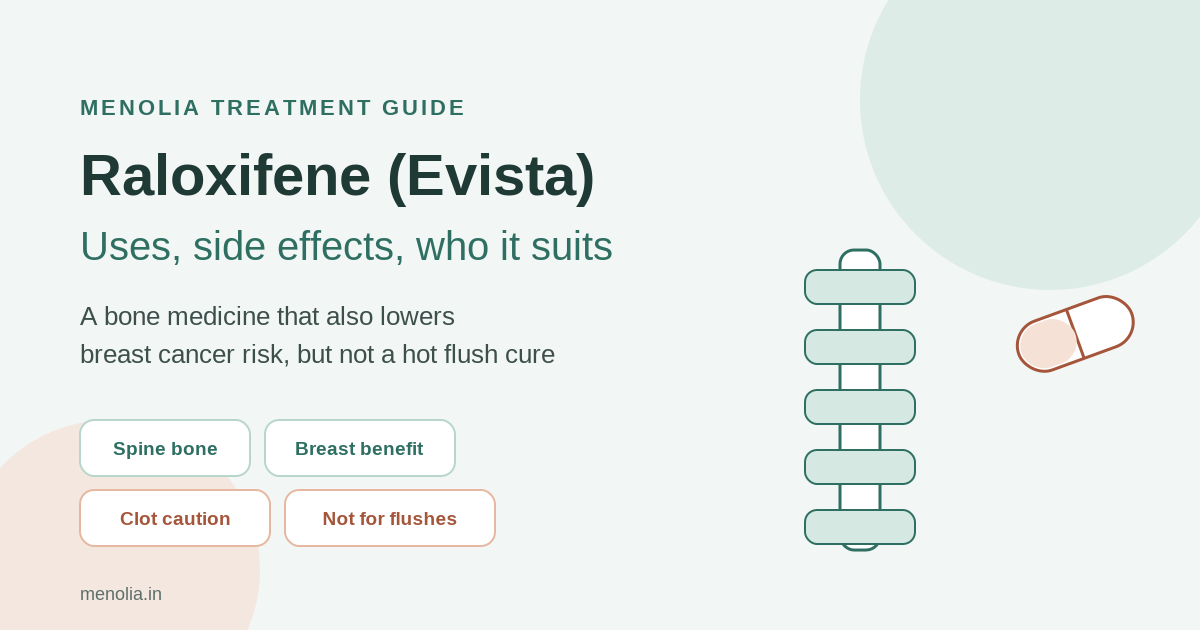
- What it is used for: the spine, and breast cancer risk
- What it does not do, including for hot flushes
- Side effects, and the blood clot caution
- Who it tends to suit, and who should avoid it
- How it compares with other bone medicines
- Raloxifene in India: names to ask for
What Raloxifene Is
Raloxifene belongs to a group of medicines called SERMs, short for selective oestrogen receptor modulators. The word “selective” is the key. Oestrogen acts on receptors in many tissues: bone, breast, the womb lining, blood vessels and the brain. A SERM switches some of those receptors on and blocks others.
Raloxifene acts like oestrogen on bone, which slows the bone loss that speeds up after menopause. In the breast it does the opposite, blocking oestrogen’s effect. In the womb lining it is largely neutral, so it does not cause the lining to thicken and does not need a progestogen added.
That combination is why it sits in an unusual place. It is not hormone replacement therapy, and it will not replace the oestrogen your ovaries stopped making. It is a bone medicine with a breast benefit attached. Evista is the original brand name, made by Eli Lilly, and the standard dose studied in the large trials is 60 mg once a day, taken with or without food.
What Raloxifene Is Used For
Protecting the spine in women with osteoporosis
The main use of raloxifene is to treat and prevent osteoporosis after menopause, particularly where the spine is the concern. The pivotal trial, known as MORE, enrolled 7,705 postmenopausal women with osteoporosis across 25 countries. Over three years, raloxifene 60 mg a day lowered the risk of new vertebral (spine) fractures by about 30% compared with placebo, and it increased bone density at the spine and the hip (Ettinger B et al., JAMA, 1999, PMID 10517716).
The same trial also showed a limit that matters. The risk of fractures outside the spine, including the hip and wrist, was not significantly different from placebo. So raloxifene is a reasonable choice for a woman whose main risk is in the spine, and a weaker choice for a woman whose hip is the bigger worry.
Lowering the risk of invasive breast cancer
The bone trials produced a second finding. Women taking raloxifene developed fewer invasive breast cancers, and this effect was concentrated in the oestrogen receptor positive cancers, the type that grows in response to oestrogen. In a follow-on study of women from the MORE trial, raloxifene continued to reduce invasive breast cancer over eight years (Martino S et al., J Natl Cancer Inst, 2004, PMID 15572757).
The larger RUTH trial, in 10,101 postmenopausal women with heart disease or several heart risk factors, confirmed the breast effect: 40 invasive breast cancers with raloxifene against 70 with placebo, an absolute reduction of 1.2 cancers per 1,000 women treated for a year (Barrett-Connor E et al., N Engl J Med, 2006, PMID 16837676).
The STAR trial then compared raloxifene directly with tamoxifen in postmenopausal women at higher risk of breast cancer. Raloxifene was about as effective as tamoxifen at lowering invasive breast cancer, with fewer blood clots and fewer cataracts. It was less effective than tamoxifen against non-invasive breast cancer, although that difference did not reach statistical significance, and there were numerically fewer uterine cancers with raloxifene (Vogel VG et al., JAMA, 2006, PMID 16754727).
For a woman who already has osteoporosis of the spine and a family history of breast cancer, that pairing of benefits can make raloxifene an attractive option. It is a decision your breast specialist or gynaecologist will want to make with your full family history in front of them.
What Raloxifene Does Not Do
This section matters as much as the one above, because the most common misunderstanding about raloxifene is that it is a gentler form of HRT. It is not.
- It does not treat hot flushes. Because it blocks oestrogen in some tissues, raloxifene can bring on or worsen hot flushes and night sweats, especially in the first months. A woman whose main problem is flushing, sleep and mood is usually better served by HRT or by a non-hormonal hot flush treatment. Our non-hormonal hot flush guide covers those options.
- It does not help vaginal dryness. Dryness and discomfort need their own treatment, often a local vaginal oestrogen.
- It does not protect the heart. In the RUTH trial, raloxifene did not change the risk of heart attacks or other coronary events (Barrett-Connor E et al., N Engl J Med, 2006, PMID 16837676).
- It is not shown to prevent hip fractures. As described above, its fracture benefit in the trials was in the spine.
- It is not treatment for breast cancer. It lowers the risk of developing invasive breast cancer in some women. Women already being treated for breast cancer follow their oncologist’s plan.
This is also why raloxifene is used mostly in women who are a few years past menopause, when hot flushes have usually settled, rather than in the perimenopause years.
Side Effects and the Blood Clot Caution
Most women take raloxifene without major problems, but three effects are worth knowing about before you start.
Hot flushes and leg cramps. These are the most common complaints. They are usually mild and often settle with time. Tell your doctor if they are affecting your sleep or daily life.
Blood clots. This is the important one. Like oestrogen tablets, raloxifene raises the risk of venous thromboembolism, meaning a clot in a leg vein (DVT) or in the lungs. In the MORE trial the risk was about three times that of placebo (Ettinger B et al., JAMA, 1999, PMID 10517716). In RUTH, the absolute increase was 1.2 extra clots per 1,000 women per year (Barrett-Connor E et al., N Engl J Med, 2006, PMID 16837676). In plain terms, most women never have a clot, but the risk is real enough that raloxifene is not used in women who have had one.
Practical steps help. If you have planned surgery or a period of bed rest coming up, your doctor will usually ask you to stop raloxifene at least 72 hours beforehand, stay off it while you are immobile, and restart it only once you are fully up and walking again. On long journeys, get up and walk regularly and drink enough fluids. A painful, swollen calf should be checked by a doctor the same day. Sudden breathlessness or chest pain is an emergency: go to the nearest emergency department or call for help straight away. Our guide to HRT and blood clots explains how clot risk is assessed, and the same thinking applies here.
Stroke in women at high heart risk. In RUTH, which deliberately enrolled women with heart disease or several heart risk factors, raloxifene did not increase stroke overall but was linked with a higher risk of fatal stroke, 0.7 extra per 1,000 women per year (Barrett-Connor E et al., N Engl J Med, 2006, PMID 16837676). For a woman who has had a stroke, or who carries a high stroke risk, this tips the balance towards a different bone medicine.
If you are unsure whether raloxifene fits your history, you can talk it through with me online.
WhatsApp Dr. Suganya and we can look at your scan and history together.
Who Raloxifene Tends to Suit
These are common patterns, not rules. Your doctor will weigh your own scan, history and preferences.
| Situation | Is raloxifene usually considered? |
|---|---|
| Past menopause, osteoporosis or low bone density mainly in the spine, no clot history | Often a good fit |
| Spine osteoporosis plus a raised breast cancer risk (for example, a strong family history) | Often a strong fit, because of the dual benefit |
| Cannot tolerate bisphosphonates (stomach or swallowing problems) | A reasonable alternative |
| Main concern is the hip, or a previous hip fracture | Usually another medicine is preferred |
| Troublesome hot flushes, night sweats or poor sleep | Usually not; HRT or non-hormonal options fit better |
| Still having periods (premenopausal) | Not used |
Who Should Avoid Raloxifene
Raloxifene is generally not used by women who:
- have had a DVT, pulmonary embolism or a clot in the eye’s retinal vein
- have had a stroke, or are at high risk of one
- have active liver disease
- have unexplained vaginal bleeding, until the cause has been checked
- are taking oestrogen as HRT at the same time (the two are not combined)
- are pregnant or may become pregnant
Tell your doctor about every medicine you take. If you take warfarin, your doctor will usually check your INR (a clotting blood test) more closely when raloxifene is started or stopped. Cholestyramine, a cholesterol-lowering powder, greatly reduces how much raloxifene the body absorbs, so the two are not taken together.
How Raloxifene Compares With Other Bone Medicines
Raloxifene is one of several medicines for osteoporosis, and it is rarely the first one offered to every woman.
- Bisphosphonates (alendronate, risedronate, zoledronic acid) reduce fractures at the spine and the hip, and they are the usual first choice for many women. Our guide to bisphosphonates and other osteoporosis medicines covers them in detail.
- Denosumab, an injection every six months, is another option, especially when bisphosphonates are not suitable.
- HRT protects bone too, and for a woman in her early fifties who also has hot flushes, it may treat both problems at once.
- Raloxifene earns its place when the spine is the main concern, a breast benefit is wanted, bisphosphonates are not tolerated, and the clot risk is low.
Medicine is one part of the plan. Weight-bearing exercise, enough protein, calcium from food first (ragi, dahi, paneer, sesame and green leafy vegetables) and enough vitamin D all matter, whichever tablet you take. These foods are good sources of calcium but provide little vitamin D, so ask your doctor whether you need a vitamin D test or supplement. The menopause bone health guide explains why Indian women in particular benefit from starting early, and the bone density test guide explains how to read your T-score.
Raloxifene in India: What to Ask For
Raloxifene is available in India on prescription, usually as 60 mg tablets sold under several brand names by Indian manufacturers. Because brand names and prices vary between pharmacies and change often, ask your doctor and pharmacist for the salt name, “raloxifene hydrochloride 60 mg”, and compare prices on that basis rather than by brand. It is not a medicine to start from an online pharmacy without a doctor’s assessment, because of the clot and stroke cautions above.
A follow-up bone density scan, typically after about two years, shows whether the treatment is working. Your doctor will also decide how long to continue. Bone benefit fades after stopping, so a plan for what comes next is part of the conversation.
Your Next Steps
- If you have a bone density report, note which site (spine or hip) has the lowest T-score.
- Write down any history of clots, stroke, liver disease or breast cancer in yourself and your close family.
- List every medicine and supplement you take.
- Ask your doctor whether your main fracture risk is at the spine or the hip, and how raloxifene compares with a bisphosphonate for you.
- If hot flushes are your main problem, say so, because that usually points to a different treatment.
Frequently Asked Questions
What is raloxifene used for? Raloxifene is mainly used to treat and prevent osteoporosis in women after menopause, and it lowers the risk of spine fractures. It also reduces the risk of invasive, oestrogen-sensitive breast cancer in postmenopausal women, which makes it useful for women who have both concerns.
Is raloxifene a hormone or HRT? No. Raloxifene is a selective oestrogen receptor modulator (SERM). It acts like oestrogen on bone but blocks oestrogen in the breast, and it does not replace the oestrogen lost at menopause. It is not combined with oestrogen HRT.
Does raloxifene help with hot flushes? No. Raloxifene can cause or worsen hot flushes, especially in the first few months. If hot flushes are your main symptom, HRT or a non-hormonal hot flush medicine is usually more suitable.
What are the common side effects of raloxifene? Hot flushes and leg cramps are the most common. The most important risk is a blood clot in the leg or lungs, so it is not used by women who have had a clot, and it is usually paused before surgery or long periods of immobility.
Is raloxifene better than alendronate? Neither is better for everyone. Alendronate reduces both spine and hip fractures, while raloxifene’s proven fracture benefit is in the spine but it also lowers breast cancer risk. The choice depends on where your bone loss is, your breast cancer risk and your clot risk.
How long can I take raloxifene? The large trials followed women for several years, and many women take it for a number of years under review. Your doctor will repeat your bone density scan and decide how long to continue and what to switch to afterwards, because the bone benefit fades after stopping.
Raloxifene 60 mg tablet kab aur kaise lena chahiye? Raloxifene 60 mg is usually taken as one tablet a day, at any time, with or without food, and only on a doctor’s prescription. Taking it at the same time each day makes it easier to remember, and calcium and vitamin D are usually continued alongside it as advised.
Raloxifene is a good medicine for the right woman: past menopause, spine-predominant bone loss, ideally with a reason to want breast protection, and no history of clots. If you would like a doctor to go through your scan and history with you, I consult with women across India and abroad online, over video call.
WhatsApp Dr. Suganya to book a consultation (₹399 in India, US $20 from outside India).