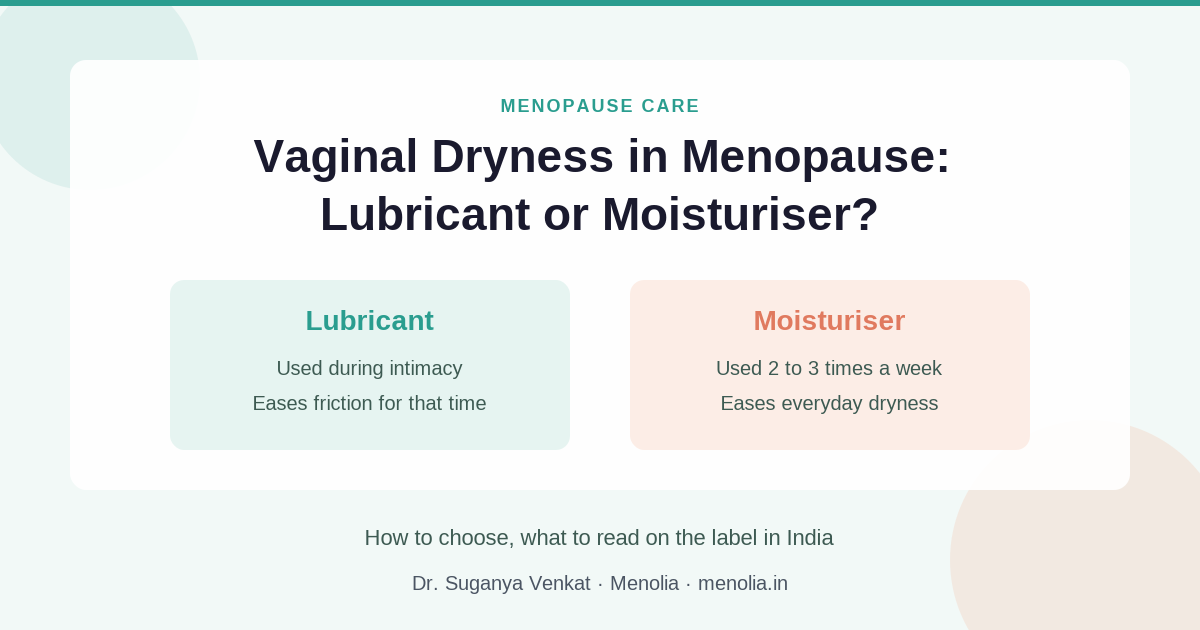
You stand in the pharmacy aisle, or scroll a shopping app late at night, and there are two kinds of tubes that seem to promise the same thing. One says “personal lubricant”. The other says “vaginal moisturiser”. Both talk about dryness. Neither tells you which one you need, and asking the person at the counter feels like too much.
This is one of the most common practical questions women bring to me after 45, usually after months of quietly putting up with burning, itching or discomfort during intimacy. I’m Dr. Suganya Venkat, an OB-GYN with more than 15 years in practice, and at Menolia I would rather a woman spend five minutes understanding the label than five months guessing.
This post covers the difference between a lubricant and a moisturiser, what to look for on the pack in India, how to use each, the common household substitutes, and the point at which a prescription treatment makes more sense. If you want the fuller picture of why dryness happens at all, and how it feels, read vaginal dryness in menopause: breaking the silence first. This post stays with the products.
Why Dryness Starts Around Menopause
As oestrogen falls, the lining of the vagina becomes thinner, less elastic and produces less natural moisture. The same change affects the vulva and the bladder opening, which is why doctors group these symptoms under one name, the genitourinary syndrome of menopause, or GSM. Our guide to genitourinary syndrome of menopause explains the condition and its full range of treatments.
It is very common. The North American Menopause Society’s 2020 GSM position statement (The NAMS 2020 GSM Position Statement Editorial Panel, Menopause, 2020, PMID 32852449) estimates that GSM affects roughly 27% to 84% of postmenopausal women, and notes that it is underdiagnosed and undertreated. The same statement lists vaginal lubricants and moisturisers among the treatments that work, depending on how severe the symptoms are.
Unlike hot flashes, which often settle with time, vaginal dryness tends to continue or slowly increase after menopause. That is why a simple, regular routine matters more than a one-off fix.
Lubricant vs Moisturiser: Two Different Jobs
These two products are often sold side by side, but they are meant for different moments.
| Lubricant | Moisturiser | |
|---|---|---|
| When you use it | Just before or during intimacy | Regularly, on a schedule, whether or not you are sexually active |
| What it does | Reduces friction for that occasion | Holds water in the vaginal tissue for a few days |
| How long it lasts | Minutes to an hour | Usually around two to three days per application |
| Who it suits | Women whose main problem is discomfort or pain during sex | Women with everyday dryness, itching, burning or soreness |
A review on lubricants and moisturisers for menopause dryness makes the same point: there is a real distinction between the two, and there are notable differences between brands within each group (Edwards D, Panay N, Climacteric, 2016, PMID 26707589). The authors found both kinds effective at relieving discomfort during intercourse for women with mild to moderate dryness, particularly for women who cannot or choose not to use oestrogen.
Many women need both: a moisturiser two or three times a week for daily comfort, and a lubricant on the days they are intimate.
Choosing a Lubricant in India
Lubricants come in three main bases. Each has a place.
Water-based
This is the easiest place to start and the most widely available in Indian pharmacies and online.
- Safe with latex condoms and silicone devices
- Washes off easily and rarely stains clothes or bedsheets
- Can dry out during longer intimacy, so you may need to reapply a little
Silicone-based
- Lasts much longer than water-based gels and feels smoother
- Safe with latex condoms
- Not suitable with silicone devices, and needs soap and water to wash off
Women who find that a water-based gel “disappears” too quickly often prefer silicone.
Oil-based (including household oils)
- Long-lasting and familiar
- Weakens latex condoms, so do not combine the two if you rely on condoms for protection
- Harder to wash away, and can trap moisture on the vulva
What to read on the label
The Edwards review recommends choosing a product that is balanced in both osmolality and pH, and as close as possible to natural vaginal secretions (Edwards D, Panay N, Climacteric, 2016, PMID 26707589). In plain terms, osmolality describes how concentrated a gel is. A very concentrated gel can draw water out of the tissue and leave it more irritated, not less.
Most Indian packs do not print osmolality, so use these practical filters instead:
- Unflavoured, unscented and colourless. Fragrance and colour add nothing and can sting.
- No “warming”, “cooling”, “tingling” or “sensation” claims. These usually come from added ingredients that irritate tissue that is already thin.
- Short ingredient list. If a gel lists ten ingredients you cannot pronounce, try a simpler one.
- Labelled for vaginal use. A gel sold for massage or for the skin is not designed for this tissue.
- Patch test first. Put a small amount on the inner arm or the outer vulva and wait a day before full use.
If a product stings or burns every time, stop it. The problem is usually the product, not you.
Choosing and Using a Vaginal Moisturiser
Moisturisers are designed to cling to the vaginal lining and release water slowly. In India they are sold as gels, creams and vaginal pessaries or ovules. Many are based on hyaluronic acid, a substance that holds water well, and some are polycarbophil-based gels. Ask your pharmacist for a product labelled “vaginal moisturiser” rather than a lubricant.
How to use one:
- Apply at bedtime, so it stays in place while you lie down.
- Use the applicator or a clean finger to place it inside the vagina, as the pack directs.
- Start with two or three applications a week, on fixed days, so you remember.
- A little can also be smoothed on the outer vulva if that skin is sore.
- Give it four to six weeks before deciding whether it helps.
What to expect, realistically. A moisturiser eases symptoms. It does not reverse the thinning of the tissue the way oestrogen does. A US trial of 302 postmenopausal women with moderate to severe symptoms compared a vaginal estradiol tablet, an over-the-counter moisturiser and a placebo gel over 12 weeks (Mitchell CM et al., JAMA Intern Med, 2018, PMID 29554173). All three groups improved by a similar amount, and neither treatment did better than the placebo. The placebo in that trial was itself a gel, so one sensible reading is that regularly applying a gentle, non-irritating gel already brings real relief for many women. It is a reason to keep trying with a simple product, not a reason to give up.
Not sure whether you need a lubricant, a moisturiser, or something more? We can talk it through privately over a video call, with no examination needed for the first conversation. Message Dr. Suganya on WhatsApp for a ₹399 video consultation.
Household Substitutes: What Women Often Use at Home
Many Indian women reach for what is already in the kitchen or the bathroom cupboard. Here is how I think about the common ones.
- Coconut oil. Widely used and often comfortable on the outer vulva. It has not been studied well as a vaginal lubricant, it weakens latex condoms, and some women find it encourages irritation inside the vagina. If you use it, keep it to the outside and use a fresh, clean jar kept only for this.
- Petroleum jelly (Vaseline). Thick and hard to clear from the vagina. Fine as a thin barrier on sore outer skin; not a good choice inside.
- Baby oil, body lotion or face cream. These often contain fragrance, alcohol or preservatives that sting thin tissue. Avoid inside the vagina.
- Ghee, curd or aloe from the plant. Well meant, but not clean or stable enough for this use.
- Saliva. Dries quickly and can carry germs. Not a substitute.
Some women ask about sea buckthorn oil capsules; our post on sea buckthorn oil for vaginal dryness looks at what that evidence shows.
Also look at what goes on the area every day. Antiseptic liquids, scented soaps and intimate washes with fragrance are some of the most common reasons dryness feels worse. Our guide to menopause intimate hygiene covers what to use instead.
When a Lubricant or Moisturiser Is Not Enough
Over-the-counter products are a good first step for mild to moderate dryness. Think about talking to a doctor about prescription options if:
- Dryness, burning or itching is there most days despite six weeks of a moisturiser
- Intimacy is still painful even with a lubricant
- You are getting repeated urinary infections or urgency
- There is spotting after intimacy
Low-dose vaginal oestrogen is the most studied prescription treatment and works on the tissue itself. Our guide to vaginal estrogen cream in India explains the forms, how to use them and the costs. For women who prefer not to use oestrogen, vaginal DHEA (prasterone) is another prescription option. Moisturisers and lubricants can also be used alongside either of these, so starting one does not mean stopping the other.
If intimacy is painful even when you feel ready and the area seems moist, the muscles of the pelvic floor may be involved too. Painful sex in perimenopause: vaginismus or GSM explains how to tell these apart.
Bleeding is a separate question
Any bleeding after menopause, including a spot after intimacy, deserves a check, even if you are sure it is “just dryness”. It is usually something simple, and our post on bleeding after sex in menopause explains what is usually found. A quick review settles it and lets you get on with treating the dryness.
If you have had breast cancer
Lubricants and non-hormonal moisturisers are the usual first choice for women with a history of breast cancer. Before starting anything hormonal, including a vaginal cream, speak to your oncologist, who will weigh it with your own treatment history.
A Simple Starting Plan
If you are not sure where to begin, this is a reasonable first month for most women with mild to moderate dryness:
- Stop irritants. Switch to plain water for the vulva and drop scented washes and antiseptic liquids.
- Start a moisturiser at bedtime, two or three times a week, on fixed days.
- Keep a water-based lubricant for intimacy, and try silicone if water-based dries out too fast.
- Wear cotton underwear and change out of damp clothes after a walk or a workout.
- Note how you feel every week: dryness, burning, comfort during intimacy, any urinary symptoms.
- Review at six weeks. Better? Carry on. Not much better? That is the time to discuss a prescription option.
In her consultations, Dr. Suganya Venkat usually asks women to bring exactly that six-week note, because it makes the next decision quick and clear.
Frequently Asked Questions
What is the difference between a lubricant and a vaginal moisturiser?
A lubricant is used just before or during intimacy to reduce friction for that occasion. A vaginal moisturiser is used regularly, two or three times a week, to hold water in the tissue and ease everyday dryness, itching and burning. Many women use both.
Which lubricant is best for menopause dryness in India?
For most women, a plain, unscented, water-based lubricant labelled for vaginal use is the best place to start. If it dries out too quickly, try a silicone-based lubricant. Avoid flavoured, coloured or “warming” products, which can irritate thin tissue.
Can I use coconut oil for vaginal dryness?
Coconut oil is often comfortable on the outer vulva, but it has not been studied well inside the vagina, and it weakens latex condoms. If you use it, keep it to the outside, use a clean jar kept only for this, and stop if you notice itching or discharge.
How long does a vaginal moisturiser take to work?
Some women feel more comfortable within a few days, but give it four to six weeks of regular use, two or three times a week, before judging it. If you still have symptoms most days after that, talk to a doctor about prescription options.
Is it safe to use a lubricant every time?
Yes. A gentle, unscented lubricant can be used every time you are intimate. Needing one after menopause is normal and simply reflects the change in your body’s own moisture.
Can I use a moisturiser with vaginal oestrogen?
Yes. Moisturisers and lubricants can be used alongside vaginal oestrogen or other prescription treatments. Your doctor may suggest applying them on different nights so each stays in place.
Do I need a prescription for a vaginal moisturiser in India?
No. Vaginal moisturisers and lubricants are sold over the counter in pharmacies and online. Vaginal oestrogen and DHEA are prescription treatments and need a doctor’s advice.
Talk It Through With Us
You do not need to keep guessing in the pharmacy aisle. If dryness is affecting your comfort, your sleep or your relationship, a short conversation can sort out what to try first and when to consider more. Menolia consultations are online, by video call, from anywhere in India.