I hear this question more often than you might expect, usually from a woman in her early sixties who has never taken hormone therapy. Her hot flashes eased years ago, but her sleep never fully recovered, her joints ache more than they used to, and she has heard from a friend or read online that HRT could help. She wants to know if it is too late for her.
It is not a simple yes or no answer, and anyone who gives you one in a single sentence is skipping the part that actually matters for you. The position most current guidelines take is that starting HRT for the first time after 60, or more than ten years past your last period, changes the calculation. It does not automatically rule it out.
This post walks through why the timing matters, what the evidence actually shows for late starters, what remains reasonable to consider at any age, and when a menopause specialist might still individualise a low-dose option for you.
Why Age at Starting Changes the Picture
For the standard HRT decision, women who start within ten years of their last period and before age 60, read our complete guide to HRT benefits and risks. That post covers the mainstream case. This one is for the woman outside that window, wondering whether the conversation is closed to her.
The idea that timing changes the risk-benefit balance is called the timing hypothesis, and it comes from looking more closely at how the original Women’s Health Initiative (WHI) trial data broke down by age.
When the WHI results were first published in 2002 (Writing Group for the Women’s Health Initiative Investigators, JAMA 2002;288(3):321-333), the headline conclusion, an overall small increase in cardiovascular events and breast cancer with combined HRT, did not separate out women by how old they were or how long it had been since menopause. It treated a 51-year-old five years past menopause the same as a 70-year-old twenty years past menopause.
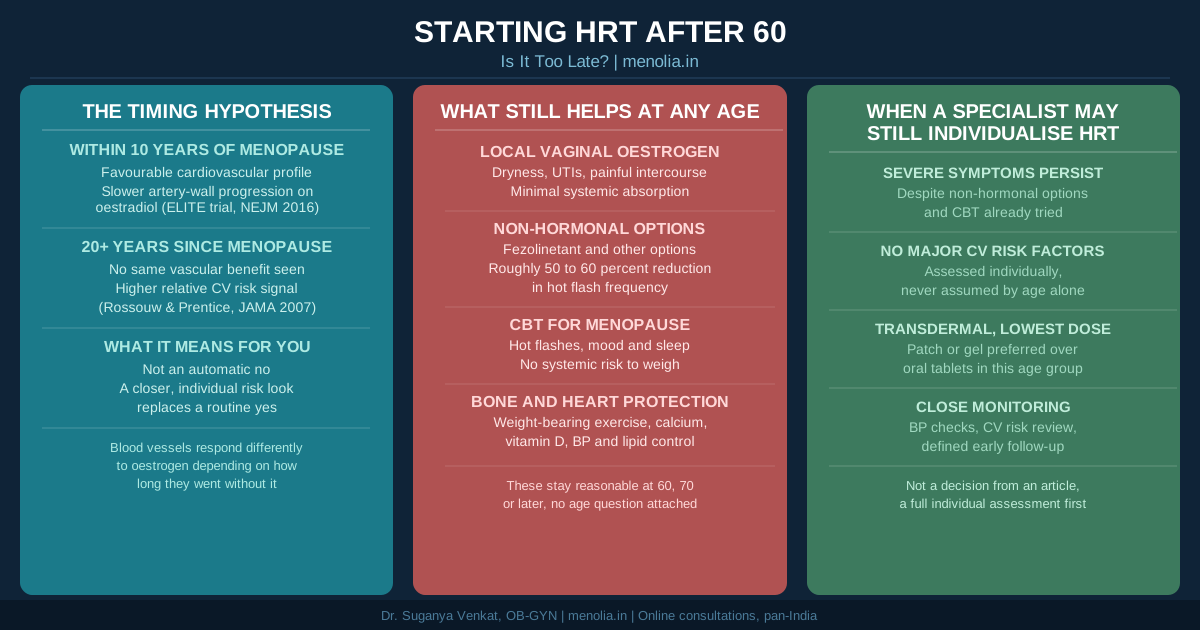
That mattered, because those two women are not starting from the same place biologically. A later analysis by Rossouw and Prentice, published in JAMA in 2007, went back to the WHI data specifically to look at cardiovascular risk by age and years since menopause (Rossouw JE, Prentice RL et al., JAMA 2007;297(13):1465-1477). What they found: women who started hormone therapy within 10 years of menopause had a cardiovascular risk profile that looked favourable, while women who started 20 or more years after menopause, largely an older group, showed a higher relative risk of coronary events.
A separate randomised trial, the ELITE trial (Hodis HN, Mack WJ et al., New England Journal of Medicine 2016;374(13):1221-1231), tested this directly by comparing women who started oestradiol within six years of menopause against women who started ten or more years after menopause, and measuring the actual thickness of the artery wall over time using carotid ultrasound. The early-start group showed significantly slower progression of atherosclerosis on hormone therapy compared to placebo. The late-start group showed no such benefit, and no significant harm either, on that particular vascular measure.
Put simply: your blood vessels respond differently to oestrogen depending on how much time has passed since they last had regular exposure to it. Vessels that have already developed age-related changes do not seem to get the same protective effect, and in the WHI data, an older population starting late showed a higher early cardiovascular signal than a younger population starting close to menopause.
This is the biological reason menopause societies, including NAMS in its 2022 position statement (The 2022 hormone therapy position statement of The North American Menopause Society, Menopause 2022;29(7):767-794), draw a line around age 60 and ten years since your last period as the point where the discussion needs to become more individualised rather than routine.
What This Means, and What It Does Not Mean
It does not mean HRT is dangerous for every woman over 60. It does not mean the door is shut. What it means is that the general population data that supports HRT as a reasonably low-risk, well-tolerated option for a 52-year-old does not automatically extend to a 62-year-old who has never taken it before. The risk-benefit conversation needs a closer look at your individual cardiovascular health, not a blanket rule.
Where you already have some risk factors, such as high blood pressure, elevated cholesterol, or early signs of vascular disease, that closer look matters even more, because oestrogen’s effect on an artery that already has plaque is genuinely different from its effect on one that does not.
Not sure where you fall in this picture? Dr. Suganya reviews your symptom history, age at menopause, and cardiovascular risk factors to give you an individual answer rather than a generic rule.
What Remains Reasonable at Any Age
Even when systemic HRT is not the first recommendation, several things remain fully on the table regardless of how many years have passed since your last period.
Local vaginal oestrogen
Vaginal dryness, recurrent urinary tract infections, and painful intercourse after menopause fall under what is called Genitourinary Syndrome of Menopause (GSM). Local vaginal oestrogen, delivered as a cream, tablet, or ring, treats these symptoms directly at the tissue level with minimal absorption into the rest of the body. The timing hypothesis and the systemic cardiovascular concerns above do not apply to local vaginal oestrogen in the same way, because so little of it reaches the bloodstream. This option stays reasonable at 60, 70, or later. Our vaginal estrogen cream guide covers what is available in India and how it is used.
Non-hormonal options for hot flashes
If hot flashes are still troubling you, several non-hormonal medications reduce their frequency by roughly 50 to 60 percent, meaningfully less than the roughly 75 percent reduction with systemic HRT, but a real and useful improvement. Fezolinetant is a newer, non-hormonal option specifically approved for vasomotor symptoms. Our guides on hot flash treatment options and fezolinetant cover the full ladder.
CBT for sleep and hot flashes
Cognitive behavioural therapy, specifically adapted for menopause symptoms, is recommended by NICE Clinical Guideline NG23 (nice.org.uk, updated 2024) for hot flashes, low mood, and sleep disruption, and it works regardless of age or years since menopause. It has no systemic risk profile to weigh at all. See our CBT for menopause guide for what this actually involves and how to access it in India.
Bone and heart protection through other means
If bone density was the reason HRT crossed your mind, weight-bearing exercise, adequate calcium and vitamin D, and, where needed, bone-specific medications like bisphosphonates remain effective at any age and do not carry the same age-related timing considerations that systemic HRT does. The same is true for cardiovascular protection through blood pressure control, cholesterol management, and activity.
When a Specialist May Still Individualise Systemic HRT
None of this means systemic HRT is never appropriate after 60. It means the decision moves from a fairly routine one to a genuinely individualised one, made with closer input from a menopause specialist and, depending on your health history, sometimes a cardiologist as well.
Situations where a specialist may still consider low-dose transdermal HRT for a woman over 60 or more than ten years past menopause include:
Severe, ongoing vasomotor symptoms that have not responded to anything else. If hot flashes and night sweats are still significantly affecting your quality of life despite non-hormonal options and CBT, and you have no major cardiovascular or clotting risk factors, a careful trial of low-dose transdermal oestrogen is sometimes reasonable after a full risk assessment.
No significant cardiovascular disease or risk factors. A woman at 62 with normal blood pressure, no diabetes, no vascular disease, and a healthy cardiovascular profile is in a meaningfully different position from a woman with several risk factors already present. This is assessed individually, not assumed.
Transdermal route specifically, at the lowest effective dose. When systemic HRT is considered in this age group, transdermal oestrogen (patch or gel) is generally preferred over oral tablets, because it avoids the liver’s first-pass metabolism and carries a lower clot risk. This is the same route preference we recommend more broadly, covered in our full HRT guide, but it becomes a firmer default rather than a preference in this older, later-starting group.
Close monitoring from the outset. Blood pressure checks, a cardiovascular risk review, and a defined early follow-up plan are part of starting HRT later, in a way they are not always emphasised for a 51-year-old starting close to menopause.
This is not a decision to make from an online article, including this one. It requires your gynaecologist or a menopause specialist to look at your specific health history, your blood pressure, your lipid profile, and your personal and family history, and weigh that against how much your symptoms are affecting you.
Symptoms Versus Prevention: A Distinction Worth Making
One thing worth separating clearly: HRT started later in life for symptom relief is a different conversation from HRT started specifically to prevent future disease, such as osteoporosis or heart disease, in a woman who is otherwise well.
For symptom relief in a woman who is genuinely still struggling, and where no major contraindication exists, an individualised low-dose trial can be reasonable at any age, always weighed against her personal risk profile.
For prevention alone, starting systemic HRT for the first time after 60 in a woman without significant symptoms is not generally recommended, a position reflected in both the NAMS 2022 hormone therapy position statement (Menopause 2022;29(7):767-794) and NICE NG23, because the preventive benefits for bone and heart do not clearly outweigh the age-related risks in someone starting this late, and other prevention strategies, exercise, bone-specific medication, cardiovascular risk management, achieve similar protective goals without that trade-off.
This distinction matters because it is often blurred in casual conversation. “I want to protect my bones” and “I cannot sleep because of night sweats at 63” are two different clinical questions with two different answers.
Wondering whether your specific situation still fits the case for HRT? Dr. Suganya works through your full health history over a video consultation and gives you a clear, individualised recommendation, whether that is HRT, a non-hormonal option, or a combination. WhatsApp consultation at Rs 399.
What I Tell Women in This Situation
At Fertilia and Menolia, Dr. Suganya Venkat works with women across the menopause transition and well beyond it, through online video consultations across India. The women who come to me at 60 or later, newly wondering about HRT, are rarely asking because they read a headline. They are asking because something specific is still bothering them, sleep, joint pain, dryness, mood, and they want to know if there is more they can do.
My answer is almost never a flat no. It is: let us look at your actual risk profile, not just your birthday, and see what fits. For many women in this position, the answer ends up being local oestrogen for genitourinary symptoms plus a non-hormonal approach for anything else, which resolves most of what is bothering them without the systemic timing question ever needing to be settled. For a smaller number, with no major cardiovascular risk and symptoms that have not responded to anything else, a carefully monitored low-dose transdermal trial is a genuine option, discussed properly rather than ruled out by age alone.
If you are considering coming off HRT rather than starting it, our guide on how to stop HRT safely covers that separate question.
Frequently Asked Questions
Is it too late to start HRT at 60?
Not automatically, but the decision requires a more individualised assessment than it does for a woman starting closer to menopause. The timing hypothesis, supported by trial data including the ELITE study, shows that the cardiovascular response to oestrogen differs depending on how long it has been since your last period. A specialist will look at your cardiovascular risk factors specifically before recommending or ruling out systemic HRT.
What is the timing hypothesis in HRT?
It is the finding that oestrogen’s effect on blood vessels differs depending on when therapy starts relative to menopause. Starting within about 10 years of menopause is associated with a more favourable cardiovascular profile; starting later, particularly 20 or more years after menopause, does not show the same benefit and, in some WHI data, showed a higher early cardiovascular signal. This comes from Rossouw and Prentice’s 2007 JAMA analysis of the WHI data and the 2016 ELITE trial.
Can I take HRT 10 years after menopause?
Ten years since your last period is generally considered the point where guidelines suggest a more individualised approach rather than a routine recommendation. It does not mean HRT is unsafe at that point for everyone, but it does mean your specific cardiovascular risk factors need a closer look before starting, ideally with a menopause specialist.
What can I use instead of HRT if I am over 60?
Local vaginal oestrogen for dryness and urinary symptoms, non-hormonal medications like fezolinetant or certain antidepressants for hot flashes, and CBT for hot flashes, mood, and sleep are all reasonable options that remain effective regardless of age or years since menopause. Bone and heart protection can also be managed through exercise, calcium and vitamin D, and, where needed, other medications.
Is local vaginal oestrogen the same as HRT?
No. Local vaginal oestrogen is applied directly to vaginal tissue and has minimal absorption into the bloodstream, so the systemic risks and the timing hypothesis discussed in this post do not apply to it in the same way. It remains a reasonable option at any age for vaginal dryness, recurrent UTIs, and painful intercourse, and is generally considered separately from the systemic HRT decision.
Will my doctor definitely say no to HRT if I am over 60?
Not necessarily. A doctor familiar with current guidance will assess your individual cardiovascular risk factors, your symptom severity, and what you have already tried, rather than applying a blanket age cut-off. If you have no significant cardiovascular disease and your symptoms are genuinely affecting your quality of life, a carefully monitored, low-dose transdermal trial may still be discussed as an option.
Why does starting HRT early protect the heart but starting late may not?
The leading explanation is that oestrogen receptors in blood vessel walls respond differently depending on the vessel’s existing condition. In vessels without established plaque, oestrogen appears to support healthy vessel function. In vessels that have already developed age-related atherosclerotic changes, that same effect is not seen, and some data suggest oestrogen may even destabilise existing plaque in older vessels. This is why the ELITE trial found a benefit on artery-wall thickness only in the early-start group.
If you are over 60 and weighing whether HRT still has a place in your care, or wondering what else might help, you can talk it through directly with me. Message on WhatsApp to start the conversation.