It usually starts with one ache that does not go away. A sore neck, a heavy feeling in both legs, a shoulder that complains at night. Over a few months it spreads. You wake up more tired than when you went to bed. Words slip away mid-sentence. Your blood reports come back normal, and someone tells you it is just menopause. Someone else says it is stress. A third person mentions fibromyalgia, and you are left wondering which of them is right.
Often, more than one of them is. Menopause and fibromyalgia share so many symptoms that they are hard to separate, and for a sizeable number of women the two sit on top of each other. I’m Dr. Suganya Venkat, an OB-GYN, and this overlap is one of the more common reasons women in their late forties tell me they feel dismissed: they are in real pain, the tests say nothing is wrong, and nobody has explained how the pieces fit.
What This Post Covers
- How the symptoms of menopause and fibromyalgia overlap
- The practical differences between ordinary menopausal aches and fibromyalgia pain
- Why menopause can bring fibromyalgia to the surface or make it harder to live with
- What to check, and when a rheumatologist should see you
- Where HRT fits, and where it does not
- What helps both conditions at once
If your aches are recent, mild, and settle when you keep moving, our post on menopause body aches is the better starting point. This post is for pain that is widespread, stubborn, and tangled up with exhaustion and broken sleep.
Two Conditions That Look Alike
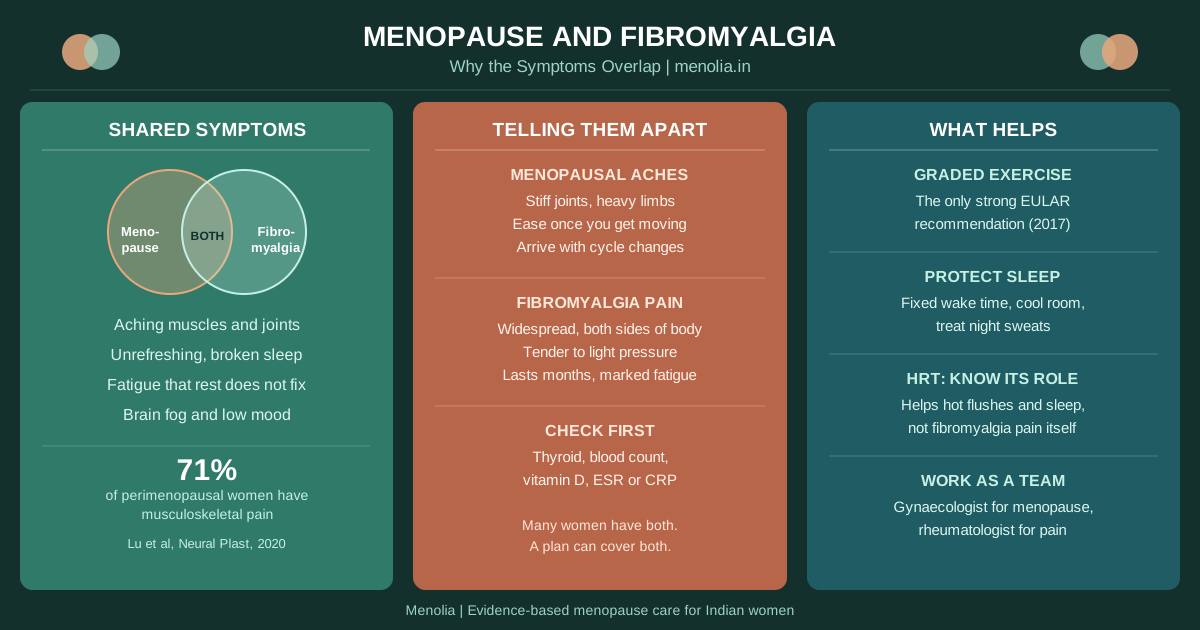
Aches are one of the most common parts of the menopause transition. A meta-analysis of 16 studies (Lu CB et al., Neural Plast, 2020, PMID 33299396) estimated that 71% of perimenopausal women experience musculoskeletal pain, and found that the odds of moderate to severe pain rise from premenopause through perimenopause into postmenopause.
Fibromyalgia is far less common, but it is not rare in women. A meta-analysis covering more than 3.6 million people (Heidari F et al., Rheumatol Int, 2017, PMID 28447207) estimated fibromyalgia prevalence at 1.78% in the general population and 3.98% among women. Fibromyalgia is now understood as a problem of pain processing: the nervous system turns up the volume on pain signals, and the condition typically travels with fatigue, memory problems, and sleep and mood disturbances (Clauw DJ, JAMA, 2014, PMID 24737367).
Put those two descriptions next to each other and the difficulty is obvious. Both can bring:
- Aching in muscles and around joints
- Tiredness that sleep does not fix
- Broken or light sleep
- Brain fog and forgetfulness
- Low mood, irritability or anxiety
- Headaches and digestive upsets
This overlap shows up in the research too. In a survey of 216 women aged 35 to 55 living with fibromyalgia or chronic fatigue syndrome (Wilbur J et al., Health Care Women Int, 2006, PMID 16844673), women who were peri- or postmenopausal reported more severe musculoskeletal, digestive and hot-flush symptoms than those who were still premenopausal.
Ordinary Menopausal Aches or Fibromyalgia?
No single feature settles it, but some patterns point one way or the other. This is a guide for your conversation with a doctor, not a self-diagnosis tool.
| Feature | More typical of menopausal aches | More typical of fibromyalgia |
|---|---|---|
| Where it hurts | Stiff joints, heavy limbs, often in a few areas | Pain in many areas on both sides of the body |
| How it feels | Achy, stiff, worse in the morning | Deep, burning or throbbing; skin and muscles can be tender to light pressure |
| Sleep | Broken by night sweats or waking to pass urine | Unrefreshing even after a full night, whether or not night sweats are present |
| Timing | Began around the time periods became irregular | May have started years earlier, then got harder to manage around menopause |
| Response to activity | Usually eases once you get moving | Too much at once can bring a flare the next day, while steady, gradual activity helps over weeks |
| Other features | Hot flushes, night sweats, cycle changes | Marked fatigue, memory and concentration difficulty |
Fibromyalgia is diagnosed clinically, from the pattern and severity of symptoms. There is no blood test or scan that confirms it. The criteria have changed over time: the 2010 American College of Rheumatology criteria removed the need for a doctor to press on specific tender points (Queiroz LP, Curr Pain Headache Rep, 2013, PMID 23801009), and a 2016 revision added a requirement that the pain be generalised across the body rather than limited to one region, so that a localised problem is not mislabelled (Wolfe F et al., Semin Arthritis Rheum, 2016, PMID 27916278). The same revision made clear that fibromyalgia can be diagnosed even when another condition is also present. That matters here, because menopause and fibromyalgia are not an either-or.
Why Menopause Can Bring Fibromyalgia to the Surface
Oestrogen is one of several influences on how the nervous system handles pain. When it falls, some women become more sensitive to pain than they were before. Whether that is enough to trigger fibromyalgia in someone who never had it is an open question, and the studies we have point to an association, not proof.
Early menopause turns up more often in women with fibromyalgia. In a Turkish study of 115 postmenopausal women with fibromyalgia compared with 67 women with rheumatoid arthritis (Pamuk ON et al., Clin Rheumatol, 2009, PMID 19169621), early menopause (at 45 or younger) was reported by 38.3% of the fibromyalgia group against 13.4% of the arthritis group, and hysterectomy by 16.5% against 6%. About a quarter of the women with fibromyalgia said their symptoms began with menopause or within the first year after it.
An earlier menopause is linked with greater pain sensitivity. In a Spanish study of 74 postmenopausal women with fibromyalgia and 32 without (Martínez-Jauand M et al., Clin Rheumatol, 2013, PMID 23417348), women with fibromyalgia whose menopause came at 49 or earlier were more sensitive to pain on testing than those with a later menopause. No such difference appeared in women without fibromyalgia.
Often, fibromyalgia was already there. In a 2026 Greek study of 169 women with fibromyalgia (Gkouvi A et al., Maturitas, 2026, PMID 41785644), fibromyalgia had begun before menopause in 51.0% and at the same time as it in 21.9%. Women with more severe fibromyalgia also reported more severe menopausal symptoms, so each condition seemed to add weight to the other.
Sleep links the two. Night sweats and early waking break sleep, and poor sleep lowers the threshold for pain the next day. Pain in turn makes it harder to sleep. Add the stress of midlife, including caring for parents and children at the same time, and it is easy to see how a manageable level of pain can tip into something that takes over the day. Hormones are one input in that loop among several, which is why treating the hormones alone rarely resolves it.
Living with widespread pain and not sure whether it is menopause, fibromyalgia, or both? Dr. Suganya can go through your symptoms, reports and sleep pattern with you and help you plan the next step.
What to Check Before Calling It Either
Because both menopause and fibromyalgia are diagnosed from symptoms, it is worth ruling out conditions that look similar and have their own treatment. A doctor will usually suggest a few simple blood tests, commonly:
- Thyroid function (TSH). An underactive thyroid causes aches, tiredness, low mood and weight gain, and it is common in Indian women over 40. Our guide to hypothyroidism and menopause explains how the two get confused.
- Complete blood count. Anaemia from heavy perimenopausal bleeding can add a great deal to fatigue.
- Vitamin D. Low levels are common in India and can contribute to bone and muscle aches.
- Inflammation markers (ESR or CRP). These help separate inflammatory conditions from fibromyalgia, where they are typically normal.
Normal results do not mean the pain is imagined. In fibromyalgia, the tests are expected to be normal, because the problem lies in how pain is processed rather than in damage to the muscles or joints.
When a rheumatologist should see you
Some features suggest an inflammatory or autoimmune condition rather than menopausal aches or fibromyalgia, and they deserve a rheumatology opinion:
- Joints that look swollen or feel warm, not just painful
- Morning stiffness that lasts more than an hour
- A new rash, mouth ulcers, very dry eyes and mouth, or fingers that turn white in the cold
- Fever or unexplained weight loss
- Muscle weakness, such as difficulty getting up from a chair or lifting your arms above your head, rather than aching
These call for a prompt check, and most of them have clear tests and effective treatment. If you already live with rheumatoid arthritis, lupus or Sjogren’s syndrome, our post on menopause and autoimmune disease covers how those conditions shift at this stage.
Fibromyalgia is a real diagnosis in India too, and women often live with it for years before it is named. In a study of 107 Indian patients with fibromyalgia (Kumar A et al., Natl Med J India, 2026, PMID 42325028), the average duration of pain was 7.3 years. If you have been told your pain is “just stress” for a long time, a fresh, structured look is reasonable.
Where HRT Fits, and Where It Does Not
This is the question women ask me most often, and the evidence is less encouraging than many hope.
In a placebo-controlled trial of hormone therapy for fibromyalgia (Stening KD et al., Rheumatology, 2011, PMID 21078629), 29 postmenopausal women with fibromyalgia used a transdermal estradiol patch or a placebo patch for eight weeks. Estradiol levels rose as expected, but pain scores and pain sensitivity did not differ between the two groups.
An open study from Brazil (Dias RC et al., Minerva Obstet Gynecol, 2023, PMID 35686636) gave twelve weeks of transdermal estradiol with micronised progesterone to menopausal women with and without fibromyalgia. Women with fibromyalgia reported improvement on a fibromyalgia impact questionnaire, and both groups slept better and reported better quality of life. Without a placebo group, though, it cannot show how much of that change came from the hormones.
A 2024 review in Climacteric (Vidal-Neira LF et al., Climacteric, 2024, PMID 39037037) drew the practical line clearly: evidence for hormone therapy in fibromyalgia itself is limited, so it should not be recommended for fibromyalgia unless the woman also has menopausal symptoms that need treating.
In practice, that means:
- If hot flushes and night sweats are breaking your sleep, treating them can take one weight off the pain-and-sleep loop. HRT is the most effective treatment for these symptoms, and our guide to HRT in India covers who it suits.
- If you have fibromyalgia without troublesome menopausal symptoms, HRT is unlikely to help the pain, and other treatments deserve the first place.
There is one useful overlap on the non-hormonal side. The North American Menopause Society’s 2023 position statement (The North American Menopause Society, Menopause, 2023, PMID 37252752) recommends SSRIs, SNRIs and gabapentin among non-hormonal treatments for hot flushes, and SNRIs and gabapentinoids are also among the medicines used for fibromyalgia pain (Clauw DJ, JAMA, 2014, PMID 24737367). For some women, one well-chosen medicine can ease both, which is a decision to make with your doctor. Our post on non-hormonal hot flash treatment explains these options.
What Helps Both
The European League Against Rheumatism’s revised recommendations (Macfarlane GJ et al., Ann Rheum Dis, 2017, PMID 27377815) found that exercise was the only treatment with a strong recommendation for fibromyalgia. They advise starting with education and non-drug approaches, then adding psychological therapy, medicines for severe pain or sleep problems, or a rehabilitation programme when needed.
Graded movement. A Cochrane review of 13 trials with 839 people (Bidonde J et al., Cochrane Database Syst Rev, 2017, PMID 28636204) found that aerobic exercise improved pain intensity by about 11 points on a 100-point scale compared with no exercise, along with better physical function and quality of life. The key is starting low and building slowly. If a ten-minute walk flares your pain, begin with five minutes on most days and add a minute or two each week. The same approach helps menopausal joint stiffness, mood and sleep, and our guide to exercise during menopause has a realistic weekly plan.
Protecting sleep. A fixed wake-up time, a cool room, and limiting screens and tea late in the evening all help. Cognitive behavioural therapy for insomnia (CBT-I) is a structured, non-drug treatment for long-standing sleep problems, and our post on perimenopause sleep problems walks through it.
Understanding the pain. Knowing that fibromyalgia pain reflects an over-sensitive pain system, not damage, often makes it less frightening. Many women find they stop avoiding activity once they understand that the pain is not a sign of injury.
Pacing your energy. Spreading tasks through the day and the week, rather than pushing through on good days and collapsing afterwards, reduces flares. For the fatigue side of menopause, see our guide on menopause fatigue.
Support for mood. Low mood and anxiety make pain harder to bear, and pain makes mood worse. Psychological therapies such as CBT are part of the EULAR approach, and getting help with mood is part of treating the pain.
A Practical Starting Plan
- Keep a two-week diary. Note where it hurts, how you slept, any hot flushes or night sweats, and where you are in your cycle if you still have periods. Patterns that are invisible day to day become clear on paper.
- Get the basic tests done. Thyroid, blood count, vitamin D and an inflammation marker, as discussed with your doctor.
- Start moving, gently. Five to ten minutes of walking on most days, building slowly.
- Anchor your sleep. Same wake-up time every day, including weekends.
- Treat the menopausal symptoms that are breaking your sleep. Discuss hormonal or non-hormonal options.
- Bring in a rheumatologist if any of the features in the checklist above are present, or if the pain keeps progressing despite these steps.
When a woman with this picture speaks to me, I start by separating what belongs to menopause from what looks like fibromyalgia, treat the menopausal part directly, and work alongside her rheumatologist or physician on the rest. For most women, the plan ends up covering both conditions at once.
Frequently Asked Questions
Can menopause cause fibromyalgia?
It has not been shown that menopause causes fibromyalgia. Studies find early menopause and hysterectomy more often in women with fibromyalgia, and some women first notice symptoms around menopause, but these studies show an association rather than cause. In one recent study, fibromyalgia had started before menopause in about half of the women.
Does fibromyalgia get worse during menopause?
For many women it can feel worse. Falling oestrogen may increase pain sensitivity, and night sweats and broken sleep make pain harder to cope with. Studies also find that women with more severe fibromyalgia report more severe menopausal symptoms. Treating sleep and menopausal symptoms often makes the pain more manageable.
How do I know if it is menopause or fibromyalgia?
Menopausal aches are usually milder, often centred on joints and stiffness, and ease once you get moving. Fibromyalgia pain is widespread on both sides of the body, lasts months, and comes with unrefreshing sleep, marked fatigue and memory difficulty. A doctor makes the diagnosis from the overall pattern after ruling out conditions such as thyroid disease or anaemia.
Does HRT help fibromyalgia?
HRT is not a treatment for fibromyalgia itself. A placebo-controlled trial found that eight weeks of transdermal estradiol did not reduce fibromyalgia pain. HRT can still help if you have hot flushes and night sweats that disturb your sleep, because better sleep can make the pain easier to live with.
Which doctor should I see for fibromyalgia after 45?
A gynaecologist can assess and treat the menopausal side, including whether HRT or a non-hormonal option suits you. A rheumatologist confirms fibromyalgia and rules out arthritis or autoimmune conditions, especially if you have swollen joints, long morning stiffness, a rash or muscle weakness. Many women benefit from both working together.
Is exercise safe if I have fibromyalgia and menopause?
Yes, and it is the most strongly recommended treatment for fibromyalgia. Start low, with five to ten minutes of walking, and increase slowly over weeks. A mild rise in aches when you begin is common and does not mean harm; if a session causes a big flare, go back to the previous level for a while.
My tests are all normal. Is my pain real?
Yes. In fibromyalgia, blood tests and scans are expected to be normal, because the problem is how the nervous system processes pain signals, not damage to muscles or joints. Normal results help rule out other causes. They do not mean the pain is imagined.
If widespread pain, broken sleep and exhaustion have become part of your everyday life around menopause, you do not have to sort it out alone. Message Dr. Suganya Venkat on WhatsApp to talk it through over a video consultation.