A woman in her late 40s messaged me recently, embarrassed to even be asking. She had never had a problem with piles, not even during either of her two pregnancies. Now, a few years into perimenopause, she was noticing bleeding after bowel movements and a swelling that had not been there before. She wanted to know if this was somehow connected to “the change”, or if it was just bad luck.
It is a more common question than most women realise, and one that almost nobody asks out loud. Hemorrhoids carry a particular kind of embarrassment that keeps women quiet even with their own doctors, and that silence means most never hear a fuller picture: the connective tissue that supports the anal cushions changes with age and falling oestrogen, and bowel habits often shift around this time too, and both can plausibly make hemorrhoids more likely. Neither of those things has anything to do with hygiene or something you did wrong.
This post covers why hemorrhoids can newly appear or worsen around this age even without a pregnancy history, what is actually happening in the tissue, what genuinely helps, and when it is worth seeing a doctor rather than managing it alone.
What Hemorrhoids Are
Hemorrhoids are not a disease you either have or do not have. Everyone has hemorrhoidal cushions, cushions of blood vessels and supporting tissue that sit inside the anal canal and help maintain continence. The term “hemorrhoids” describes what happens when those cushions become enlarged, displaced downward, or engorged enough to cause bleeding, itching, discomfort, or a visible swelling.
Internal hemorrhoids sit higher up, inside the anal canal, and typically cause painless bright red bleeding, often noticed as streaks on toilet paper or in the toilet bowl, sometimes with a sense of tissue prolapsing during a bowel movement. External hemorrhoids sit under the skin around the anal opening and can be felt as a lump. They are usually only painful if a clot forms inside them, a thrombosed external hemorrhoid, which is uncomfortable but not dangerous and typically settles within one to two weeks.
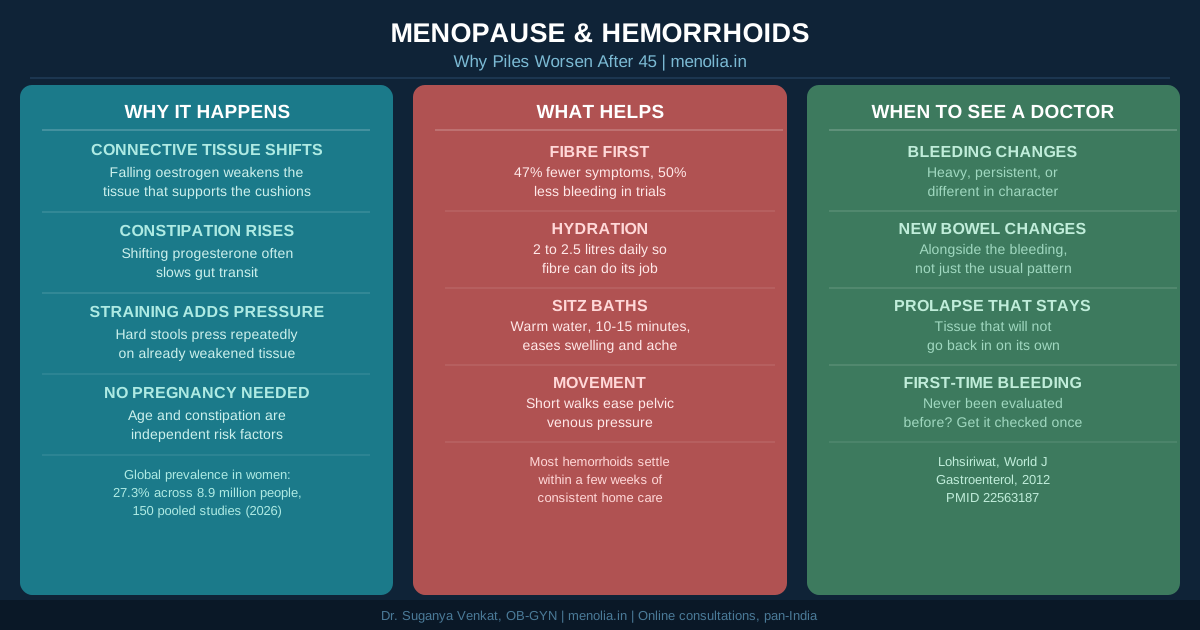
The best-described mechanism, which applies mainly to internal hemorrhoids, is a breakdown in the supporting connective tissue that normally holds these vascular cushions in their proper position, alongside dilation of the blood vessels themselves. Thrombosis of an external hemorrhoid is a different process, involving a clot forming in the external vascular plexus. A widely cited review describes this plainly, hemorrhoids develop through “destructive changes in the supporting connective tissue within the anal cushion” together with abnormal dilation of the vascular channels (Lohsiriwat V 2012, World J Gastroenterol, PMID 22563187). That single sentence explains why this is an age-linked condition, and why menopause, a period defined by connective-tissue change throughout the body, is relevant to it.
Why This Age, Why Now
Hemorrhoidal disease is genuinely common. A 2026 systematic review pooling data from over 8.9 million people across 150 studies found a global point prevalence of nearly 26%, and it was higher in women than in men, with older age, obesity, pregnancy, diabetes, family history, constipation, and hypertension all identified as associated factors (Esmaeilnia Shirvani A et al., Ann Med, 2026, PMID 41450176). Notice that “older age” and “constipation” both appear on that list independently of pregnancy, which is the part most women do not expect. You do not need a pregnancy history for hemorrhoids to become a problem in your 40s and 50s.
Dealing with bleeding, discomfort, or a new swelling and not sure if it is hemorrhoids? Dr. Suganya can talk through what you are noticing and whether it needs an in-person exam, over a video consultation.
Two things often sit alongside hemorrhoids at this age: what is happening to supporting tissue, and what is happening to bowel habits. Neither one alone fully explains it, and a menopause-specific cause has not been proven. Together they are a plausible combination, not an established mechanism.
The connective-tissue piece. Oestrogen has a broad, well-documented effect on connective tissue turnover across the body, not just in the reproductive organs. A review on menopause and connective tissue put it directly: “oestrogen has profound effects on connective tissue turnover, no matter the site,” and menopause has been shown to affect the connective tissue of the skin, the carotid artery wall, intervertebral discs, and bone in similar ways (Calleja-Agius J & Brincat M, Gynecol Endocrinol, 2012, PMID 21970508). This is the same underlying mechanism we discuss in menopause and varicose veins and in pelvic organ prolapse after menopause, where declining oestrogen weakens the collagen support of leg veins and pelvic floor tissue respectively. Direct research specifically on oestrogen and the anorectal cushions is limited, so this connection should be read as biologically plausible and consistent with what happens elsewhere in the body, not as a fully proven, hemorrhoid-specific mechanism. What is well established is that the anal cushions themselves are supported by the same kind of connective tissue that weakens elsewhere in menopause, and that hemorrhoids are, at their core, a connective-tissue problem.
The constipation piece. This one is more direct. As we cover in our guide to menopause and IBS, many women notice their bowel habits become less predictable through perimenopause, with constipation a common pattern. Why that happens is not settled, and it is almost certainly multifactorial rather than down to any single hormone: ageing, diet, fluid intake, activity levels, and medications all contribute alongside shifting hormone levels. Straining against a hard, infrequent stool is one of the most direct mechanical triggers for hemorrhoids, because it repeatedly increases pressure on the very cushions that are already losing some of their structural support. A lower-fibre diet, reduced fluid intake, some calcium supplements, and lower activity levels, all things that become more common around this stage of life, tend to compound the problem.
Put together, two things often sit alongside new or worsening hemorrhoids after 45: connective tissue that is less resilient with age, and a bowel habit that involves more straining. Age and constipation are the associations we have good evidence for. A menopause-specific effect on the anal cushions is biologically plausible and consistent with connective-tissue change elsewhere, but it is not a proven cause. None of this is something you did wrong.
What Genuinely Helps
The reassuring part of this story is that hemorrhoids are one of the most treatable conditions in this entire cluster, and most cases respond well to changes you can make yourself.
Fibre is the single most evidence-backed intervention. A systematic review and meta-analysis of seven randomised trials found that fibre supplementation roughly halved the risk of persisting hemorrhoid symptoms (relative risk 0.47, about a 53% relative reduction) and reduced bleeding by 50%, compared with a non-fibre control (Alonso-Coello P et al., Am J Gastroenterol, 2006, PMID 16405552). This is not a folk remedy, it is one of the better-studied interventions in this area. Indian diets already lean toward good fibre sources if you build meals around them deliberately: whole dals like rajma and chana, foods with the skin left on like guava and apples, ragi in place of refined flour, and bhindi, whose natural mucilage is gentle on the gut. Aim for a gradual increase rather than a sudden jump, since fibre added too quickly can cause bloating.
Hydration matters as much as fibre does. Fibre without adequate water intake can actually worsen constipation rather than relieve it, since fibre draws water into the stool to soften it. Drinking enough that you are comfortably not thirsty, with a little extra in hot weather, is the practical aim. There is limited evidence that pushing fluids beyond an already adequate intake helps constipation, and if you have been advised to limit fluids for a heart or kidney condition, follow that advice rather than a general target.
Do not strain, and do not linger. Straining on the toilet, and sitting there for long stretches scrolling your phone, both increase pressure on the anal cushions unnecessarily. If a bowel movement is not happening within a minute or two of sitting down, it is better to get up and try again later than to push.
A warm sitz bath is optional comfort, not a proven treatment. Sitting in a few inches of warm water for 10 to 15 minutes, once or twice daily, especially after a bowel movement, is a simple measure many women find soothing. Evidence that it materially reduces hemorrhoidal swelling or changes the course of the condition is limited, so treat it as comfort alongside fibre and hydration, not as something that has to work.
Topical relief has its place, used correctly. Over-the-counter creams containing a mild local anaesthetic or a short course of hydrocortisone can ease itching and discomfort. Hydrocortisone preparations are for short-term use. Follow the product label; many non-prescription anorectal hydrocortisone products tell you to seek medical advice if symptoms have not settled within about seven days. Prolonged use can thin the skin, so if you keep needing it past that window, have it assessed rather than continuing to self-treat.
Movement helps more than most people expect. Prolonged sitting increases pelvic venous pressure, the same mechanism behind the leg heaviness we describe in menopause and varicose veins. Getting up and walking for a few minutes every hour, particularly if your day involves long stretches at a desk, genuinely helps both conditions.
Tried fibre, water, and the basics, and it is still not settling? Dr. Suganya can review what you have tried, check whether anything else needs ruling out, and talk through the next step, over a video consultation.
When It Needs a Doctor, Not Just Self-Care
Most hemorrhoids settle with the measures above within a few weeks. A few signs mean it is worth having it properly looked at rather than continuing to self-manage:
- Bleeding that is heavy, persistent beyond a couple of weeks despite home care, or changes in character (darker blood, or blood mixed into the stool rather than on its surface, rather than the usual bright red streaking).
- A new change in bowel habit alongside the bleeding, particularly narrower stools, ongoing diarrhoea or constipation that does not resolve, or unintended weight loss.
- A hemorrhoid that prolapses and does not go back in on its own, or one that becomes suddenly very painful and hard, which can suggest a thrombosed external hemorrhoid.
- Any rectal bleeding if you have never had it properly evaluated before, especially if you have a family history of colorectal conditions.
None of this is to alarm you. Hemorrhoids are a common cause of rectal bleeding, and they do turn out to be the explanation for some women. But after 45, bleeding should never be assumed to be hemorrhoidal on appearance alone, because bright red blood can also come from a fissure, inflammation, a polyp, or a bowel cancer, and the only way to know for certain is a proper examination. Symptoms and colour cannot confirm the source. That is not something to be embarrassed about asking for. At Fertilia and Menolia, Dr. Suganya Venkat has this exact conversation with women regularly in video consultations.
You Are Not Imagining the Change
If piles never bothered you before and now they have, or if a mild issue has become a genuinely disruptive one, that is not bad luck and it is not something wrong with you specifically. Hemorrhoids become more common with age and with constipation; menopause may add a connective-tissue backdrop, but that part is plausible rather than proven. What is manageable either way is the straining, the fibre, the fluids, and a few simple habit changes, and for most women those are enough to bring real relief.
Frequently Asked Questions
Does menopause cause hemorrhoids?
Menopause does not directly cause hemorrhoids the way a single trigger would. Connective tissue throughout the body becomes less resilient as oestrogen declines, and many women notice new or worsened constipation through the menopausal transition, for several reasons rather than any single hormone. Age and constipation are associated with hemorrhoids. A menopause-specific effect on the anal cushions remains biologically plausible rather than proven, so it should not be treated as the established reason they appear or worsen after 45.
I never had hemorrhoids in pregnancy, why would I get them now?
Pregnancy and menopause put pressure on the same tissue through different routes. Pregnancy involves rising blood volume, a growing uterus pressing on pelvic veins, and progesterone-driven relaxation of vein walls. Those exposures largely recede after delivery, but hemorrhoids and some venous or connective-tissue changes can persist. Menopause instead involves a gradual, longer-term decline in the oestrogen that supports connective tissue, combined with age-related changes in bowel habit. Avoiding one does not protect you from the other, since the mechanisms are not the same.
What foods help with hemorrhoids in menopause?
Fibre is the best-studied dietary intervention, shown in a meta-analysis of randomised trials to meaningfully reduce both symptoms and bleeding. Whole dals such as rajma and chana, fruits like guava and apples eaten with the skin, ragi in place of refined flour, and bhindi are all practical, India-relevant ways to build fibre into daily meals. Increase gradually and pair with adequate water intake, since fibre without enough fluid can worsen constipation rather than help it.
Are hemorrhoid creams safe to use long term?
Over-the-counter creams for itching and discomfort are generally fine for short courses. Hydrocortisone-containing preparations specifically should follow the product label; many advise seeking medical advice if symptoms have not settled within about seven days, because prolonged use can thin the surrounding skin. If you keep reaching for the cream past that window, have the hemorrhoids assessed rather than continuing to self-treat.
When should I see a doctor about hemorrhoids after 45?
See a doctor if bleeding is heavy, lasts beyond a couple of weeks despite home care, or changes in character, if you notice a new change in bowel habit alongside it, if a hemorrhoid prolapses and will not go back in, or if you have never had rectal bleeding properly evaluated before. Bright red bleeding is often hemorrhoidal, but it can also come from a fissure, inflammation, a polyp, or a bowel cancer, and it can look the same in each case, so after 45 it is worth having examined rather than assumed.
Can hemorrhoids in menopause be linked to constipation?
Yes, and this is one of the more direct connections in this picture. Bowel habits often become slower or less predictable through perimenopause, for several reasons rather than one, and straining against hard or infrequent stools puts repeated mechanical pressure on the anal cushions. Addressing the underlying constipation, through fibre, fluids, and movement, often improves hemorrhoid symptoms directly.
Will hemorrhoids go away on their own after menopause?
Hemorrhoid symptoms often do settle on their own, and many thrombosed external hemorrhoids resolve without any treatment, although the cushions themselves remain and symptoms can return. Fibre, hydration, and the habit changes covered above make settling more likely and recurrence less frequent. Because the underlying connective-tissue changes of menopause are ongoing rather than a one-time event, staying consistent with these measures, rather than treating them as a short course, is what keeps symptoms manageable over the years that follow.
Is it normal to be embarrassed talking about this with a doctor?
Completely normal, and also one of the main reasons hemorrhoids go unmanaged for longer than they need to. This is an extremely common condition, not a hygiene failure or something unusual about your body. A doctor who treats women through this life stage has this exact conversation often, and getting it assessed properly is usually quicker and less uncomfortable than the anxiety of wondering about it alone.
If hemorrhoids have newly appeared or worsened since perimenopause began, this is a common and very treatable pattern, not something to manage alone out of embarrassment. Message Dr. Suganya Venkat on WhatsApp to talk it through.