Many women with multiple sclerosis (MS) were diagnosed in their twenties or thirties. They have spent years learning their disease: which symptoms mean a relapse, which ones come back when they are tired or unwell, and which medicine keeps things steady. Then, somewhere in their mid-forties, the ground shifts again. Fatigue gets heavier. Words go missing mid-sentence. The legs feel weaker on hot afternoons. Sleep breaks up, periods become irregular, and it is hard to know whether this is MS moving forward or menopause arriving.
That question is a reasonable one, and it deserves a careful answer. I’m Dr. Suganya Venkat, an OB-GYN, and my part in a woman’s MS care is the menopause side: sorting out which symptoms are hormonal, what can be treated, and how a menopause plan fits with the neurologist’s plan. This post walks through what the research says about MS across the menopausal transition, why the two sets of symptoms overlap so much, and what you can bring to your neurologist and gynaecologist.
What This Post Covers
- Why menopause is a normal part of the MS journey for most women
- What happens to relapses and disability around menopause, and where the studies disagree
- Why fatigue, brain fog, bladder changes and low mood are hard to assign to one cause
- How hot flushes and heat can bring back old MS symptoms without a new relapse
- Where HRT fits, including the clot question and bone health
- What to bring to your neurologist and gynaecologist
This post is for women who already have an MS diagnosis. If you have never been diagnosed and are worried about a new electric-shock or tingling sensation, our post on electric shock sensations during menopause explains the common menopausal causes and the specific features that need a neurologist’s assessment.
Menopause Is Part of the MS Story for Most Women
MS is more common in women. The third edition of the Atlas of MS, which pooled data reported by countries worldwide (Walton C et al., Mult Scler, 2020, PMID 33174475), estimated 2.8 million people living with MS globally, with women twice as likely as men to live with it and a mean age at diagnosis of 32.
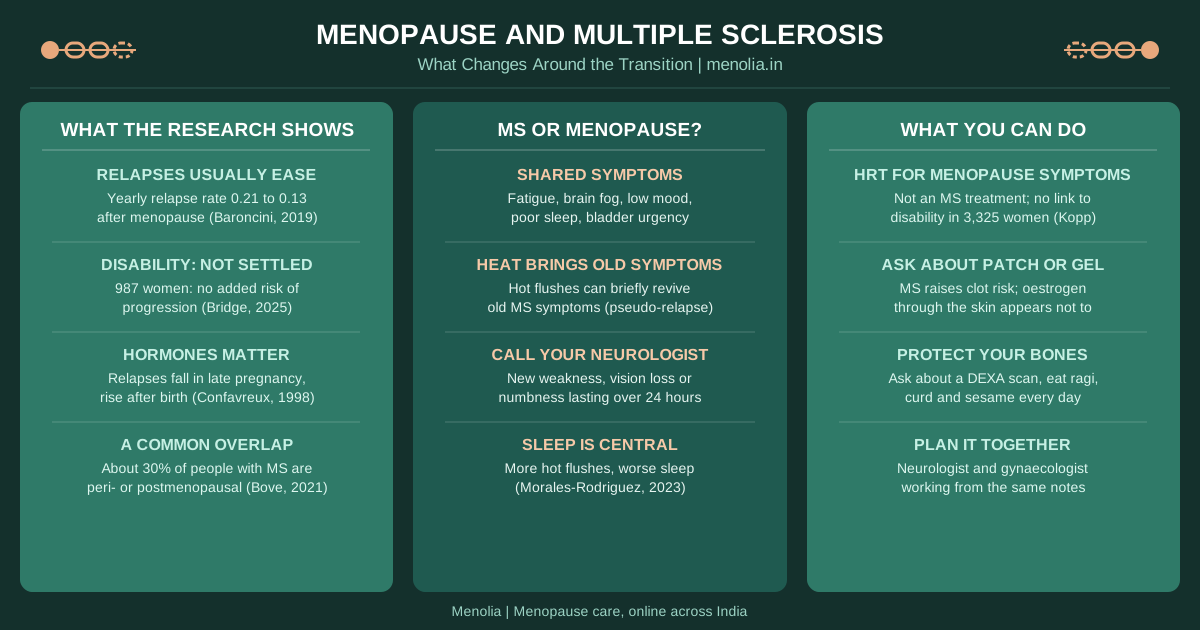
That age matters. A woman diagnosed in her early thirties will usually reach menopause while living with MS. An evidence-based review (Bove R et al., Front Neurol, 2021, PMID 33815241) estimated that about 30% of the current MS population is peri- or postmenopausal, and noted that having MS does not appear to change the age at which menopause starts.
Hormones and MS have a long, well-documented relationship. The clearest example is pregnancy. In the landmark PRIMS study of 254 women with MS across 269 pregnancies (Confavreux C et al., N Engl J Med, 1998, PMID 9682040), the relapse rate fell from 0.7 per woman per year before pregnancy to 0.2 in the third trimester, rose to 1.2 in the first three months after delivery, and then returned to the pre-pregnancy level. That pattern, settling when oestrogen and progesterone are high and rising after they drop, is one reason researchers have looked closely at menopause.
What Happens to Relapses and Disability Around Menopause
This is the question most women ask first: “Will menopause make my MS worse?” The research gives a mixed answer, and it helps to look at relapses and disability separately.
Relapses tend to become less frequent. In a multicentre study of 148 women followed for an average of 3.5 years on each side of their final period (Baroncini D et al., J Neurol Neurosurg Psychiatry, 2019, PMID 31189614), the annual relapse rate fell from 0.21 to 0.13 after menopause. A meta-analysis of four studies (Shahraki Z et al., BMC Neurol, 2023, PMID 37667181) also found that menopause was associated with a lower relapse rate. Relapses become less common with age and longer disease in general, so this drop may reflect ageing as much as hormones.
Disability is where the studies disagree. Some have found that disability, measured on the standard neurologist-rated scale (the EDSS), climbed faster after menopause:
- In the multicentre study above, disability worsened by an average of 0.4 points after menopause compared with 0.2 points before it. Smokers showed a trend towards faster worsening after menopause (Baroncini D et al., 2019).
- In a prospective cohort of 184 postmenopausal women followed for a median of 13 years (Silverman HE et al., Neurology, 2025, PMID 39715474), menopause marked a turning point towards faster decline on a set of timed performance tests (the MS Functional Composite), and a rise in a blood marker of nerve injury (serum neurofilament light chain).
Other large studies found no such effect:
- In an Australian registry study of 987 women with relapse-onset MS (Bridge F et al., JAMA Neurol, 2025, PMID 41021242), after adjustment, menopause was not associated with a higher risk of 6-month confirmed disability progression (hazard ratio 0.95) or of moving into secondary progressive MS (hazard ratio 1.00). The authors concluded that reproductive ageing may add to the effects of ordinary ageing, but that menopause is not the leading driver of disability in older women with MS.
- A cohort study of 559 peri- and postmenopausal women (Simonsen CS et al., Eur J Neurol, 2025, PMID 39601490) found no significant difference in disability progression or relapse rate in the five years before and after menopause.
So the fair summary is this: relapses usually ease with time, and whether menopause itself speeds up disability is not settled. Nobody can predict for an individual woman that menopause will make her MS worse. What changes more reliably is the load of symptoms around the disease, which is where much of the day-to-day difficulty comes from.
Fatigue, Brain Fog and Low Mood: MS, Menopause or Both?
Many symptoms of MS and menopause look alike. The 2021 review above lists cognition, mood, sleep and bladder function as the main areas of overlap, and notes that this makes it hard to tell which condition is driving a given symptom (Bove R et al., 2021). In a case series of women with MS describing their own menopause (Bove R et al., Mult Scler Relat Disord, 2016, PMID 27645345), women wrote about MS and menopausal symptoms blurring together, and about fatigue and thinking problems increasing after menopause. Some noticed no change at all.
Here is how the common overlaps tend to look. Use it to prepare for a conversation with your doctors, not to diagnose yourself.
| Symptom | Clues it may be menopausal | Clues it may be MS-related |
|---|---|---|
| Fatigue | Follows nights broken by sweats; improves when sleep improves | Builds through the day or with heat; can be heavy even after a good night |
| Brain fog | Word-finding lapses that come and go with poor sleep and hot flushes | Steady change in processing speed noticed by your neurologist on testing |
| Low mood or anxiety | Began with cycle changes; worse in the days around irregular periods | Present for years, or linked with a recent relapse or new disability |
| Bladder urgency | Comes with vaginal dryness, burning or recurrent urinary infections | Started with or after a relapse; comes with hesitancy or incomplete emptying |
| Joint and muscle aches | Diffuse, moving around, with stiffness on waking | Spasticity, cramps or stiffness in the legs that worsens with fatigue |
| Tingling or numbness | Brief, diffuse, with flushes or anxiety | New patch of numbness, weakness or vision change lasting more than a day |
The last row is the one to act on. If weakness in a limb, loss of vision in one eye, double vision, a drooping face or difficulty speaking comes on suddenly, seek emergency care straight away, even if you have MS and it looks like a relapse. Do not wait to see whether it lasts. A new symptom that builds up more gradually, such as a new band of numbness, and lasts more than 24 hours needs a prompt call to your neurologist, whatever your menopause stage, because it may be a relapse.
Sleep sits at the centre of much of this. In a study of 59 peri- and postmenopausal women with MS (Morales-Rodriguez D et al., Mult Scler, 2023, PMID 37715710), worse sleep quality went with more frequent and more disruptive hot flushes, and mental health was associated with sleep and mood rather than with the level of MS disability. The authors pointed to hot flushes, sleep and mood as an important care gap in this group. That is encouraging, because those are things a menopause plan can work on. Our guides to menopause fatigue and menopause brain fog cover the hormonal side in more detail.
Bladder symptoms deserve their own check. The genitourinary changes of menopause cause urgency, frequency and infections, and so can MS. A simple urine test to rule out infection, and treatment of vaginal dryness with local oestrogen if suitable, can sometimes take away a layer of symptoms that was being blamed on MS. Our post on bladder leaks after menopause explains what helps on the menopause side.
Living with MS and finding it harder to tell what is menopause and what is MS? Dr. Suganya goes through your symptoms, sleep and menopause stage, and helps you work out what to raise with your neurologist.
Hot Flushes, Heat and Old Symptoms Coming Back
Many people with MS are sensitive to heat. When body temperature rises, nerves that were damaged by old MS lesions conduct signals less well, and old symptoms can return for a while. This is called Uhthoff’s phenomenon. In a Japanese study (Park K et al., Eur Neurol, 2014, PMID 25195501), 48.1% of the MS patients who responded reported worse neurological symptoms when their body temperature rose. In a Swiss registry survey of 760 people with MS (Iaquinto S et al., Mult Scler Relat Disord, 2026, PMID 42501584), 73.3% reported sensitivity to temperature, and fatigue was the symptom most often made worse.
Indian summers already test this. Add hot flushes and night sweats, and a woman with MS can have several short bursts of heat a day. In the case series above, some women described MS symptoms and what they called pseudo-exacerbations being triggered by hot flushes (Bove R et al., 2016).
A pseudo-relapse is a temporary return or worsening of old symptoms, brought on by heat, fever, infection or exhaustion, that settles when the trigger passes. It does not mean new inflammation. This difference matters, because a true relapse may need steroids or a change in MS treatment, while a heat-related flare needs cooling and treatment of whatever is causing the heat. Some practical points:
- Note the timing. If blurred vision or leg weakness comes on during a flush or in the afternoon heat, and settles within hours as you cool down, tell your neurologist that pattern. A symptom that does not settle as you cool down, or persists beyond a day, needs assessment, and sudden new weakness, loss of vision or double vision needs emergency care straight away.
- Cool down early. A cool shower, a fan, a damp cotton cloth on the neck, and cotton clothing in layers help many women. Keep the bedroom as cool as you can.
- Treat the flushes themselves. Fewer hot flushes means fewer heat triggers. HRT is the most effective treatment, and non-hormonal medicines are an option if HRT does not suit you. Our guide to non-hormonal hot flush treatments compares them.
- Check for infection. A urinary infection is a common hidden trigger for a pseudo-relapse, and urinary infections become more frequent after menopause.
Where HRT Fits
HRT is not a treatment for MS. No trial has shown that hormone therapy slows MS in menopausal women, and your MS treatment stays with your neurologist. But HRT can be considered for menopause symptoms in women with MS in the same way as for any other woman, and the studies so far are reassuring.
- In a Danish nationwide registry study of 3,325 women with MS (Kopp TI et al., Eur J Neurol, 2022, PMID 35196406), hormone therapy was not associated with disability accrual, especially when used for under five years. Current users had a 20% higher risk of recurrent relapses, but that signal came mainly from 1996 to 2005, before today’s more effective MS medicines were in use.
- In a small year-long study of 14 peri- and early postmenopausal women with MS on hormone therapy (Juutinen L et al., Mult Scler Relat Disord, 2022, PMID 35994896), hot flushes and depressive symptoms decreased, insomnia improved in those who had it at the start, and no increase in MS activity was seen on clinical review or brain MRI.
- In the Nurses’ Health Study, postmenopausal women with MS who had used systemic hormone therapy had better physical quality-of-life scores than non-users (Bove R et al., Neurology, 2016, PMID 27605175). This was observational, so it shows an association, not proof that HRT caused the difference.
So the decision rests on your menopause symptoms and your individual risk profile. Our complete HRT guide for Indian women walks through that decision step by step. Two parts of it need more attention when you have MS.
The clot question. MS itself is linked with a higher risk of venous thromboembolism, a clot in a leg vein or the lungs. In a large cohort study (Peeters PJ et al., J Thromb Haemost, 2014, PMID 24502649), people with MS had about 2.6 times the risk of the comparison group (hazard ratio 2.56), and the risk was higher in those with reduced mobility, spasticity, recent steroid use or greater disability. Oral oestrogen also raises clot risk, while oestrogen through the skin appears not to: in the French ESTHER study (Canonico M et al., Circulation, 2007, PMID 17309934), oral oestrogen users had about four times the odds of a venous clot (odds ratio 4.2), while transdermal users showed no increase (odds ratio 0.9). If HRT is suitable for you, a patch or gel is usually the route to discuss, especially if your mobility is limited. Our guide to HRT and blood clots explains the route difference in more detail.
Your MS medicines. Most MS disease-modifying medicines have not been studied specifically alongside HRT. Ask your neurologist and pharmacist to check your exact combination, and make sure every doctor involved has your full medicine list.
Bones Need a Closer Look
Bone loss speeds up after menopause in every woman. With MS, several things can add to that: less weight-bearing activity, repeated steroid courses for relapses, and a higher risk of falls. In a Dutch population study of 2,415 people with MS (Bazelier MT et al., Neurology, 2012, PMID 22592374), MS was linked with a 1.7-fold higher risk of osteoporotic fracture and a 4-fold higher risk of hip fracture compared with people without MS. The risk was higher still in those recently prescribed antidepressants or sleeping and anti-anxiety medicines.
Practical steps that help:
- Ask about a DEXA bone scan around menopause, rather than waiting until 65, if you have had several steroid courses or have reduced mobility.
- Eat calcium-rich foods every day: curd, buttermilk, ragi, sesame (ellu), paneer and green leafy vegetables. Ask your doctor to check your vitamin D level.
- Keep doing weight-bearing and strength exercise that suits your mobility. A physiotherapist familiar with MS can design a programme that also works on balance.
- Make the home safer from falls: good lighting at night, a grab bar in the bathroom, and no loose rugs.
Our guide to bone health after menopause covers diet, exercise and treatment options in more detail.
Have MS and struggling with hot flushes, sleep or low mood? Dr. Suganya reviews your menopause symptoms, current medicines, clot risk and bone health over a video consultation, and suggests a plan you can take back to your neurologist. WhatsApp consultation at Rs 399.
Planning It Together With Your Neurologist
MS around menopause is best handled by your neurologist and gynaecologist working from the same information. Bring these to your next appointments:
- A symptom diary for four weeks: fatigue, sleep, hot flushes and night sweats, bladder symptoms, mood, and any MS symptoms that came and went. Note whether MS symptoms appeared during heat or flushes.
- Your menstrual history: when periods started changing, and the date of your last period.
- Your full medicine list, including your MS treatment, any steroid courses in the past few years, and supplements.
- Your smoking status. Smoking was linked with a trend towards faster disability after menopause in the multicentre study above, and stopping helps MS, bones and heart together.
- Questions for your neurologist: Has my MS changed on examination or MRI, or is this a heat or menopause effect? Does my MS medicine affect the choice of HRT? Is my mobility a factor in my clot risk?
- Questions for your gynaecologist: Are these symptoms likely to be menopausal? Is HRT suitable for me, and which route? Should I have a bone scan? What are the non-hormonal options?
When a woman with MS comes to Dr. Suganya Venkat for a video consultation, the first step is to separate the symptoms that can be treated in their own right, such as hot flushes, broken sleep, vaginal dryness and bladder urgency, from the ones that belong with the neurologist. Treating that first group leaves the MS plan untouched and can make the days noticeably lighter. If you have rheumatoid arthritis or lupus alongside MS, our post on menopause and autoimmune flares explains how those conditions behave around menopause.
Frequently Asked Questions
Does menopause make multiple sclerosis worse?
Not necessarily. Relapses usually become less frequent with time. Some studies found that disability progressed faster after menopause, while other large studies found no such effect. Many women go through menopause with their MS behaving much as before, though symptoms such as fatigue and poor sleep often increase.
Can menopause symptoms be mistaken for MS symptoms?
Yes, often. Fatigue, brain fog, low mood, poor sleep and bladder urgency occur in both. Patterns help: symptoms that follow broken sleep and hot flushes lean towards menopause, while a new symptom such as weakness, vision loss or a new band of numbness needs medical review. If it comes on suddenly, seek emergency care straight away. If it builds up gradually and lasts more than 24 hours, your neurologist needs to review it as a possible relapse.
Can hot flushes trigger MS symptoms?
They can. Heat makes nerves damaged by old MS lesions work less well, so old symptoms can return briefly during a flush, a hot afternoon or a fever. This is called Uhthoff’s phenomenon or a pseudo-relapse. It settles when you cool down and does not mean new inflammation, but tell your neurologist about the pattern.
Is HRT safe if I have multiple sclerosis?
For many women with MS, HRT can be considered in the same way as for other women. A Danish study of 3,325 women with MS found no link between hormone therapy and disability accrual, especially with under five years of use. Because MS can raise clot risk, a patch or gel is usually preferred, and the decision is best made with your neurologist and gynaecologist.
Will HRT slow down my MS?
There is no evidence that HRT slows MS. It is used to treat menopause symptoms such as hot flushes, night sweats and poor sleep. Easing those can help with energy and mood, which matters a great deal in MS, but your MS treatment stays with your neurologist.
Can MS start around menopause?
It can, though it is less common. The average age at MS diagnosis is in the early thirties, but some women develop or are diagnosed with MS in their forties and fifties. If you notice new neurological symptoms such as vision loss in one eye, weakness, or numbness, do not assume it is menopause. Seek emergency care straight away if they come on suddenly, and see a neurologist promptly if they build up more gradually.
Do women with MS need a bone scan after menopause?
It is worth asking about. MS is linked with a higher risk of osteoporotic and hip fractures, and repeated steroid courses and reduced mobility add to bone loss after menopause. A DEXA scan around menopause gives a baseline, and calcium-rich foods, vitamin D and suitable strength exercise all help protect bone.
If MS and menopause are pulling at you from both sides, a plan that looks at both can make each easier to live with. Message Dr. Suganya Venkat on WhatsApp to talk it through.