There is a tender lump in the fold under your breast again. You know how it will go: a few days of throbbing, then it bursts and drains, then it heals into another small puckered mark beside the old ones. It has happened under the breasts, in the groin, sometimes in the armpit, for years. Everyone has called them boils, heat boils, too much sweating. You had quietly hoped they would stop when your periods did. Now you are 48, your periods are irregular, and the lumps are still coming.
If that sounds familiar, the pattern may have a name: hidradenitis suppurativa, usually shortened to HS. It is a chronic inflammatory skin condition, it is not caused by poor hygiene, it is not an infection you can pass to anyone, and it is one of the most commonly missed diagnoses in skin medicine. Many women spend years treating each lump as a separate boil before anyone gives the pattern a name.
This post is for the woman in her forties or fifties who has those recurring lumps and wants to know what menopause will do to them. It covers what HS is, how to tell it apart from an ordinary boil or a fungal rash, what the research shows about flares around periods and after menopause (the evidence here is mixed), why the years around menopause can change the pattern, what treatment looks like, and when to see a dermatologist.
What hidradenitis suppurativa is
HS is an inflammatory disease that starts around hair follicles in the skin folds. A review in Nature Reviews Disease Primers describes painful inflamed nodules, abscesses and pus-discharging tunnels in the armpits, groin, buttocks and the area around the anus, usually starting in early adulthood, with genetic predisposition, smoking, obesity and hormonal factors as established contributors (Sabat R et al., Nat Rev Dis Primers, 2020, PMID 32165620). In women, the fold under the breasts is another common site.
It is far from rare. The same review puts the estimated prevalence at around 1% in most countries studied, and a 2025 meta-analysis of questionnaire-based surveys pooled a global estimate of 2.5%, while cautioning that the estimate should be read with care because data from the Global South are sparse (Zahid JA et al., Dermatology, 2025, PMID 39715604). Women are affected more often than men: a 2024 meta-analysis of 23 studies found female sex associated with roughly twice the odds of HS (OR 2.34) (Elzawawi KE et al., Int Wound J, 2024, PMID 39267324).
Because the lumps look like boils, HS is often treated as a run of bad luck rather than one condition. An international study led by dermatologists across several continents described this diagnostic delay as a global problem (Saunte DM et al., Br J Dermatol, 2015, PMID 26198191). If you have had the same kind of lump in the same places for years, the delay is not your fault, and naming it now still helps.
What it is called at home
Most women do not walk in saying “hidradenitis”. In Tamil homes the lumps are usually just called katti (கட்டி), a lump or boil, and in Hindi phoda (फोड़ा), a boil, often with “garmi” (heat) blamed for them. Those words describe a single lump well. When the “katti” keeps returning to the same folds, it is worth asking whether this is HS.
Is it HS, an ordinary boil, or a fungal rash?
These three get confused all the time, especially under the breasts, where heat and sweat sit in the fold.
An ordinary boil (a furuncle) is a one-off infection of a single hair follicle. It comes up, comes to a head, drains and heals, and you may not get another for years.
A fungal or sweat rash under the breasts (intertrigo, often with candida) is a flat, red, itchy or sore patch, sometimes with small satellite spots at the edges. It is on the surface. There are no deep, painful lumps.
HS has a pattern:
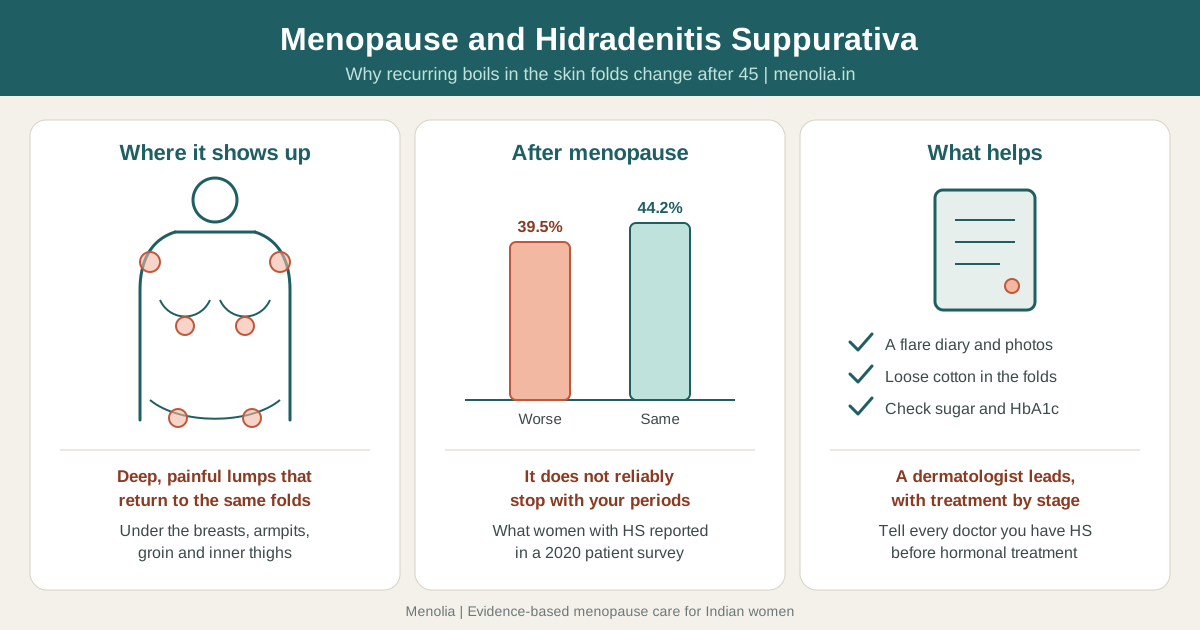
- Deep, painful lumps that return again and again, in the same areas
- Usually more than one site: under the breasts, the armpits, the groin, the inner thighs or the buttocks
- Often on both sides of the body
- Lumps that drain, heal with rope-like or pitted scars, and sometimes connect under the skin through tunnels that keep leaking
- Small blackhead-like dots, sometimes in pairs, in the affected folds
Researchers screening for HS in large populations use two simple questions: do you have recurrent boils, and in the past six months have you had two or more boils in the armpits, groin, around the genitals or on the buttocks (Zahid JA et al., 2025, PMID 39715604). If your answer to both is yes, show the area to a doctor and use the word hidradenitis.
Dermatologists then grade HS using Hurley staging: stage I is lumps and abscesses without tunnels or scarring, stage II is recurrent lumps with some tunnels and scarring, and stage III is widespread involvement with many connected tunnels. The stage helps decide which treatment comes first.
Recognising the pattern under your breasts or in your groin and unsure what it is? We can go through your history, your photos and your menopause symptoms together over a video call. Message Dr. Suganya on WhatsApp for a ₹399 video consultation.
What the research shows about periods, pregnancy and menopause
Hormones clearly matter in HS, because so many women notice a monthly rhythm. In an online survey of 283 women with HS who still had periods, 62.4% said their HS worsened with menstruation, and of those, 78.9% said the flare came in the week before the period started (Collier EK et al., Int J Womens Dermatol, 2020, PMID 33898701).
That monthly rhythm is why so many women hope HS will simply stop when their periods do. The evidence does not support that hope as a general rule. In a companion survey from the same research group, women reported how their HS changed after menopause: 39.5% said it got worse and 44.2% said it stayed the same, so improvement was the less common experience (Fernandez JM et al., Int J Womens Dermatol, 2020, PMID 33898700). In the same survey, 76.7% said menstruation made their HS worse.
A 2026 systematic review of menopause and common skin conditions found that HS responses to menopause were inconsistent (Roster K et al., Am J Clin Dermatol, 2026, PMID 41331233). An older endocrine study of 66 women with HS included eight who were already past menopause when they presented and one who developed HS for the first time six years after menopause, and it found no excess of androgens in the blood of women with HS compared with matched controls (Barth JH et al., Br J Dermatol, 1996, PMID 8763424).
So here is where the evidence leaves you. HS does not reliably fade after menopause. It can continue, it can change character, and occasionally it starts later in life. Some women do find their flares become less frequent or less tied to a calendar. You will only know your own pattern by watching it, which is one reason a simple flare diary is so useful in these years.
Why the menopause years can change your flares
Nobody can yet say exactly why one woman’s HS settles while another’s worsens. But several things that shift around menopause are known to matter in HS, and each one is something you can work on.
The monthly trigger goes, but perimenopause comes first. If your flares tracked your cycle, perimenopause can make them unpredictable before they settle, because cycles become irregular, sometimes closer together, sometimes months apart. Once periods have stopped for good, any flare pattern that was tied to the premenstrual week should lose that timing, even if the HS itself carries on.
Weight moves towards the middle. Many women gain weight around the waist after 45, and the fold under the breasts and the lower abdominal fold get deeper and warmer. Obesity is one of the strongest associations with HS, with roughly 2.5 times the odds in the 2024 meta-analysis (OR 2.48) (Elzawawi KE et al., 2024, PMID 39267324). Why this fat shift happens, and the approaches that help, are covered in the menopause belly fat guide.
Insulin resistance rises. The same meta-analysis found HS associated with type 2 diabetes (OR 2.78), and an Indian study of 30 patients with HS found more severe HS linked to higher BMI and higher fasting insulin (Mendiratta V et al., Indian J Dermatol, 2023, PMID 37151284). Menopause itself nudges blood sugar upwards, which is explained in the menopause and blood sugar guide. If you have HS and are over 45, a fasting sugar and HbA1c are worth checking.
Hot flashes and night sweats add heat and moisture to the folds. HS is not caused by sweating, but sweat, heat and friction in an already inflamed fold make it more uncomfortable, and many women find tight synthetic clothing aggravates sore areas. Managing the sweats themselves helps your comfort generally, and the practical steps in the night sweats guide apply here too.
Smoking. Smoking had the strongest association of all in that meta-analysis (OR 3.10) (Elzawawi KE et al., 2024, PMID 39267324). If you smoke or use tobacco in any form, stopping is one of the few things that helps both HS and your menopause health at once.
Hormone treatments you may be starting. Few women are told about this one. In the 2020 perimenstrual survey, more than a quarter of women who had used medroxyprogesterone acetate or a hormonal intrauterine device (such as the one often used for heavy perimenopausal bleeding) reported their HS got worse, while more than a third of those treated with spironolactone reported improvement (Collier EK et al., 2020, PMID 33898701). These are self-reported survey answers, not trial results, so they are a reason to tell your doctor you have HS before starting a hormonal treatment, not a reason to refuse one. For systemic menopausal hormone therapy, the 2026 review found the HS data too limited to draw a conclusion (Roster K et al., 2026, PMID 41331233). If you are weighing HRT for your hot flashes or sleep, the HRT in India guide covers the broader decision, and your HS is one more piece to mention in that conversation.
What treatment looks like
HS is treatable, and getting the diagnosis named is what opens the door to treatment matched to your stage. A dermatologist leads HS care. The 2019 North American guidelines for medical management describe a stepwise range of options: topical treatments, oral antibiotics, hormonal therapies and a growing group of immune-targeted medicines (Alikhan A et al., J Am Acad Dermatol, 2019, PMID 30872149). Part I of the same guidelines covers procedural options, including surgery (Alikhan A et al., J Am Acad Dermatol, 2019, PMID 30872156). In practice, depending on your stage, treatment may include:
- Gentle skin care with an antiseptic wash on the affected folds, and loose cotton clothing that does not rub.
- Topical antibiotics for early, mild lumps.
- Courses of oral antibiotics chosen for their anti-inflammatory effect as much as for bacteria.
- Hormonal or metabolic medicines in selected women. After menopause, the options and their safety are different from those for a younger woman, so this is a decision for your dermatologist and gynaecologist together.
- An injection into a single painful lump to settle it quickly.
- Biologic medicines for moderate to severe HS. In two large phase 3 trials, adalimumab brought a clinical response at 12 weeks in 41.8% and 58.9% of patients, compared with 26.0% and 27.6% on placebo, where a response meant at least halving the count of abscesses and inflammatory nodules, with no increase in the number of abscesses or draining fistulas (Kimball AB et al., N Engl J Med, 2016, PMID 27518661). Medicines that block a different immune signal, IL-17, have also improved responses in randomised trials (Ishkirat H et al., Skin Health Dis, 2026, PMID 42812940).
- Minor procedures or surgery to open up or remove tunnels that keep draining, which can bring lasting relief for areas that medicines alone have not settled.
Alongside whatever your dermatologist prescribes, the menopause-side work is where an OB-GYN can help: steadying weight around the waist, checking and improving blood sugar, supporting you to stop tobacco, managing night sweats, and choosing menopause or bleeding treatments with your HS in mind.
Two more things belong in the plan. HS can be exhausting to live with, and a 2025 meta-analysis found depression in 20.9% of people with HS compared with 8.4% in people without HS, and anxiety in 19.3% compared with 8.1% (Folkmann CL et al., Br J Dermatol, 2025, PMID 40251988). If your mood has been low, that is a recognised part of living with this condition, and the menopause mood guide is a place to start. And a 2026 review has raised bone health as an under-recognised concern in women with long-standing HS, because chronic inflammation, repeated steroid courses, low vitamin D and lower activity may add to the bone loss of menopause, while noting that direct evidence is still limited (Beraja GE et al., Int J Womens Dermatol, 2026, PMID 42369852). The menopause bone health guide covers what you can do about that.
If you also have eczema or psoriasis flaring at this age, those are covered separately in the perimenopause eczema and psoriasis guide.
Practical steps for this month
- Start a flare diary. Note the date, the site, and anything around it: your period (if you still have one), a new medicine, a hot week, a stressful stretch. Two or three months of this tells you and your doctor more than any single photo.
- Take photos of each lump on the day it appears and as it heals. Many flares settle before an appointment, and photos let a dermatologist see the pattern anyway.
- Switch to loose cotton in the folds, especially under the breasts. A soft, well-fitting cotton bra and cotton innerwear reduce friction.
- Do not squeeze or cut lumps at home. Handling them this way can worsen the inflammation and injure the skin further. A warm compress can ease the pain while you wait to be seen.
- Ask for a fasting sugar and HbA1c if they have not been checked in the past year.
- Tell every prescribing doctor you have HS, particularly before starting a hormonal IUD, progestogen tablets or HRT.
When to see a dermatologist
Book a dermatology appointment if you have:
- Painful lumps that keep returning in the folds, even if each one heals
- Lumps that leave scars, keep draining, or seem connected under the skin
- More than one site affected, or both sides of the body
- Flares that are getting more frequent or that stop you from working, sleeping or moving comfortably
And see a doctor in person promptly for a high fever with a spreading hot red area of skin, or for any single firm lump in the breast itself that stays put and does not come and go like your usual flares. These need examining in their own right, and most of the time the answer is reassuring.
Frequently Asked Questions
Does hidradenitis suppurativa go away after menopause?
Not reliably. Many women hope it will because their flares were tied to their periods, but in a survey of women with HS, 39.5% said it worsened after menopause and 44.2% said it stayed the same. Some women do find flares become less frequent. Watching your own pattern with a flare diary is the best guide.
Can hidradenitis suppurativa start for the first time after 45?
It usually begins in early adulthood, but it can appear later. One study of women with HS included a woman whose HS started six years after menopause. A new pattern of recurring lumps in the folds at any age deserves a proper diagnosis rather than repeated treatment as separate boils.
Is it just boils from heat or poor hygiene?
No. HS is a chronic inflammatory condition that starts around hair follicles. It is not caused by being unclean and it is not contagious. Heat, sweat and friction can make sore areas feel worse, but they do not cause the disease.
Will HRT make my hidradenitis better or worse?
There is not enough good evidence to say either way for systemic menopausal hormone therapy. A survey did find that more than a quarter of women who had used certain progestogen treatments or a hormonal IUD reported their HS worsened. If you are considering HRT or a hormonal IUD, tell your doctor about your HS so the choice is made with it in mind.
Why do I get painful lumps under my breasts after 40?
The common causes are a one-off boil, a fungal or sweat rash in the fold, or HS. A rash is flat and itchy on the surface. HS causes deep, painful lumps that return to the same places, drain and scar. A single firm lump within the breast itself is different again and should be examined by a doctor.
Can weight loss help hidradenitis suppurativa?
Obesity is strongly linked with HS, and losing some weight around the waist reduces friction and depth in the folds. It is one helpful part of a plan that also includes the medical treatment your dermatologist recommends, not a replacement for it.
Is hidradenitis linked to diabetes?
Yes, people with HS are more likely to have type 2 diabetes, and blood sugar tends to rise after menopause. If you have HS and are over 45, ask for a fasting sugar and HbA1c test.
I’m Dr. Suganya Venkat, an OB-GYN with more than 15 years of practice, and in Menolia’s menopause consultations I ask about recurring lumps in the skin folds, because women rarely bring them up on their own after talking through hot flashes and sleep. Your dermatologist leads the skin treatment. Alongside that care, I can help you with the menopause side of the picture: weight, blood sugar, night sweats, and choosing bleeding or hormone treatments that suit you and your skin.
Chat with Dr. Suganya on WhatsApp about HS and your menopause symptoms