You finish the cream. The itching settles. Three weeks later it is back, the same burning, the same thick white discharge, the same quiet embarrassment at the chemist’s counter. After the third or fourth round you start to wonder whether this is simply what life after 45 looks like.
It does not have to be. And there is one fact that surprises most women I speak to: true yeast infections usually become less common after menopause, not more. So when “thrush” keeps returning in your late forties or fifties, it is a signal worth reading carefully rather than a reason to keep buying the same tube.
This post covers why candida behaves differently across perimenopause and menopause, the situations that make it more likely to return, the conditions that are often mistaken for it, and when a swab genuinely changes the plan.
What Thrush Is, in Plain Terms
Thrush is the everyday name for vulvovaginal candidiasis, an overgrowth of a yeast called Candida, most often Candida albicans. Small amounts of candida live harmlessly in the vagina of many healthy women. Symptoms appear when the balance shifts and the yeast multiplies.
The classic picture is:
- Itching and soreness of the vulva and vaginal opening
- A thick, white, curd-like discharge that usually does not smell strongly
- Burning when urine touches irritated skin
- Discomfort or stinging during sex
A review in the Lancet describes vulvovaginal candidiasis as a common problem worldwide, and notes that the lack of quick, simple tests leads to both overdiagnosis and underdiagnosis (Sobel JD, Lancet, 2007, PMID 17560449). That second point matters a great deal for women in midlife, as you will see below.
Why Oestrogen Changes the Picture
During the reproductive years, oestrogen keeps the vaginal lining thick and stocked with glycogen, a stored sugar. The friendly lactobacilli feed on that glycogen and keep the vagina mildly acidic. Candida also does well in this oestrogen-rich environment, which is why thrush is common in pregnancy and in the years when periods are regular.
After menopause, oestrogen falls. The lining becomes thinner, holds less glycogen, and the vaginal environment shifts. This is the change behind genitourinary syndrome of menopause (GSM), and one side effect of it is that candida has less to live on.
So the pattern across the transition looks roughly like this:
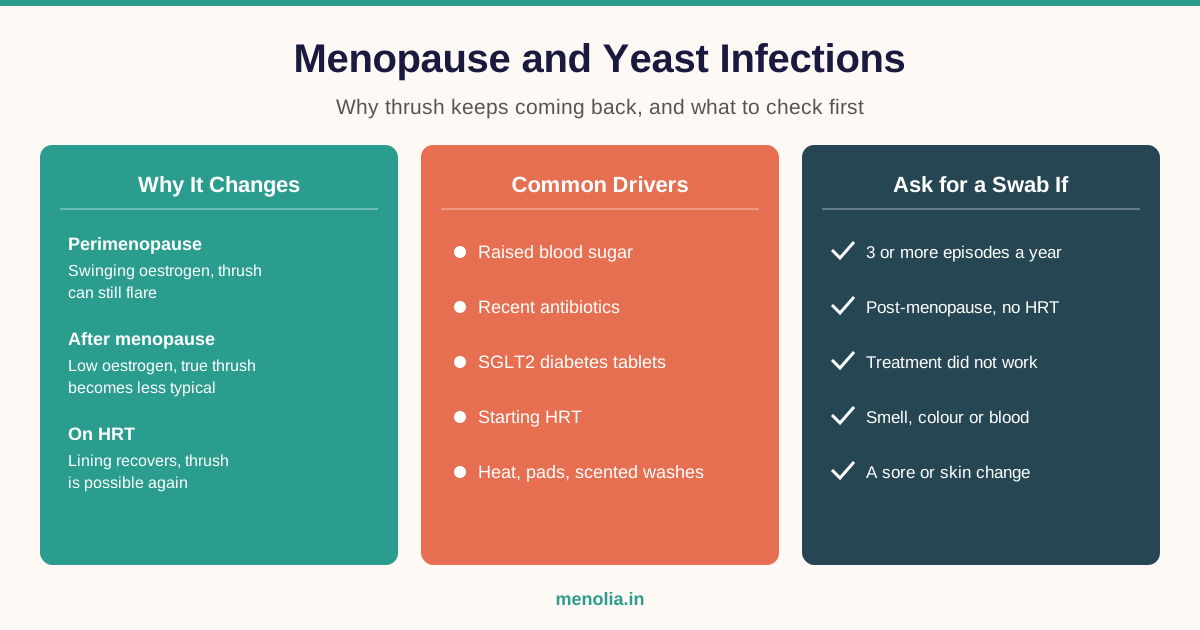
| Stage | What is happening with oestrogen | What this tends to mean for thrush |
|---|---|---|
| Perimenopause | Levels swing up and down | Thrush can still flare, sometimes around the high-oestrogen phases of an irregular cycle |
| After menopause, no hormone therapy | Levels stay low | True thrush becomes less typical; itch and soreness more often come from other causes |
| After menopause, on HRT or vaginal oestrogen | Oestrogen is replaced | The vaginal lining recovers, and thrush becomes possible again |
None of this means thrush cannot happen after menopause. It means that if you are past your last period, not on any hormone treatment, and have “thrush” again and again, it is reasonable to ask whether candida is really the cause.
When Thrush Genuinely Keeps Coming Back
Some women in this age group do have true, repeated candida. The usual reasons are worth knowing, because most of them can be changed.
Blood sugar
Raised blood sugar is one of the most important and most fixable drivers. When glucose is high, more sugar reaches the vaginal and vulval tissues, and candida thrives on it. Type 2 diabetes becomes more common after 45, and many women first learn about their raised sugar because of recurring itching. If you have not had a recent HbA1c or fasting glucose test, this is a good reason to get one. Our guide to blood sugar and diabetes risk after menopause explains which tests to ask for.
One diabetes medicine deserves a special mention. The SGLT2 inhibitor group (dapagliflozin, empagliflozin and similar tablets) works by passing extra sugar out in the urine. A meta-analysis of 77 randomised trials found these drugs raised the risk of genital infections in people with type 2 diabetes (Liu J et al., Sci Rep, 2017, PMID 28588220). These are valuable medicines with real heart and kidney benefits, so please do not stop one on your own. If you started one and thrush followed, tell the doctor who prescribed it. Often simple hygiene steps and prompt treatment are enough to continue safely.
Hormone therapy
Starting HRT or a vaginal oestrogen cream brings the vaginal lining back to its younger state. For most women that is exactly the point, and it relieves dryness and pain. Occasionally it also brings back the conditions in which thrush lives. This is not a reason to avoid HRT. It is useful to know, so a new itch in the first months of treatment is recognised and treated rather than blamed on the HRT itself. If you are using a local cream, our guide to vaginal oestrogen in India covers how it is used.
Antibiotics and steroids
A course of antibiotics clears the protective lactobacilli along with the infection it was meant for, and thrush often follows within days. Long-term steroid tablets and some immune-lowering medicines can have a similar effect.
Heat, moisture and friction
Tight synthetic clothing, long hours sitting in humid weather, sanitary or incontinence pads worn all day, and scented washes all irritate the skin and keep it damp. In an Indian summer this is a very real factor.
If the itching keeps returning and you would like a clear plan instead of another tube of cream, you can talk it through with Dr. Suganya. Message her on WhatsApp.
Conditions Often Mistaken for Thrush After 45
Because itch and soreness are the main symptoms, several other conditions get labelled “thrush” and treated with antifungals that cannot help them. In my years as an OB-GYN, this is the single most common reason a woman tells me her thrush “never really goes away”.
- Genitourinary syndrome of menopause. Thin, dry tissue itches, stings and tears easily. There is usually little or no discharge. Antifungals do nothing; local oestrogen or moisturisers do.
- Lichen sclerosus. A chronic skin condition of the vulva that peaks after menopause, causing intense itch, often worse at night, with white or crinkly patches of skin. It needs a steroid ointment, not an antifungal. Our post on lichen sclerosus after menopause describes how to recognise it.
- Bacterial vaginosis. A thin, grey discharge with a fishy smell, especially after sex. It is a bacterial imbalance and needs different treatment.
- Contact dermatitis. Soaps, wipes, pad liners, perfumed powders and even some antifungal creams can irritate the skin and cause a rash that looks like thrush.
- Urinary symptoms. Burning on passing urine can come from the bladder rather than the vulva. Our guide to UTIs after menopause explains the difference.
If discharge is part of what you are noticing, the post on discharge after menopause walks through what each colour and texture usually means.
When a Swab Changes the Plan
For a single, typical episode in perimenopause, many doctors reasonably treat without a test. A swab becomes important when:
- You have had three or four episodes or more in a year, which is how recurrent thrush is usually defined
- You are after menopause and not on hormone treatment, so true thrush is less likely
- Symptoms do not clear with a standard treatment
- The discharge has a smell, a colour or blood in it (after menopause, any bleeding or blood-stained discharge needs a prompt check by a doctor even if a swab finds candida)
- There is pain, a sore or a patch of skin that looks different
A high vaginal swab sent for culture confirms whether candida is present and which species it is. This matters because a minority of infections come from species such as Candida glabrata, which respond less well to the usual tablets and creams. If the swab is negative, it points your doctor towards the other causes listed above, which is just as useful.
Many women in India have used over-the-counter antifungals for years without ever having a swab. You are not doing anything wrong by having done so. A test is simply the step that turns guesswork into a plan.
How Recurrent Thrush Is Usually Treated
Treatment depends on what the swab shows, so this section is to help you understand the options, not to choose doses for yourself.
A single episode is usually treated with an antifungal pessary or cream or, if you are not pregnant, a single oral tablet of fluconazole. Women in perimenopause can still conceive, so if there is any chance you could be pregnant, tell your doctor before taking fluconazole. Oral fluconazole is avoided in pregnancy, and a seven-day course of a vaginal antifungal cream or pessary is used instead. The same pregnancy check applies before the longer and maintenance courses described below.
Confirmed recurrent thrush usually needs two stages: a longer initial course to clear the infection fully, followed by a maintenance course to keep it away while any possible trigger is looked for and managed. The best-known trial of this approach gave women weekly fluconazole for six months after clearing the infection. At six months, 90.8% of women on fluconazole were free of symptoms, compared with 35.9% on placebo. Six months after stopping, the figure in the fluconazole group had fallen to 42.9%, so the authors concluded that a long-term cure remains difficult (Sobel JD et al., N Engl J Med, 2004, PMID 15329425).
That last finding is why it helps to look for anything that may be feeding the infection. Maintenance treatment reduces episodes while it is taken, but it does not reliably cure recurrent thrush. In some women, bringing raised blood sugar down or reviewing a medicine such as an SGLT2 inhibitor helps. Changing pads or washes eases irritation, and recognising GSM or lichen sclerosus means the right condition gets treated. Many women with confirmed recurrent thrush have no clear trigger at all, and for them the plan is built around maintenance treatment and regular review with their doctor.
Fluconazole interacts with several common medicines, including some blood thinners and statins, so please take it only after your doctor has checked your other prescriptions.
Practical Steps You Can Start Today
- Wash with plain water or a mild, unscented cleanser. Avoid scented washes, antiseptic liquids in the bath water and vaginal douching.
- Choose loose cotton underwear, and change out of damp clothes after exercise or a long hot day.
- Change pads and liners often, and avoid wearing liners every day if you do not need them.
- Pat dry gently after bathing rather than rubbing.
- Check your sugar if it has not been tested in the past year.
- Keep a short diary of each episode: date, symptoms, what you used, any antibiotics, and whether you started a new medicine. This saves a lot of time at a consultation.
- Ask before repeating an over-the-counter antifungal more than twice in six months.
Plain dahi in your meals is a perfectly good food, but please do not put curd or any home remedy inside the vagina. It can introduce other bacteria and irritate already sore skin.
Frequently Asked Questions
Is thrush common after menopause?
Less common than before. Low oestrogen thins the vaginal lining and reduces the glycogen candida feeds on, so true thrush becomes less typical after menopause unless you are on HRT, vaginal oestrogen, have raised blood sugar, or have recently taken antibiotics. Repeated “thrush” after menopause often turns out to be GSM, lichen sclerosus or skin irritation.
Can perimenopause cause yeast infections?
Yes. During perimenopause oestrogen swings up and down, and in the higher phases the vaginal environment can still favour candida. Antibiotics, raised blood sugar and humid weather add to the risk. Most perimenopausal thrush responds to standard treatment.
Why does my thrush keep coming back?
The common reasons are raised blood sugar, a recent course of antibiotics, a diabetes medicine from the SGLT2 group, starting HRT or vaginal oestrogen, and skin irritation from pads, washes or tight clothing. It is also possible that the problem is not candida at all. A swab helps sort out which.
Can HRT cause thrush?
HRT and vaginal oestrogen restore the vaginal lining, which can occasionally make thrush possible again. It is usually easy to treat and is not normally a reason to stop hormone therapy. Mention it to your doctor so it can be treated and the HRT plan continued.
Is recurring thrush a sign of diabetes?
It can be. Repeated vaginal yeast infections are a recognised sign of raised blood sugar, and some women learn they have diabetes this way. A fasting glucose or HbA1c test is simple and worth doing if you have not had one recently.
Do I need a swab test for thrush?
Not for every episode. A swab is worth doing if you have had several episodes in a year, if you are after menopause and not on hormones, if treatment has not worked, or if the discharge smells, is coloured or contains blood. Any bleeding after menopause, including blood-stained discharge, needs a prompt check by a doctor even if candida is found, because a swab alone cannot rule out other causes.
Can my husband pass thrush back to me?
Thrush is not considered a sexually transmitted infection, and treating a male partner routinely has not been shown to prevent recurrence in women. If he has his own symptoms, such as an itchy rash, he should get them checked.
A Clear Next Step
Recurring thrush after 45 is common, uncomfortable and very treatable, but the answer is rarely another tube of the same cream. It is usually a swab, a blood sugar check, and a look at your medicines and daily routine. Dr. Suganya Venkat, an OB-GYN with more than 15 years of experience, works through exactly this with women across India over a video consultation at Menolia, and the first consultation is ₹399.
If you are tired of the itch returning and want to understand what is driving it, start a conversation with Dr. Suganya on WhatsApp.