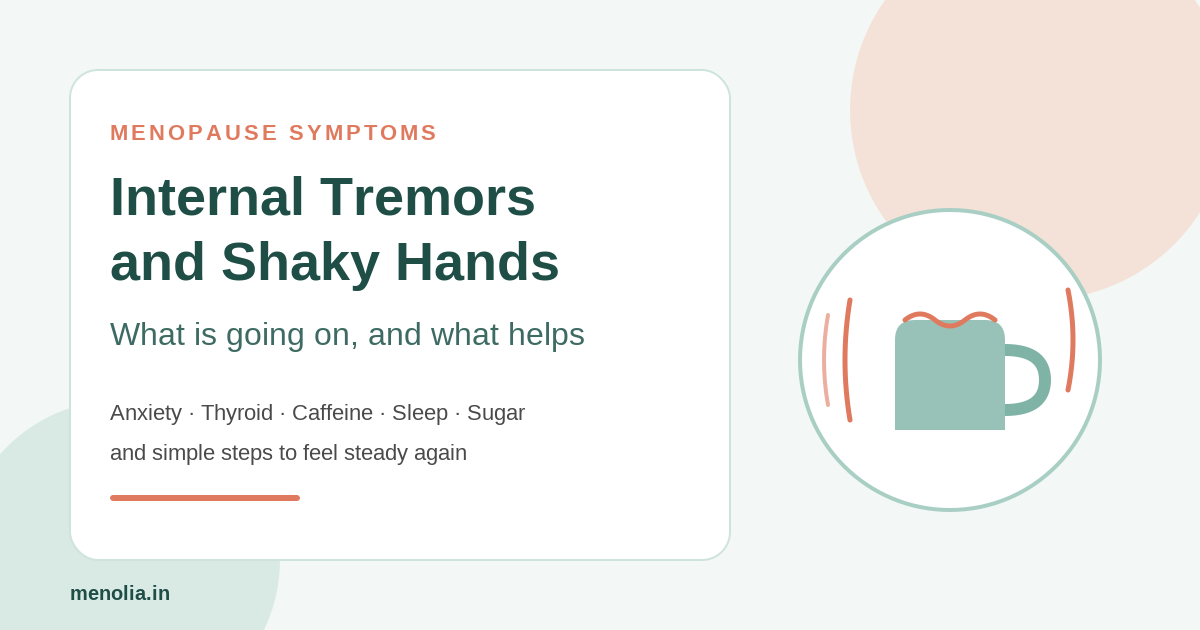
You are lying in bed, perfectly still, and yet something inside you feels like it is humming. Not your heart exactly, more like a quiet buzz running through your chest or belly. Or it shows up in the daytime: you lift a tumbler of filter coffee and notice the surface rippling because your hand will not stay steady.
Women describe this to me with some embarrassment, as if it sounds too strange to say out loud. It is not strange. I’m Dr. Suganya Venkat, an OB-GYN with more than 15 years of clinical practice, and in Menolia consultations “I feel shaky inside” comes up often enough that I now ask about it directly. Most of the time the cause is something we can name and work with, and a few simple checks help sort it out.
What This Post Covers
- What “internal tremor” and “shaky hands” usually mean
- Why they tend to show up around perimenopause
- The common causes that look alike: anxiety, thyroid, caffeine, low blood sugar, poor sleep and medicines
- A simple way to notice your own pattern
- What helps, day to day
- When a tremor needs a doctor to look at it
This post is about trembling and shaking. If what you feel is more like sudden zaps or a crawling sensation on the skin, our post on electric shock sensations and skin crawling in menopause covers that. If the main thing is a pounding or racing heart, see menopause heart palpitations.
What It’s Called in Tamil and Hindi
Many women search for this in their own words:
| Language | Word | Meaning |
|---|---|---|
| Tamil | nadukkam (நடுக்கம்) | trembling, shaking |
| Tamil | kai nadukkam (கை நடுக்கம்) | shaking hands |
| Hindi | kampan (कंपन) | trembling, vibration |
| Hindi | haath kaanpna (हाथ काँपना) | hands shaking |
Two Different Experiences
It helps to separate two things women often describe together.
Internal tremor. A sense of vibration or trembling inside the body, usually in the chest, abdomen or limbs, that you can feel but nobody can see. Many women notice it most when resting or lying down at night. There is very little formal research on internal tremor as a menopause symptom, so I will not give you a figure for how common it is. What I can say is that it is a familiar description in midlife clinics, and it often travels with anxiety, poor sleep or night sweats.
Visible shaking. A fine tremor of the hands that you or others can see, especially when holding something out (a phone, a cup, a pen) or doing a fine task like threading a needle. This is a physical sign a doctor can examine, and it has a clearer list of causes.
Both can happen at the same time. Both are worth noticing without panic.
Why It Tends to Show Up Around Perimenopause
The years before your final period are not a smooth decline in hormones. Oestrogen rises and falls unevenly, sometimes from week to week. Oestrogen affects the brain’s stress systems, temperature control and sleep, so these swings can leave the nervous system feeling more “switched on” than usual.
That shows up in several ways at once. Hot flashes and night sweats come with a burst of adrenaline-like activity in the body. Sleep gets broken. And anxiety becomes more likely, even in women who never felt anxious before. In the large SWAN study, which followed 2,956 women aged 42 to 52 for about ten years, women who had low anxiety at the start were more likely to report high anxiety in perimenopause and after menopause than before it (odds ratio 1.56 to 1.61), even after accounting for life stress and hot flashes (Bromberger JT et al., Menopause, 2013, PMID 23615639).
When your body is running on more stress hormones and less sleep, a background trembling feeling is an understandable result. That is the most common pattern I see. It does not mean it is “all in your head”, and it does not mean we skip checking other causes.
The Common Look-Alikes
Several everyday causes produce exactly the same shaky feeling. Going through them one by one is how you and your doctor find the real driver.
Anxiety and stress
Anxiety is a whole-body experience. A tight chest, a fluttery stomach, restless legs, a trembling sensation inside, and slightly shaky hands are all part of how adrenaline feels. If your tremor comes with racing thoughts, worry that is hard to switch off, or waking at 3 a.m. with your mind already busy, anxiety is a strong possibility. Our post on perimenopause anxiety treatment walks through the options, from breathing practice and CBT to hormone therapy and medicines.
An overactive thyroid
An overactive thyroid (hyperthyroidism) is one of the classic causes of a fine hand tremor. It often comes with a fast heartbeat, feeling hot, sweating, weight loss without trying, loose stools and irritability. Because several of these overlap with perimenopause, it is easy to miss. A simple TSH blood test sorts it out. Thyroid conditions are common in women around this age, and our guide to thyroid changes in menopause explains which tests help.
Caffeine
Many of us drink more coffee or tea when sleep is poor, and caffeine can make hands shakier and the body jittery. If you have gone from two cups a day to four, or you are drinking strong decoction coffee in the afternoon, that may be part of your tremor. Our post on coffee and caffeine in menopause has a two-week test you can try.
Low blood sugar
Going a long time without food can leave some women feeling shaky, sweaty and light-headed, and the feeling eases after eating. In women who do not have diabetes, these symptoms alone do not mean blood sugar is actually low. That can only be confirmed by a glucose reading taken while the symptoms are happening. Even so, steadier meals are worth trying if your shakiness tends to follow a skipped breakfast or a long gap between lunch and dinner. If you take medicine for diabetes, shakiness can be a sign of low sugar and you should check it as your doctor has advised.
Poor sleep
A few nights of broken sleep can make you feel wired and tremulous during the day. Night sweats waking you up, or lying awake from 2 to 4 a.m., both count. Our post on perimenopause sleep problems covers what helps.
Medicines
Some medicines can cause a fine tremor as a side effect, including asthma inhalers (like salbutamol), thyroid tablets when the dose is higher than you need, some antidepressants, and certain other prescriptions. Do not stop any medicine on your own. If a tremor began after starting or changing a medicine, mention it to the doctor who prescribed it so they can review it with you.
Feeling shaky inside and not sure why? Dr. Suganya Venkat consults online with women across India through perimenopause and menopause. WhatsApp 91 99402 00330 to ask about a consultation.
Essential Tremor: When It Is Not Hormonal
There is one more cause worth knowing about, simply so it does not surprise you. Essential tremor is a common, usually harmless condition where the hands (and sometimes the head or voice) shake during action, such as holding a cup or writing. It often runs in families and becomes more common with age. A review of 28 population studies from 19 countries estimated it affects about 0.9% of people overall and 4.6% of people aged 65 and over (Louis ED et al., Mov Disord, 2010, PMID 20175185).
Essential tremor is not caused by menopause, but it can start or become noticeable in midlife, so the timing sometimes overlaps. A doctor can usually tell the difference by watching how your hands move and asking about family history. Treatment is available if it bothers you.
Notice Your Own Pattern
Before your consultation, spend a week jotting down a few notes. This one exercise often tells us more than any single test.
- When does it happen? At rest, lying in bed, or when holding something?
- Where do you feel it? Inside the chest or belly, or visibly in the hands?
- What came just before? A hot flash, a stressful call, two cups of coffee, a skipped meal, a bad night?
- What else is going on? Racing heart, sweating, weight change, low mood, worry?
- What eases it? Eating, rest, slow breathing, a quiet evening?
If the shaking clusters around hot flashes and broken nights, hormones and sleep are likely central. If it eases within minutes of eating, look at meal timing. If it comes with weight loss and a fast pulse, the thyroid goes to the top of the list.
What Helps, Day to Day
Steady your meals
Avoid long gaps without food. A breakfast with protein, such as pesarattu, ragi dosa with sambar, idli with a bowl of sambar, or an egg with a chapati, keeps you more even through the morning. Plan a small afternoon snack like roasted chana, a handful of peanuts or a glass of buttermilk.
Look at your caffeine
Try keeping coffee and tea to the morning, and see whether a smaller cup or one fewer cup changes things over two weeks. Cut down gradually rather than all at once, which can bring on headaches.
Calm the stress response
Slow breathing helps the body move out of “alert” mode. Try breathing in through your nose for a count of four and out through your mouth for a count of six, for five minutes, twice a day and whenever the trembling starts. Many women find a short walk after dinner or gentle yoga in the evening helps too.
Protect your sleep
Keep a regular bedtime, keep the room cool, keep a cotton sheet and a fan within reach for night sweats, and put the phone away half an hour before sleep.
Move every day
A brisk 30-minute walk on most days helps mood, sleep and stress, and most women notice they feel steadier for it.
Where HRT Fits In
When internal trembling comes along with hot flashes, night sweats and broken sleep, treating those symptoms may help the shaky feeling settle too, through better sleep and fewer hot flashes, though there is no reliable evidence that HRT treats tremor directly. Hormone therapy (HRT) is the most effective treatment for hot flashes and night sweats, and it suits many women, though not everyone. Whether it is right for you depends on your age, how long it has been since your last period, and your personal and family health history. This is a decision to make with your doctor, and non-hormonal options exist if HRT is not a fit.
When to See a Doctor
Most shaky feelings in perimenopause have an everyday cause. Please get checked if:
- Your hands shake visibly and it is new or getting worse
- The tremor comes with weight loss, a fast heartbeat, or feeling hot all the time
- One side of the body shakes more than the other, or the shaking happens mostly when your hand is resting in your lap
- You notice stiffness, slowness of movement, or changes in your handwriting or walking
- It started after a new medicine or a dose change
- It is affecting your sleep, work or daily tasks
Call emergency services or go to the nearest emergency department straight away if a tremor comes with sudden weakness, numbness, trouble speaking, confusion, chest pain or fainting. Do not wait to see if it settles.
A basic first check usually includes a physical examination, a TSH test, blood sugar, and a review of your medicines. Your doctor may suggest more depending on what they find.
Frequently Asked Questions
Can perimenopause cause internal tremors?
Many women report a trembling or vibrating feeling inside during perimenopause. Research on it as a specific symptom is limited, but it often appears alongside the anxiety, hot flashes and poor sleep that are common in this stage. It is worth checking thyroid, blood sugar, caffeine and medicines too.
Why do my hands shake during menopause?
Common reasons include anxiety, caffeine, low blood sugar, poor sleep, an overactive thyroid and some medicines. Essential tremor, a common and usually harmless condition, can also start in midlife. A doctor can examine your hands and order a TSH test to help find the cause.
Is internal vibration in menopause dangerous?
Usually not. Most internal trembling is linked to stress, sleep and hormonal changes. See a doctor if it comes with visible shaking, weight loss, a fast heartbeat, stiffness, or weakness, and get emergency help straight away if it comes with sudden numbness, trouble speaking or chest pain.
Menopause mein haath kaanpna normal hai kya?
Mild shakiness can be common in menopause, especially with stress, poor sleep or extra caffeine. If the shaking is new, visible, getting worse, or comes with weight loss or a racing heart, it is worth seeing a doctor to check your thyroid, blood sugar and medicines.
Can anxiety cause shaking inside the body?
Yes. Adrenaline released during anxiety can cause a trembling feeling inside, shaky hands, a fluttery stomach and a tight chest. In the SWAN study, women with low anxiety before the transition were more likely to report high anxiety during perimenopause and after menopause.
Which test should I do for shaky hands?
A TSH test to check your thyroid is a good starting point, often with a blood sugar test. Your doctor will also examine you and review any medicines you take. Further tests depend on what they find.
Does HRT help with internal tremors?
There is no reliable evidence that HRT treats internal tremors directly. If the trembling comes with hot flashes, night sweats and broken sleep, HRT can ease those symptoms, and some women find the shaky feeling settles as their sleep improves and hot flashes ease. HRT is not right for every woman, so discuss your health history with your doctor first.
You Are Not Imagining It
A shaky feeling inside is unsettling, especially when nobody else can see it. Most of the time it points to a body running on more stress and less sleep than usual, and that is something you can work on. A few simple checks rule out the other causes, and steady meals, less caffeine, slow breathing and better sleep help many women feel calmer within weeks.
Trembling inside, or hands that will not stay steady? WhatsApp Dr. Suganya at 91 99402 00330 to book a ₹399 online consultation. She consults over video call with women across India through perimenopause and menopause.