The decoction is ready, the milk is frothed from one tumbler to the other, and the first sip of filter coffee is the only quiet moment you get before the house wakes up. Then, twenty minutes later, the heat climbs up your chest and into your face, and you wonder whether the coffee did it.
If you have asked yourself that, you are in good company. Caffeine is often named as a hot flash trigger, and in Indian homes it is hard to avoid: the morning kaapi, the 11 o’clock office chai, the evening tea with biscuits, the cup a relative presses on you when you visit.
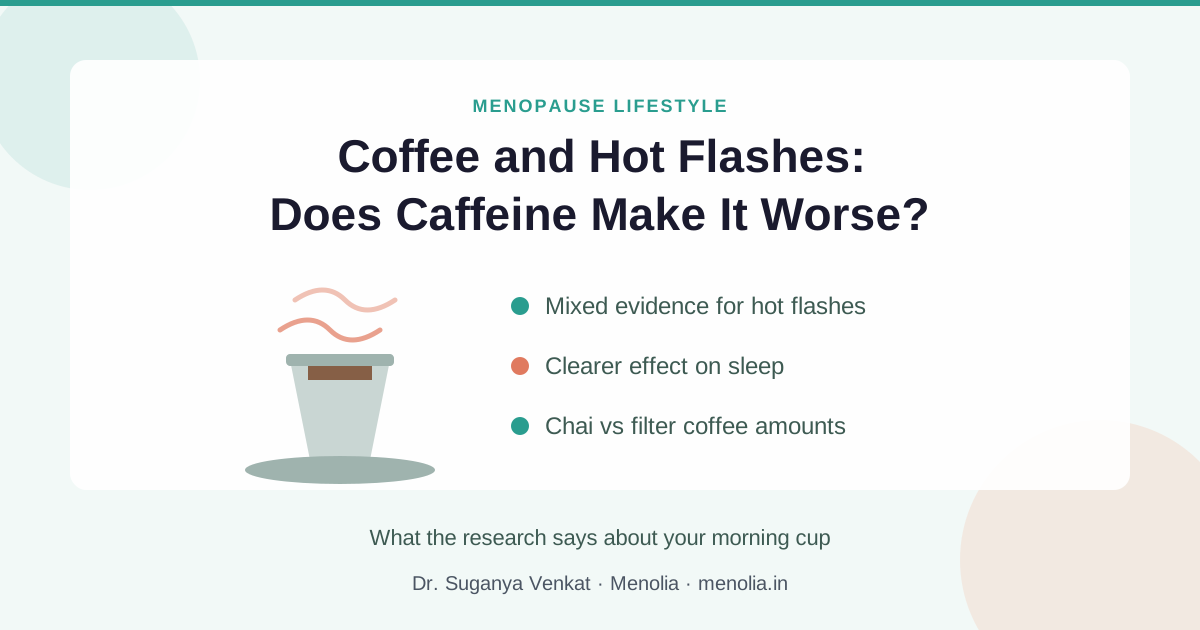
I’m Dr. Suganya Venkat, an OB-GYN with more than fifteen years of practice, and “should I stop my coffee?” is one of the most common questions women ask me once hot flashes begin. This post goes through what the research says about caffeine and hot flashes, what caffeine does to sleep, palpitations, bladder and iron, how much caffeine sits in a cup of chai or coffee, and a simple way to find out whether your own cup is a trigger. You will not be told to give up your coffee.
For the full list of hot flash triggers (spicy food, warm rooms, stress, alcohol and more), see our guide to what hot flashes are and what triggers them. This post stays with caffeine.
What the Research Says About Caffeine and Hot Flashes
The evidence is mixed, and it is worth knowing what it can and cannot tell you.
One large clinic study found a small link. Researchers at the Mayo Clinic analysed questionnaires from 1,806 women who came to their women’s health clinic with menopausal concerns. Women who used caffeine rated their vasomotor symptoms (hot flashes and night sweats) as slightly more bothersome than women who did not, with an average score of 2.30 against 2.15, and the link held after accounting for smoking and menopause stage (Faubion SS et al., Menopause, 2015, PMID 25051286). The authors concluded that caffeine use is associated with greater hot flash bother in postmenopausal women.
Two things are worth noticing. The difference was small. And this was a snapshot survey, so it shows that caffeine and bothersome flushes travel together, not that caffeine causes them. Women who sleep badly because of night sweats may also lean on more coffee to get through the day.
A systematic review called the evidence inconclusive. A 2021 review of diet and menopausal symptoms in postmenopausal women found that studies did point to an association between caffeine intake and symptom intensity, but described the evidence for diet and menopausal symptoms overall as inconsistent, inconclusive and drawn from a small number of studies (Noll PRES et al., Climacteric, 2021, PMID 33112163).
The temperature of the drink may matter too. A 2026 study of 169 postmenopausal women in Turkey, most of whom drank Turkish coffee, found that the type of coffee and the temperature it was drunk at were associated with some vasomotor symptoms. The authors called for larger studies to clarify this (Akbal YS et al., Afr Health Sci, 2026, PMID 42564606). A small study cannot settle the question, but it is a reasonable thing to test for yourself: if a scalding hot tumbler seems to bring on a flush, try letting it cool a little.
Avoiding triggers is not a proven treatment. The North American Menopause Society’s 2023 position statement on non-hormonal treatment for hot flashes reviewed the lifestyle evidence and did not recommend “avoiding triggers” as a treatment, because the evidence for it was limited or inconsistent (Level II) (The North American Menopause Society, Menopause, 2023, PMID 37252752). That does not mean your coffee cannot be a trigger for you. It means that, across groups of women, cutting out triggers has not been shown to reduce hot flashes reliably.
What this means for you: caffeine may make flushes more bothersome for some women, many women notice no difference, and the only way to know which group you are in is to test it on yourself (there is a simple two-week method further down).
Why Caffeine Can Feel Like a Trigger
Caffeine is a stimulant: it acts on the nervous system to make you more alert, which is why it chases away sleepiness (efsa.europa.eu, EFSA topic page on caffeine, checked October 2026). A few things can make it feel like a hot flash trigger at this stage of life:
- The heat of the drink. A hot tumbler of coffee or tea warms your mouth and throat, and in a warm Indian kitchen in summer that may be enough on its own.
- How sensitive you are to caffeine. The way the body breaks down caffeine varies a great deal from person to person. Age, sex and hormones, liver function, smoking, diet, genes and some medicines all change how long caffeine stays in your system (Nehlig A, Pharmacol Rev, 2018, PMID 29514871). So a cup that never bothered your sister may keep you buzzing.
- The knock-on effect on sleep. Poor sleep makes the whole day harder, including how you cope with flushes. This is the effect of caffeine with the strongest evidence, and it is the next section.
Caffeine, Sleep and Night Sweats
If hot flashes and night sweats are already breaking your sleep, caffeine late in the day can make the nights harder.
- In a two-year study of 436 women aged 35 to 49, greater caffeine consumption was one of the factors independently linked with poor sleep, alongside hot flashes, anxiety, depression and, in women aged 45 to 49, lower oestradiol levels (Hollander LE et al., Obstet Gynecol, 2001, PMID 11530118).
- In a home sleep study, a 400 mg dose of caffeine (roughly four cups of filter coffee) disturbed sleep whether it was taken at bedtime, three hours before or six hours before (Drake C et al., J Clin Sleep Med, 2013, PMID 24235903).
- A 2023 meta-analysis of 24 studies found that caffeine cut total sleep time by 45 minutes on average and reduced deep sleep. To avoid losing sleep, the authors worked out that a cup of coffee (about 107 mg of caffeine per 250 mL) should be drunk at least 8.8 hours before bedtime (Gardiner C et al., Sleep Med Rev, 2023, PMID 36870101).
In practice, if you go to bed at 10:30 pm, that points to finishing your last coffee by about 1:30 pm. The European Food Safety Authority notes that even a single 100 mg dose may affect sleep in some adults, particularly close to bedtime (efsa.europa.eu, EFSA topic page on caffeine, checked October 2026).
Our guides to perimenopause sleep problems and night sweats cover the other things that help at night.
Caffeine and a Racing Heart
Many women in perimenopause notice their heart pounding or skipping, and coffee often gets the blame. The research here is reassuring for most people, with one caveat.
- In a randomised trial, 100 adults were told by text message on random days either to drink caffeinated coffee or to avoid caffeine, while wearing a heart monitor. Coffee days did not bring significantly more extra beats from the upper chambers of the heart. They did bring more extra beats from the lower chambers (an average of 154 a day against 102), and 36 minutes less sleep at night (Marcus GM et al., N Engl J Med, 2023, PMID 36947466).
- In 1,388 older adults who wore a 24-hour heart monitor, how often people habitually drank coffee or tea, or ate chocolate, was not linked with more extra beats (Dixit S et al., J Am Heart Assoc, 2016, PMID 26813889).
So a usual amount of coffee is unlikely to be the main cause of palpitations, but some women do notice more fluttering on heavy coffee days. Our guide to heart palpitations in menopause explains the hormonal reasons and when to get checked.
Go to the nearest hospital emergency department straight away if palpitations come with chest pain, fainting, or breathlessness at rest.
Not sure whether it is the coffee, the hormones, or both? If hot flashes, broken sleep or a racing heart are wearing you down, we can go through your symptoms together over a video call. Message Dr. Suganya on WhatsApp for a ₹399 video consultation.
Two More Reasons to Watch the Timing: Bladder and Iron
Bladder urgency. In a national survey of 4,309 women in the United States, caffeine intake of 204 mg a day or more was linked with leaking urine, though not with moderate or severe leaking (Gleason JL et al., Int Urogynecol J, 2013, PMID 22699886). If you rush to the toilet after your second cup, our guide to bladder leaks in menopause explains why this becomes more common after 45 and what helps.
Iron absorption. This one is about tea and coffee rather than caffeine itself. Compounds called polyphenols in black tea and coffee reduce how much iron you absorb from a meal: black tea cut iron absorption from a test meal by 79 to 94 percent, and adding milk made little or no difference (Hurrell RF et al., Br J Nutr, 1999, PMID 10999016). If your periods have been heavy, having chai between meals rather than with breakfast and lunch is a small change worth making. Our post on ferritin and low iron in perimenopause explains why.
How Much Caffeine Is in Your Cup?
The amount varies a lot with how strong the decoction is, how long tea leaves are boiled and how big your cup is. The European Food Safety Authority gives these approximate amounts as a rough guide (efsa.europa.eu, EFSA topic page on caffeine, checked October 2026):
| Drink (EFSA’s serving size) | Approximate caffeine |
|---|---|
| Filter coffee, 200 mL cup | 90 mg |
| Espresso, 60 mL | 80 mg |
| Black tea, 220 mL cup | 50 mg |
| Cola, 355 mL can | 40 mg |
| Energy drink, 250 mL can | 80 mg |
| Plain chocolate, 50 g bar | 25 mg |
These are European figures, not Indian ones. South Indian filter coffee made with a thick decoction, or chai boiled for a long time with extra tea dust, can be stronger than these values, while a small tumbler of milky coffee or tea may hold less. Treat the table as a guide to the order of size: a cup of coffee usually carries more caffeine than a cup of tea.
For safety, EFSA’s 2015 Scientific Opinion on caffeine found that up to 400 mg a day, spread through the day, does not raise safety concerns for healthy adults in general (pregnant women excepted) (efsa.europa.eu, EFSA topic page on caffeine, checked October 2026). That is roughly four of EFSA’s filter coffees or eight cups of black tea. Your own trigger point may sit well below that limit. Many women find that one or two cups before lunch causes no trouble, while a fourth cup in the evening shows up as a bad night.
A Two-Week Test: Is Your Coffee a Trigger?
Rather than giving up coffee on a guess, find out what it does for you.
- Week one: keep your usual routine and keep notes. Each day, write down what you drank and when, and roughly how many hot flashes you had and how you slept. A notebook or a phone note is enough.
- Week two: change one thing. Keep your morning cup, and move every other cup of tea or coffee to before about 1 pm, or swap the afternoon and evening cups for a caffeine-free drink. Keep everything else the same.
- Compare the two weeks. If your flushes or sleep are clearly better, caffeine is likely one of your triggers. If nothing changes, you can enjoy your coffee without guilt and look at other triggers.
A few changes that help many women:
- Cut down gradually over a week or two, one cup at a time. Stopping suddenly can bring on headaches and tiredness for a few days.
- Let the drink cool a little before you sip, rather than drinking it scalding.
- Make the decoction lighter, use a smaller tumbler, or have half a cup topped up with milk.
- Switch the afternoon cup to something caffeine-free: buttermilk (neer mor), plain or jeera water, tender coconut water, or a herbal infusion of tulsi or chukku (dry ginger) made without tea leaves. Our list of foods that help with hot flashes has more ideas.
- Remember the other sources: cola, energy drinks, chocolate, and some pain-relief tablets and supplements contain caffeine too. Decaffeinated coffee still contains a small amount.
- Watch for the reflux link if you get heartburn as well. Our guide to acid reflux after 45 explains why the evening cup is often the problem.
When Cutting Caffeine Is Not Enough
For many women, adjusting coffee and tea makes flushes a little easier and sleep a little better. It rarely stops hot flashes altogether, and you should not feel you have failed if it does not.
If hot flashes are disturbing your sleep, your work or your mood, there are effective treatments. The same 2023 position statement notes that hormone therapy remains the most effective treatment for hot flashes and should be considered for women within ten years of their final period, and it recommends several non-hormonal options for women who cannot or prefer not to take hormones, including cognitive behavioural therapy, certain antidepressants (SSRIs and SNRIs), gabapentin and fezolinetant (The North American Menopause Society, Menopause, 2023, PMID 37252752). Not every one of these is available in India, which your doctor can advise on. Our guides to hot flash treatment from lifestyle to HRT and non-hormonal hot flash treatment explain each option, so you can discuss them with your own doctor.
Alcohol is the other drink women often ask about. It is covered separately in our post on menopause and alcohol.
What Women Call It in Tamil and Hindi
Women describe both the drink and the heat in their own words, at home and when they search:
| Language | Term | Meaning |
|---|---|---|
| Tamil | Kaapi (காபி) | Coffee, as in filter kaapi |
| Tamil | Theneer (தேநீர்) | Tea |
| Tamil | Soodurudal | A hot flash, a rush of heat |
| Hindi | Chai (चाय) | Tea |
| Hindi | Ubal aana | A hot flash, a sudden rush of heat |
Whatever your family calls it, the question is the same: does your cup bring on the heat, and is it costing you sleep?
Practical Takeaways
- The evidence linking caffeine to hot flashes is mixed. One large study found slightly more bothersome flushes in caffeine users; reviews call the evidence inconclusive.
- Sleep is where caffeine has the clearest effect. Finish coffee about nine hours before bed.
- The heat of the drink may play a part too. Try letting it cool a little.
- Usual coffee intake is unlikely to be the main cause of palpitations, though heavy coffee days can bring extra beats.
- Drink tea and coffee between meals if your iron is low, and cut back if your bladder is urgent.
- Test it on yourself for two weeks rather than giving up your coffee on a guess.
- If hot flashes are still hard, effective treatments exist. Talk to your doctor.
Frequently Asked Questions
Does caffeine make hot flashes worse?
For some women, possibly. A study of 1,806 women at a menopause clinic found that caffeine users rated their hot flashes and night sweats as slightly more bothersome than non-users, but reviews describe the overall evidence as inconsistent. The best way to know whether caffeine affects you is a two-week diary: keep your usual routine for a week, then cut afternoon and evening cups for a week and compare.
Should I stop drinking coffee during menopause?
Most women do not need to stop. A morning cup is usually fine. If you notice more flushes or worse sleep, move your caffeine earlier in the day, make your cups lighter or smaller, and cut down gradually rather than stopping suddenly, which can cause headaches.
Is tea better than coffee for hot flashes?
A cup of tea usually has less caffeine than a cup of coffee, so switching may help if caffeine is your trigger. By the European Food Safety Authority’s rough figures, a 200 mL filter coffee has about 90 mg and a 220 mL cup of black tea about 50 mg, though strong Indian decoctions and long-boiled chai vary a lot.
What can I drink instead to reduce hot flashes?
Cool, caffeine-free drinks are a good swap, especially in the afternoon: buttermilk (neer mor), tender coconut water, jeera water, or tulsi or dry ginger infusions made without tea leaves. No drink has been shown to stop hot flashes, but replacing a late cup of coffee can help your sleep.
Kya chai se hot flashes badhte hain? (Does chai make hot flashes worse?)
It can for some women, both because of the caffeine and because a very hot drink warms you up. Try letting your chai cool a little, have it before lunch, and see whether your flushes change over two weeks. Strong chai taken in the evening is the cup most likely to affect your sleep.
How late can I drink coffee without it affecting my sleep?
A 2023 analysis of 24 studies suggested drinking a cup of coffee at least 8.8 hours before bedtime to avoid losing sleep. For a 10:30 pm bedtime, that means your last coffee by about 1:30 pm. People vary in how quickly they clear caffeine, so some women need an even earlier cut-off.
Can coffee cause palpitations in menopause?
Usual amounts are unlikely to be the main cause. In a trial of 100 adults, coffee days did not bring significantly more extra beats from the upper heart chambers, though they did bring more from the lower chambers. If coffee seems to set off fluttering, cut down and mention it to your doctor. Go to an emergency department straight away if palpitations come with chest pain, fainting or breathlessness at rest.
Your morning kaapi or chai is part of your day, and for most women it can stay. What helps is knowing whether caffeine is one of your triggers, moving it earlier, and getting proper treatment if hot flashes are still wearing you down. If you would like help working out what is driving your symptoms and what to try next, alongside your own doctor, I see women across India online over video consultation. You can also read about Menolia’s menopause program.