A woman came to see me last month describing something she found hard to put into words. She had never been an anxious person. No history of it, nothing that would have predicted this. Then somewhere around 46, she started waking at 3 AM with her heart pounding for no reason she could name. She would sit in traffic and feel a wave of dread rise up out of nowhere. She had started avoiding a work presentation she would once have walked into without a second thought. “I don’t know who this person is,” she told me. “I don’t recognise myself.”
What she described is one of the most common things I hear in perimenopause consultations, and one of the least talked about outside the consulting room. New-onset anxiety, arriving with no warning and no obvious trigger, is a real and well documented feature of the menopause transition. It is also, and this is the part that gets lost in the “just push through it” advice women are often given, genuinely treatable. Not with one single fix, but with a set of options that actually work, matched to what is driving the anxiety in your specific case.
This post walks through the full treatment spectrum for perimenopause anxiety, in the order I actually think about it with a patient sitting across from me: when hormone therapy is the right first move, when a talking therapy like CBT is the better starting point, when medication for an anxiety disorder makes clinical sense, the lifestyle levers that support any of these, and how to work out which door to walk through first.
Why perimenopause anxiety is not “just stress”
Before getting to treatment, it helps to understand what is actually happening, briefly, because the treatment choice follows from the cause.
Oestrogen does more in the brain than regulate the reproductive cycle. It modulates serotonin, GABA and the stress-response system, the same chemistry that keeps a normal, everyday level of alertness from tipping into fear. During perimenopause, oestrogen does not decline in a smooth line. It swings, sometimes sharply, from cycle to cycle and even week to week, and those swings are what destabilise mood regulation. Research following women through this transition has found that the risk of clinically significant anxiety symptoms rises measurably as women move through perimenopause, peaking around the late transition and early postmenopause (Bromberger JT, Kravitz HM, Chang Y, et al. Menopause. 2013;20(5):488-495. PMID: 23615639).
That is the biological piece, and the general guide to menopause mood and anxiety covers the neurotransmitter mechanism in more depth if you want the full picture. What I want to focus on here is the practical question that follows from it: given that this is happening, what actually helps, and how do you choose?
Option 1: hormone therapy, when anxiety is hormonally driven
This is the option most women are never offered, and it is often the one that makes the most sense first.
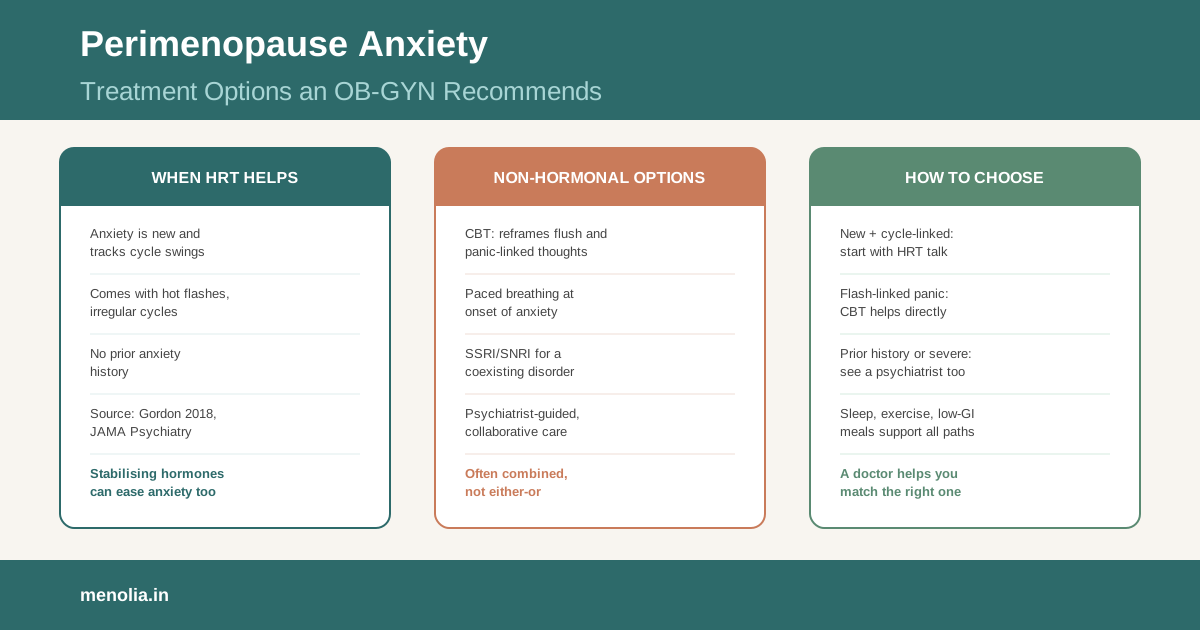
When anxiety appears for the first time during perimenopause, tracks with the erratic swings rather than sitting at a constant level, and comes bundled with other classic perimenopausal symptoms (irregular cycles, hot flashes, disrupted sleep, brain fog), the anxiety is frequently a direct consequence of hormonal instability rather than a separate psychiatric illness that happens to have started at the same time. In that situation, stabilising the hormone level, rather than treating the anxiety as an isolated target, is often the more direct fix.
The trial evidence for this is stronger than most women realise. A randomised, placebo-controlled study of transdermal estradiol combined with cyclic micronized progesterone, given specifically to prevent depressive symptoms in perimenopausal and early postmenopausal women, found that hormone therapy significantly reduced the likelihood of clinically significant depressive symptoms compared to placebo, and the effect was more pronounced in women who had experienced more stressful life events (Gordon JL, Rubinow DR, et al. JAMA Psychiatry. 2018;75(2):149-157. PMID: 29322164). Mood and anxiety symptoms in this transition share overlapping hormonal drivers, and in clinical practice the same stabilisation that lifts depressive symptoms very often eases anxiety alongside it.
HRT is not the automatic answer for every woman with perimenopausal anxiety, and it is not a substitute for treating a separate, pre-existing anxiety disorder. But it is genuinely under-considered as a first option specifically for anxiety that is tracking the hormonal pattern, partly because HRT still gets framed in most conversations as being about hot flashes alone. The complete guide to HRT in India covers routes, risk profile and how to start the conversation with your doctor if this looks like your pattern.
Talk to Dr. Suganya about whether HRT could help your anxiety
Option 2: CBT and paced breathing, with or without hormones
Cognitive behavioural therapy is one of the few non-drug approaches for menopausal anxiety with a genuinely strong evidence base behind it, recommended by the UK’s National Institute for Health and Care Excellence for exactly this symptom cluster. It works by interrupting the loop between a physical sensation (a racing heart, a hot flash, a wave of unease) and the catastrophic thought that follows it, which is often what turns a manageable moment into a spiral.
CBT is particularly well suited to three situations: when a woman cannot or prefers not to take HRT, when anxiety is entangled with hot flashes and disrupted sleep in a way that a purely hormonal approach will not fully untangle, or when someone wants to build durable coping skills alongside whatever else they are doing. Paced breathing, six to eight breaths a minute at the first sign of a flush or a wave of dread, is one specific technique from this toolkit that most women can start using immediately, with no prescription required.
I have written a full, dedicated breakdown of what CBT for menopause actually involves, the trial evidence behind it, and how to access it in India, since it deserves more space than a single section here can give it: the CBT for menopause guide.
Option 3: SSRIs or SNRIs, when it is a coexisting anxiety disorder
Sometimes the anxiety a woman brings to me in perimenopause is not new. It is a pre-existing generalised anxiety disorder, panic disorder or depression that predates the transition, now intensified by hormonal instability layered on top of an already vulnerable system. In that situation, hormone therapy alone is often not enough, because the underlying condition needs its own treatment.
This is where SSRIs (selective serotonin reuptake inhibitors) or SNRIs (serotonin-norepinephrine reuptake inhibitors) come in, prescribed and monitored by a psychiatrist. These medications have a well-established evidence base in treating anxiety and depression in midlife and postmenopausal women. A randomised comparison of venlafaxine, an SNRI, against fluoxetine, an SSRI, in postmenopausal women with major depressive disorder found both were effective over eight weeks of treatment, with broadly comparable response rates (Zhou J, Wang X, Feng L, et al. BMC Psychiatry. 2021;21(1):267. PMID: 34011310). Several SSRIs and SNRIs also have the useful secondary benefit of reducing hot flash frequency, which makes them a reasonable option for women who have both a significant mood disorder and disruptive vasomotor symptoms and cannot or do not want to take HRT. The non-hormonal hot flash treatment guide sets out which SSRIs and SNRIs are used for that indication and how they compare.
This is a decision I make jointly with a psychiatrist, not one an OB-GYN manages alone. Where the anxiety picture is complex, has features of panic disorder, or is not responding as expected to first steps, a joint plan between your gynaecologist and a psychiatrist brings the hormonal context and the psychiatric one together, so your care is not split between two specialists working from different pictures.
Option 4: the lifestyle layer that supports all three
None of the options above work in isolation from how the rest of the body is functioning. Sleep, exercise and how well your cortisol response is managed all set the baseline that hormone therapy, CBT or medication then build on. A woman who is sleeping four broken hours a night and skipping every meal is starting several steps behind, whichever treatment she chooses.
The levers that consistently make a measurable difference: protected sleep (even an imperfect routine helps more than none), regular strength or cardio exercise, a low-glycaemic Indian diet built around dal, vegetables and whole grains rather than refined carbohydrates, and daily pranayama or a similar breathing practice. None of these replace HRT, CBT or medication when one of those is genuinely needed, but they meaningfully lower the floor anxiety has to climb from. The menopause and cortisol guide goes through the HPA-axis mechanism behind why stress hits harder in this decade and the specific levers that help, in more detail than fits here.
How to work out which door to walk through first
In practice, I use a rough sequence with patients, adjusted to their specific picture:
If the anxiety is new, tracks with irregular cycles and other perimenopausal symptoms, and there is no significant prior psychiatric history: hormone therapy is often worth discussing first, alongside the lifestyle layer. If HRT is contraindicated or not preferred, CBT is the next reasonable step.
If hot flashes and panic-like spikes are tightly linked: CBT specifically addresses that loop, and is worth trying whether or not HRT is also in the picture. The menopause panic attacks guide covers this connection and how to tell a panic attack from a cardiac event, which is often the first fear that needs settling.
If there is a personal history of an anxiety disorder, or the anxiety has features that go beyond the typical hormonal pattern, such as constant background dread unrelated to any trigger, or panic attacks that are frequent and severe: a psychiatric assessment and likely SSRI or SNRI treatment, alongside gynaecological input on the hormonal side, gives the most complete picture.
In every case: the lifestyle layer runs underneath, not instead of, whichever of the above applies.
This is rarely a single-option decision. Many women end up combining two of these approaches, HRT with CBT, or an SSRI with lifestyle changes and hormone support for physical symptoms, because the anxiety usually has more than one contributing thread. At Fertilia’s sister brand Menolia, I work through this combination with women individually over a video consultation, because the right starting point genuinely depends on your specific pattern, your history, and what you have already tried.
Talk through your options with Dr. Suganya on WhatsApp
Frequently Asked Questions
Is perimenopause anxiety treatable, or do I just have to wait it out?
It is treatable, and you do not have to simply endure it until it passes. Hormone therapy, CBT, medication where appropriate, and lifestyle changes all have genuine evidence behind them, and most women see meaningful improvement once they start on an approach matched to their specific pattern.
Should I try HRT or an SSRI first for perimenopause anxiety?
It depends on the pattern. If the anxiety is new, fluctuates with your cycle, and comes with other classic perimenopausal symptoms, HRT is often a reasonable first conversation because it addresses the underlying hormonal instability directly. If you have a personal history of an anxiety disorder or depression, or the anxiety picture is more complex, an SSRI or SNRI under psychiatric guidance may be the more direct route. This is a discussion to have with your doctor rather than a decision to make from a checklist.
Can CBT help with perimenopause anxiety even without medication?
Yes. CBT for menopause has a solid evidence base for anxiety, low mood and hot flash-related distress, and works well as a standalone approach for women who prefer to avoid medication, or as an add-on alongside HRT or an SSRI. The CBT for menopause guide has the full detail on how it works and how to access it in India.
Will my anxiety go away once my periods stop completely?
For many women, anxiety does ease once hormone levels settle at their steady postmenopausal baseline rather than swinging, because it is the fluctuation, not simply the lower level, that destabilises mood regulation for many women. That said, some women need active treatment, whether hormonal, CBT-based or medication, to bring symptoms down in the meantime rather than waiting for the transition to finish on its own.
Do I need to see a psychiatrist, or can my OB-GYN manage this?
For anxiety that is clearly following the hormonal pattern of perimenopause, many OB-GYNs can start the conversation and manage first steps, including HRT where appropriate. When there is a history of an anxiety disorder, when symptoms are severe or not improving, or when medication like an SSRI or SNRI is being considered, a psychiatrist should be involved. The two specialities working together, rather than a woman being bounced between them, gives the best outcome.
Can I combine HRT with an SSRI or CBT for anxiety?
Yes, and many women do. HRT addresses the hormonal driver, while CBT builds coping skills and an SSRI or SNRI treats an underlying anxiety disorder if one is present. These approaches work through different mechanisms and are commonly used together rather than as alternatives to each other, always with your doctor’s input on the specific combination.
How is perimenopause anxiety different from PMDD?
PMDD (premenstrual dysphoric disorder) is strictly tied to the luteal phase of the cycle, appearing after ovulation and resolving within days of a period starting, and can predate perimenopause by years. Perimenopausal anxiety is less strictly cycle-bound and tends to become more erratic as cycles themselves become irregular. The two can overlap, and PMDD often worsens as perimenopause begins, which is a common source of confusion. If you are unsure which pattern fits you, tracking symptoms against your cycle for a couple of months is the most useful first step, and it is something worth discussing at a consultation.
New anxiety in your 40s, arriving without warning and unlike anything you have experienced before, is one of the most disorienting parts of perimenopause, and one of the most under-discussed. It is also one of the more directly treatable ones, once the driver behind it is understood. Whether that turns out to be hormonal instability, a coexisting anxiety condition, or most often some combination of the two, there is a clear, evidence-based path forward you can start working through with your doctor.
I’m Dr. Suganya Venkat, and this is one of the conversations I have most often with women in Menolia’s perimenopause program. If what you are feeling sounds like what is described here, a video consultation is a good place to work out which of these options fits your situation.