It is four in the afternoon. You slept badly again, the house is finally quiet, and the box of Mysore pak on the kitchen shelf seems to be calling your name. You have one piece, then a second with your tea, and later you wonder why the pull towards sweets feels so much stronger now than it did at 35.
You are not imagining it, and it is not a failure of willpower. Many women notice a change in their appetite for sweet things during perimenopause and the years after. Some of the reasons are well studied, some are only partly understood, and almost all of them have something practical attached.
This post covers what sits behind sugar cravings after 45, how much of it is hormones versus sleep and stress, and the small, realistic changes that make the afternoon pull easier to manage in an Indian kitchen.
What a Craving Is, and Why It Is Not Just Hunger
Hunger is your body asking for fuel. A craving is a strong pull towards one particular food, often sweet, often at a predictable time of day, and often present even when you have just eaten.
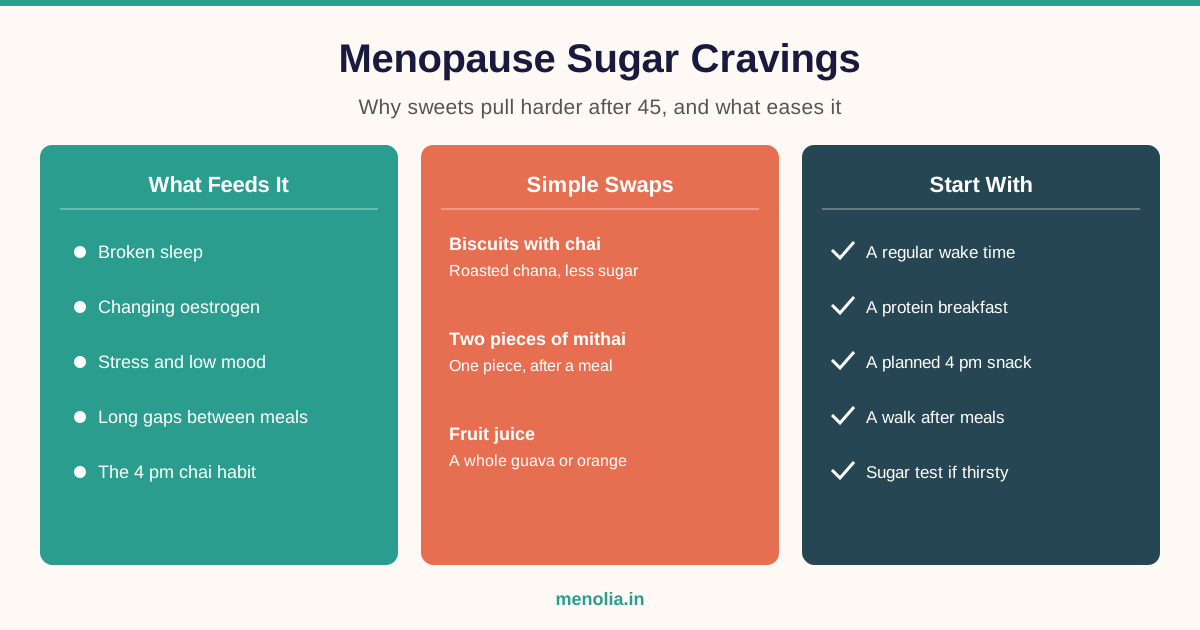
Cravings are shaped by several things at once:
- Appetite hormones such as ghrelin (which nudges you to eat) and leptin (which signals that you have had enough)
- Sleep, which turns out to have a large effect on both of these
- Stress and mood, because sweet food is quick comfort
- Habit and routine, such as the evening tea that always comes with biscuits
- Hormonal changes across the menopause transition
In midlife, several of these shift at the same time. That overlap is the main reason cravings can feel stronger now.
Oestrogen and Appetite: What the Evidence Shows, and Where It Stops
Oestrogen does more than govern periods. Receptors for it sit in the parts of the brain that regulate eating. A review of the research on sex hormones and appetite describes oestradiol as having an inhibitory effect on eating, with much of the detailed evidence coming from animal studies (Asarian L et al., Philos Trans R Soc Lond B Biol Sci, 2006, PMID 16815802).
It is reasonable, then, to think that the falling and fluctuating oestrogen of perimenopause plays some part in appetite changes. But I want to be careful here. The human evidence linking menopause directly to sugar cravings specifically is modest. There is no reliable study that lets me tell you “your oestrogen dropped by this much, so you will crave this much more mithai.”
What we can say with more confidence is that menopause changes the things that drive cravings: sleep, mood, energy and stress. Those are where most of the practical gains lie.
Poor Sleep Is One of the Biggest Drivers
If there is one thing I would ask you to look at first, it is sleep. Night sweats, hot flushes, waking at 3 am and lying awake with a busy mind are all common in the transition, and they leave you running short of sleep for weeks at a time.
Short sleep changes appetite in a measurable way. In a small, tightly controlled study, two nights of restricted sleep lowered leptin, raised ghrelin, and increased both hunger and appetite, with the strongest increase for calorie-dense, carbohydrate-rich foods such as sweets and starchy snacks (Spiegel K et al., Ann Intern Med, 2004, PMID 15583226). That study was done in young men, not menopausal women, so it is a guide to the mechanism rather than a direct measure of what happens to you. Still, the pattern fits closely with what women describe to me: the craving is worst on the day after a broken night.
The relationship may also run in both directions. In the Women’s Health Initiative, a large study of postmenopausal women, diets with a higher glycaemic index, and higher intakes of added sugars and refined grains, were linked with higher odds of developing insomnia over three years, while more fruit and vegetables were linked with lower odds (Gangwisch JE et al., Am J Clin Nutr, 2020, PMID 31828298). This is an observational study, so it shows an association, not proof of cause. But it raises a fair possibility: poor sleep fuels sweet cravings, and a sweet-heavy diet may in turn make sleep worse.
If sleep is your main struggle, our guides to perimenopause sleep problems and menopause sleep solutions go through what helps, including the hot flush and night sweat side of it.
Stress, Mood and the Comfort of Something Sweet
Many women in their late forties are holding a great deal: ageing parents, children finishing school or leaving home, work, and their own changing body. Sweet food is fast, familiar comfort, and a cup of sweet chai with a biscuit is often the only pause in a long day.
Stress hormones and mood changes both affect eating, and low mood in perimenopause is common. The cortisol side of this has its own post, why stress hits harder after 45, so I will not repeat it here. The useful point is this: if your cravings cluster around tense moments or a low evening, they are partly an emotional signal, and they respond better to addressing the stress than to fighting the sweet.
If cravings, poor sleep and low energy are all arriving together and you want to understand what is driving them for you, message Dr. Suganya on WhatsApp to book a video consultation.
When a Craving Is Worth a Blood Test
Most sugar cravings are about sleep, stress and routine. Occasionally, a change in appetite or thirst is a reason to check your blood sugar, because the risk of type 2 diabetes rises in midlife.
It is worth asking your doctor for a fasting glucose or HbA1c test if you notice any of these alongside the cravings:
- Unusual thirst or passing urine more often, especially at night
- Tiredness that does not lift with rest
- Weight change you cannot explain
- Itching or infections that keep returning
- A family history of diabetes and no test in the last year
These are common, checkable things, and a normal result is reassuring. Our post on blood sugar and diabetes risk after 45 explains which tests to ask for and what the numbers mean.
Practical Ways to Ease the Pull
None of these involve giving up sweets forever. A rule you cannot keep is worse than a small change you can.
1. Protect your sleep first
Because sleep has such a strong effect on appetite, improving it often reduces cravings without any effort aimed at food at all. A regular wake time, a cooler bedroom, and treating troublesome night sweats properly are more powerful here than they look.
2. Do not skip breakfast or lunch
Long gaps between meals, followed by a sudden dip in energy at 4 pm, are the classic setup for a sweet raid. A breakfast with some protein (idli with sambar, pesarattu, a moong dal chilla, or eggs) and a proper lunch make the afternoon far easier.
3. Build a better 4 pm
If tea time is when the craving strikes, plan for it rather than resisting it:
| Instead of | Try |
|---|---|
| Biscuits with sweet chai | Roasted chana or a handful of peanuts with less-sugar chai |
| Two pieces of mithai | One piece, eaten slowly after a meal, not on an empty stomach |
| Fried namkeen and a sweet | Sundal or a small bowl of sprouts |
| Sugary fruit juice | A whole fruit such as guava, orange or apple |
| Payasam every evening | A small bowl of plain dahi with a few pieces of fruit |
For the nutrition side of this in more detail, see our menopause diet guide for Indian women.
4. Cut the sugar in chai gradually
Taking one spoon of sugar out of several cups a day adds up. Reduce it by half a spoon a week, and most women find their taste adjusts within a few weeks. Swapping sugar for jaggery feels healthier, but jaggery is still sugar, so the amount matters more than the type.
5. Watch the evening drink
Alcohol disturbs sleep and lowers your resistance to snacking, which makes the next day’s cravings worse. Our post on menopause and alcohol looks at this more closely.
6. Notice the trigger, not just the craving
For a week, jot down when the craving hits and what was happening: tired, stressed, bored, after a bad night. Most women find two or three repeating situations, and those are much easier to change than a vague “I eat too many sweets.”
7. Move after meals
A ten-minute walk after lunch or dinner is one of the simplest habits for women in midlife. It helps energy, it breaks the sit-and-snack routine, and it gets you away from the kitchen at the moment the pull is strongest.
Does HRT Help With Sugar Cravings?
This is a fair question, and the answer is: not directly, as far as current evidence shows. HRT is not a treatment for cravings, and I would not start it for that reason alone.
Where HRT can help indirectly is through sleep. If hot flushes and night sweats are what keep waking you, treating them often improves sleep, and better sleep tends to calm appetite. That decision depends on your symptoms and health history, and it is one to make with your own doctor.
How We Approach This at Menolia
When a woman tells me her sweet cravings have become hard to control, I rarely start with the food. I ask about her sleep, her flushes, her mood, her meal timings and her family history. In fifteen years as an OB-GYN, I have found that the craving usually makes sense once the rest of the day is laid out. As Dr. Suganya Venkat, that is how I work with women across India in online video consultations at Menolia: look at the whole picture, check what needs checking, and then make two or three changes that fit real life.
Frequently Asked Questions
Why do I crave sweets so much during perimenopause?
Several changes overlap in perimenopause: disturbed sleep, fluctuating oestrogen, more stress and lower mood. Short sleep in particular raises appetite for sweet and starchy food. The hormonal link is real but modestly studied, while the sleep link is better established.
Are menopause sugar cravings caused by low oestrogen?
Oestrogen does influence appetite, mostly shown in animal research. In women, the direct link between menopause and sugar cravings specifically is not well measured. Falling oestrogen likely contributes, but sleep, stress and routine usually play a larger, more fixable part.
Can sugar cravings be a sign of diabetes?
Cravings alone are rarely a sign of diabetes. But if they come with unusual thirst, frequent urination, tiredness, unexplained weight change or repeated infections, ask your doctor for a fasting glucose or HbA1c test. Diabetes risk rises after 45, and testing is simple.
Is jaggery better than sugar during menopause?
Jaggery contains small amounts of minerals, but your body handles it much like sugar. If you prefer the taste, use it, but keep the amount small. Reducing total sweetness in chai and desserts matters more than which sweetener you choose.
How long does it take for sugar cravings to reduce?
Many women notice a difference within two to four weeks of better sleep, regular meals and gradually cutting sugar in tea. Taste preferences adjust with time, so sweets often start to taste sweeter than before as you reduce them.
Will HRT stop my sugar cravings?
HRT is not a treatment for cravings. It can help indirectly if hot flushes and night sweats are disrupting your sleep, because better sleep tends to reduce appetite for sweets. Whether HRT suits you is a decision to make with your doctor.
Should I cut out sweets completely after menopause?
Usually not. A complete ban is hard to keep and often ends in a binge. A small sweet after a meal, eaten slowly, fits into a healthy diet for most women. Focus on sleep, regular meals and smaller portions rather than strict rules.
A Simple Place to Start
Sugar cravings after 45 are common, understandable and manageable. Start with sleep, steady your meals, plan the 4 pm moment, and check your blood sugar if other signs are present. The first consultation is ₹399.
If you would like help working out what is behind your cravings and a plan that fits your day, start a conversation with Dr. Suganya on WhatsApp.