You have probably seen it by now. A reel of a fit woman in her fifties scooping white powder into her water bottle, a caption promising stronger muscles, stronger bones and a sharper brain, all from one supplement. Then a friend in your walking group mentions she has started it too, and you wonder whether you are missing something.
I’m Dr. Suganya Venkat, an OB-GYN with more than 15 years of clinical practice, and creatine has become one of the most common supplement questions women bring to their Menolia video consultations this year. It deserves a careful answer, because the research on creatine after menopause is more specific than the reels suggest. For some goals it helps a little. For others, the best trials found nothing.
What This Post Covers
- What creatine is, and why it is being talked about for menopause
- What the trials in postmenopausal women found for muscle and strength
- What the trials found for bone
- The doses used in those studies
- Kidney questions, and the blood-test effect your doctor should know about
- Who might consider it, and who should ask first
What Creatine Is
Creatine is a compound your body makes from amino acids, mostly in the liver and kidneys, and stores mainly in muscle. Muscles use it to regenerate energy quickly during short, hard efforts, such as lifting a weight or climbing stairs briskly. You also get some from food, but almost entirely from meat and fish. A woman eating a vegetarian Indian diet of dal, rice, roti, curd and vegetables takes in very little creatine from her meals and relies on what her body makes.
As a supplement, the form that has been studied most is creatine monohydrate, a plain white powder. It is not a hormone and not a steroid. It has been used by athletes for decades, and the International Society of Sports Nutrition’s position stand describes short- and long-term use as safe and well tolerated in healthy people, based on studies including older adults (Kreider RB et al., J Int Soc Sports Nutr, 2017, PMID 28615996). That review comes from a sports nutrition society, so read it as a summary from an interested field, not the last word.
Why It Is Being Discussed for Menopause
As oestrogen falls, women lose muscle mass and strength faster, and bone density declines, especially in the first years after the last period. We cover the muscle side in our post on why strength matters after 50. The idea behind creatine is simple: if it helps muscles train a little harder, and muscle pull on bone helps bone, perhaps it can slow both losses.
That idea is reasonable. The question is whether it holds up when tested in women like you.
What the Trials Found for Muscle and Strength
The most useful single source is a 2026 systematic review and meta-analysis of randomised, placebo-controlled trials in postmenopausal women (Naddafha S et al., J Int Soc Sports Nutr, 2026, PMID 42141930). It pooled seven trials with 608 women, average age around 62, followed for 12 weeks to two years.
What it found:
- Lean mass: creatine added an average of 0.37 kg of lean mass compared with placebo.
- Leg strength: leg-press strength improved by an average of 7.5 kg more than placebo, though this came from only three trials.
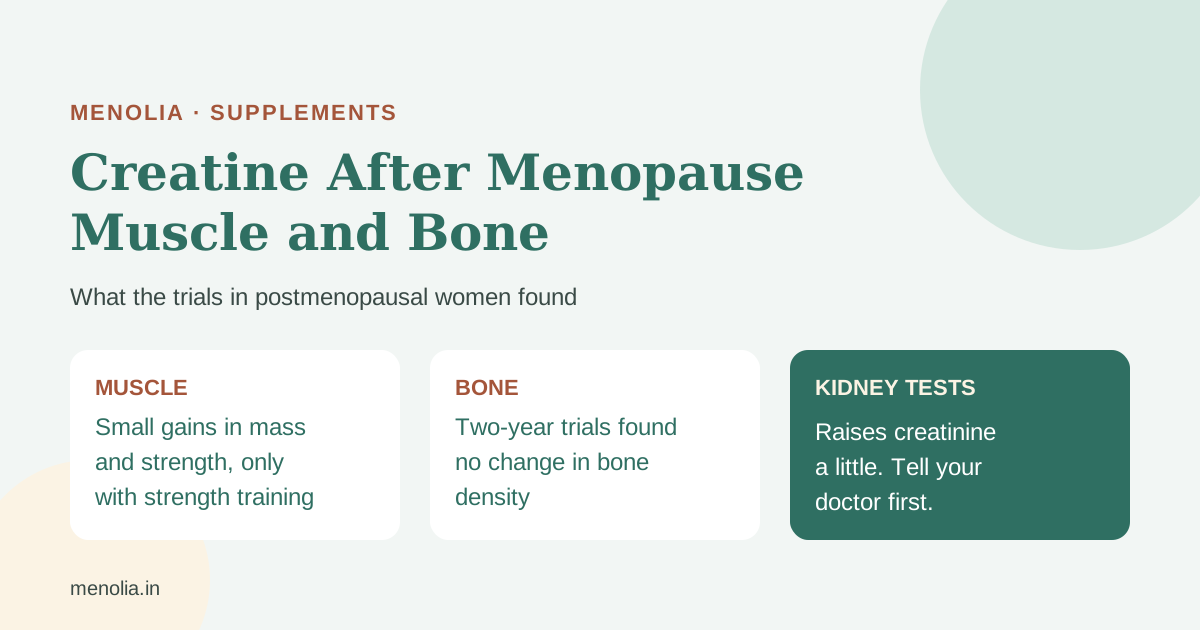
- The condition that mattered: the benefit showed up when women took 5 g a day or more and did resistance training. Trials using 3 g a day or less without resistance training showed no measurable effect.
- Safety: side effects were mild and similar to placebo, and kidney measures did not change.
The authors called these gains “small but meaningful.” I would describe them as small. Less than half a kilogram of lean mass is real, but it is modest compared with what the training itself does.
An older meta-analysis of 22 trials in adults over about 57, men and women together, found a similar direction: creatine during resistance training gave more lean mass and upper and lower body strength than training alone (Chilibeck PD et al., Open Access J Sports Med, 2017, PMID 29138605).
Notice the word that keeps appearing: training. In every positive result, creatine was an add-on to lifting weights two or three times a week. In the large Brazilian trial where 200 postmenopausal women took 3 g a day without a supervised strength programme for two years, creatine did not improve lean mass or muscle function (Sales LP et al., J Gerontol A Biol Sci Med Sci, 2020, PMID 31257405).
So if you are not yet doing any strength work, creatine is the wrong place to start. Our guide to strength training for women over 45 is the better first step, and protein comes before supplements too (see how much protein you need on an Indian diet).
Wondering whether a supplement like creatine fits your health picture, your medicines and your kidney reports? WhatsApp Dr. Suganya to book an online video consultation.
What the Trials Found for Bone
This is where the social media claims run ahead of the evidence.
An early, small Canadian trial was encouraging. Postmenopausal women who took creatine during 12 months of resistance training lost less bone at the femoral neck (the top of the thigh bone, near the hip) than women on placebo, 1.2% versus 3.9% (Chilibeck PD et al., Med Sci Sports Exerc, 2015, PMID 25386713). Only 33 women completed it, though.
Two larger, longer trials followed:
- The Brazilian trial (200 women with osteopenia, 3 g a day for two years, no supervised training programme): no difference in bone density at the spine or hip, no change in bone markers, and no change in falls or fractures (Sales LP et al., 2020, PMID 31257405).
- The Canadian two-year trial (237 women, mean age 59, creatine at 0.14 g per kg body weight per day alongside resistance training and walking): no effect on bone density at the femoral neck, total hip or lumbar spine. It did find that creatine helped maintain some geometric measures of the femoral neck that predict bending strength, and women walked slightly faster (Chilibeck PD et al., Med Sci Sports Exerc, 2023, PMID 37144634).
The 2026 meta-analysis summed it up: bone density was unchanged overall, and effects on bone remain unclear (Naddafha S et al., 2026, PMID 42141930).
Creatine is not a treatment for osteopenia or osteoporosis. If your bone density test shows low bone mass, the steps that have evidence are calcium and vitamin D where intake is low, weight-bearing and resistance exercise, fall prevention, and, where your doctor advises it, medicines such as bisphosphonates or HRT. Our posts on menopause and bone health and the bone density test in India walk through those steps.
Doses Used in the Studies
I am describing what researchers used, not prescribing a dose for you:
- 3 g a day in the Brazilian trial, which showed no benefit for muscle or bone without training.
- About 0.1 to 0.14 g per kg of body weight a day in the Canadian trials. For a 60 kg woman, that works out to roughly 6 to 8.5 g a day.
- The meta-analysis found benefit mainly at 5 g a day or more combined with resistance training.
None of these trials needed a “loading phase” of large doses, and the women took plain creatine monohydrate. Many products in Indian pharmacies and online stores are sold for gym users, sometimes blended with caffeine, flavours or other ingredients. If you and your doctor decide to try it, a plain monohydrate product with a third-party testing mark is closer to what the studies used than a branded “pre-workout” blend.
Kidneys and the Creatinine Effect
This is the part I most want you to know before you start.
Creatine is broken down into creatinine, the same substance your kidney function blood test measures. A 2026 meta-analysis of randomised trials found that creatine supplements raised serum creatinine by about 0.13 mg/dL on average, without a change in urea or in estimated kidney filtration (eGFR) where that was measured (Tsiaras A et al., J Ren Nutr, 2026, PMID 42035842). The authors noted that trials longer than a year are still needed to be sure about long-term kidney safety.
What this means for you in practice:
- Tell your doctor you are taking creatine before any kidney test. A slightly higher creatinine on a routine report could otherwise lead to worry, repeat tests or a change in medicines that you do not need.
- If you already have kidney disease, a single kidney, or reduced kidney function on past reports, do not start creatine without speaking to your nephrologist. Our post on HRT with chronic kidney disease explains why kidney function shapes many treatment decisions after menopause.
- If you take medicines that act on the kidneys, such as some blood pressure tablets, diuretics or regular painkillers, check with the doctor who prescribes them.
Some women notice a small rise in body weight in the first weeks, from water held in muscle. Stomach upset can occur at larger single doses.
Who Might Consider It, and Who Should Ask First
Creatine may be worth a conversation with your doctor if:
- you are already doing resistance training two or three times a week and want a small extra edge in strength
- your protein intake is already adequate
- your kidney function is normal on a recent report
It is not a good fit, or needs a doctor’s view first, if:
- you are not yet doing any strength training (start there)
- you are looking for a treatment for low bone density
- you have kidney disease or diabetes affecting the kidneys
- you are hoping it will help hot flashes, mood or weight (it has not been shown to)
Women also ask whether creatine helps memory or brain fog. Some early research exists, but I have not found trials in menopausal women strong enough to recommend it for that. Our evidence-based supplements guide covers the supplements with clearer evidence after menopause.
Practical Takeaways
- Creatine helps muscle only alongside strength training, and the gains are small.
- For bone density, the two-year trials found no benefit. It does not replace bone treatment.
- Studies that showed benefit used about 5 g a day or more, plain monohydrate.
- It raises your serum creatinine a little. Tell your doctor before kidney tests.
- Kidney disease means ask your nephrologist first.
- Training, protein, calcium and vitamin D come before creatine.
Frequently Asked Questions
Is creatine good for women in menopause?
It can help a little with muscle mass and strength when combined with regular resistance training. A 2026 meta-analysis of seven trials in postmenopausal women found an average gain of 0.37 kg lean mass and 7.5 kg in leg-press strength, mainly at 5 g a day or more with training. Without training, low-dose trials showed no effect.
Does creatine increase bone density after menopause?
The larger two-year trials found no improvement in bone density at the spine or hip. One small 12-month trial suggested less bone loss at the hip with training, but the bigger trials did not confirm a change in bone density. Creatine should not be used as a treatment for osteopenia or osteoporosis.
Is creatine safe for women over 50?
In trials of postmenopausal women, side effects were mild and similar to placebo, and kidney measures were stable. It does raise serum creatinine slightly on blood tests. Women with kidney disease, or on medicines that affect the kidneys, should check with their doctor before starting.
Should I take creatine in perimenopause?
The trials summarised here were done in postmenopausal women, so there is less direct evidence for perimenopause. If you are already strength training and your kidneys are healthy, it is reasonable to discuss with your doctor. Training and adequate protein matter more at this stage than any supplement.
How much creatine did the studies use?
The trials used 3 g a day (no benefit without training) up to about 0.14 g per kg of body weight a day, which is roughly 8 g for a 60 kg woman. The pooled benefit appeared mainly at 5 g a day or more combined with resistance training. Your doctor can advise what suits you.
I am vegetarian. Do I need creatine?
Vegetarian diets supply very little creatine because it comes mostly from meat and fish, and your body makes the rest. Being vegetarian alone is not a reason to take a supplement. If you are training regularly and want to try it, discuss it with your doctor along with your protein intake.
Will creatine cause weight gain?
Some women see a small rise on the scale in the first few weeks, which is water stored in muscle, not fat. It has not been shown to help with weight loss either.
A Clear Next Step
A supplement decision is easier when someone looks at your whole picture: your training, your diet, your bone density report and your kidney tests. If you would like that kind of review, WhatsApp Dr. Suganya to book an online video consultation (₹399 in India, US $20 from outside India).