Your phone buzzes at 9 p.m. with a cheerful message: “You have walked 3,412 steps today.” The ring on the screen is not even half full, the target says 10,000, and you feel a small, familiar sense of failure.
Many women in their forties and fifties tell me some version of this. They know walking is good for them. What they do not know is how much is enough, whether a slow evening stroll counts, and whether walking alone can do anything for hot flashes, sleep or bones.
I’m Dr. Suganya Venkat, an OB-GYN with more than fifteen years of practice, and walking is the exercise I recommend most often to women going through menopause, because almost every woman can start it tomorrow with no equipment and no fees. This post covers what the step-count research says, what walking does and does not do for menopause symptoms, how fast to walk, and how to walk safely through an Indian summer.
For the full picture of exercise at this stage, including yoga and balance work, see our guide to exercise during menopause. This post stays with walking.
Where Did 10,000 Steps Come From?
The 10,000 figure is a round number that became popular, not a target that came out of medical research. The researchers behind the largest pooled analysis of step counts said so in their own paper: 10,000 steps is widely promoted, but there was little evidence to support it.
So they went looking. The Steps for Health Collaborative combined individual data from 15 studies covering 47,471 adults followed for a median of about seven years (Paluch AE et al., Lancet Public Health, 2022, PMID 35247352). Here is what they found:
- More steps meant lower risk of dying from any cause, up to a point. Compared with the least active group (a median of about 3,550 steps a day), people in the second group (about 5,800 steps) already had a 40% lower risk.
- The benefit levelled off with age. In adults aged 60 and above, risk kept falling as steps went up until roughly 6,000 to 8,000 steps a day, then flattened. In adults under 60, the plateau came later, around 8,000 to 10,000 steps.
- Speed mattered less than total steps. Once total daily steps were accounted for, time spent walking at faster paces added little.
A second meta-analysis of 17 cohort studies and nearly 227,000 people found a similar pattern: each extra 1,000 steps a day was associated with a 15% lower risk of death from any cause (Banach M et al., Eur J Prev Cardiol, 2023, PMID 37555441).
Two caveats. These are observational studies, so they show that people who walk more tend to live longer, not proof that the steps alone caused it. And they measured mortality, not menopause symptoms. But the message for you is still useful: the biggest gain comes from moving out of the lowest range, not from reaching 10,000.
How Many Steps Should You Aim For?
Here is how I put it to women in consultations:
| Where you are now | A sensible next target |
|---|---|
| Under 3,000 steps a day | Add 1,000 steps a day for two weeks, then another 1,000 |
| 3,000 to 5,000 | Work towards 6,000 |
| 5,000 to 7,000 | Work towards 7,000 to 8,000 |
| Already above 8,000 | Keep it up, and spend your effort on strength training |
If you are past 60, the 6,000 to 8,000 range is a reasonable goal. If you are in your forties or early fifties, 8,000 or so is a fair aim, with anything above that a bonus.
Your housework counts. Sweeping, carrying vegetables back from the market, climbing to the terrace to dry clothes, walking around the temple: if your phone or watch records it, it counts.
What Walking Does for Menopause Symptoms
This is where I want to be careful, because walking is often sold as a cure for everything. Some of these benefits are well supported, and one is not.
Hot flashes: walking is not a hot flash treatment
The best trial we have on this question is the MsFLASH exercise study. Sedentary women with frequent hot flashes were randomly assigned either to supervised aerobic exercise three times a week for 12 weeks, or to their usual activity. Hot flash frequency and bother fell by about the same amount in both groups; exercise did not reduce them more than usual activity did (Sternfeld B et al., Menopause, 2014, PMID 23899828).
So if hot flashes are your main problem, walking alone is unlikely to fix them. That is not a reason to stop walking. It is a reason to look at the treatments that do work for hot flashes, which we cover in our guide to hot flash treatment options.
Sleep and mood: small but real
The same MsFLASH trial found that the exercise group reported somewhat better sleep quality, fewer insomnia symptoms and fewer depressive symptoms. The differences were small and lost statistical significance after adjusting for multiple comparisons, so treat this as a modest, likely benefit rather than a strong effect.
The mood evidence from larger studies is more encouraging. A meta-analysis of 15 prospective studies with over 191,000 adults found that people doing half the recommended weekly activity had an 18% lower risk of depression than inactive people, and those meeting the full recommendation had a 25% lower risk (Pearce M et al., JAMA Psychiatry, 2022, PMID 35416941). The steepest gains were at the low end, which means a daily walk is worth far more than nothing, even if you never reach the full target.
Bone: helpful for the hip, not enough on its own
After menopause, bone loss speeds up as oestrogen falls. Walking is weight-bearing, so it does load the bones of the legs and hips. But how much does it actually protect them?
A meta-analysis of eight walking trials in postmenopausal women found that regular walking had no significant effect on bone density at the spine, but a small positive effect at the femoral neck (the top of the thigh bone, where hip fractures happen). The authors concluded that exercise with more targeted loading may be needed to preserve bone density (Martyn-St James M et al., Bone, 2008, PMID 18602880).
A second analysis by the same group found that programmes mixing walking with jogging and stair climbing, or combining impact with resistance exercise, were effective at both the spine and the hip (Martyn-St James M et al., Br J Sports Med, 2009, PMID 18981037).
In plain terms: walking is a good base for your bones, stairs help, and strength training is what completes the job. Our post on strength training after 45 explains how to add it, and the guide to menopause and bone health covers who should get a bone density scan.
Heart and blood sugar
Women’s heart disease risk rises after menopause, and the Banach meta-analysis above found that each extra 500 steps a day was associated with a 7% lower risk of death from cardiovascular disease. If you have been told your sugars are creeping up, our post on menopause and diabetes risk explains what else helps alongside walking.
Not sure where to begin, or worried about your knees, BP or sugars? We can look at your symptoms, reports and current activity together over a video call and plan a walking routine that suits your body. Message Dr. Suganya on WhatsApp for a ₹399 video consultation.
How Fast Should You Walk?
You do not need a fitness tracker to judge pace. Use the talk test:
- Easy pace: you could sing. Good for warming up, after meals, and on tired days.
- Brisk pace: you can talk in full sentences but would not want to sing. This is moderate intensity, and it is the pace most activity guidelines count.
- Too fast for now: you can only get out a few words at a time. Fine in short bursts once you are fitter, not where to begin.
If you do use a watch, about 100 steps a minute is a commonly used marker of moderate intensity. In a 12-week trial of 120 sedentary postmenopausal women, simple step counters helped women nearly double their daily steps and add around 20 to 30 active minutes a day, whether or not they were told to focus on speed (Tudor-Locke C et al., J Phys Act Health, 2020, PMID 31698336). The step counter itself was the useful tool.
Since the step-count research suggests total steps matter more than speed, start with whatever pace is comfortable. Add brisk stretches of a few minutes once a daily walk feels easy.
Walking Through an Indian Summer
In much of India, the comfortable walking window shrinks for half the year. If hot flashes already make you feel overheated, a midday walk can feel impossible. A few things help:
- Walk early or late. Before 7 a.m. or after sunset is usually cooler. The early morning slot also gets you some daylight, which helps set your body clock for sleep.
- Carry water and sip through the walk, especially on humid days. Buttermilk (moru or chaas) or lime water with a pinch of salt after a long walk is a familiar, sensible option.
- Wear loose cotton and comfortable footwear with a cushioned sole. Old rubber slippers are hard on the heels and knees over long distances.
- Move indoors when needed. Walking laps of your terrace in the evening, the corridor of your apartment block, or a shopping mall on very hot or rainy days all count.
- Slow down on hot days. On a warm day, a shorter, easier walk is better than pushing hard. On a scorching afternoon, skip the outdoor walk: wait for the cooler hours or walk indoors instead.
Stop and rest in the shade if you feel dizzy, unusually breathless, or develop a headache in the heat.
Making It Stick: Small Habits That Add Steps
Most women I speak with do not lack motivation. They lack time and a routine. These small changes add up:
- A 10 to 15 minute walk after dinner, on the terrace or around the block, instead of sitting straight down in front of the TV.
- Walk while on the phone. Calls with your sister or daughter are an easy 1,000 steps.
- Walk with someone. A neighbour, your husband, or a friend from the temple turns it into time you look forward to.
- Break it up. Three 10-minute walks count the same as one 30-minute walk for total steps.
- Track it loosely. Note your daily steps for a week to find your real starting point, then add from there.
One of our Menolia patients, Sathyadevi, was 62, postmenopausal and managing knee arthritis and high BP when she started. She built up gradually from barely 1,000 steps a day to around 5,000, with exercises chosen for her knees alongside the walking, and a year later she walked 16,000 steps a day on a trip to Rome. You can read Sathyadevi’s story in her own words. Her number is not a target for you; the gradual build-up is the part worth copying.
When to Check with a Doctor First
Walking is safe for most women. Talk to your doctor before starting or stepping up a routine if you:
- Get chest pain, chest tightness or unusual breathlessness on exertion
- Have uncontrolled high blood pressure or diabetes
- Have knee or hip pain that worsens with walking, or recent swelling in a joint
- Feel dizzy or have had a recent fall
- Have been diagnosed with osteoporosis and are unsure which activities suit you
If you get chest pain while walking, stop. If the pain is severe or persistent, or comes with breathlessness, sweating, nausea or faintness, call an ambulance or go to the nearest emergency department straight away. Even if new chest pain on exertion settles with rest, get it assessed urgently before you walk again. For the difference between hormonal palpitations and heart symptoms, see our post on menopause chest pain.
What Women Call It
Walking for exercise is often called nadai payirchi in Tamil and tehelna or morning walk in Hindi. If you have been searching for “menopause mein kitna chalna chahiye” (how much should I walk in menopause), the short answer is the table above: start from where you are and add about 1,000 steps at a time.
Practical Takeaways
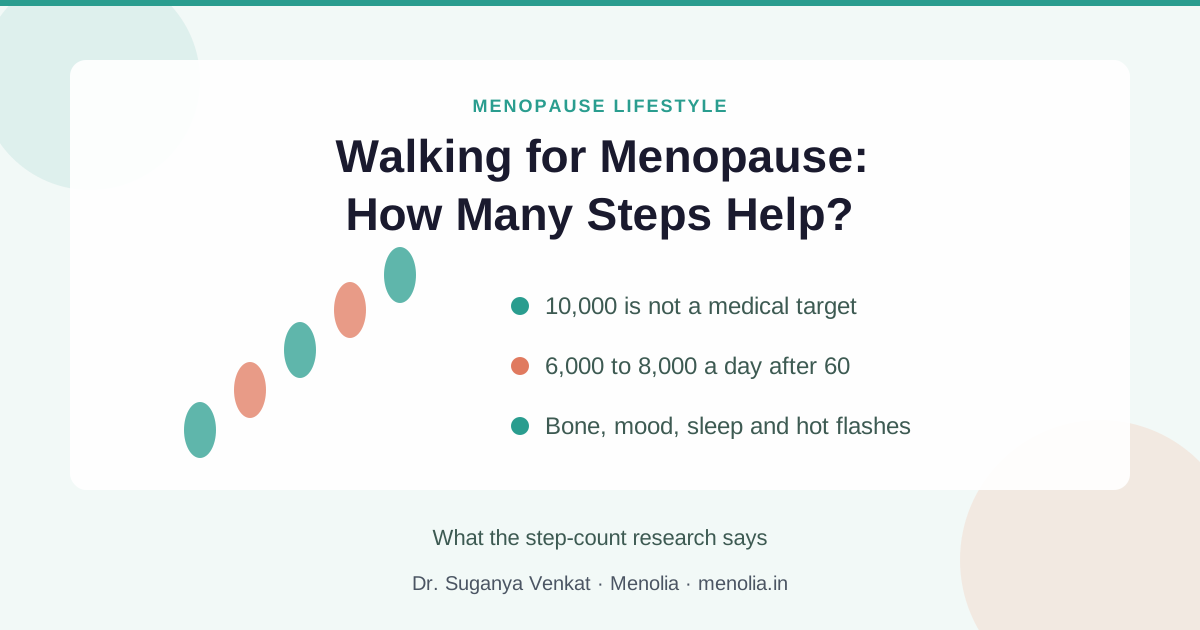
- 10,000 steps is not a medical target. For women over 60, benefits in large studies levelled off around 6,000 to 8,000 steps a day.
- The biggest gain is getting out of the lowest range. Going from 3,000 to 6,000 matters more than going from 9,000 to 12,000.
- Walking does not reduce hot flashes in the best trial we have, but it may help sleep and mood a little.
- For bone, walking helps the hip; add stairs and strength training for fuller protection.
- Use the talk test for pace, and walk early or late in summer.
- Build up by about 1,000 steps a day every two weeks.
Frequently Asked Questions
How many steps a day should a woman walk after menopause?
In the largest pooled analysis of step counts, the benefit for adults aged 60 and above levelled off at around 6,000 to 8,000 steps a day (Paluch AE et al., Lancet Public Health, 2022). For women in their forties and fifties, 8,000 or so is a fair aim. If you walk far less now, simply adding 1,000 steps a day is a good first goal.
Is walking enough exercise for menopause?
Walking is an excellent base for heart health, mood and the hip bones, but it does not build much muscle and has little effect on spine bone density. Adding strength training two or three times a week, even with body weight or water bottles at home, covers what walking misses.
Does walking help with hot flashes?
Not much, according to the best trial. In the MsFLASH study, 12 weeks of aerobic exercise did not reduce hot flash frequency or bother more than usual activity. Walking is still worth doing for its other benefits, and effective hot flash treatments are available if flushes are bothering you.
Is a slow walk useful, or does it have to be brisk?
A slow walk still counts. In the step-count research, total daily steps mattered more than speed once steps were accounted for. Brisk walking (talking is possible, singing is not) is a good goal once an easy pace feels comfortable.
What is the best time of day to walk during menopause?
The best time is the one you will keep up. In Indian summers, early morning or after sunset is more comfortable, especially if you get hot flashes. A short walk after dinner is a simple habit that many women find easy to keep.
Can walking help with menopause weight gain?
Walking adds to your daily energy use and supports heart and metabolic health, but on its own it usually produces only modest weight change. It works best combined with strength training and attention to meals. Our post on losing weight during perimenopause covers the full approach.
I have knee pain. Should I still walk?
Often yes, with adjustments: a flat surface, cushioned footwear, shorter walks spread through the day, and exercises to strengthen the muscles around the knee. If walking makes the pain clearly worse or the knee swells, get it assessed first so your routine can be planned around it.
Talk to Dr. Suganya
If you would like help working out a walking and strength routine that fits your body, your knees and your symptoms, you can speak with Dr. Suganya Venkat over a video consultation from anywhere in India.