The Appointment She Kept Putting Off
A woman in her early 50s booked a video consultation recently for a general review. Her hot flashes had settled, her bone density report was good, and she had taken care of her Pap smear. Going through her checklist, I asked about a colonoscopy.
She had never had one. She knew it existed, she had meant to ask about it at her last consultation, and then she had not. “That one feels like it is for men,” she said. “Or for people with symptoms.”
Neither is true. Colorectal cancer does not care about gender, and by the time symptoms appear, the cancer has often been growing quietly for several years. That is exactly why screening exists: to catch the problem before it announces itself.
This post is the guide I wish every woman over 45 had read before that first conversation. It covers what colorectal cancer screening actually involves, which option makes sense for you, what it costs in India, and the warning signs that mean you should not wait for a routine appointment.
Why Colorectal Cancer Matters for Women After 45
Colorectal cancer develops in the large intestine (colon) or rectum. In India, it is the fourth most common cancer in women, with an age-standardised incidence rate of 3.7 per 100,000 women (GLOBOCAN 2022, IARC). The numbers are lower than in Western countries, but they are rising, and urban Indian women now face rates similar to those seen in the West a generation ago.
The biology is straightforward: the colon lining replaces itself constantly, and occasionally a cell division goes wrong. Small non-cancerous growths called polyps form. Most polyps stay harmless, but a small proportion, over years, develop into cancer. The entire process, from a polyp appearing to a cancer becoming invasive, typically takes 10 to 15 years.
This slow progression is actually good news. Screening has a wide window in which to intervene.
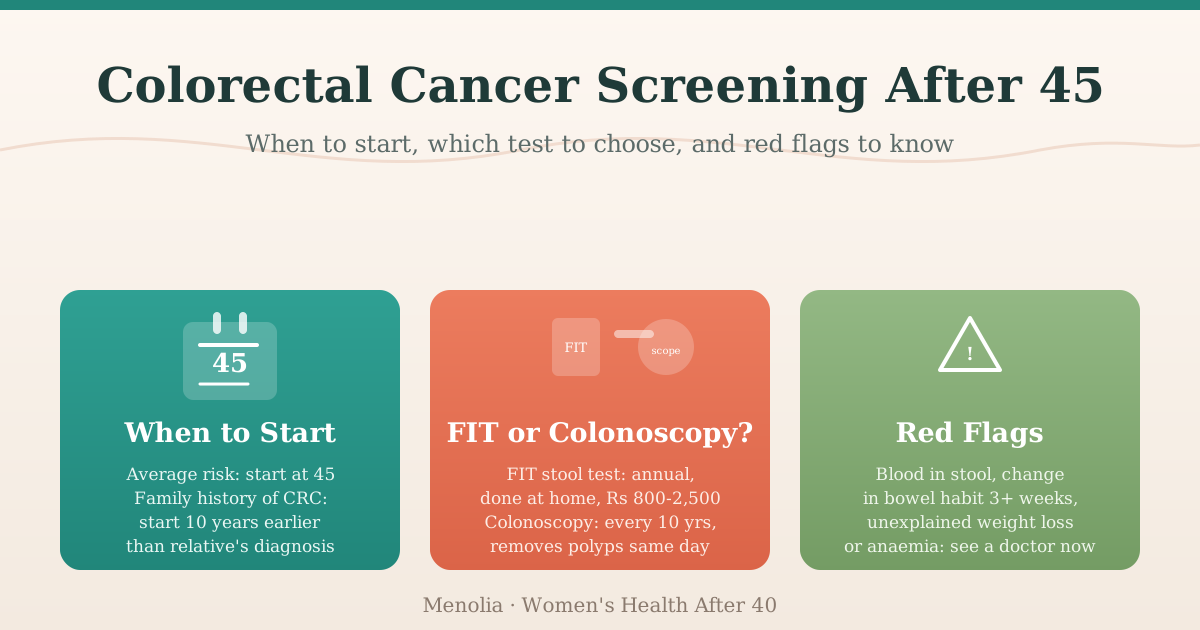
After the age of 45, the cumulative risk of developing colorectal cancer begins to climb meaningfully. In 2021, the US Preventive Services Task Force updated its recommendation to start average-risk screening at 45, citing both the rising incidence in younger adults and modelling data showing the benefit of earlier detection (Davidson KW et al., JAMA 2021, PMID 34003218). Major Indian hospital systems, including Apollo and Fortis, now align with this guidance for Indian adults.
Women specifically are sometimes under-screened because colorectal cancer has historically been framed as a “men’s disease.” The risk is lower in women throughout the reproductive years, likely partly due to oestrogen’s protective effect on the colon lining. After menopause, that protection wanes. Postmenopausal women catch up to men in risk, and they remain at meaningful lifetime risk for the rest of their lives.
Your Two Main Screening Options
The FIT Stool Test: Simple and Done at Home
The FIT (fecal immunochemical test, also called iFOBT) looks for microscopic traces of blood in a stool sample. Blood in the stool can be an early sign that a polyp or growth is present, even when it is invisible to the eye.
You collect a small stool sample at home using a kit provided by the lab, post it or drop it off, and receive a result within a few days. There is no diet restriction beforehand, no bowel preparation, and no procedure.
A 2014 systematic review and meta-analysis in the Annals of Internal Medicine (Lee JK et al., PMID 24658694) found that FIT has a pooled sensitivity of 79% and specificity of 94% for detecting colorectal cancer in average-risk adults. In plain terms: it picks up roughly four out of five cancers and correctly reassures about nine out of ten people with no cancer.
A normal FIT result is genuinely reassuring. An abnormal FIT does not mean cancer. It means blood was found, and the next step is a diagnostic colonoscopy to find out why.
Cost in India: Rs 800 to 2,500 depending on the chain. Thyrocare, Metropolis, Dr Lal Path Labs, and SRL all offer FIT or FOBT (the older chemical version). FIT is preferred over FOBT as it is more accurate and does not require dietary restrictions.
How often: Annually, if you are choosing this route rather than colonoscopy.
Colonoscopy: The Complete Picture
Colonoscopy uses a thin, flexible camera to examine the entire colon and rectum directly. It is done under mild sedation so most people remember little of the procedure itself. A gastroenterologist can not only see polyps but remove them in the same sitting, which is why a single colonoscopy effectively breaks the cancer chain.
If the exam is normal, the next one is not needed for 10 years in an average-risk person. That long gap is one of colonoscopy’s practical advantages: you do it once, you know you are clear, and you move on.
The preparation is the part most people find uncomfortable. You take a laxative the evening before to clear the bowel completely so the camera has a clean view. The procedure itself takes around 30 to 45 minutes.
Cost in India: This varies significantly by setting. Diagnostic and endoscopy centres typically charge Rs 4,500 to 8,000 for a straightforward outpatient colonoscopy. Multi-speciality corporate hospitals generally charge Rs 15,000 to 30,000 or more, which usually includes sedation, facility, and specialist fees. Most places do not require admission overnight. CGHS and Ayushman Bharat empanelled hospitals have fixed rates that are considerably lower.
How often: Every 10 years if normal and average risk.
Which option is right for you?
For most women starting screening at 45 with no symptoms and no family history, either path is reasonable. FIT is lower-risk, lower-cost, and can be done without any procedure, but it requires annual commitment and a colonoscopy follow-up if the result is positive. Colonoscopy offers a definitive view and the ability to remove polyps immediately, but it requires bowel preparation and a procedure.
The conversation with your gastroenterologist will weigh your individual preferences, any travel constraints, and your access to colonoscopy facilities.
The Family History Modifier
If a first-degree relative (parent, sibling, or child) has been diagnosed with colorectal cancer, your personal risk is roughly double the average. The same applies if a close relative was diagnosed with colorectal polyps.
The standard guidance in this case is to begin screening either at age 40 or 10 years before the age at which the relative was diagnosed, whichever comes first.
Example: If your mother was diagnosed at 55, you should consider starting screening at 45 (10 years before her diagnosis). If she was diagnosed at 48, you should consider starting at 38.
This is the conversation worth having with your doctor early, before you reach the average-risk starting age. The family history modifier also applies if you have a personal history of inflammatory bowel disease (Crohn’s disease or ulcerative colitis), which raises lifetime colorectal cancer risk independently of screening age.
If you are unsure where to start or whether your family history places you in a higher-risk category, Dr. Suganya is available for an online consultation. Reach her on WhatsApp at wa.me/919940270499 to book a review appointment.
Red-Flag Symptoms That Cannot Wait for a Routine Screen
Screening is for people without symptoms. If any of the following are present, the conversation changes from “when should I schedule my next screen” to “I need an evaluation now.”
Rectal bleeding or blood in the stool. Any visible blood, whether bright red, maroon, or dark and tarry, that is not clearly explained by haemorrhoids confirmed by a doctor warrants proper investigation. Blood in the stool is one of the more common early signs of colorectal cancer, and it should never be attributed to haemorrhoids without an exam.
A change in bowel habit lasting more than three weeks. This includes a shift to looser stools, constipation that is new or worsening, a feeling of incomplete emptying after a bowel movement, or stools that are noticeably narrower than usual.
Unexplained weight loss. Losing weight without trying, particularly 3 to 5 kg or more over a few months, is a red flag across multiple cancer types, including colorectal.
Fatigue and anaemia. Colorectal cancer can bleed slowly over a long time without visible blood in the stool. That slow blood loss often shows up first as iron-deficiency anaemia, with symptoms of persistent tiredness, pallor, and breathlessness on minor exertion. If your recent blood count shows unexplained anaemia, a bowel evaluation is part of the workup. Low B12 and iron deficiency can look similar, so a thorough panel helps sort this out.
Abdominal pain or a lump. Persistent lower abdominal pain or a mass felt in the abdomen always warrants imaging and investigation.
These symptoms do not mean cancer is present. Most people who have them have something far more benign: haemorrhoids, irritable bowel syndrome, dietary changes, or a gut infection. But these symptoms need a face-to-face examination and appropriate tests, not a “wait and see” approach.
The Post-Menopause Screening Picture: Putting It All Together
Colorectal cancer screening is one of several health checks that become important after menopause. The full checklist includes bone density, lipid panel, blood sugar, thyroid, vitamin D and B12, blood pressure, mammogram, Pap smear, and now bowel screening. Our complete post-menopause health checklist covers all of these in one place.
One connection worth highlighting: postmenopausal diabetes risk rises as oestrogen falls, and women with type 2 diabetes have a modestly higher risk of colorectal cancer compared with non-diabetic women. Managing blood sugar well is part of the cancer-prevention picture, not just the cardiovascular one.
Cervical cancer screening has its own set of considerations after 40, and the guidance is similar: screening does not stop at menopause, and the decision to stop requires meeting specific criteria with your doctor.
A Practical Action Step for This Month
If you are 45 or older and have never had a FIT test or a colonoscopy, book one. The first step is simply calling a diagnostic centre near you and asking for a FIT test. If you want to start with colonoscopy, ask your GP for a referral to a gastroenterologist.
If you are under 45 with a family history of colorectal cancer, this is the conversation to have at your next appointment rather than waiting.
If you have any of the red-flag symptoms above, do not schedule a routine screening appointment. Ask for a prompt evaluation.
Not sure where to start or how to fit this into your current health checks? Dr. Suganya is available for online consultations, pan-India, by video call. Message her on WhatsApp at wa.me/919940270499.
Frequently Asked Questions
At what age should I start colorectal cancer screening in India?
For an average-risk woman with no family history and no symptoms, the current guidance supported by major health systems, including the updated USPSTF 2021 recommendation (JAMA, PMID 34003218), is to begin screening at 45. Indian hospital chains including Apollo and Fortis now follow this same starting age. If you have a first-degree relative with colorectal cancer, begin screening earlier: either at 40 or 10 years before your relative’s diagnosis age, whichever comes first.
What is a FIT test and how is it different from the old FOBT?
Both tests look for blood in the stool, but FIT (fecal immunochemical test) is more accurate and easier to use. Unlike the older guaiac FOBT, FIT does not require any diet restrictions before the test. It uses an antibody that specifically detects human haemoglobin, so it is not triggered by dietary iron or red meat. A 2014 meta-analysis (Lee JK et al., Ann Intern Med, PMID 24658694) found FIT has sensitivity of 79% and specificity of 94% for colorectal cancer. It is widely available at Thyrocare, Metropolis, Dr Lal Path Labs, and SRL.
Is a colonoscopy painful?
The procedure itself is done under mild sedation, so most people experience little to no discomfort during the scope. The preparation the night before, which involves drinking a laxative to empty the bowel completely, is uncomfortable but manageable. The actual scope takes 30 to 45 minutes. You would need someone to drive you home afterwards because of the sedation, but there is typically no overnight stay required.
What does it mean if my FIT test is positive?
A positive FIT means blood was detected in the stool sample. It does not mean cancer is present. Many things can cause a positive result, including haemorrhoids, benign polyps, or small areas of inflammation. A positive FIT is a signal to proceed to a diagnostic colonoscopy so the cause can be identified directly. The important thing is not to ignore a positive result.
I have haemorrhoids. Can I still rely on a FIT test?
Active haemorrhoids can potentially trigger a positive FIT result because they bleed into the stool. If you have confirmed, symptomatic haemorrhoids, let the doctor or radiologist know, because some clinicians prefer colonoscopy as the primary screen in this situation rather than FIT. Either way, a symptomatic haemorrhoid that bleeds should be examined and confirmed, not assumed, before attributing any rectal bleeding to it.
How much does a colonoscopy cost at a government hospital in India?
Rates at government and CGHS-empanelled hospitals are substantially lower than at private facilities. CGHS has fixed rates for endoscopic procedures, and Ayushman Bharat covers colonoscopy for eligible beneficiaries. Rates at government medical college hospitals vary by state but are generally in the Rs 500 to 2,000 range for the procedure. The waiting time may be longer. For private settings, diagnostic and endoscopy centres typically charge Rs 4,500 to 8,000 for a basic outpatient colonoscopy, while corporate hospitals charge more.
Can colorectal cancer be prevented completely?
Colorectal cancer cannot be prevented with certainty, but the risk can be meaningfully reduced. Removing polyps during colonoscopy before they become cancerous is the most effective preventive step. Beyond screening, a diet with adequate fibre from foods like rajma, chana, dal, and vegetables, regular physical activity, maintaining a healthy weight, limiting red and processed meat, and not smoking all reduce risk. Screening is the most powerful tool in the toolkit.