Women who have spent years caring for a parent with Alzheimer’s often bring the same question to an HRT conversation: if hormone therapy protects the brain, they want it, and if it harms the brain, they want nothing to do with it.
I’m Dr. Suganya Venkat, an OB-GYN with more than 15 years of clinical experience, and in recent years this question has started to come up almost as often as the breast cancer question. Many of the women asking are in their late forties and noticing their own word-finding slipping. They have read one article saying HRT protects the brain and another saying it raises Alzheimer’s risk. Both articles quoted real studies.
This post walks through those studies, what each one tested, and what they add up to. The short version: HRT should not be started to prevent dementia. In women who start it around the time of menopause for symptoms, the randomised trials show no clear effect on thinking and memory, good or bad. In women who started combined tablet HRT at 65 or older, the largest trial found a higher rate of dementia. And the population studies in between disagree with each other.
What This Post Covers
- Why people thought oestrogen might protect the brain
- The WHI Memory Study, and why its results worried everyone
- The trials in younger women (WHIMS-Y, KEEPS, ELITE)
- The “timing hypothesis” and how far the evidence supports it
- The large population studies from Denmark, Finland and the UK, and why they disagree
- Vaginal oestrogen, early menopause and surgical menopause
- What does have trial evidence for protecting the brain after 45
If your main worry is ordinary forgetfulness right now (losing names, walking into a room and forgetting why), start with our post on whether menopausal memory loss is dementia or hormones. This post is about something different: whether taking HRT changes your long-term risk of dementia.
Why Oestrogen and the Brain Became a Question at All
Oestrogen receptors are present in brain regions involved in memory, including the hippocampus. Women also make up a larger share of people living with Alzheimer’s disease, partly because women live longer. Put those two facts together and it was natural to ask whether losing oestrogen at menopause speeds up brain ageing, and whether replacing it slows it down.
Early observational research seemed to say yes. In the Cache County Study in Utah, which followed older women over three years, those who had used HRT had a lower rate of Alzheimer’s disease than those who had not (adjusted hazard ratio 0.59) (Zandi PP et al., JAMA, 2002, PMID 12413371). Most of that apparent benefit came from women who had used HRT in the past; current use showed no clear effect unless it had gone on for more than ten years.
The trouble with this kind of study is that women who choose HRT tend to differ from women who do not. In many settings they have had more education, more access to doctors, and healthier habits, and each of those is linked to lower dementia risk on its own. So the only way to know whether HRT itself made the difference was a randomised trial.
The WHI Memory Study: The Result That Changed Practice
The Women’s Health Initiative Memory Study (WHIMS) enrolled women aged 65 and older who were already in the large WHI hormone trials. They were randomly assigned to HRT tablets or a placebo.
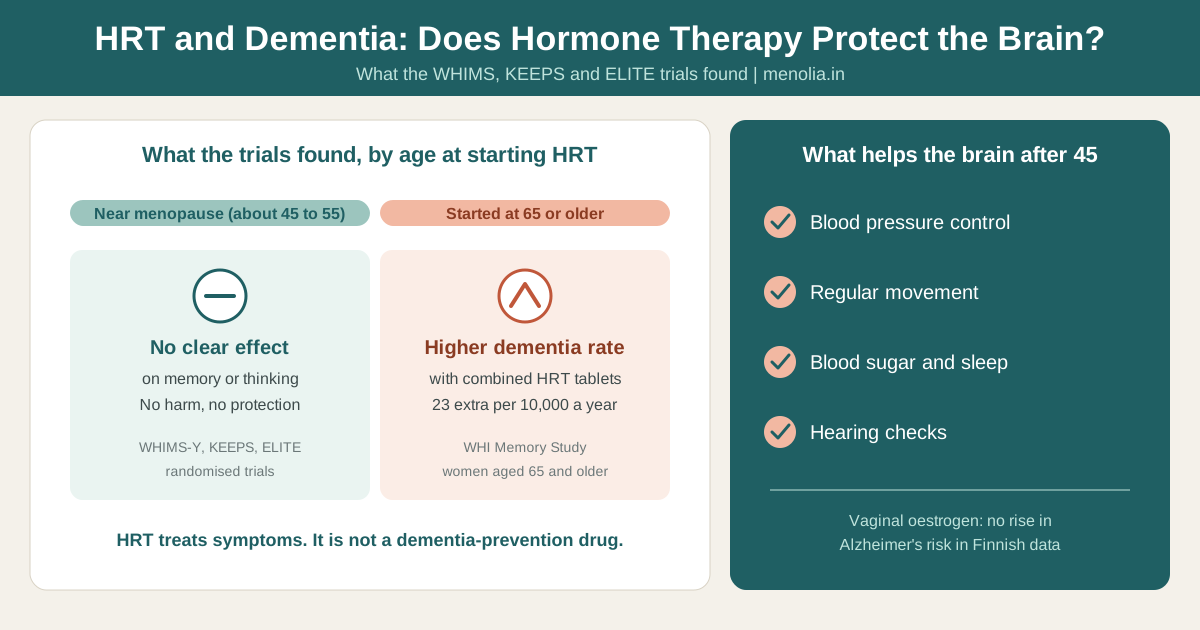
Combined HRT (oestrogen plus a progestogen). Among 4,532 women aged 65 or older, 40 women on HRT and 21 on placebo developed probable dementia over an average of about four years (Shumaker SA et al., JAMA, 2003, PMID 12771112). That is a hazard ratio of 2.05, roughly a doubling. In absolute terms, the authors estimated 23 additional cases of dementia per 10,000 women per year. HRT did not prevent mild cognitive impairment either.
Oestrogen-only HRT (for women who had had a hysterectomy). In 2,947 women aged 65 to 79, 28 on oestrogen and 19 on placebo developed probable dementia (hazard ratio 1.49, which did not reach statistical significance) (Shumaker SA et al., JAMA, 2004, PMID 15213206). When dementia and mild cognitive impairment were counted together, the risk was higher on oestrogen. The authors concluded that hormone therapy should not be used to prevent dementia or cognitive decline in women aged 65 or older.
Two details matter when you read these results today:
- The women were 65 to 79 when they started, usually more than ten years past their menopause. Very few women start HRT at that age for symptoms.
- The HRT was a specific tablet regimen: conjugated equine oestrogens, with medroxyprogesterone acetate in the combined arm. That is one formulation among several now available, and the trials did not test patches or gels.
So WHIMS answered one question clearly: starting tablet HRT in your late sixties or seventies does not protect the brain and may harm it. It could not answer the question most women in their late forties are asking.
What Happened When Younger Women Were Studied
Three trials looked at women closer to menopause.
WHIMS-Y. Researchers went back to 1,326 women who had joined the WHI trials when they were aged 50 to 55 and had taken HRT or placebo for an average of seven years. They tested their thinking skills about seven years after the trials ended, at an average age of 67 (Espeland MA et al., JAMA Internal Medicine, 2013, PMID 23797469). Global cognitive scores were similar in the HRT and placebo groups. The authors concluded there was no overall sustained benefit or risk.
KEEPS-Cognitive. This trial enrolled women who were on average just 1.4 years past their last period, with low cardiovascular risk. They were randomised to oral conjugated oestrogens, a transdermal estradiol patch (each with cyclic micronised progesterone), or placebo, for up to four years (Gleason CE et al., PLoS Medicine, 2015, PMID 26035291). Neither form of HRT changed thinking or memory compared with placebo. Women on the oral tablet did report fewer symptoms of depression and anxiety.
ELITE. This trial tested the timing question directly. It randomised women who were either within six years of menopause or ten or more years past it to oral estradiol or placebo, and followed them for about five years (Henderson VW et al., Neurology, 2016, PMID 27421538). Estradiol neither helped nor harmed verbal memory, executive function or global cognition, and the result was the same in the early and late groups.
Put together, these three trials say something reassuring and something limiting. Reassuring: for a woman in her late forties or early fifties who takes HRT for hot flashes, night sweats or sleep, the trials did not find harm to thinking and memory. Limiting: they did not find protection either.
Have a family history of dementia and weighing up HRT? Dr. Suganya Venkat can go through your symptoms, your family history and your other health factors with you over a video consultation.
The Timing Hypothesis: How Far Does the Evidence Go?
The “timing hypothesis” (also called the “critical window”) is the idea that oestrogen may help, or at least not harm, the brain when started near menopause, but may harm it when started many years later.
Some of the support comes from observational work. A later analysis of the Cache County Study found that women who started any HRT within five years of menopause had about 30% less Alzheimer’s disease, while women who started it five or more years after menopause had no reduction (Shao H et al., Neurology, 2012, PMID 23100399). Women who had started combined HRT later in life, in the three years before the study began, had a higher rate, close to what WHIMS found. The authors described HRT near menopause as “possibly beneficial” and called for more research.
Studies of women whose ovaries were removed before natural menopause point the same way. In a Minnesota cohort, women who had one or both ovaries removed before menopause had a higher risk of later cognitive impairment or dementia, and the risk was greater the younger they were at surgery (Rocca WA et al., Neurology, 2007, PMID 17761551).
So the timing idea is consistent with several observations. But when it was put to a direct randomised test in ELITE, estradiol started early did no better for cognition than estradiol started late. The fairest reading today: in the trials, HRT started close to menopause caused no measurable harm to thinking and memory over the years studied, but whether it changes long-term dementia risk is still uncertain, and it has not been shown to protect against dementia.
This fits the wider guidance. The North American Menopause Society’s 2022 position statement says that for women under 60, or within ten years of menopause, without contraindications, the benefit-risk balance is favourable for treating bothersome hot flashes and preventing bone loss. For women who start more than ten years after menopause or after 60, it describes the balance as less favourable, partly because of greater absolute risks of heart disease, stroke, blood clots and dementia (The North American Menopause Society Hormone Therapy Position Statement Advisory Panel, Menopause, 2022, PMID 35797481). Our post on starting HRT after 60 covers that later-start decision in more detail.
The Population Studies: Why the Headlines Disagree
Since the trials, three very large registry studies have examined HRT and dementia in ordinary practice. They reached different conclusions, and each one generated its own headlines.
Finland (2019). Comparing 84,739 women with Alzheimer’s disease against the same number of matched women without it, use of systemic HRT (tablets, patches or gels) was linked to a 9% to 17% higher risk (Savolainen-Peltonen H et al., BMJ, 2019, PMID 30842086). In women who started before 60, the increase was seen with more than ten years of use. Vaginal estradiol on its own showed no increase. The authors noted that the absolute increase was small.
United Kingdom (2021). Using two large GP databases, 118,501 women with dementia were compared with 497,416 controls (Vinogradova Y et al., BMJ, 2021, PMID 34588168). Overall, HRT was not linked to a higher risk of dementia. Combined HRT taken for five years or more was linked to a slightly higher risk of Alzheimer’s disease specifically, equivalent to about five to seven extra cases per 10,000 women per year. Oestrogen-only HRT for ten years or more was linked to a slightly lower risk of dementia in women under 80.
Denmark (2023). This study looked at all Danish women aged 50 to 60 in the year 2000, comparing 5,589 who developed dementia with 55,890 who did not (Pourhadi N et al., BMJ, 2023, PMID 37380194). Combined HRT was linked to a 24% higher rate of dementia, and longer use was linked to higher rates. The link was also seen in women who had used HRT at 55 or younger, which is the finding that most challenges the timing hypothesis. The authors themselves wrote that more research is needed to know whether this reflects an effect of HRT or an underlying predisposition in women who need these treatments.
Why do careful studies disagree? Registry data cannot fully separate the effect of a medicine from the reasons people take it. Severe hot flashes, poor sleep and low mood may themselves be linked to brain health, and women with those symptoms are the ones prescribed HRT. Countries also differ in which products they use. None of these studies is wrong; each answers a slightly different question with different data.
What I take from all three: if there is any increase in dementia risk with HRT started in midlife, it appears small, and it is seen mainly with long-term combined HRT. Neither study design is strong enough to tell you HRT protects the brain, and neither is a reason on its own for a woman with disabling symptoms to go without treatment.
Three Situations Where the Answer Is Different
Vaginal oestrogen for dryness
Low-dose vaginal oestrogen creams, tablets and pessaries act mainly on the vaginal and bladder tissues. The Finnish study found no rise in Alzheimer’s risk among women who used only vaginal estradiol. If you use a vaginal cream for dryness, pain with sex or recurrent urine infections, the dementia studies above are about a different treatment. Our guide to vaginal oestrogen cream in India explains how it differs from systemic HRT.
Early menopause or premature ovarian insufficiency
For women whose periods stop before 40, or whose ovaries stop working early, hormone replacement until around the usual age of menopause is generally advised for bone and heart health. The Minnesota data on early ovary removal suggest the brain may be part of that picture too, though this has not been tested in a trial. Our post on premature menopause covers this group.
Surgical menopause
Women who have both ovaries removed before natural menopause lose oestrogen abruptly. The Minnesota cohort described above found a higher risk of later cognitive impairment or dementia after removal of one or both ovaries before menopause, and the risk was greater the younger the woman was at surgery. Whether and how long to use HRT after surgery is an individual decision, discussed in our guide to surgical menopause.
Does the Type of HRT Make a Difference?
This is one of the open questions. WHIMS tested only conjugated equine oestrogen tablets, given either alone or combined with medroxyprogesterone acetate. KEEPS included a transdermal estradiol patch with micronised progesterone and found no cognitive harm in recently menopausal women, but it ran for four years and was not designed to measure dementia. The Finnish study did not find that the type of progestogen changed the Alzheimer’s association.
At standard doses, patches and gels have been linked to lower risks of blood clots and stroke than tablets, which is one reason they are often preferred in women with other risk factors. Whether they are also better for the brain is not yet known. Our comparison of HRT patch, gel and pill covers the practical differences between the routes.
What Has Trial Evidence for Protecting Your Brain
If HRT is not a brain-protection medicine, what is? This is where I would put your energy.
Blood pressure. In the SPRINT MIND trial, adults aged 50 and over with high blood pressure were treated to either a tighter or a standard systolic target (Williamson JD et al., JAMA, 2019, PMID 30688979). The tighter target lowered the rate of mild cognitive impairment, and the combined rate of mild cognitive impairment or dementia. The reduction in dementia alone was not statistically significant, partly because the trial stopped early. The target that is right for you is something to agree with your physician. Our post on menopause and blood pressure explains why readings often rise after 45.
Movement, blood sugar, sleep and hearing. Regular physical activity, keeping diabetes well controlled, not smoking, treating sleep problems and getting hearing checked are all part of the usual advice for brain health in midlife, and physical activity, diabetes control and not smoking also protect your heart. If you have noticed your hearing changing, our post on menopause and hearing loss covers when to get tested.
Treating the symptoms that wear you down. Night sweats that wake you three times a night, anxiety and low mood all affect how sharp you feel during the day. HRT is often the most effective treatment for night sweats and hot flashes, and treating them can improve sleep. That is a good reason to consider HRT, even though dementia prevention is not. Our menopause brain fog guide looks at the day-to-day side of this.
For the broader decision, including who should not take systemic HRT, see our guide to HRT in India: benefits, risks and when to start.
Questions to Bring to Your Doctor
- What is my main reason for considering HRT, and how much is it affecting my sleep, work and mood?
- How far am I from my last period, and what does that mean for my overall risk-benefit balance?
- Would a patch or gel suit me better than a tablet, given my blood pressure, weight and other conditions?
- If I need a progestogen, which one, and does that change anything?
- How long do we plan to continue, and when will we review it? (Our post on how long you can stay on HRT covers this.)
- Are my blood pressure, blood sugar and cholesterol where they should be?
Frequently Asked Questions
Does HRT prevent dementia?
No. HRT has not been shown to prevent dementia in randomised trials. Trials in women who started HRT near menopause (WHIMS-Y, KEEPS and ELITE) found no benefit or harm to thinking and memory. HRT is used to treat menopausal symptoms and prevent bone loss, not to protect the brain.
Does HRT cause dementia or Alzheimer’s?
In women who started combined HRT tablets at 65 or older, the WHI Memory Study found about twice the rate of probable dementia, or 23 extra cases per 10,000 women per year. In women who start HRT around menopause, the trials found no harm to cognition. Large registry studies are mixed: a UK study found no overall rise in dementia, while Finnish and Danish studies found small increases, mainly with longer use.
Is it true that starting HRT early protects the brain?
This is called the timing hypothesis. In the trials, women who started HRT close to menopause showed no measurable harm to thinking and memory over the years they were followed. This differs from the higher rate of dementia seen in women who started at 65 or older, but those trials measured thinking and memory scores, not long-term dementia risk. But a randomised trial designed to test this (ELITE) found that estradiol started within six years of menopause had no better effect on memory than estradiol started ten or more years later. So early HRT showed no cognitive harm in the years studied, but protection has not been proven and its long-term effect on dementia risk remains uncertain.
My mother had Alzheimer’s. Should I avoid HRT?
A family history of Alzheimer’s does not by itself rule HRT in or out. The studies have not shown that HRT changes your risk differently because of a family history. If your symptoms are affecting your life, the decision is weighed in the usual way, with your age, time since menopause, blood pressure and other risks. Tell your doctor about the family history so you can plan for the things that do help, such as blood pressure and blood sugar control.
Does vaginal oestrogen cream increase dementia risk?
A large Finnish study found no increase in Alzheimer’s risk among women who used only vaginal estradiol. Low-dose vaginal oestrogen acts mainly on the vaginal and bladder tissues, so the dementia findings for tablets, patches and gels do not transfer to it in the same way.
Will HRT help my brain fog and memory lapses?
In KEEPS, HRT did not improve scores on memory tests in recently menopausal women. Some women still feel clearer on HRT, which may be because it settles night sweats and improves sleep. If brain fog is your main complaint, it is worth also checking sleep, thyroid function, vitamin B12 and iron levels.
I started HRT after 60. Should I stop because of dementia risk?
Do not stop suddenly on your own. Discuss it with your doctor, who will look at why you started, which product you are on, how long you have taken it and your other risks. For women who start more than ten years after menopause or after 60, menopause guidance describes the overall balance as less favourable, so a review is reasonable. Our guide on how to stop HRT safely explains the options if you decide to come off.
If you are trying to decide about HRT and the dementia question is holding you back, message Dr. Suganya Venkat on WhatsApp. She consults online, pan-India, via video call.