A year into HRT, your hot flushes have settled and you are sleeping through the night again. Then your annual mammogram report arrives with a line you have not seen before: “heterogeneously dense breast tissue.” A quick search connects dense breasts to breast cancer, someone mentions that HRT makes breasts denser, and the relief of the past year starts to feel uncertain.
I’m Dr. Suganya Venkat, an OB-GYN with more than 15 years of clinical experience, and a dense-breast line on a mammogram report is something women on HRT regularly bring to their video consultations with me. Usually they want two answers: did the HRT do this, and does it mean they have to stop?
This is one of the better-studied corners of menopause care, because large randomised trials took mammograms before and after women started hormones. The short version: combined HRT (oestrogen plus a progestogen) makes breast tissue look denser in a minority of women, mostly within the first year. Oestrogen alone has a much smaller effect. The change reverses when HRT stops. What it means for you depends on your density category, whether it changed, and your overall risk, and each of those can be worked through calmly.
What This Post Covers
- What “dense breasts” means on a mammogram report, and how it differs from the result itself
- Why density matters for screening
- What the trials show HRT does to density, by type of HRT
- Whether a denser mammogram on HRT is a warning sign
- Whether stopping HRT before a mammogram helps
- Ultrasound and MRI as extra screening for dense breasts
- Questions to take to your doctor
If you have not had a mammogram yet, or want the basics of when to screen and what it costs, start with our guide to mammograms after 45. This post picks up from there, for women already on HRT who have a report in hand.
What “Dense Breasts” Means on Your Report
Breasts are made of fatty tissue and fibroglandular tissue (milk glands, ducts and the supporting fibrous tissue). On a mammogram, fat looks dark grey. Fibroglandular tissue looks white. “Density” is the radiologist’s description of how much of the breast is white tissue.
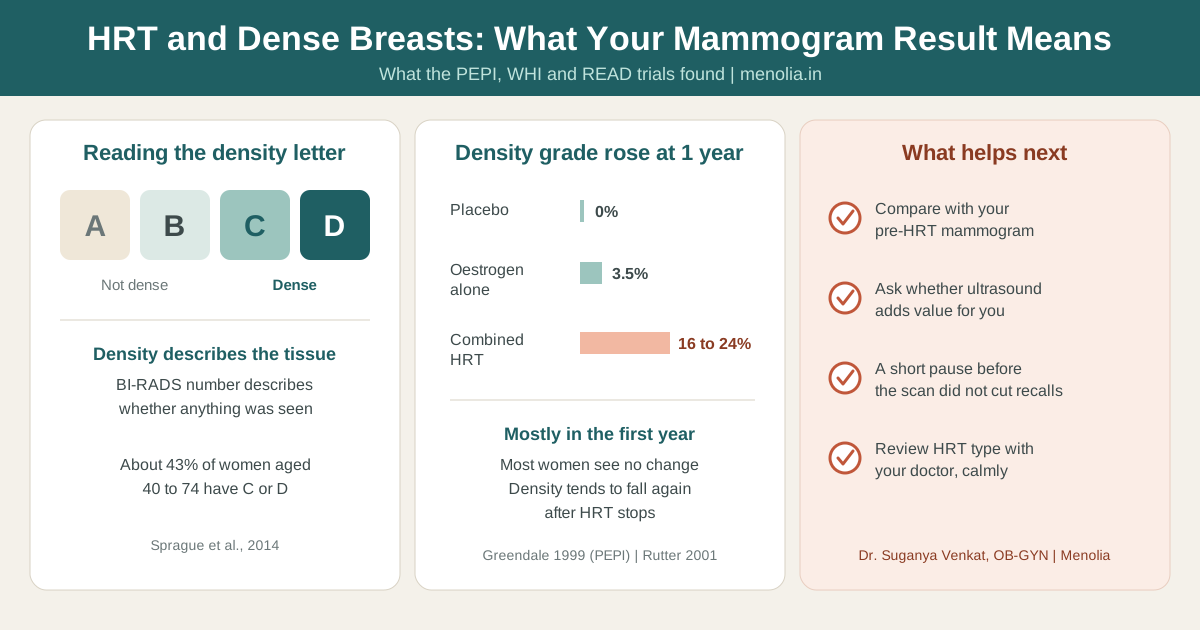
Most reports grade this with a letter:
| Density category | What it means |
|---|---|
| A | Almost entirely fatty |
| B | Scattered areas of fibroglandular density |
| C | Heterogeneously dense |
| D | Extremely dense |
Categories C and D are what doctors mean by “dense breasts.” This is common. In a large US analysis of more than 1.5 million mammograms, 43.3% of women aged 40 to 74 had heterogeneously or extremely dense breasts, and the proportion fell with age and with higher body weight (Sprague BL et al., J Natl Cancer Inst, 2014, PMID 25217577). Density describes how your breast tissue is built. It is not a disease, and you cannot feel it in a self-examination.
The density letter and the result are two separate lines
This is the most useful thing to understand on your report. The density letter (A to D) describes the tissue. The BI-RADS assessment category (0 to 6) describes whether anything suspicious was seen. A report that reads “BI-RADS 2, density C” means the radiologist found nothing concerning, in breasts that happen to be dense. The BI-RADS section of our mammogram guide explains each assessment category.
Why Density Matters for Screening
Density matters for two different reasons.
It can hide things. Fibroglandular tissue looks white on a mammogram, and so does a tumour. In very dense breasts, a small cancer can blend into the white background. This is why mammography is less sensitive in dense breasts, and why some women are offered an extra test.
It is a risk factor on its own. Women with denser breasts have a higher background risk of breast cancer. In three nested case-control studies within screening programmes, covering 1,112 matched pairs of women with and without breast cancer, women whose mammograms were 75% or more dense had 4.7 times the odds of breast cancer compared with women whose mammograms were less than 10% dense (Boyd NF et al., N Engl J Med, 2007, PMID 17229950).
That 4.7 figure compares the two extremes of density. Most women sit somewhere in between, and density is one factor among several (age, family history, previous biopsies, alcohol, body weight after menopause) that a doctor weighs together. On its own, a “C” on your report is a prompt to think about your screening plan.
What HRT Does to Breast Density
This is where the trials are clear, and where the type of HRT makes a real difference.
Combined HRT: oestrogen plus a progestogen
In the PEPI trial, a randomised placebo-controlled study, women had mammograms before and during three years of treatment. Almost all the density increases happened in the first year. At 12 months, the share of women whose density grade went up was (Greendale GA et al., Ann Intern Med, 1999, PMID 10068383):
- 0% on placebo
- 3.5% on oestrogen alone
- 16.4% to 23.5% on the three combined regimens
The combined regimen that used micronised progesterone (the body-identical form) also raised density: 16.4% of women on it moved up a grade, compared with 23.5% and 19.4% on the two regimens using the synthetic progestin medroxyprogesterone acetate.
So most women starting combined HRT do not see their density grade change. A minority, roughly one in six to one in four in PEPI, do.
The Women’s Health Initiative measured the same thing more precisely in a randomised sub-study of 413 women on daily combined HRT tablets or placebo. Average mammographic density went up by 6.0 percentage points after one year on combined HRT and fell slightly on placebo. The rise was larger in women who started in their seventies (McTiernan A et al., J Natl Cancer Inst, 2005, PMID 16174858).
Oestrogen alone
Women who have had a hysterectomy usually take oestrogen without a progestogen. In PEPI, oestrogen alone moved only 3.5% of women up a density grade, and at 12 months the combined regimens carried 7 to 13 times the odds of a density increase compared with oestrogen alone. The progestogen part of combined HRT appears to account for much of the density effect.
If you still have your uterus, this does not mean you should drop the progestogen. It protects the womb lining from the overgrowth that oestrogen alone can cause, which is explained in our post on why HRT needs progesterone.
Tibolone
Tibolone is a different kind of menopause medicine. In a small six-month Swedish trial of 154 women, combined oestradiol-norethisterone tablets raised digitised breast density by an average of 14.3%, while tibolone raised it by 2.3% (Lundström E et al., Maturitas, 2011, PMID 21958943). That is a small, short study. Tibolone has its own benefits and cautions, so whether it suits you is a conversation with your doctor rather than a switch to make because of one mammogram.
Patches and gels
Most density research used oral tablets. There is less direct trial evidence on transdermal oestrogen (patches and gels) and density, so I would not tell you a patch or gel will keep your density lower. What the trials do show is that the bigger difference comes from whether a progestogen is added.
The Change Is Not Permanent
HRT-related density is not a fixed feature of your breasts. In a study of 5,212 postmenopausal women who had two screening mammograms, women who started HRT between the two scans were more likely to show an increase in density (relative risk 2.57). Women who stopped HRT between the two scans were more likely to show a decrease (relative risk 1.81). The authors described the change as dynamic: up with starting, down with stopping (Rutter CM et al., JAMA, 2001, PMID 11176809).
Density also tends to fall with age: in the large US analysis above, dense breasts were less common in the older age groups.
If your mammogram report has left you unsure whether to continue HRT, message Dr. Suganya on WhatsApp. She consults online, pan-India, over video call, and can go through your report with you.
Is a Denser Mammogram on HRT a Warning Sign?
Two findings from the Women’s Health Initiative are worth knowing, explained plainly.
Combined HRT means more call-backs. After one year, 9.4% of women on combined HRT had an abnormal mammogram, compared with 5.4% on placebo, and this pattern continued for the length of the study (Chlebowski RT et al., JAMA, 2003, PMID 12824205). An “abnormal” mammogram here means a recall: the radiologist wants extra views or an ultrasound to look more closely. A recall is a request for a closer look, and if you are on combined HRT it helps to know in advance that one is more likely.
A large jump in density may matter. In a nested case-control analysis within the WHI combined-HRT trial, the women whose density rose the most in the first year (an increase of more than 19.3%) had 3.6 times the odds of a later breast cancer diagnosis, and the extra breast cancer risk linked to combined HRT in that analysis was accounted for by the density change (Byrne C et al., J Natl Cancer Inst, 2017, PMID 28376149). This was one analysis of one older tablet regimen (conjugated equine oestrogen with medroxyprogesterone acetate), and it needs confirming in other groups of women.
What it supports in practice is simple: after starting combined HRT, ask for your next mammogram to be compared with your pre-HRT mammogram. If your density category is unchanged, which is the case for most women, that is reassuring. If it has jumped, that is a reason for a calm conversation about your HRT type and your screening plan. The overall breast cancer numbers on HRT, in absolute terms, are covered in our post on HRT and breast cancer risk.
Should You Stop HRT Before Your Mammogram?
Some women are advised to pause HRT for a few weeks before a mammogram so the breasts look less dense. This has been tested.
In the READ trial, 1,704 women aged 45 to 80 on HRT were randomly assigned to no pause, a 1-month pause, or a 2-month pause before their screening mammogram. Recall rates were 11.3% with no pause, 12.3% with a 1-month pause and 9.8% with a 2-month pause, and the researchers could not find any group of women in whom a brief pause reduced recalls. Density did fall slightly with the pause, by 0.9% after one month and 1.5% after two (Buist DS et al., Ann Intern Med, 2009, PMID 19487710).
So for most women, stopping HRT for a short while before a mammogram is unlikely to change the result. It is likely to bring back hot flushes and broken sleep for those weeks. If you are told to pause, it is reasonable to ask what the pause is expected to achieve in your situation. If you and your doctor do decide to come off HRT for longer, our guide on how to stop HRT safely covers tapering and what to expect.
Extra Screening for Dense Breasts: Ultrasound and MRI
A dense report sometimes leads to a suggestion of an additional test. The evidence for each:
Breast ultrasound
Ultrasound uses no radiation, is widely available in India, and is relatively affordable. In the J-START trial in Japan, 72,998 women aged 40 to 49 were randomised to mammography alone or mammography plus ultrasound. Adding ultrasound raised sensitivity from 77.0% to 91.1% and found more early-stage cancers. The trade-off was more false alarms: specificity fell from 91.4% to 87.7% (Ohuchi N et al., Lancet, 2016, PMID 26547101). This trial was in women in their forties, and its results are about detection rather than deaths from breast cancer.
Breast MRI
MRI is the most sensitive test but costs more, needs a contrast injection, and is offered in fewer centres. In the Dutch DENSE trial, 40,373 women aged 50 to 75 with extremely dense breasts (category D) and a normal mammogram were randomised to an MRI invitation or mammography alone. The rate of cancers diagnosed between screening rounds was 2.5 per 1,000 screenings in the MRI-invitation group versus 5.0 per 1,000 in the mammography-only group. The false-positive rate among women who had the MRI was 79.8 per 1,000 screenings (Bakker MF et al., N Engl J Med, 2019, PMID 31774954).
Whether either test is right for you depends on your density category, your personal and family history, and what is available near you. For most women on HRT with category C density and no other risk factors, a good-quality annual mammogram compared against previous films, plus ultrasound if your doctor or radiologist suggests it, is a sensible plan. These are decisions to make with your doctor and radiologist, not from a single report.
Questions to Take to Your Doctor
These help turn a worrying report into a plan:
- What is my density category now, and what was it before I started HRT? A change matters more than the letter alone.
- What type of HRT am I on? Combined oestrogen plus progestogen, oestrogen alone after hysterectomy, or tibolone each affect density differently.
- What was my BI-RADS assessment? This is the line that says whether anything needs follow-up.
- Given my family history and density, would an ultrasound alongside my mammogram help?
- Is my current HRT type and dose still the right fit for me, given this report?
- Can my next mammogram be read alongside my previous ones? Carry your earlier reports and images, especially if you change centres.
Practical Takeaways
- Read the density letter and the BI-RADS category separately. “Dense” describes your tissue. The BI-RADS number tells you whether anything was seen.
- Combined HRT raises density in a minority of women, mostly in the first year. Oestrogen alone has a much smaller effect.
- The change reverses after stopping HRT, and density tends to fall with age anyway.
- A short pause before a mammogram did not reduce recalls in a randomised trial, so it is usually not worth the returning symptoms.
- Keep your old mammograms. Comparison with your pre-HRT scan is one of the most useful things a radiologist can do.
- Ask about supplemental ultrasound if your breasts are dense and your doctor feels it adds value for you.
- If you have a uterus, do not drop the progestogen on your own to lower density. It protects the womb lining.
- Between mammograms, report any new lump, skin dimpling, nipple change or discharge to your doctor, whatever your density.
Frequently Asked Questions
Does HRT cause dense breasts?
Combined HRT (oestrogen plus a progestogen) increases breast density in a minority of women, usually within the first year. In the PEPI trial, 16.4% to 23.5% of women on combined regimens moved up a density grade at 12 months, compared with 3.5% on oestrogen alone and 0% on placebo. Most women on HRT do not see their density category change.
My report says “heterogeneously dense” (category C). Is that bad?
Category C means a large part of your breast tissue is fibroglandular, which is common: about 43% of women aged 40 to 74 in a large US analysis had category C or D breasts. It does not mean anything abnormal was found. Look at the BI-RADS assessment number on the same report, which tells you whether anything needs follow-up.
Do I have to stop HRT if my breasts are dense?
Not automatically. Density is one factor your doctor weighs alongside your symptoms, the type of HRT you take, your family history, and whether your density changed after starting. Many women with dense breasts continue HRT with a sensible screening plan. Do not stop or change your HRT on your own because of one report; discuss it first.
Should I stop HRT a few weeks before my mammogram?
For most women, no. In a randomised trial of 1,704 women on HRT, pausing it for one or two months before the mammogram lowered density only slightly and did not reduce the chance of being called back. A pause usually brings back symptoms without improving the result.
Will my breast density go down if I stop HRT?
It tends to. In a study of more than 5,000 postmenopausal women, those who stopped HRT between two mammograms were more likely to show a decrease in density, and those who started were more likely to show an increase. Density also falls naturally with age.
Is a gel or patch better than tablets for breast density?
Most density research used tablets, and there is little direct trial evidence comparing patches or gels with tablets on density. The clearest difference in the trials was whether a progestogen was added to oestrogen. Your choice of route depends on many factors, which our guide on HRT patch vs gel vs pill walks through.
Do I need a breast MRI because I have dense breasts and take HRT?
Not routinely. In the DENSE trial, MRI reduced cancers found between screening rounds in women with extremely dense (category D) breasts, at the cost of more false positives. For most women with category C density and no other risk factors, an annual mammogram, with ultrasound if your doctor suggests it, is a reasonable plan. MRI is considered case by case, based on your overall risk and what is available.
If you are on HRT and your mammogram report has raised questions, message Dr. Suganya Venkat on WhatsApp. She consults online, pan-India, via video call, and can look at your report, your HRT and your history together.