A woman I was seeing for hot flashes and disrupted sleep once asked me a very reasonable question: “If oestrogen is what I’m missing, why am I also being given a second tablet?” She had read that progesterone was for periods and pregnancy, not menopause, and could not see why her prescription needed both.
It is one of the most common points of confusion in HRT, and it deserves a clear answer, because the second tablet is not an add-on. For a woman with a uterus, it is what keeps oestrogen therapy safe.
What This Post Covers
- Why oestrogen on its own is a problem if you still have a uterus
- How progesterone and progestogens protect the uterine lining
- The two ways progesterone is given: sequential and continuous-combined regimens
- What women without a uterus are spared
- Oral versus vaginal progesterone, and why the oral capsule is often taken at night
- Body-identical progesterone versus synthetic progestogens
- The “wild yam is natural progesterone” myth, and why it does not hold up
Why Oestrogen Alone Is Not Enough
Oestrogen is the hormone behind most of the relief women feel on HRT: fewer hot flashes, better sleep, less vaginal dryness, steadier mood. None of that is in question.
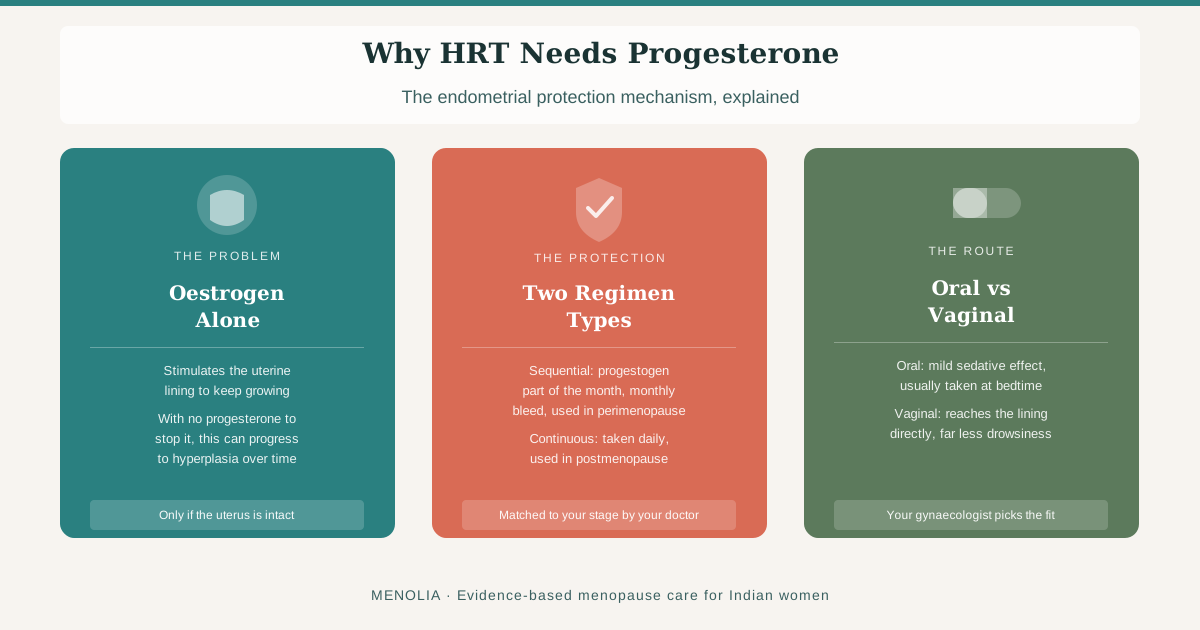
The problem is what oestrogen does to the uterine lining, the endometrium, when nothing balances it. The endometrium has oestrogen receptors and responds to oestrogen by growing. During the reproductive years, this was never a problem, because ovulation produced progesterone in the second half of each cycle, which stopped the growth and triggered the lining to shed as a period. That built-in brake is what perimenopause and menopause remove.
Give oestrogen on its own to a woman with an intact uterus, month after month, with no progesterone to stop the growth, and the lining keeps thickening. Over time this can progress to endometrial hyperplasia, a precancerous thickening, and in a proportion of untreated cases, to endometrial cancer. The Postmenopausal Estrogen/Progestin Interventions Trial, a randomised trial published in JAMA in 1996, put a number on exactly this risk: postmenopausal women given oestrogen with no progestogen developed endometrial hyperplasia at a far higher rate over three years than women given oestrogen with a progestogen added, whose hyperplasia rates matched placebo (PEPI Trial, JAMA, 1996, PMID 8569016).
That trial is why “oestrogen needs a progesterone partner if the uterus is still there” is not a preference. It is a non-negotiable part of the regimen, in the same category as any other essential safety component of a prescription.
How Progesterone Protects the Lining
Progesterone and its synthetic relatives, called progestogens, work against oestrogen at the level of the endometrium itself. They limit how much the lining can build up, and they push the tissue toward a stable, non-proliferating state instead of ongoing growth. A review in the journal Climacteric lays out this mechanism in detail: progesterone and progestins counteract oestrogen’s proliferative signal in the endometrium, and this counter-effect is what makes combined HRT and cyclical progestogen regimens through perimenopause safe for the uterine lining (Gompel A, Climacteric, 2018, PMID 29583028).
In practical terms, this means the progesterone or progestogen on your prescription is not treating a separate condition. It is protecting the organ that oestrogen would otherwise overstimulate. Fertilia Health’s sister site, Menolia, sees this misunderstanding often enough that it is worth stating plainly: if you have a uterus and you are on oestrogen, the progestogen is doing structural safety work, every single cycle.
Sequential vs Continuous-Combined: The Two Ways It Is Given
How the progesterone or progestogen is scheduled depends on where you are in the transition.
Sequential regimens give oestrogen every day and add the progestogen for roughly 10 to 14 days each month. When the progestogen phase ends, the lining sheds, producing a withdrawal bleed similar to a light period. This pattern suits perimenopause, when the uterus can still respond in a cyclical way, and the regular bleed is itself a useful sign that the lining is shedding as expected rather than accumulating.
Continuous-combined regimens give oestrogen and the progestogen together every single day, with no gap. The steady low-level progesterone keeps the lining from building up in the first place, and most women stop bleeding entirely after the first several months of adjustment. This pattern is generally reserved for postmenopause, once the uterus is no longer cycling. Starting it too soon after the final period tends to produce irregular spotting rather than the intended settled pattern.
Neither regimen is “better” in the abstract. Which one is right depends on where you are in the transition, and your gynaecologist matches the regimen to your stage rather than the other way round. For the specific tablets used in each pattern and their India pricing, Susten and Duphaston in menopause HRT covers the brand-level detail.
If your prescription includes a progestogen and you want to understand why, or whether your current regimen fits your stage of the transition, that is exactly the kind of question worth bringing to a consultation.
Ask Dr. Suganya about your HRT regimen on WhatsApp
What a Hysterectomy Changes
If your uterus has been surgically removed, none of the above applies to you. There is no endometrium left to protect, so oestrogen-only HRT is appropriate, without a progestogen. This is one of the genuine simplifications surgical menopause brings, even though the abrupt hormonal drop that follows oophorectomy has its own set of challenges. If your ovaries were removed but your uterus was kept, the picture is different again, and the progesterone requirement still applies, since the organ it protects is still there.
Oral vs Vaginal Progesterone: Why the Route Changes How It Feels
Body-identical, or micronised, progesterone can be taken two ways, and the route changes how it feels in the body, not just how well it works.
Oral progesterone is swallowed and absorbed through the gut, then passes through the liver before reaching general circulation. This first-pass liver metabolism produces neurosteroid byproducts, including allopregnanolone, that act on GABA-A receptors in the brain, the same receptor family targeted by anti-anxiety medication. A 2023 review in Pharmaceuticals describes exactly this pathway: progesterone’s metabolites have a calming, sedative action on the brain through this receptor system (Stefaniak M et al., Pharmaceuticals, 2023, PMID 37111278). A 2026 study in the Journal of Obstetrics and Gynaecology Research measured this directly in women on HRT and found that micronised progesterone improved sleep quality compared with alternatives that did not carry this metabolite effect (Hirose A et al., J Obstet Gynaecol Res, 2026, PMID 42454969).
This is precisely why oral progesterone is almost always prescribed at bedtime. For a woman also fighting menopause-related insomnia, the drowsiness becomes a genuine benefit rather than a side effect to tolerate, and some women describe it as the one part of their HRT regimen that reliably helps them sleep.
Vaginal progesterone bypasses the liver. The capsule is inserted rather than swallowed, and a larger share of the dose reaches the uterine lining directly through local tissue absorption, sometimes called the first-uterine-pass effect. This route delivers strong local endometrial protection with lower levels circulating through the rest of the body, which means the sedative effect is much smaller. Some women prefer this precisely because they want the endometrial protection without the drowsiness, particularly if they are taking their dose in the morning or need to stay alert.
Neither route is more “correct.” Your gynaecologist recommends the one that matches your symptoms, your tolerance for daytime versus night-time dosing, and your overall regimen.
Body-Identical Progesterone vs Synthetic Progestogens
Not every tablet used for endometrial protection is chemically the same as the progesterone your ovaries once made. Micronised progesterone is body-identical, meaning its molecular structure matches what the body itself produces. Synthetic progestogens, such as dydrogesterone, norethisterone, or medroxyprogesterone acetate, act on the same receptors and provide equivalent endometrial protection, but they are chemically distinct molecules, not copies of the natural hormone.
This distinction matters for two reasons beyond the mechanism itself. First, it affects the side-effect profile: synthetic progestins are more likely to carry off-target effects, since their structure can also interact with other hormone receptor types, while body-identical progesterone tends to stay more selective. Second, it feeds into the breast cancer risk conversation that comes up in almost every HRT decision, where the data on body-identical progesterone versus older synthetic progestins differs. That fuller risk-benefit picture, including the trial data behind the modern HRT consensus, is covered in our full HRT guide for Indian women. “Bioidentical” as a marketing term outside a doctor’s prescription pad is a separate and more complicated story, which our guide to bioidentical hormones untangles in full.
How Much Progesterone, and For How Long
It is worth stating the dosing logic in plain terms, without a specific number, because the actual dose is a decision your gynaecologist makes for your regimen, not something to select yourself. The logic runs like this: a sequential regimen uses a higher dose of progestogen for a shorter number of days each month, timed to trigger a clean withdrawal bleed. A continuous-combined regimen uses a steadier, generally lower daily dose, calibrated to prevent build-up without producing ongoing bleeding. The dose is also adjusted to the specific oestrogen dose and route you are on, since the two hormones are balanced against each other, not chosen independently.
The progestogen needs to continue for as long as you are taking oestrogen and still have a uterus. Stopping the progestogen while continuing oestrogen removes the protective effect entirely, even if you feel completely well. Any change to your regimen, including a switch between oral and vaginal progesterone or between sequential and continuous dosing, should go through your prescribing gynaecologist rather than being adjusted on your own.
The “Wild Yam Is Natural Progesterone” Myth
A search for natural alternatives to prescription progesterone often turns up wild yam cream, marketed as a plant-based source of progesterone. It is worth correcting this clearly, because the confusion has a real safety consequence if a woman relies on it in place of prescribed endometrial protection.
Wild yam contains a plant steroid called diosgenin. Diosgenin is genuinely used as a starting material in the industrial synthesis of pharmaceutical progesterone, which is where the “natural” framing comes from. But that conversion from diosgenin to progesterone happens in a laboratory, through a chemical process the human body cannot perform on its own. Applying a wild yam cream to the skin does not raise the progesterone level in your bloodstream, and it does not protect the endometrium the way a prescribed progestogen does. A woman using oestrogen therapy who substitutes wild yam cream for her prescribed progesterone is not protected, even though the product is marketed as though she would be. This is a marketing gap, not a failure on the part of any woman who has been misled by it.
Practical Takeaways
- If you have a uterus and are on oestrogen HRT, a progestogen is not optional. It is protecting the endometrium from unopposed oestrogen stimulation.
- Sequential regimens (progestogen for part of the month) suit perimenopause and produce a monthly withdrawal bleed. Continuous-combined regimens (progestogen every day) suit postmenopause and generally settle into no bleeding after a few months.
- Oral progesterone is usually taken at night because of its mild, genuinely useful sedative effect. Vaginal progesterone avoids most of that effect while still protecting the lining.
- Body-identical progesterone and synthetic progestogens both protect the endometrium, but they are not chemically the same, and that difference is relevant to the wider risk conversation.
- Wild yam cream does not deliver active progesterone to your body, whatever the label implies.
I am Dr. Suganya Venkat, an OB-GYN with fifteen years of clinical experience, and questions like “why do I need this second tablet” come up in nearly every HRT consultation I do at Menolia. If your prescription has left you with a similar question, or if something about your regimen does not feel right, a short online video consultation is usually the fastest way to get a clear, specific answer.
Message Dr. Suganya on WhatsApp about your HRT prescription
Frequently Asked Questions
Why does oestrogen HRT need progesterone if I still have my uterus? Oestrogen stimulates the uterine lining to grow. Without progesterone or a progestogen to counteract that growth, the lining can thicken over time into endometrial hyperplasia and, in some cases, endometrial cancer. Progesterone protects against this by limiting the buildup and keeping the tissue stable. This applies to any woman with an intact uterus taking oestrogen HRT.
Do I need progesterone if I’ve had a hysterectomy? No. If your uterus has been surgically removed, there is no endometrium left to protect, so oestrogen-only HRT is appropriate without a progestogen. This is one of the few genuine simplifications after a hysterectomy.
What is the difference between sequential and continuous-combined progesterone regimens? Sequential regimens add progestogen for about 10 to 14 days each month and produce a monthly withdrawal bleed; they are generally used in perimenopause. Continuous-combined regimens give progestogen every day alongside oestrogen and usually settle into no bleeding after a few months; they are generally used in postmenopause, once the uterus is no longer cycling.
Why does progesterone make me sleepy at night? Oral micronised progesterone is processed by the liver into metabolites that act on GABA-A receptors in the brain, producing a calming, sedative effect. This is exactly why it is usually prescribed at bedtime rather than during the day, and many women use this effect deliberately for the sleep benefit.
Is vaginal progesterone as effective as oral progesterone for endometrial protection? Yes. Vaginal progesterone reaches the uterine lining directly through local absorption and provides strong endometrial protection, with much lower levels reaching general circulation. It causes far less sedation than the oral route, which is why some women prefer it, particularly if they are dosing during the day.
Is body-identical progesterone the same as the synthetic progestogens in some HRT tablets? Not chemically. Body-identical, or micronised, progesterone matches the molecule the ovaries naturally produced. Synthetic progestogens such as dydrogesterone act on the same receptors and provide equivalent endometrial protection but are structurally different molecules. Both are legitimate options, and your gynaecologist chooses based on your clinical picture.
Does wild yam cream work as a natural source of progesterone? No. Wild yam contains diosgenin, a plant compound used as a raw material to manufacture pharmaceutical progesterone in a laboratory. The human body cannot perform that same conversion, so applying wild yam cream does not raise progesterone levels or protect the endometrium. It should not be used as a substitute for prescribed progesterone alongside oestrogen therapy.