Women often come back after stopping hormone replacement therapy and say something like this: they put on a few kilograms, their clothes stopped fitting, and they assumed the HRT was the cause. The reasoning makes sense on the surface: the weight change happened around the same time as starting HRT, so the connection felt obvious.
But the evidence tells a different story. And getting this wrong has real consequences, because weight gain fear is now the single biggest reason Indian women either refuse to start HRT or abandon it before it has had a chance to work.
This post addresses the question directly, with what the research actually shows.
What This Post Covers
- What systematic reviews and trials say about HRT and body weight
- Why mid-life weight gain happens (and it is not HRT)
- Why some women feel heavier in the first few weeks of starting HRT
- How HRT may affect where fat is stored, not how much
- What the real levers are for weight management in this phase of life
What the Research Shows About HRT and Weight
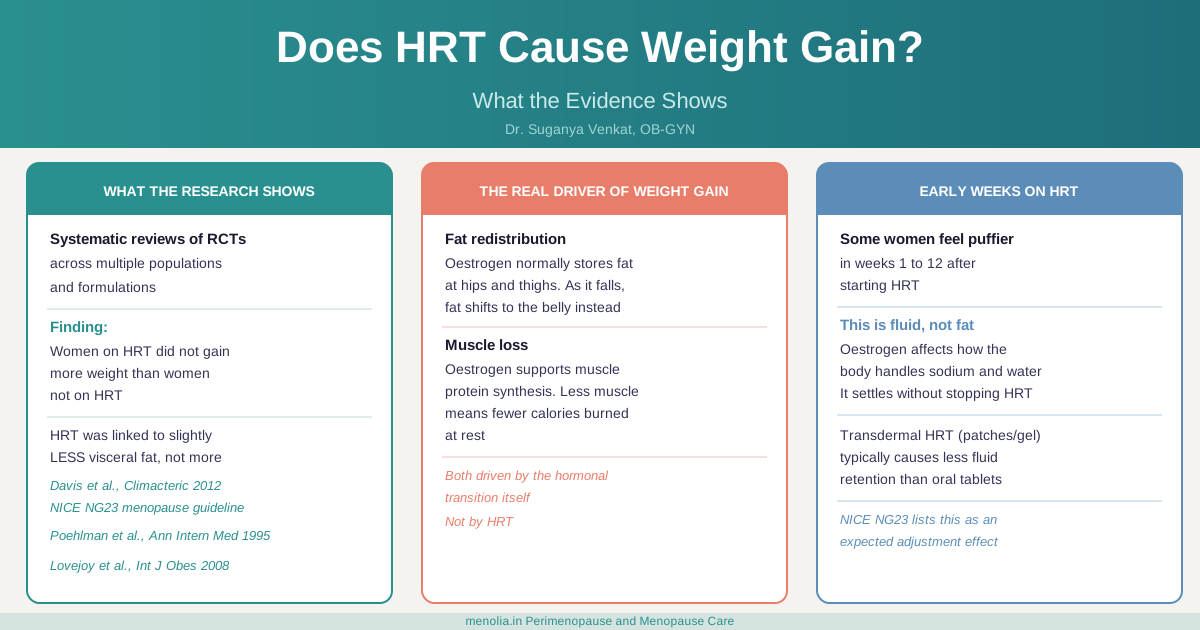
Multiple systematic reviews and randomised controlled trials have examined this question directly. The consistent finding across them: women on HRT do not gain more weight than women not on HRT.
Professor Susan Davis and colleagues published a review in the journal Climacteric (2012) examining the relationship between menopause, HRT, and body composition. The conclusion: weight and fat gain in the late 40s and 50s is driven by the menopausal transition itself, not by taking hormonal therapy to manage that transition. Systematic reviews of randomised controlled trials have found that HRT is, if anything, associated with a modest reduction in total body fat and visceral fat compared to placebo. Women on HRT do not gain more weight than women not on HRT.
These findings have been consistent across different types of HRT (oral, transdermal, sequential, continuous) and across different populations. The absence of HRT does not protect women from weight gain in menopause. The evidence, taken together, points the other way.
Then What Is Driving the Weight Gain?
The weight gain that happens around menopause is real, documented in cohort studies, and biologically driven. The driver is the hormonal shift itself, not the treatment for it.
Two changes happen in parallel as oestrogen falls:
Fat redistribution. Oestrogen normally favours subcutaneous fat storage, the kind that sits under the skin at the hips and thighs. As oestrogen falls, this pattern shifts toward visceral fat: the kind that accumulates in the abdomen, around the organs. A woman can weigh the same on the scales and still find that her clothes no longer fit, because the fat has moved. Lovejoy and colleagues (International Journal of Obesity, 2008, following 236 women over several years through the menopause transition) found accelerated visceral fat accumulation that was tied specifically to the transition period, not to changes in diet or physical activity.
Muscle loss. Oestrogen plays a role in maintaining muscle protein synthesis. As oestrogen levels fall, lean mass declines more quickly. The European Working Group on Sarcopenia in Older People (EWGSOP2, Cruz-Jentoft 2019) defines accelerated muscle loss in women as beginning around menopause. Since muscle burns more calories at rest than fat does, even a small decline in lean mass quietly reduces the body’s energy requirements. A woman eating exactly as she did at 42 may find she is gaining weight at 49, not because anything changed in her behaviour, but because her body’s resting metabolism has gradually fallen.
Poehlman and colleagues (Annals of Internal Medicine, 1995) conducted a controlled longitudinal study following women through the menopausal transition. Women who became naturally menopausal gained an average of 2.5 kg of fat mass over approximately 6 years while also losing lean mass, independent of any hormonal therapy. The process was driven by the transition itself.
This is not inevitable or untreatable. But understanding what is actually causing it is the first step.
Why Some Women Feel Heavier After Starting HRT
Some women do notice they feel a little heavier or puffier in the first weeks after starting HRT. This is real, but it is not fat gain.
Oestrogen influences how the body handles sodium and water, through its effect on the renin-angiotensin-aldosterone system. When exogenous oestrogen is introduced, the body may temporarily hold a small amount of extra fluid, particularly in the first 4 to 12 weeks. NICE NG23, the clinical menopause guideline, lists mild fluid retention as an expected early adjustment effect that typically settles without any change to treatment.
This is water, not fat. The scales may read higher. Rings may feel tighter for a few weeks. But it usually resolves on its own as the body adjusts.
This temporary fluid shift is one of the main reasons the scale reading in the first month of HRT can feel alarming, even when nothing has changed in terms of adipose tissue. Stopping HRT at week 3 because of a 1 to 2 kg increase means losing the long-term benefits to a transient effect that was already on its way out.
If early fluid retention is uncomfortable, a conversation with the prescribing doctor about route or dosing is worth having. Transdermal HRT (patches or gel) tends to have a lower fluid-retention effect than oral tablets, because it bypasses the liver’s first-pass metabolism and its effect on sodium-handling pathways. For a full picture of early HRT adjustment effects, what usually settles and what needs review, the HRT side effects guide covers this in detail.
WhatsApp Dr. Suganya if you have stopped HRT because of weight concerns or are unsure whether what you are experiencing is HRT-related or menopause-related.
Can HRT Affect Where Fat Is Stored?
There is reasonable evidence that HRT may influence fat distribution, and that the direction of the effect is favourable.
Systematic reviews of randomised trials have found that women on HRT tended to have lower visceral fat than women in placebo groups. This is consistent with what oestrogen does biologically: it favours peripheral fat storage (hips, thighs) and resists central, visceral deposition. Supplementing oestrogen in the post-menopausal period may partially preserve that pattern, slowing the shift toward belly fat that happens as oestrogen falls.
This is not a reason to take HRT for weight loss. HRT is a treatment for menopausal symptoms and has a specific risk-benefit profile that needs to be assessed individually with the prescribing doctor. But for women who are already suitable candidates because of hot flashes, sleep disruption, bone health, or quality of life, it is useful to know that the data does not support the weight gain concern, and may modestly support the body composition benefit.
For a full discussion of who is a suitable candidate for HRT and how to have the decision conversation, see the HRT in India guide.
What Moves the Scale After 45
If HRT is not the cause, and the real drivers are hormonal fat redistribution and muscle loss, the levers for managing weight in menopause are:
Strength training. This is the most evidence-supported intervention for countering menopause-related muscle loss and visceral fat gain. Resistance training twice a week preserves lean mass, which in turn keeps resting metabolic rate from falling as quickly. The menopause strength training guide covers how to start and what the research shows.
Protein-forward meals. As muscle protein synthesis slows, dietary protein becomes more important. The PROT-AGE study group recommends 1.2 to 1.6 g per kg of body weight per day for women looking to preserve lean mass. Good Indian sources: dahi (curd, 100g delivers around 3.5 to 4g protein), chana, rajma, moong dal, paneer, and eggs. These also support stable blood sugar, which becomes more relevant in the post-menopausal years when insulin sensitivity tends to decline.
Low-GI carbohydrate choices. The shift toward insulin resistance that happens at menopause (partly because of visceral fat accumulation) means the body handles high-GI carbohydrates less efficiently than before. Ragi (finger millet), bajra, jowar, and dal-rice combinations slow glucose absorption and reduce the insulin spikes that promote fat storage. Replacing some white rice with millets, or adding a generous katori of dal or sabzi before the rice, is a practical change that does not require abandoning a traditional eating pattern.
Sleep quality. Poor sleep consistently predicts higher cortisol in the mornings, higher hunger hormones through the day, and worse insulin sensitivity. Menopause disrupts sleep through night sweats and thermoregulatory changes. Addressing the underlying cause, which may include treating vasomotor symptoms (HRT is among the most effective tools for this), is often more productive than trying to manage weight around a chronically sleep-deprived metabolism.
Managing blood sugar stability. The menopause and blood sugar guide explains why insulin resistance rises after 45 and what tests are worth monitoring. Managing blood sugar is one of the clearest levers for reducing visceral fat accumulation in this phase.
For a broader look at why the menopause transition makes weight management harder and what the evidence-based approach looks like, the perimenopause weight guide and the menopause weight gain guide cover this in depth.
India Foods That Support Healthy Weight After 45
These are practical additions to a regular Indian diet, not a separate protocol:
- Ragi koozh or ragi dosa: Ragi has a low GI and 364 mg of calcium per 100g. Sustaining without causing glucose spikes.
- Rajma-chawal with less chawal: Adding more rajma and less rice at lunch maintains the meal but shifts the protein-to-carbohydrate ratio in a way that supports stable blood sugar and lean mass.
- Dahi at every meal: A small bowl of plain curd at lunch adds protein, probiotics, and blunts the glycaemic response of the rest of the meal.
- Methi seeds soaked overnight: One teaspoon in warm water in the morning, or added to atta, has been studied for glycaemic benefit in the Indian context (Gupta et al., JAPI, 2001).
- Til and alsi (sesame and flaxseed): Both are magnesium-rich (which supports sleep quality) and contain lignans with mild phytoestrogenic properties. Two tablespoons of alsi in a smoothie or on porridge covers the daily lignan dose studied for hot flash benefit.
Frequently Asked Questions
Does HRT definitely not cause weight gain? Multiple systematic reviews and randomised controlled trials consistently show no significant weight gain in women on HRT compared to women on placebo. Some women notice temporary fluid retention in the first 4 to 12 weeks after starting, but this is not fat gain and typically resolves without changing treatment.
I gained 2 kg after starting HRT. Should I stop? Not necessarily. The change could be early fluid retention (common, temporary), could be unrelated to HRT entirely, or could reflect the natural menopause-related fat redistribution that was already underway. Tracking over 2 to 3 months and discussing with the prescribing doctor before stopping is the better approach. Stopping at week 3 based on the scale means losing long-term benefits for a transient effect.
Which type of HRT is least likely to cause fluid retention? Transdermal oestrogen (patches or gel) tends to cause less fluid retention than oral tablets, because it bypasses the liver’s first-pass effect on sodium-handling pathways. If early puffiness is a concern, this is worth discussing with the prescribing doctor.
Does stopping HRT lead to weight loss? There is no evidence that stopping HRT produces weight loss. The menopause-related fat redistribution continues regardless of whether HRT is taken. In some studies, women who stopped HRT saw more visceral fat accumulation than those who continued, because the protective effect of oestrogen on fat distribution was lost.
What is causing my belly fat if it is not HRT? The shift from oestrogen-favoured peripheral fat storage (hips, thighs) to visceral fat accumulation (belly, around organs) is driven by falling oestrogen during the menopausal transition, not by HRT. This redistribution has been documented in longitudinal studies following women through the natural transition. The menopause belly fat guide covers this in detail.
I am hesitant about HRT because I do not want to gain weight. What should I do? Discuss the concern directly with the prescribing doctor, and share what you have read. The evidence does not support the weight gain fear. What is worth avoiding is declining a treatment that may significantly improve quality of life based on a risk that the data does not support.
Can HRT and weight loss efforts work together? Yes. HRT and lifestyle strategies for weight management are not mutually exclusive. HRT addresses the hormonal drivers of menopausal symptoms; strength training, protein-forward eating, sleep, and blood sugar management address the metabolic changes of the transition. Women who pursue both often find their results more sustainable than either approach alone.
Weight gain around menopause is real. The frustration of clothes not fitting when your habits have not changed is real. But stopping HRT to avoid weight gain is, in most cases, the wrong response to the wrong cause. The changes that are actually driving the scale are driven by the menopause transition itself, not by the treatment.
If you have questions about HRT and whether it is right for your situation, or if you are trying to understand what is driving weight changes in your 40s or 50s, a video consultation is a good starting point. Dr. Suganya consults online, across India, by video call.
WhatsApp Dr. Suganya to book a video consultation or ask a question.