Many women come to their first HRT conversation already taking an antidepressant, often sertraline or escitalopram, sometimes for years. The first thing they want to know is usually not about hot flushes. It is: “Is it safe to add hormones to this, or will they fight each other?” Depression and anxiety are frequent in the years around menopause, and SSRIs and SNRIs are also prescribed on their own to calm hot flushes in women who cannot take hormones. So by the time HRT is on the table, a good number of women already have an antidepressant in the pouch.
This post covers why the two are so often prescribed together, which combinations need a closer watch, what oestrogen can and cannot do for mood, and how to think about lowering an antidepressant once HRT is working. It assumes you are already on both, or about to be. If you are choosing between HRT and an SSRI for hot flushes, our guide to non-hormonal hot flash treatment covers that decision instead.
Why So Many Women End Up on Both
There are three common routes to this combination, and knowing which one is yours changes the rest of this post.
Route 1: a separate depression or anxiety diagnosis. Many women were on an antidepressant long before menopause. The guideline on perimenopausal depression written by a joint panel of The North American Menopause Society (now The Menopause Society) and the National Network of Depression Centers found that most midlife women who have a major depressive episode during perimenopause have had an earlier episode (Maki PM et al., Menopause, 2018, PMID 30179986). For these women, the antidepressant treats a condition of its own, and HRT is added for hot flushes, sleep or vaginal symptoms.
Route 2: an SSRI or SNRI started for hot flushes. Venlafaxine, escitalopram and paroxetine are used as non-hormonal hot flash treatment. In an eight-week trial, escitalopram brought hot flashes down from about 9.8 a day to around 5.2, and 55% of women halved their frequency, compared with 36% on placebo (Freeman EW et al., JAMA, 2011, PMID 21245182). Some women start one of these, still have symptoms, and later move on to HRT.
Route 3: mood changes that arrived with the transition. Irritability, tearfulness, poor sleep and low mood often travel with hot flushes. Sometimes an antidepressant is started for this, and HRT follows. Our guide to menopause and depression explains how hormonal low mood and clinical depression overlap.
Keep your route in mind. It matters most when we get to the question of whether the antidepressant can ever come down.
Do HRT and Antidepressants Interact?
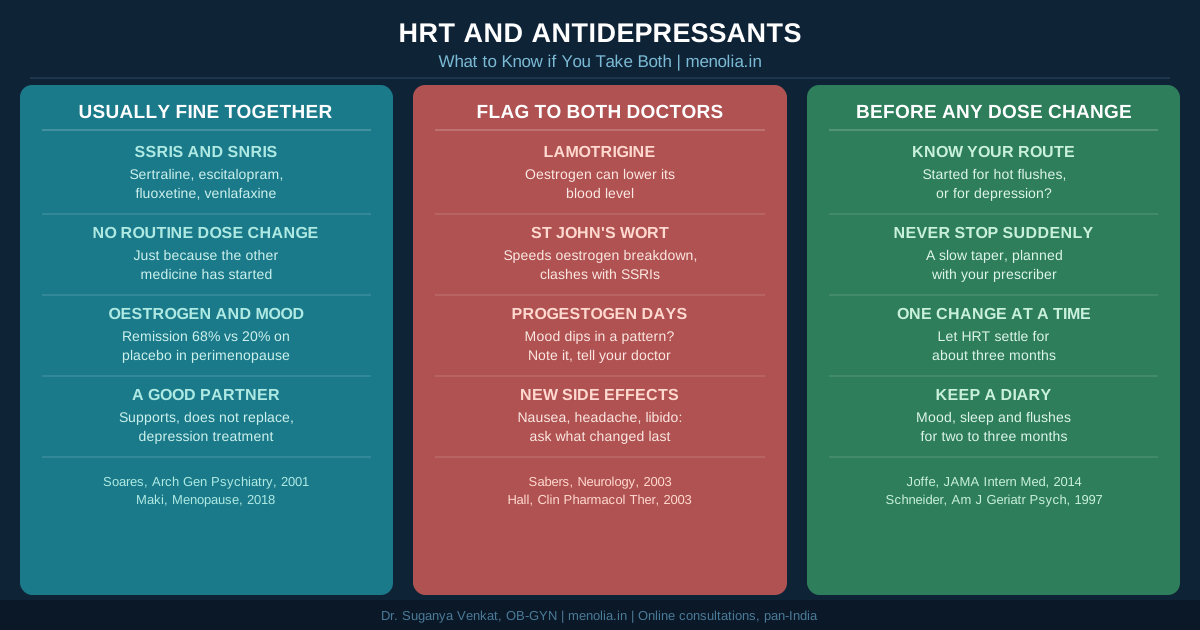
For the common pairings, the practical answer is reassuring. Oestradiol (as a pill, patch or gel), micronised progesterone or dydrogesterone, and the everyday SSRIs and SNRIs (sertraline, escitalopram, fluoxetine, venlafaxine, desvenlafaxine, duloxetine) are prescribed together all the time. Two of the studies later in this post looked at antidepressants in women who were already taking oestrogen. Neither medicine needs a dose change simply because the other has been started.
There are a few specific situations where the combination does need a flag.
Lamotrigine: oestrogen can lower its level
Lamotrigine is an epilepsy medicine that is also used as a mood stabiliser, particularly for bipolar depression. Oestrogen speeds up how the liver clears it. In women taking the combined contraceptive pill, lamotrigine levels were less than half of those in women not on the pill (Sabers A et al., Neurology, 2003, PMID 12939444). The HRT evidence is much smaller: in a randomised trial of combined oral HRT in women with epilepsy, the two participants who were taking lamotrigine had a 25 to 30% fall in their lamotrigine level (Harden CL et al., Epilepsia, 2006, PMID 16981859).
Two patients is a very small number, and HRT doses of oestrogen are lower than contraceptive doses. But lamotrigine is often the medicine keeping a woman’s mood stable, so if you take it, tell both doctors before HRT starts, stops or changes. Your psychiatrist may want to watch your mood more closely for the first couple of months. Our post on HRT with epilepsy covers lamotrigine in more detail.
St John’s wort: a herbal remedy that changes both sides
St John’s wort is sometimes taken as a “natural” mood remedy. It speeds up the liver enzymes that break down oestrogen. In a study of women on an oral contraceptive, adding St John’s wort halved the half-life of ethinyl oestradiol (from about 23 to 12 hours), and breakthrough bleeding rose from 2 of 12 women to 7 of 12 (Hall SD et al., Clin Pharmacol Ther, 2003, PMID 14663455). That study used a contraceptive pill, not HRT, but the same enzymes handle the oestradiol in HRT. St John’s wort also acts on serotonin, so it should not be combined with an SSRI or SNRI unless your prescriber has agreed to it.
If you take any herbal product for mood or sleep, put it on the medicine list you show your doctor, the same as any prescription.
Overlapping side effects
Some effects can come from either medicine, which makes it hard to tell which one is responsible:
- Nausea and headache are common in the first weeks of both an SSRI and oral HRT.
- Low libido can come from an SSRI, and also from menopause itself. If an SSRI is the likely cause, raise it with your prescriber. Our guide to sex and libido after menopause covers the menopause side and what helps.
- Low mood or irritability during the progestogen part of a cyclical HRT regimen is noticed by some women. If your mood dips in a regular pattern that matches your progestogen days, write it down and tell your gynaecologist. The type, dose or timing of the progestogen can often be changed.
When a new symptom appears, the useful question is “what changed most recently?” A symptom that began two weeks after starting HRT points one way; one that began after an SSRI dose increase points the other.
Already on an antidepressant and thinking about HRT? Dr. Suganya reviews your full medicine list, including any herbal products, and plans the HRT side around it over a video consultation.
What Oestrogen Does for Mood
This is where the combination becomes interesting, because oestrogen and serotonin-based antidepressants are not strangers to each other.
In perimenopause, oestrogen can lift depression on its own. In a 12-week randomised trial of women in perimenopause with depressive disorders, 68% of women on an oestradiol patch reached remission, compared with 20% on placebo (Soares CN et al., Arch Gen Psychiatry, 2001, PMID 11386980). In a separate 12-month trial, an oestradiol patch with intermittent micronised progesterone lowered the chance of developing clinically significant depressive symptoms (17.3% versus 32.3% on placebo) in women who were not depressed at the start, with the clearest benefit in the early menopause transition (Gordon JL et al., JAMA Psychiatry, 2018, PMID 29322164).
After menopause, the evidence is weaker. In an eight-week trial in older postmenopausal women with mild to moderate depression, an oestradiol patch worked no better than placebo (Morrison MF et al., Biol Psychiatry, 2004, PMID 14960294), so the stage of menopause you are in changes what oestrogen can be expected to do for mood.
Oestrogen may help an antidepressant work better. In a trial of fluoxetine in older women with depression, those already on oestrogen improved by 40.1% on fluoxetine versus 17.0% on placebo, while fluoxetine did not beat placebo in women who were not on oestrogen (Schneider LS et al., Am J Geriatr Psychiatry, 1997, PMID 9106373). A later analysis of sertraline found greater overall improvement and quality of life in women on oestrogen (Schneider LS et al., Am J Geriatr Psychiatry, 2001, PMID 11739065). Both were analyses of women who happened to be on oestrogen rather than trials that randomised them to it, so they suggest a helpful partnership rather than prove one.
Where this leaves the two medicines. The 2018 guideline sets it out plainly: antidepressants and psychotherapy are the front-line treatments for depression in perimenopause. Oestrogen is not approved to treat depression, although there is evidence of an antidepressant effect in perimenopausal women, particularly those with hot flushes. Data on oestrogen combined with a progestogen, which is what most women with a uterus take, are sparse (Maki PM et al., Menopause, 2018, PMID 30179986).
So HRT is a good partner for an antidepressant, not a replacement for one. For many women the combination simply works better than either alone, because HRT treats the night sweats and broken sleep that keep pulling mood down, while the antidepressant treats the depression itself.
Can Starting HRT Let You Reduce Your Antidepressant?
This is the question most women are quietly hoping to ask. The answer depends on which route brought you here.
If your SSRI or SNRI was started only for hot flushes (Route 2), starting HRT is a natural point to review it. The two treat the same symptom, and in a head-to-head trial, low-dose oral oestradiol reduced hot flash frequency by 52.9% and venlafaxine by 47.6%, against 28.6% on placebo (Joffe H et al., JAMA Intern Med, 2014, PMID 24861828). Once HRT is controlling your flushes, you and the doctor who prescribed the antidepressant can decide whether you still need both.
If your antidepressant was started for depression or anxiety (Route 1), HRT does not change the reason you are taking it. Some women do find their mood steadier once sleep and night sweats improve, and some later come down on their antidepressant with their psychiatrist’s guidance. That is a decision for the doctor who manages your depression, based on how long you have been well, how many episodes you have had, and how you are doing now. It is not something HRT decides for you.
If it was started for mood changes around the transition (Route 3), it sits in between. A review after HRT has settled is reasonable, again led by your prescriber.
Whichever route applies, three rules hold:
- Never stop an antidepressant suddenly. Stopping abruptly, especially venlafaxine or paroxetine, can cause dizziness, flu-like feelings, irritability and low mood that can be mistaken for relapse. Any reduction is a slow, planned taper.
- Change one thing at a time. If HRT and an antidepressant change in the same month, nobody can tell which change caused what you feel next.
- Give HRT time first. Most women judge how well HRT is working at around three months. Our guide on how to tell if your HRT is working explains that timeline. Plan any antidepressant review after that point.
Telling Mood Symptoms Apart Once You’re on Both
When you are on two medicines that both touch mood, a bad week can be confusing. Is it the menopause, the HRT, the antidepressant, or life?
A simple daily diary helps more than guessing. Note your mood (0 to 10), sleep, hot flushes and night sweats, and, if you are on cyclical HRT, which days you took the progestogen. Two to three months of this shows patterns that a single consultation cannot. Mood that dips with night sweats points to a hormone symptom that is not yet controlled. Mood that dips on progestogen days points to the progestogen. Low mood that stays down regardless, with loss of interest in things you used to enjoy, is a signal for your psychiatrist.
Please see your psychiatrist or doctor soon if your mood has been low for more than two weeks despite both treatments, if you have stopped enjoying most things, or if an antidepressant dose change has not helped after six to eight weeks.
If you ever have thoughts of harming yourself, or feel that life is not worth living, please reach out straight away. In India, the government’s free Tele-MANAS mental-health helpline is available 24 hours a day on 14416 or 1800-891-4416 (numbers confirmed in the Government of India’s suicide-prevention resource, page 8).
Who Manages What
This combination usually involves two prescribers, and the gap between them is where things get missed.
- Your psychiatrist or physician manages the antidepressant: dose, changes, and any taper.
- Your gynaecologist manages HRT: type, route, dose, and the progestogen.
- You carry the one complete medicine list, including herbal products and supplements, to both.
At Menolia, Dr. Suganya Venkat, an OB-GYN with more than 15 years of clinical experience, manages the HRT side over video consultation for women across India. Where depression or anxiety needs specialist care, she plans alongside Dr. Varsha Viswanathan, the team’s psychiatrist and psychotherapist, or alongside the psychiatrist you already see, so both prescriptions are planned with the other in mind.
Before Your Next Appointment: A Short Checklist
- Write down every medicine, supplement and herbal product you take, with doses.
- Note why each antidepressant was started: depression, anxiety, hot flushes, or sleep.
- Flag lamotrigine or St John’s wort if either is on the list.
- Start a mood and symptom diary if you are starting or changing HRT.
- Ask both doctors to agree who will review what, and when.
Frequently Asked Questions
Can I take HRT with antidepressants?
Yes, for most women. HRT and common SSRIs and SNRIs such as sertraline, escitalopram, fluoxetine and venlafaxine are routinely prescribed together, and neither needs a dose change just because the other has been started. The exceptions worth flagging are lamotrigine, whose level oestrogen can lower, and the herbal remedy St John’s wort.
Is it safe to take HRT and sertraline together?
Sertraline and HRT are a common pairing. One analysis of women over 60 with depression even found greater overall improvement on sertraline in women who were also taking oestrogen. As with any combination, tell both prescribers about each medicine, and mention new symptoms such as nausea, headaches or a change in mood in the first few weeks.
Will HRT make my antidepressant work better?
It may. In older women with depression, those already taking oestrogen responded better to fluoxetine than those who were not. In perimenopause, oestrogen has shown antidepressant effects of its own, especially when hot flushes are present. These findings are encouraging, but guidelines still treat antidepressants and therapy as the main treatment for depression, with HRT as a helpful partner.
Can I stop my antidepressant once I start HRT?
Not on your own, and never suddenly. If the antidepressant was started only for hot flushes, HRT may make it unnecessary, and your prescriber can plan a slow taper. If it was started for depression or anxiety, the decision rests with the doctor who manages your mood, usually after your HRT has had about three months to settle.
Can HRT cause low mood or depression?
Oestrogen tends to support mood in perimenopause. Some women notice low mood or irritability during the progestogen part of a cyclical regimen. If your mood dips in a pattern that matches those days, tell your gynaecologist, because the type, dose or timing of the progestogen can often be adjusted.
Is HRT a treatment for menopause depression?
Not on its own. Oestrogen is not approved as a depression treatment, although trials show it can lift depression in perimenopause, particularly with hot flushes. It has not worked as well after menopause. For clinical depression, antidepressants and psychotherapy remain the first-line treatment, and HRT can support them.
Which doctor should I talk to if I’m on both?
Both, ideally with each knowing about the other. Your psychiatrist or physician handles the antidepressant, and your gynaecologist handles HRT. Take one complete medicine list, including herbal products, to every appointment, and agree who reviews what before either medicine is changed.
On an antidepressant and wondering how HRT fits alongside it, or already on both and unsure whether something needs to change? Bring your medicine list and a few weeks of symptom notes, and we can work through it together. Message Dr. Suganya Venkat on WhatsApp for a Rs 399 video consultation.