A woman with well-controlled epilepsy, stable on carbamazepine for over a decade, wrote to me during perimenopause asking a question I had not been asked quite that way before: could the two medicines she might soon be juggling, her seizure medicine and HRT, actually work against each other? She was right to ask. They can, in both directions, and the interaction is well described in the epilepsy literature even though almost nobody outside neurology and menopause medicine seems to have heard of it.
This is not a reason to rule out HRT if you live with epilepsy. It is a reason to have the conversation properly, with both your neurologist and your gynaecologist aware of what the other is prescribing, before you start or change anything. This post covers what enzyme-inducing anticonvulsants do to HRT, what oestrogen can do to certain anticonvulsant levels, why the route of HRT matters here, and why this decision is never made by one doctor alone.
Why Some Anticonvulsants Weaken HRT
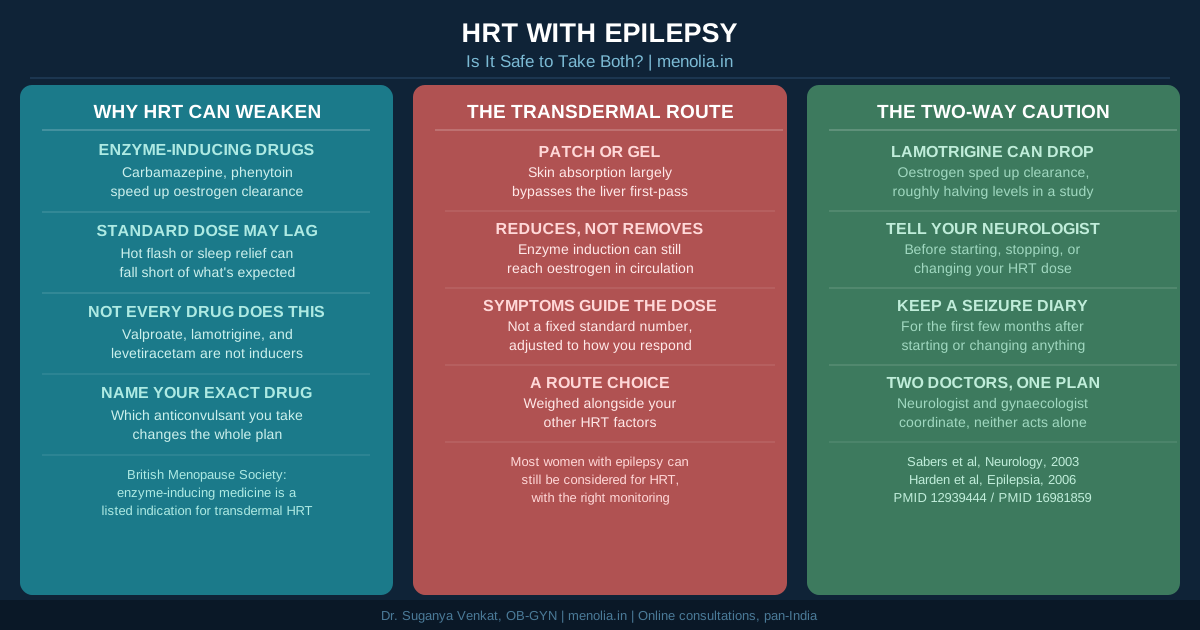
Several commonly used anticonvulsants, carbamazepine, phenytoin, phenobarbital, and to a lesser extent oxcarbazepine, are known in pharmacology as hepatic enzyme inducers. They switch on a liver enzyme system that breaks down a wide range of other medicines faster than it otherwise would, oestrogen included.
For a woman on HRT, that means the oestrogen she is taking gets cleared from her body more quickly, so less of it is available to actually do its job. In practice this can look like starting HRT for hot flashes or sleep and finding the dose that should work simply is not controlling symptoms the way it would in someone not on an enzyme-inducing drug. It is not that the HRT has failed, it is that an enzyme-inducing anticonvulsant is metabolising it faster than the standard dose accounts for.
Not every anticonvulsant does this. Sodium valproate, lamotrigine, and levetiracetam are not enzyme inducers, and women on these do not face this particular complication. The distinction matters enough that it is worth naming your exact anticonvulsant to whichever doctor is managing your HRT, rather than saying “I’m on epilepsy medication” and leaving it there.
On an anticonvulsant and considering HRT? Dr. Suganya reviews which drug you are on, whether it is an enzyme inducer, and what that means for your HRT route and dose, over a video consultation.
Why Transdermal HRT Is Usually Preferred Here
This is the same principle that comes up whenever a comorbidity enters the HRT conversation, the route the oestrogen takes into your body matters as much as the decision to take it at all. It shows up in a different form for women on levothyroxine for thyroid conditions and for those managing high blood pressure alongside HRT, each with its own reason the route matters, but the same underlying lesson: ask before assuming a standard HRT plan fits your specific medical picture.
Oral oestrogen passes through the gut and liver before it reaches general circulation, a route called first-pass metabolism, and this is exactly where an enzyme-inducing anticonvulsant does most of its work, so oral HRT is the most affected by the interaction.
Transdermal oestrogen, delivered through a patch or gel, is absorbed through the skin directly into circulation, largely bypassing that first liver pass. The British Menopause Society lists current use of a hepatic enzyme-inducing medicine as one of the specific situations where transdermal HRT is the preferred starting route, alongside migraine, variable blood pressure control, and a BMI over 30 (British Menopause Society HRT guide, thebms.org.uk, checked 2026-09-18).
There is a limit to this, though. Transdermal oestrogen reduces the impact of enzyme induction, it does not eliminate it. Once oestrogen is in your bloodstream, an enzyme-inducing drug can still speed up how quickly your body clears it, so even on a patch or gel, your doctor may need to use a somewhat higher dose than usual and rely on how your symptoms respond, rather than a fixed standard dose, to judge whether it is enough.
Our complete HRT guide covers the fuller picture of benefits, risks, and getting started if you are earlier in that decision. If transdermal is the route you and your doctor land on, our guide to the estradiol patch in India has cost and brand details.
The Lamotrigine Caution: The Interaction Runs Both Ways
This is the part that catches even careful patients off guard, because it runs in the opposite direction from everything above. Lamotrigine is not an enzyme inducer, so it does not weaken your HRT. But oestrogen can weaken lamotrigine.
Oestrogen increases how quickly your liver processes lamotrigine through a pathway called glucuronidation, which lowers the amount of active lamotrigine in your blood. A study of women taking combined oral contraceptives found lamotrigine levels roughly halved compared to women not on oestrogen-containing contraception (Sabers A et al., Neurology, 2003, PMID 12939444), a large enough drop to plausibly matter for seizure control. Later case-control work in menopausal women found the same pattern with oestrogen-containing HRT itself, not just contraceptives, and it was not limited to the oral route (Sveinsson & Tomson, Drugs & Aging, 2014, PMID 25079452).
If you are on lamotrigine and starting, stopping, or changing the dose of HRT, this is worth flagging to your neurologist specifically, so your lamotrigine level and seizure control can be watched around that change. This is not a reason to avoid HRT if you are on lamotrigine. It is a reason to time the two conversations together instead of treating them as unrelated.
On lamotrigine and thinking about HRT? Dr. Suganya coordinates the HRT side and flags the timing to discuss with your neurologist, so nothing about your seizure control gets missed in the gap between two prescriptions.
What the Seizure-Frequency Evidence Shows
There is one more piece worth setting out plainly rather than glossing over, because you deserve the real evidence, not a softened version of it.
A small randomised, placebo-controlled trial in postmenopausal women with epilepsy tested oral conjugated equine oestrogen plus medroxyprogesterone acetate (the CEE/MPA combination, an older oral HRT formulation) against placebo. Women on the higher of two CEE/MPA doses were more likely to have worsening seizure frequency than those on placebo, and the effect increased with dose (Harden CL et al., Epilepsia, 2006, PMID 16981859). The same small study found that two women on lamotrigine had their levels drop by 25 to 30 percent while taking CEE/MPA, consistent with the interaction described above.
This trial had only 21 women, tested one specific oral formulation, and is now nearly two decades old, so it should inform caution rather than be read as the last word on every HRT regimen. It is also the reason a broader review of epilepsy and menopause has urged real caution before assuming any HRT is seizure-neutral in this population (Sveinsson & Tomson, Drugs & Aging, 2014, PMID 25079452). What this means in practice is straightforward, not alarming: starting HRT with epilepsy calls for a documented seizure baseline, a lower starting dose where appropriate, transdermal oestrogen considered first, and close monitoring in the weeks after starting or changing anything, all coordinated between your neurologist and the doctor managing your HRT. Most women with epilepsy who want relief from hot flashes, sleep disruption, or other menopause symptoms can still be considered for HRT. This evidence is a reason for a carefully managed start, not a reason to assume the door is closed.
Why This Is Always a Two-Doctor Conversation
Neither your neurologist nor your gynaecologist can fully manage this on their own, because each is watching a different half of the picture. Your neurologist knows whether your specific anticonvulsant induces enzymes, how stable your seizure control has been, and what a meaningful change in seizure frequency would look like for you. Your gynaecologist knows how HRT routes and doses are chosen and adjusted, and what symptom relief should reasonably look like.
At Menolia and Fertilia, Dr. Suganya Venkat sees this exact coordination gap in video consultations: two specialists, each confident in their own domain, who have simply never spoken to each other about a shared patient. The fix is not complicated. Bring your anticonvulsant name and dose to the HRT conversation, bring the fact that you are starting or changing HRT to your neurology follow-up, and keep a simple seizure diary for the first few months after any change so a genuine shift is caught early rather than noticed months later.
If your seizure control itself, rather than the HRT interaction, is the part that needs adjusting, that decision stays with your neurologist. Your gynaecologist’s role is choosing and monitoring the HRT side around it, working with your neurologist rather than instead of them.
Frequently Asked Questions
Can I take HRT if I have epilepsy?
Usually yes, but it needs coordination between your neurologist and gynaecologist rather than being started the way HRT would be for someone with no other conditions. What matters most is which anticonvulsant you take. If it is an enzyme inducer such as carbamazepine or phenytoin, your HRT dose or route may need adjusting. If you take lamotrigine, oestrogen can lower its level, so your neurologist should be told before you start.
Does epilepsy medication make HRT less effective?
It can, if the anticonvulsant is a hepatic enzyme inducer. Carbamazepine, phenytoin, phenobarbital, and to a lesser extent oxcarbazepine speed up how quickly your liver clears oestrogen, which can mean a standard HRT dose does not control symptoms as expected. Valproate, lamotrigine, and levetiracetam do not have this effect.
Why is transdermal HRT often recommended for women on anticonvulsants?
Oral oestrogen passes through the liver first, which is exactly where an enzyme-inducing anticonvulsant does most of its work, so oral HRT is affected the most. Transdermal oestrogen, through a patch or gel, is absorbed through the skin and largely bypasses that first liver pass, which is why the British Menopause Society lists enzyme-inducing medication as one of the situations favouring the transdermal route. It reduces the interaction, it does not remove it entirely.
Can HRT affect my seizure medicine levels?
Yes, specifically if you take lamotrigine. Oestrogen speeds up how your liver processes lamotrigine, which can lower its blood level by roughly half in some studies. This is a reason to tell your neurologist before starting or stopping HRT if you are on lamotrigine, so your level and seizure control can be monitored around the change.
Does HRT increase seizure frequency?
A small, older randomised trial found that an oral formulation of conjugated equine oestrogen plus medroxyprogesterone acetate was linked to a dose-related increase in seizure frequency in some women with epilepsy. This does not mean every HRT regimen carries the same risk, but it is a real finding that supports starting cautiously, considering the transdermal route, and monitoring seizures closely in the first few months of any change.
Which anticonvulsants are enzyme inducers and which are not?
Carbamazepine, phenytoin, phenobarbital, and primidone are enzyme inducers, and oxcarbazepine is a weaker one. Sodium valproate, lamotrigine, and levetiracetam are not enzyme inducers, though lamotrigine has its own separate interaction where oestrogen lowers its level. Always confirm your specific medicine’s category with your neurologist rather than assuming from the drug class alone.
Who should manage my HRT if I have epilepsy?
Your gynaecologist chooses and monitors the HRT route and dose, and your neurologist manages your anticonvulsant and seizure control. Neither can fully do this alone. The safest approach is telling each doctor exactly what the other has prescribed, and keeping a seizure diary in the weeks after starting or changing HRT so any change is caught early.
If you live with epilepsy and are weighing whether HRT is right for you, this is a conversation worth having directly, with your neurologist and gynaecologist coordinating from the start. Message Dr. Suganya Venkat on WhatsApp to talk it through.