It is usually around the third week. The patch goes on every Monday and Thursday, or the gel goes on every morning after the bath, and the night sweats are a little lighter than they were. But she still wakes twice a night. The afternoon flush in the office still comes. And the question arrives, often typed out late at night: is this medicine doing anything, or should the dose be higher?
I am Dr. Suganya Venkat, an OB-GYN, and over fifteen years this is one of the questions women on HRT ask me most. The reassuring part is that in most cases the treatment is working and simply has not finished working yet. The useful part is that there is a clear way to tell the difference between “give it time” and “this needs adjusting,” and you can do most of it yourself with a notebook.
What This Post Covers
- How long HRT takes to work, symptom by symptom
- Why a single good or bad week is misleading, and how a symptom diary fixes that
- Why a blood test rarely answers the question
- The common, fixable reasons HRT seems not to be working
- When a dose, route or progestogen change is reasonable to ask for, and when waiting longer is the better call
How Long HRT Takes to Work
HRT does not switch symptoms off overnight. Relief builds over weeks, and different symptoms move at different speeds.
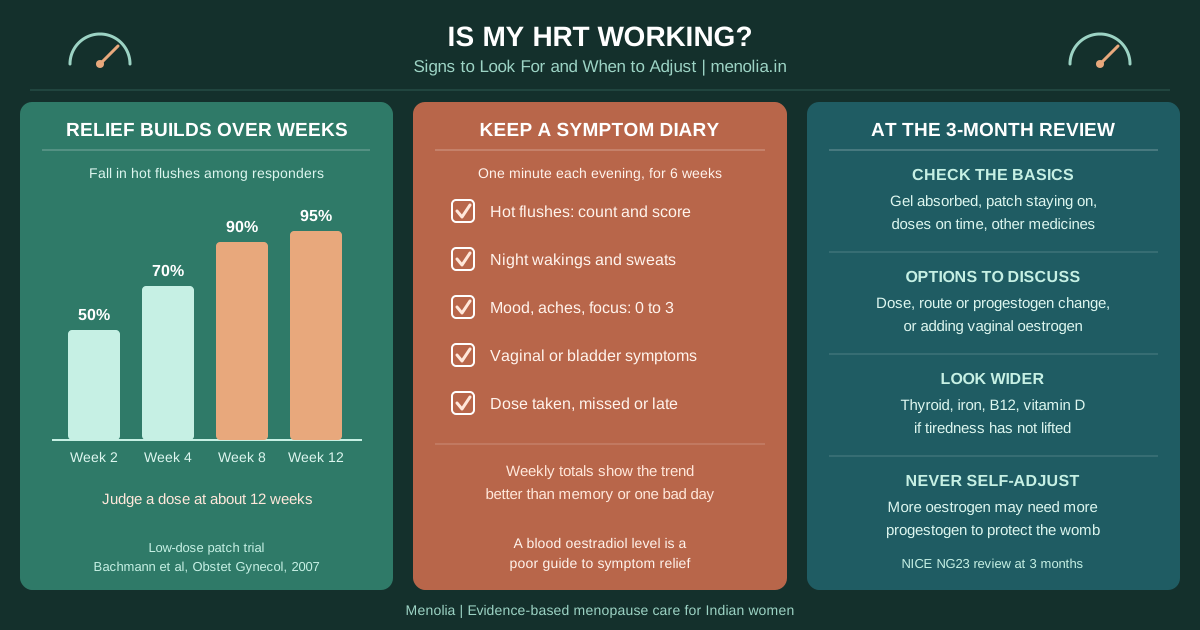
Hot flushes and night sweats respond first. A placebo-controlled trial of a very low-dose oestradiol patch gives a clear picture of the timeline. Among the women who responded well, moderate and severe hot flushes had fallen by roughly 50% after two weeks, 70% after four weeks, 90% after eight weeks and 95% after twelve weeks (Bachmann GA et al., Obstet Gynecol, 2007, PMID 17906008). The improvement climbs steadily, and at week two you are only partway up that curve.
The same trial carries a second, equally useful message. At that lowest dose, 41.3% of women reached a strong response (hot flushes reduced by 75% or more) compared with 24.2% on placebo. Starting low is the right approach, and it also means that some women will need a step up after a fair trial. Needing a dose change is a normal part of finding your dose.
Sleep usually follows the night sweats. When sweats settle, broken sleep often improves with them. Sleep that is disturbed for other reasons (worry, a snoring partner, a bladder that wakes you) may not change much with HRT alone.
Vaginal and bladder symptoms are slower. Dryness, discomfort during sex and bladder urgency usually take a few months to improve, and systemic HRT does not always settle them completely. More on that below.
Mood, joint aches and brain fog vary the most. Some women notice their mood lift early, especially when better sleep comes back. For others these symptoms change little, because they have more than one cause.
| Symptom | When change is usually noticeable | When to judge it properly |
|---|---|---|
| Hot flushes, night sweats | 2 to 4 weeks | Around 12 weeks |
| Sleep (if disturbed by sweats) | Within the first month or two | Around 12 weeks |
| Vaginal dryness, bladder urgency | A few months | 3 months or longer |
| Mood, aches, energy, focus | Variable | Review at 3 months, with other causes checked |
This is why NICE recommends reviewing any menopause treatment at 3 months to assess how well it works and how well it is tolerated, then yearly, with an earlier review if the treatment is not working or causes side effects (NICE NG23, recommendation 1.9.2, nice.org.uk, checked September 2026). Three months is the natural checkpoint, and you can ask for an earlier review if something is clearly wrong.
Why One Bad Week Tells You Very Little
Menopausal symptoms rise and fall on their own. A Cochrane review of 24 placebo-controlled trials found that oral HRT reduced weekly hot flush frequency by about 75% compared with placebo, which is a large effect. But women taking the placebo also reported their hot flushes falling by 57.7% over the course of the trials (Maclennan AH et al., Cochrane Database Syst Rev, 2004, PMID 15495039). The authors noted that symptoms fluctuate during menopause and often decline afterwards.
In practical terms: a hot, humid week, a stressful family function, a few nights of poor sleep or a spicy dinner can all bring flushes back for a few days, whatever your HRT is doing. Judging your treatment on how you felt yesterday leads to the wrong conclusion in both directions.
If you are still having periods, there is another layer. In perimenopause your own ovaries are still producing oestrogen in irregular surges and dips. A bad fortnight before a period may be your ovaries, not a failure of the HRT. The British Menopause Society notes that the fluctuation of hormones, as well as their level, may be what drives symptoms at this stage (BMS Tool for Clinicians, Measurement of serum estradiol in the menopause transition, 2025, thebms.org.uk).
Starting HRT and unsure whether it is doing enough? If you would like someone to look at your symptoms, your regimen and your timeline together, you can talk it through with me over a video consultation.
Chat with Dr. Suganya on WhatsApp
A Simple Symptom Diary: Your Best Measure
The most useful thing you can bring to your review is a written record. Memory tends to hold on to the worst night of the month. A diary shows the trend.
Start it on the day you begin HRT (or today, if you have already started). Each evening, take one minute to note:
- Hot flushes: roughly how many today, and how bad the worst one was (0 none, 1 mild, 2 moderate, 3 severe)
- Night sweats and sleep: how many times you woke, and whether you woke soaked
- Mood: a 0 to 3 score for irritability, low mood or anxiety
- Vaginal or bladder symptoms: a 0 to 3 score, if these bother you
- Aches, energy and focus: a 0 to 3 score
- Bleeding or spotting: yes or no
- Your dose: taken on time, missed, or late, and for patches, whether the patch stayed on
At the end of each week, add up the numbers. After six weeks, most women can see the direction clearly: flush counts falling, fewer wakings, scores drifting down, or a stubborn line that has not moved.
A notebook by the bed, the notes app on your phone, or a line in a WhatsApp chat with yourself all work. If you prefer a structured tool, the Menopause Rating Scale is a validated self-completed questionnaire designed to measure menopause symptoms over time, including before and after hormone therapy (Heinemann K et al., Health Qual Life Outcomes, 2004, PMID 15345062). For most women a simple daily diary is enough.
Why a Blood Test Rarely Answers the Question
Many women expect to have their oestrogen level checked to see whether HRT is working. It seems logical, but the British Menopause Society’s 2025 guidance on measuring serum oestradiol explains why it usually does not help (BMS Tool for Clinicians, 2025, thebms.org.uk):
- There is poor correlation between the blood oestradiol level and symptom relief. Two women on the same dose can have very different levels and very different responses.
- There is no value in checking the level if you take oral oestradiol tablets, because a large share of the dose is converted to estrone, a weaker oestrogen.
- In perimenopause, the test cannot tell your own oestrogen apart from the HRT.
The same guidance says that if symptoms continue, listening to the woman and changing the delivery route may be more helpful than measuring a level. In other words, your diary is a better test than the lab report. A blood test still has a place for specific questions your doctor may have, but it is not the first step for “is my HRT working.” If you want to understand your earlier hormone results, our guide to menopause blood test results walks through them.
Common Reasons HRT Seems Not to Work
Before anyone raises a dose, it is worth checking whether the medicine is getting into your body as intended, and whether the symptom in question is one HRT treats.
The gel is not being absorbed fully. Gel needs a couple of minutes to dry, and the area should not be washed for at least an hour afterwards. Putting on a tight blouse too soon, applying just before a bath, or rubbing it into skin that already has moisturiser on it can all reduce what you absorb. The step-by-step method is in our oestrogen gel guide.
The patch is lifting. Oil, lotion or talc under a patch, long hot baths and humid weather can all loosen the edges. A patch that is half off is delivering less than its label says. Our estradiol patch guide covers where to place it, how to rotate sites and what to do about adhesion.
Doses are being missed or taken late. A few missed tablets or a patch changed a day late can bring flushes back for a day or two. Your diary will show whether bad days line up with missed doses. If they do, see what to do after a missed HRT dose.
Another medicine is speeding up how oestrogen is cleared. Some anti-seizure medicines, including carbamazepine, phenytoin and phenobarbital, make the liver clear oestrogen faster, so a standard dose can underperform. If you take one, read HRT with epilepsy and tell whoever prescribes your HRT about every regular medicine you take.
The symptom is not coming from low oestrogen. The British Menopause Society reminds clinicians that HRT may not manage every symptom of menopause (BMS Tool for Clinicians, Measurement of serum estradiol in the menopause transition, 2025, thebms.org.uk). Tiredness, low mood, aches and poor concentration at this age can also come from an underactive thyroid, low iron or vitamin B12, low vitamin D, sleep apnoea, depression, or the sheer weight of caring for parents and children at once. If your hot flushes have improved but the exhaustion has not, a few blood tests from your doctor are a sensible next step before changing the HRT.
Vaginal and bladder symptoms need local treatment. NICE recommends offering vaginal oestrogen to women with genitourinary symptoms of menopause, including those already using systemic HRT (NICE NG23, recommendation 1.5.4). Adding a local cream or pessary is a common, simple addition. Our guide to vaginal oestrogen cream explains the options available in India.
Low sexual desire has persisted. For women whose low desire continues despite HRT, NICE advises considering testosterone supplementation if HRT alone has not been effective (NICE NG23, recommendation 1.5.24). The Global Consensus Position Statement on testosterone therapy for women, endorsed by the International Menopause Society and ten other societies, summarises the evidence and recommendations for its use (Davis SR et al., J Clin Endocrinol Metab, 2019, PMID 31498871). This is a specialist conversation rather than a routine add-on.
The progestogen is the part causing trouble. If mood dips, bloating or breast tenderness come on during the progestogen days, the problem may be the progestogen rather than the oestrogen dose. Our post on HRT side effects covers which effects usually settle and which are worth raising.
When a Dose or Route Change Makes Sense
After a fair trial, and with your diary in hand, these are reasonable reasons to ask your doctor about a change:
- Hot flushes or night sweats are still disturbing your sleep or work after 8 to 12 weeks of consistent use
- Relief seems to fade towards the end of each patch or before the next dose is due
- Side effects have not settled by the three-month point
- Vaginal or bladder symptoms remain despite systemic HRT
- Nothing at all has changed by four to six weeks, in which case an earlier review is appropriate
The options your doctor may consider include a modest increase in the oestrogen dose, a switch of route (tablet, patch or gel), a different progestogen, adding vaginal oestrogen, or referral to a menopause specialist. NICE recommends referral to a clinician with menopause expertise if treatments do not improve symptoms or side effects continue (NICE NG23, recommendation 1.9.3). The British Menopause Society’s prescribing guidance also advises that if a woman has not responded, changing the oestrogen preparation should be considered before going above the licensed dose (BMS Tool for Clinicians, HRT: Practical prescribing, 2026, thebms.org.uk).
Please do not adjust the dose yourself. If you have a womb, a higher oestrogen dose may need a matching change in the progestogen to keep the womb lining protected; the BMS prescribing tables set progestogen doses by oestrogen dose band. An extra pump of gel or a second patch without that adjustment removes a safeguard. The reasons are explained in why HRT needs progesterone. If you are weighing a route change, our comparison of the patch, gel and pill sets out the practical differences.
When Waiting Longer Is the Better Call
It is usually worth giving the current dose more time if:
- You are less than four weeks in
- Your diary shows a steady downward trend, even if you are not yet where you want to be
- You changed dose, brand or route in the last few weeks (the clock restarts)
- You are in perimenopause and the bad days cluster around your natural cycle
“Better but not perfect” at week three is the expected shape of a treatment that is working. NICE advises using the lowest effective dose (NICE NG23, recommendation 1.8.3), so the aim is symptoms that no longer run your days, reached with as little medicine as possible.
When to Call Sooner
Most HRT questions can wait for a planned review. A few should not:
- Vaginal bleeding that starts after the first three months of HRT, or bleeding that is heavy or persistent. NICE advises seeking medical help promptly for bleeding after three months (NICE NG23, recommendation 1.8.4). Our guide to breakthrough bleeding on HRT explains what is expected early on.
- Pain or swelling in one calf, chest pain or sudden breathlessness, or a sudden severe headache unlike your usual ones. These are uncommon, but they are emergencies. Do not wait for your review or for a same-day appointment: go to the nearest emergency department straight away, or call emergency services.
A Practical Three-Month Plan
- Weeks 0 to 2: Start the diary. Check you are applying the gel or patch the right way and taking doses at a consistent time.
- Weeks 2 to 6: Look for direction. Flush counts and night wakings should be starting to fall. If nothing at all has moved by week four to six, book an earlier review.
- Weeks 6 to 12: The fuller picture appears. Note which symptoms have improved and which have not.
- Around month 3: Review with your doctor, diary in hand. Decide together whether to keep the dose, change the route, adjust the progestogen, add vaginal oestrogen or look for another cause.
- After that: A yearly review, or sooner if something changes.
For a wider view of how HRT fits menopause care in India, see our overview of HRT benefits, risks and when to start.
Frequently Asked Questions
How long does HRT take to start working?
Hot flushes and night sweats often start to ease within two to four weeks, and continue improving for around three months. In one trial of a very low-dose oestradiol patch, women who responded had about 70% fewer moderate and severe hot flushes by week four and about 95% fewer by week twelve. Vaginal and bladder symptoms usually take a few months. Judge the full effect of a dose at around twelve weeks.
What are the signs that HRT is not working?
Hot flushes or night sweats that are still disrupting sleep or work after 8 to 12 weeks of consistent use, relief that fades before each dose is due, and no change at all in your diary by four to six weeks are the main signs. Before concluding the dose is too low, check that the gel or patch is being absorbed properly and that doses are not being missed.
HRT kaam kar raha hai ya nahi, kaise pata kare?
The simplest way to know whether HRT is working is to keep a daily symptom diary: count your hot flushes, note how often you wake at night, and score mood and other symptoms from 0 to 3. After six weeks, the weekly totals show the trend far better than memory does. Take the diary to your three-month review.
Can I increase my HRT dose myself if I still have hot flushes?
No. If you have a womb, a higher oestrogen dose may need a matching increase in progestogen to keep the womb lining protected. Speak to your doctor, who can decide whether to increase the dose, change the route or look for another reason the symptoms have continued.
Should I get a blood test to check if my HRT is working?
Usually not as a first step. The British Menopause Society advises that blood oestradiol levels correlate poorly with symptom relief, are not useful for women on oral oestradiol tablets, and cannot separate your own oestrogen from HRT during perimenopause. How you feel, recorded in a diary, is the better guide.
Why do I still have vaginal dryness even though my hot flushes have stopped?
Systemic HRT does not always fully treat the vaginal and bladder changes of menopause. NICE recommends offering vaginal oestrogen to women with these symptoms, including those already on systemic HRT. A local cream or pessary alongside your usual HRT is a common and well-tolerated addition.
I feel much better but not completely. Is that good enough?
Often, yes. The aim of HRT is the lowest dose that brings symptoms to a level that no longer disrupts your days. If the remaining symptoms still bother you at your three-month review, raise them. There may be a small adjustment, or a separate cause worth checking.
Not sure whether your HRT needs more time or a change? Bring your symptom diary and your current prescription, and we can go through it together. Message Dr. Suganya Venkat on WhatsApp to arrange a video consultation.