A woman wrote to me last month holding two prescriptions and no idea whether they belonged in the same body. Her physician had started her on atorvastatin in January after a routine health check showed her LDL had climbed past 160. Her gynaecologist, seeing her through a year of hot flashes and broken sleep, had suggested HRT. Neither doctor had mentioned the other’s prescription, so she assumed the silence meant a problem nobody wanted to name.
It usually means the opposite. Statins and hormone therapy are prescribed together often enough in women in their late forties and fifties that the combination is unremarkable to anyone who works in this space. There is no dangerous drug-drug interaction to design around. What there is, and what almost nobody explains, is a genuine interaction at the level of your lipid numbers: oral oestrogen moves cholesterol and triglycerides in its own right, so your next lipid profile after starting HRT is reading the effect of two medications, not one.
This post covers what each medicine is doing, what the combination does to your lipid panel, why the route of oestrogen matters here more than the brand of statin, the one thing HRT should never be asked to do in place of a statin, and how to tell a statin muscle ache from the joint stiffness of menopause. For why your cholesterol changed at this age in the first place, our guide on menopause and cholesterol covers that ground. This post is about taking both medications together.
Why Both End Up Prescribed at the Same Age
The overlap is not a coincidence of scheduling. Both prescriptions tend to arrive in the same five-year window for the same underlying reason.
Oestrogen keeps LDL cholesterol lower and HDL higher while it is circulating. As it falls through the menopause transition, LDL and total cholesterol drift up, often in a woman whose diet and exercise have not changed at all. A longitudinal study following women through the menopausal transition (Do KA et al., Am J Epidemiol, 2000, PMID 10733040) measured net increases across the three years before and after the final period: LDL cholesterol rose by 0.25 mmol/L, which is roughly 10 mg/dL in the units Indian labs report, and triglycerides by 0.34 mmol/L, roughly 30 mg/dL. That is enough to push a woman who sat comfortably in range at 45 into the band where a physician starts discussing medication at 52.
At the same time, hot flashes, disturbed sleep, and mood changes bring her to a gynaecologist. So one woman, one hormonal shift, two doctors, two prescriptions, usually written months apart without either clinician seeing the other’s note. The gap is administrative, not clinical.
Is There a Drug Interaction Between Statins and HRT?
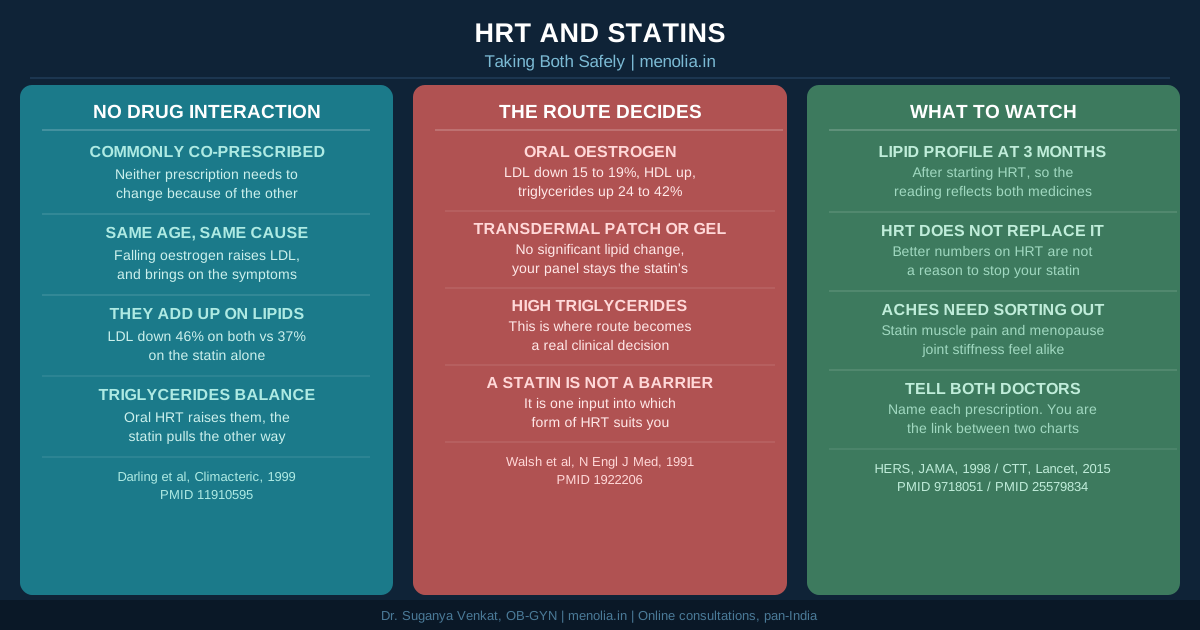
Not one that requires either prescription to change. Statins and oestrogen are both processed by the liver, which is why the question comes up, but this is not a combination where one medicine blocks or amplifies the other to a degree that alters dosing. Women take both for years without incident.
The interaction that does matter is a different kind: both medicines act on the same lipid panel, so they add to each other rather than cancel out.
A randomised crossover study in postmenopausal women with high cholesterol (Darling GM et al., Climacteric, 1999, PMID 11910595) tested exactly this. Twenty-three women received simvastatin alone, oral oestrogen-progestin therapy alone, and then both together. LDL cholesterol fell by 21 percent on hormone therapy alone, 37 percent on simvastatin alone, and 46 percent on the combination. Total cholesterol followed the same pattern, down 28 percent on both together against 26 percent on the statin alone.
The more interesting finding sat in the triglyceride column. Triglycerides rose on hormone therapy and fell on simvastatin, and on the combination they barely moved. The statin offset the rise that oral oestrogen produces. Lipoprotein(a), which statins do not touch, fell on hormone therapy and on the combination.
Two things follow from this for a woman taking both. Your LDL may drop further than your physician expected from the statin alone, which is a welcome result but worth knowing so a low number is not read as a lab error. And the triglyceride rise you might otherwise see on oral HRT may be blunted, which is part of why the combination behaves well in practice.
On a statin and considering HRT? Dr. Suganya reviews your lipid profile, your cardiovascular history, and your symptom picture over a video consultation before recommending a route and a monitoring plan.
Why the Oestrogen Route Matters Here
If you have read our other HRT posts you will recognise this theme, because it runs through nearly every comorbidity conversation: the route of oestrogen often matters more than the decision to take it.
Oral oestrogen passes through the liver before reaching the rest of the body, and that first pass is what drives its lipid effects, both the helpful ones and the less helpful one. Two randomised crossover studies in healthy postmenopausal women (Walsh BW et al., N Engl J Med, 1991, PMID 1922206) quantified it precisely. Conjugated oestrogens lowered LDL cholesterol by 15 to 19 percent and raised HDL by 16 to 18 percent, both good. They also raised VLDL triglyceride levels by 24 to 42 percent depending on dose. In the second study, transdermal estradiol produced none of these changes at all.
So the two routes sit differently in a cholesterol conversation:
Oral oestrogen gives you an additional LDL reduction on top of your statin, and raises triglycerides. For most women with normal triglycerides this is not a problem, particularly alongside a statin, which pulls in the opposite direction.
Transdermal oestrogen, through a patch or gel, leaves your lipid panel largely as the statin has set it. Your numbers stay interpretable as the statin’s work alone.
If your triglycerides are already high, and especially if they are substantially raised, this is where the route choice becomes a real clinical decision rather than a preference. Transdermal avoids adding to a number that is already the concern. Your gynaecologist weighs this alongside everything else that shapes route choice, which our guide on HRT patch, gel, or pill walks through in full.
Notice that neither route argues against HRT. The statin is not a reason to avoid hormone therapy. It is one input into which form of it suits you.
What HRT Should Not Be Asked to Do
This is the part worth being clear about, because the lipid findings above can be read the wrong way.
HRT improves lipid numbers. It does not follow that HRT can stand in for a statin in a woman who needs one for cardiovascular protection, and the evidence on that question is unusually clear.
The Heart and Estrogen/progestin Replacement Study (Hulley S et al., JAMA, 1998, PMID 9718051) randomised 2,763 postmenopausal women with established coronary disease to oestrogen plus progestin or placebo and followed them for an average of 4.1 years. Despite favourable lipid changes in the hormone group, there were no significant differences between the groups in nonfatal heart attack or coronary death, or in any secondary cardiovascular outcome. Better numbers did not translate into fewer events in women who already had heart disease.
Statins, by contrast, do reduce events in women, and the question of whether they work as well in women as in men has been settled. A meta-analysis of individual data from 174,149 participants across 27 randomised trials (Cholesterol Treatment Trialists’ Collaboration, Fulcher J et al., Lancet, 2015, PMID 25579834) found that per 1.0 mmol/L reduction in LDL cholesterol, about 39 mg/dL, major vascular events fell by a similar proportion in women (rate ratio 0.84) and men (rate ratio 0.78).
The practical conclusion is straightforward. If your physician has prescribed a statin, HRT does not replace it, and improved cholesterol numbers on HRT are not a reason to stop taking it. The two medicines are doing different jobs: the statin is there for cardiovascular risk reduction, the HRT for menopausal symptoms and their own separate set of benefits. Any decision to stop or reduce a statin belongs with the physician or cardiologist who started it, looking at your whole risk picture rather than a single improved lipid panel.
Muscle Aches, Joint Stiffness, and Which Medicine Is Responsible
This is the practical confusion I field most often from women on both, and it is genuinely hard to untangle from symptoms alone.
Statins have a reputation for muscle aches. Menopause brings joint stiffness and aching that many women describe in almost identical words, particularly in the mornings, in the hands, knees, and shoulders. When a woman on a statin starts HRT, or the reverse, and the aching begins or worsens, the instinct is to blame whichever medicine came last.
The evidence suggests statins are blamed more often than they deserve. In a series of 200 randomised, placebo-controlled n-of-1 trials in primary care (Herrett E et al., BMJ, 2021, PMID 33627334), each participant alternated between atorvastatin and placebo periods without knowing which they were taking. Muscle symptoms were no more common during statin periods than during placebo periods. Most participants who had previously stopped or considered stopping a statin because of muscle symptoms went on to continue it after the trial.
That does not mean statin muscle symptoms never happen. They do, and a small number of women genuinely cannot tolerate a particular statin. What it means is that aching on a statin is not automatic proof the statin caused it, and stopping the medicine on that assumption may mean losing real cardiovascular protection for no benefit.
Three things help sort it out in practice:
Timing. Note when the aching started relative to each prescription. A symptom that predates the newer medicine did not come from it.
Pattern. Statin-related muscle symptoms tend to be symmetrical, affecting large muscle groups like thighs and shoulders. Menopausal joint aching more often involves the joints themselves, is worse on waking, and eases as you move through the morning. Our post on menopause joint pain describes that pattern in more detail.
A conversation, not a unilateral stop. If muscle symptoms are troubling you, the prescribing physician has options: a different statin, a lower dose, alternate-day dosing, a supervised pause to see whether symptoms actually settle. Any of those is better than quietly stopping and not mentioning it at the next visit. Severe muscle pain with weakness or dark-coloured urine is uncommon, but that combination can mean serious muscle breakdown and needs immediate medical assessment, in person at a hospital or emergency department rather than a phone call and a wait-and-see.
Taking both and unsure which medicine is causing what? Dr. Suganya works through the timing, the symptom pattern, and who needs to make which call, over a WhatsApp consultation at Rs 399.
The Monitoring Plan
Nothing elaborate is required, and most of it is testing you would be having anyway.
A lipid profile roughly three months after starting HRT. If you are on a statin and add oral HRT, your numbers will have shifted, usually favourably for LDL and upward for triglycerides. Having a post-HRT reading means your physician is not comparing a future result against a baseline that no longer describes your treatment.
Tell each doctor about the other prescription, by name. This sounds obvious and is skipped constantly, partly because women assume a gynaecologist is not interested in a cholesterol tablet. Carry both strips or a written list to every appointment. In Indian practice, where a physician and a gynaecologist rarely share a chart, you are the one connecting them.
Your usual statin monitoring continues unchanged. Liver enzymes and lipids at the schedule your physician has already set. Starting HRT does not add a requirement here, though if you have a history of raised liver enzymes our post on HRT and liver enzymes covers what those readings mean alongside hormone therapy.
Keep the cardiovascular risk conversation with the doctor who owns it. Whether your statin dose is right, whether you need a lipid target, whether your blood pressure or blood sugar changes the picture, these belong with your physician or cardiologist. Your gynaecologist manages the HRT and coordinates around it.
I am Dr. Suganya Venkat, an OB-GYN with more than fifteen years in practice, and this combination comes up in video consultations at Menolia almost every week: a woman managing two prescriptions written by two doctors who have never spoken to each other. The medicines are compatible. The coordination is what tends to be missing, and it is the easier of the two problems to fix.
What This Looks Like in Practice
For most women in this situation the path is unremarkable. Continue the statin as prescribed. Discuss HRT on its own merits, symptoms, personal history, and preference, with the statin as one input into route rather than a barrier. Choose oral or transdermal with your triglycerides and the rest of your history in view. Book a lipid profile a few months in. Make sure both doctors know what the other prescribed.
Women with established heart disease, a prior heart attack, or a prior stroke are a different situation altogether. Systemic hormone therapy, oral or transdermal, is generally not advised once coronary disease or a prior heart attack or stroke is on the record, and non-hormonal options for symptoms are usually the safer route there. Very high triglycerides also change the conversation. In any of these situations the decision belongs with a cardiologist or physician alongside your gynaecologist, before any hormone therapy is started. For the broader question of what HRT does to cardiovascular risk and how timing changes it, our complete guide to HRT in India covers benefits, risks, and who it suits.
Frequently Asked Questions
Can I take HRT and statins together?
Yes. There is no drug interaction between statins and hormone therapy that requires either prescription to be changed, and the two are commonly prescribed together in women in their late forties and fifties. What the combination does do is act on the same lipid panel from two directions, so your cholesterol numbers after starting HRT reflect both medicines rather than the statin alone.
Does HRT lower cholesterol on its own?
Oral oestrogen does. In a randomised crossover study, oral oestrogen-progestin therapy lowered LDL cholesterol by about 21 percent on its own, and by 46 percent when combined with simvastatin, compared with 37 percent for the statin alone. Oral oestrogen also raises triglycerides. Transdermal oestrogen, through a patch or gel, largely avoids these changes because it does not pass through the liver first, and it is usually neutral for triglycerides, though it can still shift LDL and other lipid measures modestly.
Can I stop my statin if HRT improves my cholesterol?
No, and that decision is not one to take on a lipid result alone. In the HERS trial, hormone therapy improved lipid numbers in women with established coronary disease but did not reduce heart attacks or coronary deaths. Statins do reduce cardiovascular events in women. If your numbers improve on HRT, that is good news to share with the physician who prescribed the statin, not a reason to stop it yourself.
Should I take oral HRT or a patch if I’m on a statin?
Either can work. Oral HRT adds a further LDL reduction on top of your statin and raises triglycerides. Transdermal HRT leaves your lipid panel largely unchanged. If your triglycerides are already high, transdermal is usually the more sensible route. If they are normal, oral remains a reasonable option. One small crossover study found the statin blunted the triglyceride rise that oral oestrogen causes, but how much offset you get varies with the statin, the dose, and your own baseline, so it is not something to rely on when choosing the route.
My muscles ache since starting both. Which one is it?
Hard to tell from symptoms alone, which is why timing and pattern matter. Statin muscle symptoms are usually symmetrical and affect large muscle groups; menopausal aching tends to sit in the joints and is worse on waking. A trial of 200 n-of-1 randomised comparisons found muscle symptoms were no more common on atorvastatin than on placebo, so a statin is not automatically the cause. Raise it with your physician rather than stopping the medicine on your own.
Do I need extra blood tests if I take both?
One useful addition: a lipid profile around three months after starting HRT, so your physician has a reading that reflects both medicines. Beyond that, your existing statin monitoring schedule for liver enzymes and lipids continues as it is. Starting HRT does not by itself add new tests.
Which doctor decides my statin dose if I’m also on HRT?
The physician or cardiologist who prescribed it. They are looking at your overall cardiovascular risk, not just your lipid panel, and a change in cholesterol numbers after starting HRT is information for them rather than a reason for your gynaecologist to intervene. Your gynaecologist manages the HRT side and coordinates the timing of tests around it.
If you are on a statin and weighing HRT, or already taking both and unsure how they fit together, this is worth talking through properly rather than guessing from two separate prescriptions. Message Dr. Suganya Venkat on WhatsApp to discuss your situation.