The headlights of oncoming cars have started to bother you on the drive home. They seem to spread into a soft starburst that was not there a few years ago. The newspaper needs the lamp pulled closer, and the colours of your silk saris look a little duller than you remember. Your mother had a motiyabind operation in her sixties, and now, somewhere in your late forties or fifties, with your periods slowing down or already stopped, you wonder whether it is starting for you too, and whether menopause has anything to do with it.
I’m Dr. Suganya Venkat, an OB-GYN with more than 15 years of experience, and I am not an eye specialist. Cataract is diagnosed and treated by ophthalmologists. What I can do, as the doctor who looks after the hormonal side of a woman’s midlife, is explain what the research says about oestrogen and the lens, what it does not say, which risk factors you can do something about, and when an eye check is worth booking.
This post covers what a cataract is, why women get cataracts more often than men, the evidence on menopause, oestrogen and HRT, the risk factors that matter more than hormones, the symptoms to notice, and what to expect from an eye doctor. If your concern is everyday blurring, glare or a spectacle prescription that keeps changing, our guide to menopause vision changes covers those ordinary changes in detail.
What a Cataract Is, in Plain Terms
Behind the coloured part of your eye sits a small, clear lens. It focuses light onto the retina at the back of the eye, the way a camera lens focuses light onto film. A cataract is a clouding of that lens. Light scatters as it passes through, so the picture that reaches the retina becomes hazy, dim or washed out.
Cataracts are usually described by where in the lens the clouding sits:
- Nuclear cataract forms in the centre of the lens. It tends to develop slowly with age and can give the lens a yellow or brown tint, which dulls colours.
- Cortical cataract starts as spoke-like streaks at the edge of the lens and works inwards. Glare from bright lights is a common early complaint.
- Posterior subcapsular cataract forms at the back of the lens. It can affect reading and bright-light vision earlier than the other types, and it is the type most linked to long-term steroid use.
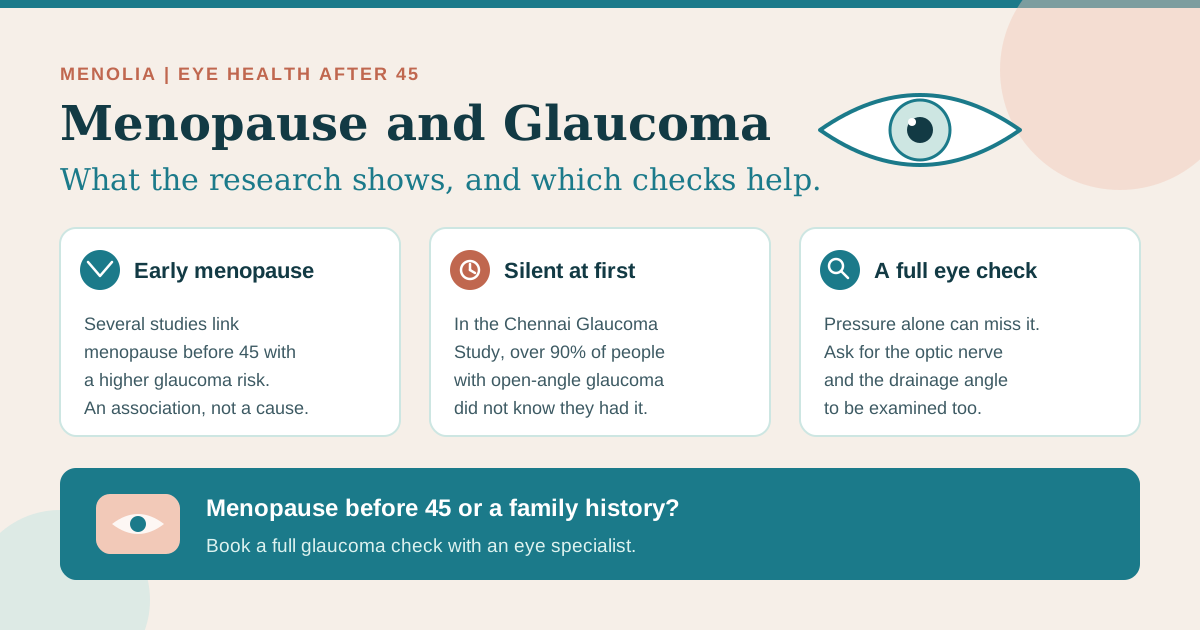
Age-related cataract develops over years. It is painless, and the good news is that it is treatable: surgery replaces the cloudy lens with a clear artificial one. This is the main way cataract differs from glaucoma, where lost vision does not come back. Our post on menopause and glaucoma explains that condition separately.
Why Women Get Cataracts More Often
Cataract is more common in women than in men. A review from the University of Gothenburg noted that this is not only because women in Western countries have more cataract operations: several population-based studies show women have more lens clouding, especially the cortical type, and there is no firm evidence that lifestyle explains the gap (Zetterberg M et al., Curr Eye Res, 2015, PMID 24987869). That gap is the reason researchers started looking at oestrogen in the first place.
In India the picture has a second layer. A systematic review of 22 Indian studies of adults aged 50 and over found that women had 69% higher odds than men of being blind from cataract. The pooled estimate also suggested women were less likely to have had cataract surgery, though that figure fell just short of statistical significance (Prasad M et al., Br J Ophthalmol, 2020, PMID 31221669).
The national blindness survey carried out across 31 districts between 2015 and 2018 examined 85,135 people aged 50 and over. It found that 12.9% had vision impairment linked to cataract, that women were more affected, and that the most common reason given for not having surgery was “need not felt” (48.1%) (Gupta V et al., Indian J Ophthalmol, 2025, PMID 40880153).
So for an Indian woman in midlife, part of the cataract story is biology and part of it is access. Women often put their own eyes last, behind the family’s needs. That second part is something you can change.
What the Research Shows About Oestrogen and the Lens
The laboratory evidence
Oestrogen receptors have been found in the cells that line the lens, and in laboratory studies, oestradiol at normal body levels protected cultured human lens cells from oxidative damage. Oxidative stress is thought to be one of the main drivers of cataract. From this, researchers have proposed that the withdrawal of oestrogen at menopause, rather than the absolute level, may raise cataract risk in women (Zetterberg M et al., Curr Eye Res, 2015, PMID 24987869). This is a reasonable idea. It is still a hypothesis.
Age at menopause: the population studies
Here the evidence is mixed, and I would rather show you the mix than pick one study.
- The Beaver Dam Eye Study (USA), first look. In a survey of women aged 43 to 84, a later menopause was linked to less cortical clouding, and current use of postmenopausal oestrogen was linked to a lower risk of more severe nuclear cataract. The authors described this as suggestive of a modest protective effect of oestrogen on the lens (Klein BE et al., Arch Ophthalmol, 1994, PMID 8285900).
- Beaver Dam, five years later. When the same community was followed up, the researchers found little evidence that hormone exposures predicted new cataracts over five years (Klein BE et al., Am J Ophthalmol, 2000, PMID 11020411).
- The Blue Mountains Eye Study (Australia), five years. Among 1,343 women re-examined after five years, a longer span of reproductive years (from first period to menopause) went with a lower rate of cataract surgery, and a later first period went with a higher one (Younan C et al., Am J Epidemiol, 2002, PMID 12034578).
- Blue Mountains, ten years. With longer follow-up, age at menopause, total years of the body’s own oestrogen exposure, HRT use and the type of menopause showed no significant link with new cataracts or cataract surgery (Kanthan GL et al., Acta Ophthalmol, 2010, PMID 19489760).
What this evidence can and cannot tell you
All of these are observational studies. They can show that two things tend to occur together. They cannot prove that falling oestrogen causes cataract, and the longer-running studies are less convincing than the early ones. My summary for a woman sitting across from me: oestrogen probably plays some part in lens health, the effect of menopause timing on any one woman’s cataract risk looks small, and age, smoking, blood sugar and steroid use are clearer factors (covered below).
Does HRT Prevent Cataracts?
This is usually the next question, and the studies disagree.
- A 2013 meta-analysis pooled nine observational studies. Women who had ever used HRT had lower odds of cataract than never-users (odds ratio 0.83 in cohort studies and 0.74 in case-control or cross-sectional studies). By cataract type, current HRT use was associated with lower odds of nuclear cataract (odds ratio 0.72), while the result for ever-use and nuclear cataract fell just short of statistical significance. No association was seen for the cortical or posterior subcapsular types (Lai K et al., PLoS One, 2013, PMID 24205286).
- The US Nurses’ Health Study examined the lenses of 480 postmenopausal women. Overall there was no significant link between HRT and lens clouding, though current use of oestrogen-only HRT was associated with a 49% lower risk of nuclear opacities (Weintraub JM et al., Ophthalmic Epidemiol, 2002, PMID 12045885).
- The Swedish Mammography Cohort followed 30,861 postmenopausal women for about eight years. Ever-use of HRT was linked to a 14% higher rate of cataract surgery, current use to an 18% higher rate, and the risk rose with longer use (Lindblad BE et al., Ophthalmology, 2010, PMID 20045566).
- A Korean national insurance study compared women who had used menopausal hormone therapy, including tibolone, for at least six months with women who never had. The hormone therapy group had a higher incidence of cataract (Yuk JS et al., Ophthalmic Physiol Opt, 2023, PMID 36609995).
One point I keep in mind with the Swedish and Korean findings: they count cataract operations or diagnoses rather than examining every woman’s lens, and women who take HRT may simply see doctors more often, which makes a cataract more likely to be found and treated. That does not cancel the finding, but it is one reason the results point in different directions.
My reading: none of these studies was a trial designed to test HRT as cataract prevention, and the results are too inconsistent to use either way. HRT is not prescribed to protect the lens, and fear of cataract is not a reason to stop HRT that is helping you. The decision to start or continue HRT should rest on your symptoms, your age, your health history and your preferences, which our guide to HRT in India walks through.
Wondering how your menopause history, HRT or other medicines fit with your eye health? Bring your list of medicines and any recent reports, and we can go through the hormonal side together over a video call, alongside your eye doctor. Message Dr. Suganya on WhatsApp for a Rs 399 video consultation.
Risk Factors That Matter More Than Hormones
These are the factors with stronger evidence, and several of them are within your control.
Age. Cataract becomes more common with every decade after 50. In a study of 6,617 adults from rural and urban areas by researchers at Sankara Nethralaya, Chennai, increasing age was a risk factor for cataract in both groups (Singh S et al., Indian J Ophthalmol, 2019, PMID 30900578).
Smoking. An umbrella review of meta-analyses on smoking, diet and age-related eye disease found that current smoking and cataract was the only association backed by convincing evidence (Kai JY et al., Br J Ophthalmol, 2023, PMID 36575624). If you smoke or chew tobacco, stopping helps your eyes as well as your heart and bones. Our post on smoking and early menopause covers the wider picture.
Blood sugar. In the same Sankara Nethralaya study, a higher HbA1c (the three-month blood sugar test) was linked to cataract in rural adults aged 60 and over, with an odds ratio of 1.14 (Singh S et al., Indian J Ophthalmol, 2019, PMID 30900578). Diabetes risk rises for women after menopause, and our post on menopause and blood sugar explains which tests to ask for.
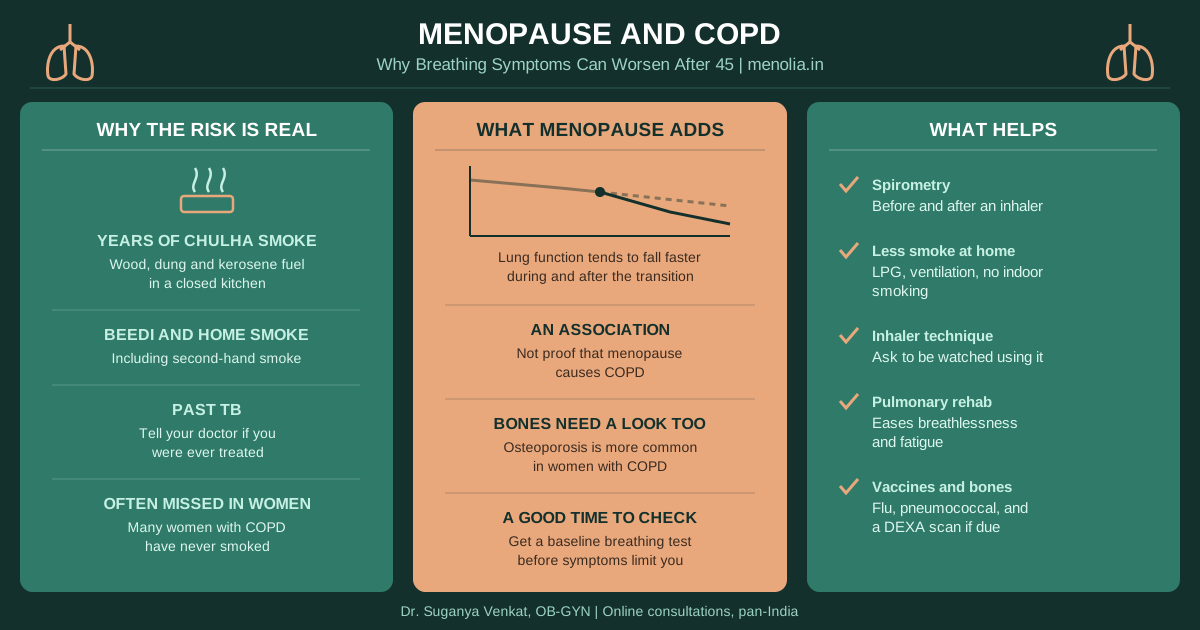
Steroids. Long-term steroid use is linked to cataract, usually the posterior subcapsular type. A review of steroid-induced cataract identified the total dose taken over time, treatment for longer than six months, and the route by which the steroid is given as key factors (Jian YF et al., Clin Ophthalmol, 2025, PMID 41080769). Steroid eye drops and injections into the eye can cause cataract too, so the risk depends on the particular medicine, the dose and how long it is used. Inhaled steroids for asthma or COPD matter too: a meta-analysis of case-control studies found the odds of cataract rose by about 25% for every 1,000 micrograms per day increase in dose, measured as beclomethasone dipropionate or an equivalent dose of another inhaled steroid (Weatherall M et al., Respirology, 2009, PMID 19740259). If you need steroids for asthma, arthritis or another condition, do not stop them on your own. Ask your doctor whether you are on the lowest dose that works, and mention it at eye check-ups.
Sunlight. A review of 22 epidemiological studies found that most supported a link between UV-B exposure and cortical cataract (McCarty CA et al., Dev Ophthalmol, 2002, PMID 12061276). In Indian sunshine, a wide-brimmed hat, a sari pallu or umbrella over the head, and sunglasses that block UV are simple habits.
What about vitamin pills? A five-year randomised trial in rural South India gave 798 people beta carotene, vitamin C and vitamin E, or placebo. The supplements did not slow cataract progression (Gritz DC et al., Br J Ophthalmol, 2006, PMID 16556618). A varied diet with vegetables, greens like keerai and fruit is good for your general health, but no supplement has been shown to stop a cataract.
A note for breast cancer survivors. Women taking tamoxifen sometimes ask about cataract. Earlier prevention trials reported more cataracts with tamoxifen, but results have been inconsistent. A Korean nationwide study of women treated for early breast cancer (DCIS) found that tamoxifen was not a significant risk factor for cataract diagnosis or surgery (Yoon CI et al., Breast Cancer Res Treat, 2023, PMID 36495379). Keep up with the eye checks your oncologist advises.
Symptoms to Notice
Cataract changes vision gradually, often over years, so it is easy to adjust without noticing. Common signs include:
- Blurred, cloudy or misty vision that glasses no longer fully correct
- Glare from headlights, streetlights or bright sunlight, and haloes around lights at night
- Colours that look faded or yellowish
- Needing brighter light to read or sew
- Spectacle prescriptions that need changing more often than before
- Double vision in one eye
Some of these overlap with ordinary menopause eye changes. Dry eye, for example, can also cause blurring that comes and goes, and our post on menopause dry eyes explains why. Blurring that clears with blinking points more towards the eye surface. Blurring that stays, and slowly gets worse, is worth an eye examination.
When to See an Eye Doctor, and What to Expect
Book an eye examination with an ophthalmologist if your vision has become hazy, if glare is affecting your driving, or if you have not had a full eye check since turning 40. Tell the doctor about your menopause history, any steroid use and whether you have diabetes.
At the visit, the eye doctor checks your vision, examines the lens with a slit-lamp microscope (often after dilating drops), and looks at the retina and optic nerve. That last part matters because the same visit can pick up glaucoma or diabetic eye changes.
If a cataract is found, there is often no hurry. Early cataract may need only a change of glasses, better lighting and a review at intervals your eye doctor suggests. Surgery is usually advised when the cataract starts to interfere with daily life: reading, cooking, driving, work or getting about safely. Many older relatives were told to wait until a cataract was “ripe”. That advice belongs to older surgical techniques, and the timing is now a decision you make with your eye doctor based on how much it affects you.
Cataract surgery is one of the most common operations in India. It is usually done as a day procedure under local anaesthetic: the cloudy lens is removed and a clear artificial lens (an intraocular lens) is put in its place. Government medical college eye departments, district hospitals and established eye hospitals across the country perform it. If you have diabetes, aim to have it well controlled before the operation, as your doctors advise.
When eye symptoms need emergency care
Cataract does not cause sudden symptoms. Go to an eye hospital or emergency department immediately if you have:
- Sudden loss of vision in one eye
- A painful, red eye with blurred vision or haloes around lights
- A sudden shower of new floaters, flashes of light, or a curtain over part of your vision
Our post on menopause red flags lists other midlife symptoms that need prompt medical attention.
Cataract in Hindi, Tamil and Telugu
Many women first hear the word for cataract from family, in their own language. These are the terms in common use:
| Language | Term | Notes |
|---|---|---|
| Hindi | motiyabind (मोतियाबिंद) | The everyday Hindi name for cataract |
| Hindi | kala motia (काला मोतिया) | This is glaucoma, a different eye condition. The two names are easy to confuse. |
| Tamil | kanpurai (கண்புரை) | The common Tamil name for cataract |
| Tamil | kannil thirai (கண்ணில் திரை) | Literally “a screen in the eye”, an older everyday expression |
| Telugu | shuklam (శుక్లము) | The Telugu term for cataract |
If an older relative was told she had motiyabind or kanpurai and had an operation, that is useful family history to share with your eye doctor, along with any history of glaucoma.
Practical Steps After 45
- Have a full eye examination with an ophthalmologist if you are over 40 and have not had one, and repeat it as advised.
- Stop smoking and chewing tobacco. It is the clearest modifiable risk factor for cataract.
- Know your blood sugar. Ask for a fasting glucose and HbA1c, and keep diabetes well controlled if you have it.
- Review steroid use with the doctor who prescribes it, without stopping it on your own.
- Protect your eyes from strong sun with a hat, pallu, umbrella or UV-blocking sunglasses.
- Make HRT decisions on their own merits. Cataract evidence is too mixed to be a reason to start or stop.
- Do not delay surgery out of habit. If a cataract is limiting your daily life, discuss timing with your eye doctor. Your eyes are worth the same care you give your family’s.
Our post-menopause health checklist covers the blood tests and scans that matter after menopause. An eye examination fits alongside them.
Frequently Asked Questions
Does menopause cause cataracts?
Menopause on its own has not been shown to cause cataracts. Cataract is more common in women than men, and laboratory studies suggest oestrogen helps protect lens cells from oxidative damage, so researchers think the drop in oestrogen at menopause may play some part. Long-term population studies have given mixed results, and age, smoking, blood sugar and steroid use are clearer risk factors.
Does early menopause increase cataract risk?
The evidence is inconsistent. An early American study linked a later menopause with less cortical cataract, and an Australian study linked a longer span of reproductive years with less cataract surgery over five years. At ten years, the same Australian study found no significant link between age at menopause and new cataracts. If your menopause came early, a regular eye check is sensible, but early menopause is not a reason to expect cataract.
Does HRT prevent cataracts?
Not reliably. A meta-analysis of observational studies found lower odds of cataract in women who had used HRT, while a large Swedish study and a Korean national study found higher rates of cataract surgery or diagnosis among HRT users. HRT is not used to prevent cataract. Decide about HRT based on your symptoms and health history.
Motiyabind menopause ke baad jaldi hota hai kya?
Motiyabind (cataract) becomes more common with age in everyone, and it is somewhat more common in women. Menopause has not been proven to bring it on early. Smoking, high blood sugar and long-term steroid use are the factors with stronger evidence. If your vision is becoming hazy after 45, see an eye doctor for a check.
Can eye drops or vitamins dissolve a cataract?
No drop or supplement has been shown to reverse a cataract. A five-year trial in South India found that beta carotene, vitamin C and vitamin E did not slow cataract progression. Surgery is the treatment that restores clear vision once a cataract affects daily life.
Is cataract surgery safe after menopause?
Cataract surgery is one of the most commonly performed operations, usually done as a day procedure under local anaesthetic. Menopause itself does not make it riskier. Tell your eye surgeon about your medicines, including HRT, steroids and any blood thinners, and keep diabetes well controlled beforehand if you have it.
How is cataract different from glaucoma?
Cataract is clouding of the lens, which blurs vision gradually and can be corrected with surgery. Glaucoma is damage to the optic nerve, often silent, and the vision it takes cannot be restored. In Hindi, motiyabind is cataract and kala motia is glaucoma. A full eye examination checks for both.
Noticing your eyesight change in midlife can feel like one more thing on a long list, especially when so much else is shifting at the same time. For most women, a cataract is a slow, manageable change with a very effective treatment, and the steps that protect your lens (no tobacco, steady blood sugar, careful steroid use, sun protection) protect the rest of your health too. If you would like help with the hormonal side of your midlife health, including HRT decisions and the checks worth doing after menopause, I see women across India online.
Chat with Dr. Suganya on WhatsApp
Related reading: Menopause and Glaucoma: What’s the Connection? · Menopause Vision Changes: Blurring, Glare & Prescription