Many women with psoriasis have spent years managing the skin side of it: the scalp patches, the elbows, the creams that work for a while and then stop. Joints were never part of the story. Then, somewhere in the mid-forties, a finger swells up and stays swollen, the heel hurts with the first steps out of bed, and the knees feel stiff for an hour every morning. Periods are changing at the same time, sleep is broken, and it becomes hard to tell what is driving what.
Other women already have a diagnosis of psoriatic arthritis (PsA) and have had it under control on their treatment for years. Around perimenopause, the pain seems to climb, even though their rheumatologist says the swelling has not changed much.
Both situations are common, and both can be untangled. I’m Dr. Suganya Venkat, an OB-GYN with more than 15 years of clinical practice, and this post walks through what the research shows about menopause and psoriatic arthritis, why joint symptoms can feel worse even when the disease itself is stable, how to tell PsA apart from osteoarthritis and ordinary menopausal aches, and where HRT and weight fit in.
What This Post Covers
- How psoriatic arthritis shows up in Indian women, and why mild skin disease does not rule it out
- What the studies say about menopause and PsA, and where the evidence stops
- Why pain can rise around menopause even when inflammation has not
- How to tell PsA, osteoarthritis and menopausal joint aches apart
- What HRT can and cannot do here, and the clot and heart questions to raise
- Why weight matters in PsA
- What to bring to your rheumatologist and gynaecologist
If your main concern is psoriasis plaques that have flared on the skin around perimenopause, start with our guide to perimenopause eczema and psoriasis flares, which covers the skin side in detail. This post is about the joints.
How Psoriatic Arthritis Shows Up in Indian Patients
Psoriatic arthritis is an inflammatory joint disease that develops in some people with psoriasis. It can affect the small joints of the fingers and toes, larger joints like the knees, the spine, and the places where tendons attach to bone (called entheses, such as the back of the heel).
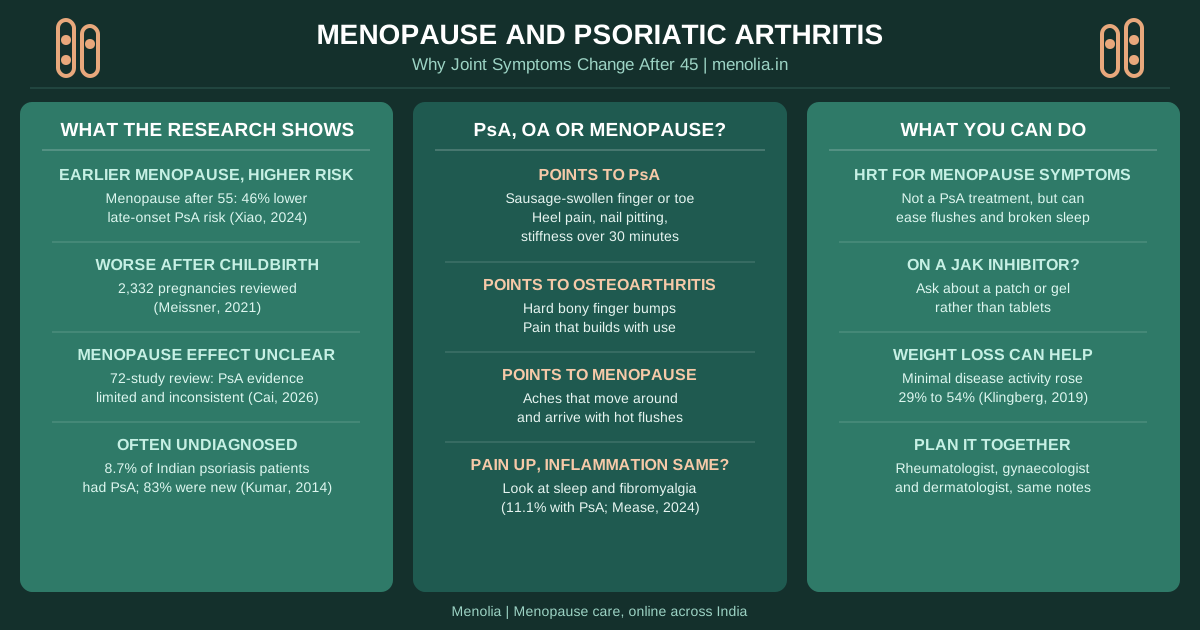
In a study of 1,149 consecutive psoriasis patients seen at a dermatology clinic in India (Kumar R et al., Indian J Dermatol Venereol Leprol, 2014, PMID 24448118), 8.7% had psoriatic arthritis, and 83% of those had not been diagnosed before. A few findings from that study are useful to know:
- Nail changes were present in 87% of those with PsA. Pitting, ridging or a nail lifting off its bed is a common clue.
- Enthesitis (tendon-attachment pain) was present in 67%, and dactylitis (a whole finger or toe swollen like a sausage) in 26%.
- The most common pattern was symmetrical polyarthritis (58%), meaning several joints on both sides of the body. This can look a lot like rheumatoid arthritis.
- Skin and nail severity did not match joint severity. Among those with PsA, the number of swollen or tender joints did not significantly correlate with how severe the skin or nail disease was. A woman with only a few small patches can still have significant joint disease.
That last point matters at this age. Many women assume that because their psoriasis is mild, their joint pain must be “just menopause”. Sometimes it is. Sometimes it is PsA that has never been named.
What the Research Shows About Menopause and PsA
The research here falls into three groups, and they answer different questions.
Does menopause timing affect the risk of developing PsA? A large prospective study using UK Biobank data (Xiao Y et al., J Invest Dermatol, 2024, PMID 38081449) followed postmenopausal women who did not have psoriatic disease at the start. Women with a later natural menopause and a longer reproductive lifespan had a lower risk of developing psoriasis and PsA later in life. Menopause after 55 was linked with a 46% lower risk of late-onset PsA compared with menopause before 45. This was an observational study, so it shows an association rather than proving that oestrogen loss causes PsA, but it fits with the idea that the hormonal environment plays some part.
Does disease activity change across hormonal life stages? The clearest signal comes from pregnancy. A systematic review of 13 studies covering 2,332 pregnancies in women with PsA (Meissner Y et al., Semin Arthritis Rheum, 2021, PMID 33887551) found that disease activity tended to increase or worsen after delivery compared with during pregnancy. That pattern, with disease activity higher after delivery than during pregnancy, hints that falling hormone levels can influence the disease.
Does menopause itself make established PsA worse? This is where the evidence is thinnest. A 2026 systematic review of 72 studies on sex hormones in psoriatic disease (Cai Y et al., Am J Clin Dermatol, 2026, PMID 42631811) found that for psoriasis of the skin, menopause appears to be a higher-risk period for relapse. For psoriatic arthritis, the authors described the evidence as limited and inconsistent. Their practical advice was closer monitoring during major hormonal transitions.
In short, menopause may matter for PsA, and there is a reasonable biological basis for that, but nobody can yet tell an individual woman that menopause will make her arthritis worse. Many women go through the transition with their disease behaving much as before. What changes more reliably is everything around the disease, which is the next section.
Why Pain Can Rise Even When Inflammation Has Not
This is the part that surprises women most. Their rheumatologist examines them, the swollen joint count is unchanged, the blood markers look similar, and yet they are hurting more. Several things can explain that.
Women with PsA report more pain to begin with. A meta-analysis of 54 clinical trials of advanced PsA treatments (Eder L et al., Lancet Rheumatol, 2023, PMID 38251562) found that at the start of the trials, women had higher tender joint counts, higher pain scores and worse physical function scores than men, while men had higher psoriasis skin scores and higher CRP (a blood marker of inflammation). Men were also more likely to reach minimal disease activity on most drug classes. The reasons for these differences are not settled, and the authors called for trials to report results by sex.
Fibromyalgia often sits alongside PsA. In a US registry of 1,823 people with PsA (Mease P et al., Arthritis Care Res, 2024, PMID 38736168), 11.1% met the definition of fibromyalgia, and female sex was one of the factors linked with it. In those with fibromyalgia, disease activity scores, pain and tender joint counts were about twice as high, even though fibromyalgia pain is not driven by joint inflammation. The authors pointed out that this can make PsA look more active than it is. Our post on menopause and fibromyalgia explains how that pattern is recognised and why sleep plays such a large part in it.
Menopause adds its own aches. Falling oestrogen brings joint stiffness and diffuse aching for many women, with or without arthritis. Night sweats break sleep, and poor sleep lowers pain tolerance the next day. Weight often shifts around the middle, adding load to knees and feet. Our guide to menopause joint pain covers this background layer.
Put together, a woman with well-controlled PsA can enter perimenopause and feel worse without her arthritis having flared. Telling the two apart changes the plan. If inflammation has risen, the arthritis treatment may need adjusting. If the extra pain is coming from sleep, menopausal aches or fibromyalgia, changing the arthritis drug will not fix it, while treating the menopause symptoms and sleep might.
Living with psoriasis or psoriatic arthritis, and finding your joints harder to manage since your periods started changing? Dr. Suganya goes through your symptoms, sleep and menopause stage, and helps you work out what to raise with your rheumatologist.
Psoriatic Arthritis, Osteoarthritis or Menopausal Aches?
After 45, three things can cause joint pain at once: psoriatic arthritis, osteoarthritis (wear-related joint change, which also becomes more common after menopause), and the general aching of the transition. No single feature settles it, but patterns help. Use this as a guide for a conversation with your doctor, not a way to diagnose yourself.
| Feature | More typical of PsA | More typical of osteoarthritis | More typical of menopausal aches |
|---|---|---|---|
| Stiffness | Long morning stiffness, often over 30 minutes, easing as you move | Short stiffness after rest; pain builds with use through the day | General stiffness and aching; short stiffness on its own does not rule out PsA |
| Swelling | Soft, warm swelling; a whole finger or toe may swell (dactylitis) | Hard, bony bumps at finger joints or the base of the thumb | Little or no visible swelling |
| Where it hurts | Fingers, toes, knees, heel, Achilles tendon, lower back | Knees, hips, finger-end joints, base of the thumb | Several joints and muscles, often moving around |
| Skin and nails | Psoriasis patches (sometimes only a few), nail pitting or lifting | Usually unrelated | Unrelated |
| Other clues | Back stiffness that wakes you in the second half of the night | Pain worse at the end of a busy day | Comes with hot flushes, night sweats, cycle changes |
The finger-end joints are where confusion is most common. Both osteoarthritis and PsA can affect the small joints nearest the fingernails. A swollen finger-end joint with pitting or lifting of the nail on the same finger points more towards PsA. Hard bony bumps with normal nails point more towards osteoarthritis. Our post on HRT and osteoarthritis explains how osteoarthritis behaves around menopause and what helps it.
One situation is urgent: a single joint that has suddenly become hot, swollen and very painful, especially with a fever or while you take medicines that lower immunity, needs same-day medical care, because it can be a joint infection (septic arthritis). Other features need a rheumatologist’s assessment soon rather than later: joints that stay swollen and warm, a sausage-shaped finger or toe, persistent heel or Achilles pain with no injury, or new back stiffness that is worse with rest. There is no single blood test for PsA. Diagnosis rests on the pattern, the examination, and sometimes X-rays or ultrasound, which is why a rheumatologist’s eye matters. If your joints are symmetrical and swollen, your doctor may also test for rheumatoid arthritis; our guide to menopause and autoimmune flares explains how rheumatoid arthritis and lupus behave around menopause.
Where HRT Fits, and Where It Does Not
HRT is not a treatment for psoriatic arthritis. The 2026 systematic review above found the evidence on menopausal hormone therapy in psoriatic disease inconclusive, varying with the formulation, timing and population studied (Cai Y et al., 2026). There are no trials showing that HRT reduces joint inflammation or protects joints in PsA. Your arthritis treatment stays with your rheumatologist.
HRT can still help the menopause side of the picture. If hot flushes, night sweats and broken sleep are adding to your pain, treating them may make the overall load lighter. So the decision to use HRT rests on your menopause symptoms and your individual risk profile, the same as for any woman. Our complete HRT guide for Indian women walks through that decision.
Two things about PsA make the planning more specific.
Your PsA medicine can change the clot conversation. Some newer PsA treatments are JAK inhibitors (tablets such as tofacitinib and upadacitinib). A 2025 meta-analysis of 42 head-to-head studies across inflammatory diseases including psoriasis and PsA (Solitano V et al., JAMA Netw Open, 2025, PMID 40928778) found a slightly higher risk of venous thromboembolism, a clot in a leg vein or the lungs, with JAK inhibitors than with TNF-blocking drugs (hazard ratio 1.26), though absolute rates were low for both. Oral oestrogen also raises clot risk, while oestrogen through the skin appears to carry a lower risk: in the French ESTHER study (Canonico M et al., Circulation, 2007, PMID 17309934), oral oestrogen users had about four times the odds of a venous clot (odds ratio 4.2), while transdermal users showed no significant increase (odds ratio 0.9). We found no study of HRT and JAK inhibitors used together, so the safety of the combination is not established. If you take one, a patch or gel is the sensible route to discuss, and your rheumatologist should know you are considering HRT. If you still have a uterus, a progestogen is added to protect its lining, whether the oestrogen is a tablet, patch or gel. Our guide to HRT and blood clots explains the route difference in more detail.
Heart health deserves a closer look. A 2024 review (Vegt DE et al., Curr Rheumatol Rep, 2024, PMID 39641871) found that psoriasis, PsA and menopause are each linked with higher cardiovascular risk, largely through chronic inflammation, though whether menopause adds to the risk from PsA has not been specifically studied. In practice, that is a good reason to check blood pressure, blood sugar and cholesterol regularly from your mid-forties, and to bring those numbers into any HRT discussion.
Why Weight Matters in PsA
Weight is linked both with the risk of developing psoriatic arthritis and with how active it is, which makes it a useful thing to work on during a stage of life when weight tends to shift.
In a UK study of 75,395 people with psoriasis (Love TJ et al., Ann Rheum Dis, 2012, PMID 22586165), the risk of developing PsA rose with body mass index: people with a BMI of 35 or more had about 1.5 times the risk (relative risk 1.48) of those with a BMI under 25.
For women who already have PsA, the encouraging finding comes from a study of 41 people with PsA and obesity, most of them women with a median age of 54 (Klingberg E et al., Arthritis Res Ther, 2019, PMID 30635024). After a medically supervised weight loss programme with a median loss of 18.7 kg, the share reaching minimal disease activity rose from 29% to 54%. Joint counts, heel and tendon pain, skin, CRP and fatigue improved, and larger weight loss brought larger improvement. That programme used a very low calorie diet under close medical follow-up, so it is not something to attempt alone, but it shows that weight is a lever you can work on alongside your treatment.
Steady changes add up over months:
- Build meals around protein and fibre: dal, sambar, channa, paneer, eggs or fish if you eat them, with plenty of vegetables, and smaller portions of rice or chapati.
- Choose whole grains such as ragi, jowar or brown rice over refined flour most days, and keep sweets and fried snacks for occasions.
- Strength work two or three times a week, adjusted to your joints. A physiotherapist can suggest exercises that do not load a painful joint.
- Protect your sleep, because short, broken sleep makes both hunger and pain harder to manage.
If menopause weight gain has been hard to shift, our post on menopause weight gain covers the changes that help most at this stage.
On treatment for psoriatic arthritis and struggling with hot flushes, sleep or weight? Dr. Suganya reviews your menopause symptoms, current medicines and heart and clot risk over an online consultation (video call), and suggests a plan you can take back to your rheumatologist. Online consultation at ₹399, booked on WhatsApp.
Planning It Together With Your Rheumatologist
Psoriatic arthritis around menopause is best handled by your rheumatologist, your gynaecologist and often your dermatologist working from the same information. Bring these to your next appointments:
- A short symptom diary for two to four weeks: which joints hurt, how long morning stiffness lasts, any swelling, how you slept, and any hot flushes or night sweats. This helps separate an arthritis flare from a bad stretch of menopause symptoms.
- Your menstrual history: when periods started changing, and when your last period was.
- Your full medicine list, including any PsA treatment, painkillers and supplements, so both doctors can check how a menopause treatment would fit.
- Recent blood pressure, sugar and cholesterol readings, or ask for them.
- Questions to ask your rheumatologist: Is my inflammation higher than before, or is the disease stable? Could some of this pain be fibromyalgia or osteoarthritis? Does my current treatment affect the choice of HRT?
- Questions to ask your gynaecologist: Are my symptoms likely to be menopausal? Is HRT reasonable for me, and which route? What are the non-hormonal options if not?
Women with PsA can end up treating every new ache as an arthritis problem, when part of it may be broken sleep and hot flushes that can be treated in their own right. Sorting the two apart is usually the first step to feeling better.
Frequently Asked Questions
Does menopause make psoriatic arthritis worse?
It can, but not for everyone. Menopause appears to be a higher-risk time for psoriasis of the skin to relapse, and PsA tends to worsen after childbirth, which suggests hormones play a part. For PsA specifically, a 2026 systematic review found the evidence limited and inconsistent. Many women find their arthritis behaves much as before, while pain from sleep loss and menopausal aches rises.
Can psoriatic arthritis start after menopause?
Yes. Psoriatic arthritis can begin at any age, including after 50. A large UK Biobank study found that women with an earlier natural menopause had a higher risk of developing PsA later in life than women whose menopause came after 55. If you have psoriasis and develop new joint swelling, heel pain or a swollen finger or toe, ask to see a rheumatologist.
How do I know if my joint pain is psoriatic arthritis or menopause?
Clues that point towards PsA include a swollen, warm joint, a whole finger or toe swelling up, heel or Achilles pain, nail pitting or lifting, and morning stiffness lasting over half an hour. Menopausal aches tend to move around and come with hot flushes or night sweats, but short-lived stiffness does not rule out PsA. A rheumatologist can examine you and confirm which it is.
Will HRT help my psoriatic arthritis?
HRT is not a treatment for PsA, and the research on hormone therapy in psoriatic disease is inconclusive. It can help with hot flushes, night sweats and sleep, which may ease the overall pain load. Your arthritis treatment stays with your rheumatologist, and the HRT decision rests on your menopause symptoms and health profile.
Is HRT safe if I take a JAK inhibitor for psoriatic arthritis?
We found no study of the two used together, so the safety of the combination is not established. JAK inhibitors carry a slightly higher risk of blood clots than TNF-blocking drugs, and oral oestrogen raises clot risk while patches and gels appear to carry a lower risk. If HRT is suitable for you, transdermal oestrogen is the route to discuss, planned with your rheumatologist and gynaecologist together. If you still have a uterus, a progestogen is added to protect its lining, whether the oestrogen is a tablet, patch or gel.
Can losing weight help psoriatic arthritis?
Yes. In a study of people with PsA and obesity, a medically supervised programme with a median weight loss of 18.7 kg increased the share reaching minimal disease activity from 29% to 54%. Smaller, steady changes in diet, strength exercise and sleep are a sensible place to start alongside your treatment.
My psoriasis is mild. Can I still have psoriatic arthritis?
Yes. In an Indian study of psoriasis patients, most of those found to have PsA had not been diagnosed before, and among those with PsA, skin and nail severity did not significantly correlate with the number of swollen or tender joints. If you have psoriasis, even a few small patches, and new joint or heel pain, it is worth asking about PsA.
If psoriatic arthritis and menopause are pulling in different directions, a plan that looks at both can make each easier to manage. Message Dr. Suganya Venkat on WhatsApp to talk it through.