You are 38. Your periods, which ran like a clock for twenty years, have started arriving a few days early. You wake at 3 a.m. for no reason. The week before your period feels heavier than it used to, emotionally and physically. A friend mentions perimenopause, and your first thought is: surely not yet, I am not even 40.
It is a fair question, and a common one. Perimenopause can begin in the late 30s for some women. But several other things that are very common at this age can look almost exactly like it, and most of them are easy to check. This post walks through what early perimenopause tends to look like, what else to rule out, and what to ask for when you speak to a doctor.
When Does Perimenopause Usually Start?
Perimenopause is the transition before your final period, when ovarian hormones start to fluctuate. In the large Massachusetts Women’s Health Study, the median age at which perimenopause began was 47.5 years, and the transition lasted close to four years on average (McKinlay SM et al., Maturitas, 1992, PMID 1565019).
A median is a middle point, not a rule. Half of women start later than that, and some start years earlier. So noticing changes at 37 or 38 does not automatically mean something is wrong, and it does not automatically mean perimenopause either. It simply means the question is worth answering properly.
Two terms are worth knowing, because they are often confused:
- Early perimenopause in the late 30s: the normal transition starting at the younger end of the range. Periods continue, often with small changes.
- Premature ovarian insufficiency (POI): when the ovaries stop working normally before 40. This is a specific diagnosis made with blood tests, not something to assume from symptoms. A 2019 meta-analysis put its pooled global prevalence at 3.7% (Golezar S et al., Climacteric, 2019, PMID 30829083).
Most women asking this question at 38 do not have POI. If you want to understand that condition in more depth, our guide to premature menopause causes and signs covers it, and early menopause symptoms explains how it differs from the usual transition.
Early Signs Women Notice in Their Late 30s
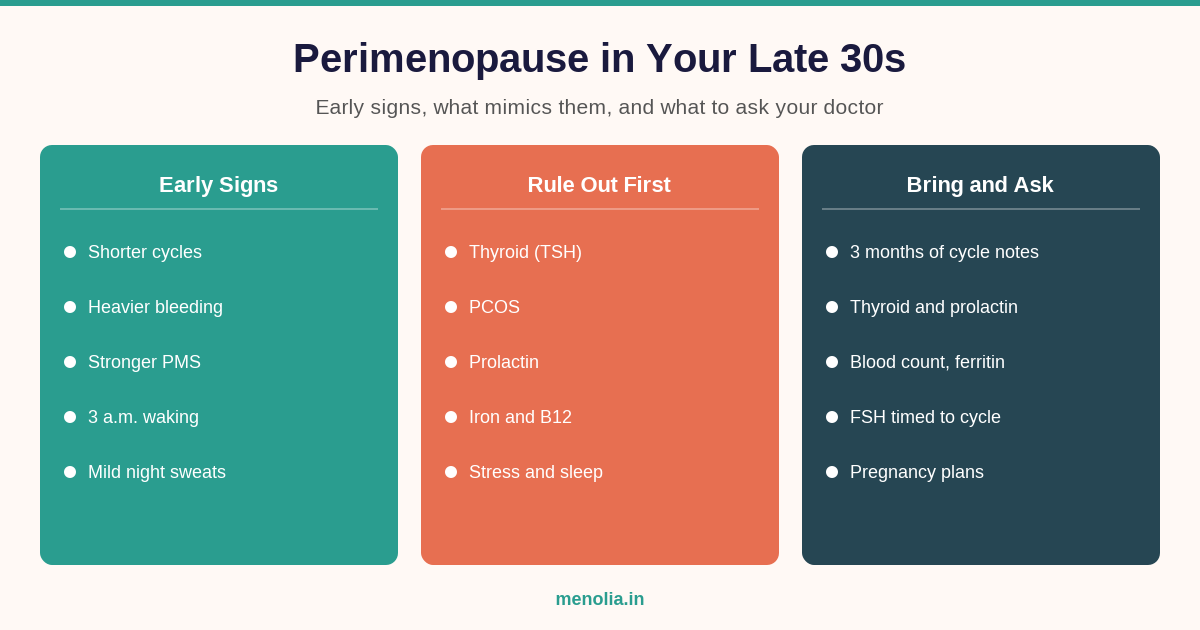
The first changes are usually subtle and come and go. Common ones include:
- A shorter cycle. Periods arriving every 23 to 25 days instead of 28 is often one of the earliest shifts, before cycles become irregular.
- Heavier or different bleeding. Some months heavier, some lighter, sometimes with more clots.
- Stronger premenstrual symptoms. More irritability, breast tenderness or low mood in the days before a period.
- Sleep changes. Waking in the early hours, or lighter sleep, especially around the period.
- Night sweats or warm flushes, often mild and only in the days before bleeding starts.
- Mood and focus changes. Feeling flat, anxious or foggy in a way that is new for you.
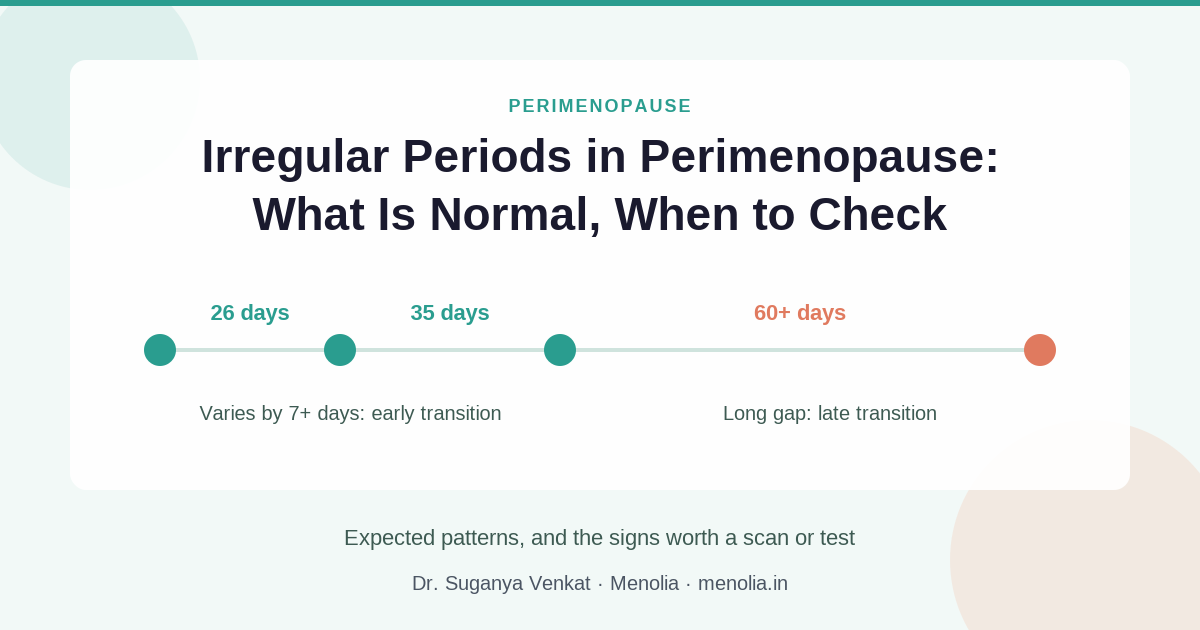
The international STRAW+10 staging system describes the early menopause transition by a persistent change in cycle length of seven days or more between consecutive cycles (Harlow SD et al., J Clin Endocrinol Metab, 2012, PMID 22344196). In other words, the cycle itself is the most useful signal, more than any single symptom. For the full range of symptoms across the transition, see perimenopause symptoms and what to expect.
In Hindi, women often search this as “38 saal mein periods jaldi aana” (periods coming early at 38). In Tamil, many describe it as maadhavidaai seekiram varudhu, periods coming sooner than before. Whatever the words, the pattern you are describing is worth writing down.
If you have noticed changes like these and would like help working out what they mean, you can talk it through with Dr. Suganya. Message her on WhatsApp.
What Else Can Look Like Perimenopause at 38?
This is the part that matters most. In the late 30s, several common conditions produce the same mix of cycle changes, tiredness, poor sleep and mood shifts. They are worth checking first because each has its own treatment.
Thyroid Problems
An underactive or overactive thyroid can change your cycle, energy, weight, mood and sleep. Thyroid conditions are common in women, and a single TSH blood test is the starting point. Our post on thyroid changes during menopause explains how the two overlap.
PCOS
Many women with PCOS reach their late 30s with cycles that are already irregular, which makes it harder to tell what is new. PCOS cycles tend to be long and unpredictable, while early perimenopause more often starts with shorter cycles. If you have a history of PCOS, read PCOS and perimenopause for what changes as you approach 40.
Raised Prolactin
Higher prolactin levels can disturb ovulation and periods. It is a simple blood test, and it is usually checked when cycles change without a clear reason.
Stress, Sleep Loss and Weight Change
A demanding job, young children, caring for parents, a big change in weight or very intense exercise can all shift your cycle and mood. These are real causes, not “just stress”, and they deserve attention in their own right.
Low Iron and Low B12
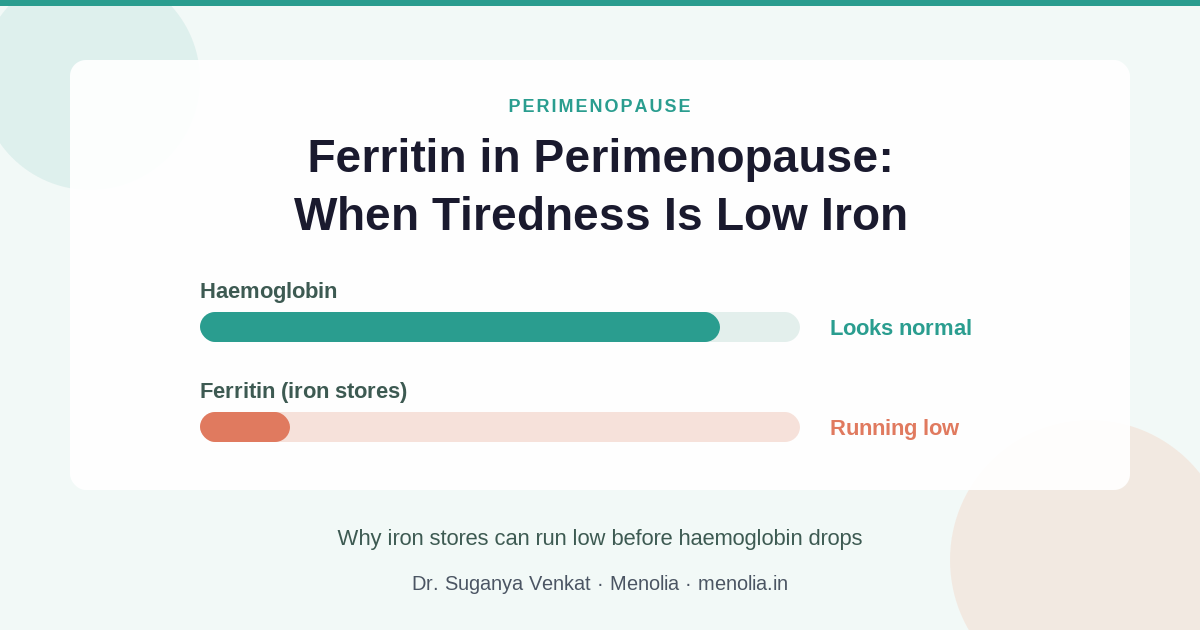
Tiredness, poor concentration and breathlessness are often put down to hormones when the cause is low ferritin or B12, both common in Indian women and easy to test.
Pregnancy
If there is any chance of pregnancy, a missed or unusual period always starts with a pregnancy test.
What to Ask For When You See a Doctor
You do not need every test at once. A sensible first conversation usually covers your cycle history and a short set of blood tests. Useful things to bring and ask about:
- Three months of cycle notes. Start date of each period, how many days it lasted, how heavy it was, and any symptoms. This is the single most useful thing you can bring.
- Thyroid function (TSH, and sometimes free T4).
- Prolactin, if cycles have changed without an obvious cause.
- A complete blood count and ferritin, especially if bleeding is heavier or you feel tired.
- Vitamin B12 and vitamin D, if fatigue or low mood is part of the picture.
- Fasting glucose or HbA1c, particularly if you have PCOS or a family history of diabetes.
- FSH and oestradiol, timed to your cycle, when your doctor wants to look at ovarian function. These hormones swing a lot in early perimenopause, so a single normal result does not rule it out, and a single high result does not confirm it. Our post on how to test for perimenopause explains the timing and how results are read.
If FSH is clearly raised on repeated tests and periods have become very infrequent before 40, your doctor will discuss POI. That is a diagnosis made carefully, over time, not from one result or from symptoms alone.
What You Can Do Now
While you are getting answers, a few steps help whatever the cause turns out to be:
- Keep a symptom and cycle diary. It turns a vague feeling into a pattern a doctor can read.
- Protect your sleep. A regular bedtime, a cooler room and less screen time late at night help most women.
- Build in strength training two or three times a week. Muscle and bone both benefit from it in the years ahead.
- Eat for steady energy. Regular meals with protein at each one (dal, paneer, eggs, curd, sundal) and whole grains like ragi or millets rather than long gaps followed by sugary snacks.
- Get calcium and protein from everyday foods such as dahi, ragi, sesame and greens.
- Talk about mood changes. Feeling low or anxious in a new way deserves attention, whatever is behind it.
If you are still planning a pregnancy, say so early in the consultation. It changes which tests are useful and how quickly they should be done, and it is something your gynaecologist will want to plan with you.
I am Dr. Suganya Venkat, an OB-GYN with more than 15 years of experience, and the women in their late 30s who bring me these questions usually leave with a much clearer picture after one careful history and a few targeted tests. Very often the answer is a thyroid result or an iron level, and when it is early perimenopause, knowing early gives you more time to plan.
Frequently Asked Questions
Can perimenopause start at 38?
Yes, for some women. The median age at which perimenopause begins is in the mid to late 40s, but the range is wide, and some women notice the first cycle changes in their late 30s. Because thyroid problems, PCOS, raised prolactin and stress can cause the same symptoms, those are worth ruling out before assuming perimenopause.
What are the first signs of perimenopause in your 30s?
The earliest sign is often a change in cycle length, usually periods coming a few days earlier than before. Heavier or more variable bleeding, stronger premenstrual symptoms, early-morning waking and mild night sweats around the period are also common early changes.
Is it perimenopause or thyroid?
The symptoms overlap a great deal: tiredness, weight change, mood shifts, poor sleep and cycle changes. A TSH blood test is the simplest way to check the thyroid, and it is usually one of the first tests a doctor will suggest when cycles change in the late 30s.
Can a blood test confirm early perimenopause?
Not reliably on its own. FSH and oestradiol fluctuate widely in early perimenopause, so one result can look normal even when the transition has started. Doctors read hormone tests alongside your age, cycle pattern and symptoms, and sometimes repeat them.
38 saal mein periods jaldi kyon aa rahe hain?
Periods coming earlier at 38 can be one of the first signs of early perimenopause, because a shorter cycle is often the earliest change. It can also be caused by thyroid problems, stress or other hormone changes, so a short history and a few blood tests are the best way to find out.
Does early perimenopause mean early menopause?
Not necessarily. Starting the transition a little earlier does not mean your final period will be early, and the transition often lasts several years. Premature ovarian insufficiency, where the ovaries stop working normally before 40, is a separate diagnosis that needs specific testing.
Can I still get pregnant in early perimenopause?
Yes. Ovulation continues in perimenopause, though less predictably, so pregnancy is still possible. If you do not want to conceive, keep using contraception. If you do, tell your doctor early so testing and planning can happen without delay.
A Clear Next Step
Changes in your cycle at 37 or 38 are worth understanding, and most of the time the answer is straightforward once the right questions are asked. A cycle diary and a few well-chosen tests usually tell you whether this is early perimenopause or something simpler to treat.
Dr. Suganya Venkat works through exactly this with women across India over a video consultation at Menolia. The first consultation is ₹399 in India.
If you would like help understanding what your symptoms mean and which tests to start with, start a conversation with Dr. Suganya on WhatsApp.