Your period was due three weeks ago. It has not come. You took a pregnancy test, it was negative, and now you are counting backwards and wondering whether this is “the start of it” or something you should be checking. Then, just as you stop thinking about it, a period arrives, heavier than usual, and the guessing begins again.
For most women in their forties, this is what the menopause transition looks like from the inside. Cycles that once ran on a steady 28 or 30 days start to wander. Some months are shorter, some are longer, and some are skipped altogether. Much of this is expected. A small part of it is worth a closer look, and the useful skill is knowing which is which.
I’m Dr. Suganya Venkat, an OB-GYN with more than 15 years in practice, and at Menolia the question I hear most often from women in their mid-forties is a simple one: “Is this normal, or should I get it checked?” This post gives you a working answer. It covers the patterns that are expected in perimenopause, the numbers doctors use, the signs that call for a scan or a blood test, and what to note down before a consultation.
If you want the full story of why cycles change across the transition, our guide to why your cycle changes in perimenopause explains the hormones. If your periods are coming closer together rather than further apart, periods every two weeks in perimenopause covers that pattern on its own. This post stays with the decision: normal, or worth checking.
What “Irregular” Means in Your Forties
Doctors count a cycle from the first day of one period to the first day of the next. Writing down only start dates, month after month, is the single most useful thing you can do, because almost every decision below depends on those numbers.
Gynaecologists describe bleeding using the FIGO system, which looks at four features: how often periods come, how long they last, how regular they are and how heavy the flow is (Jain V et al., Int J Gynaecol Obstet, 2023, PMID 37538019). In this system a typical cycle falls between 24 and 38 days. The same review points out that after 45, cycles without ovulation are common and the usual norms are less clearly defined. So a 40-day cycle at 47 is a pattern to note, not a diagnosis.
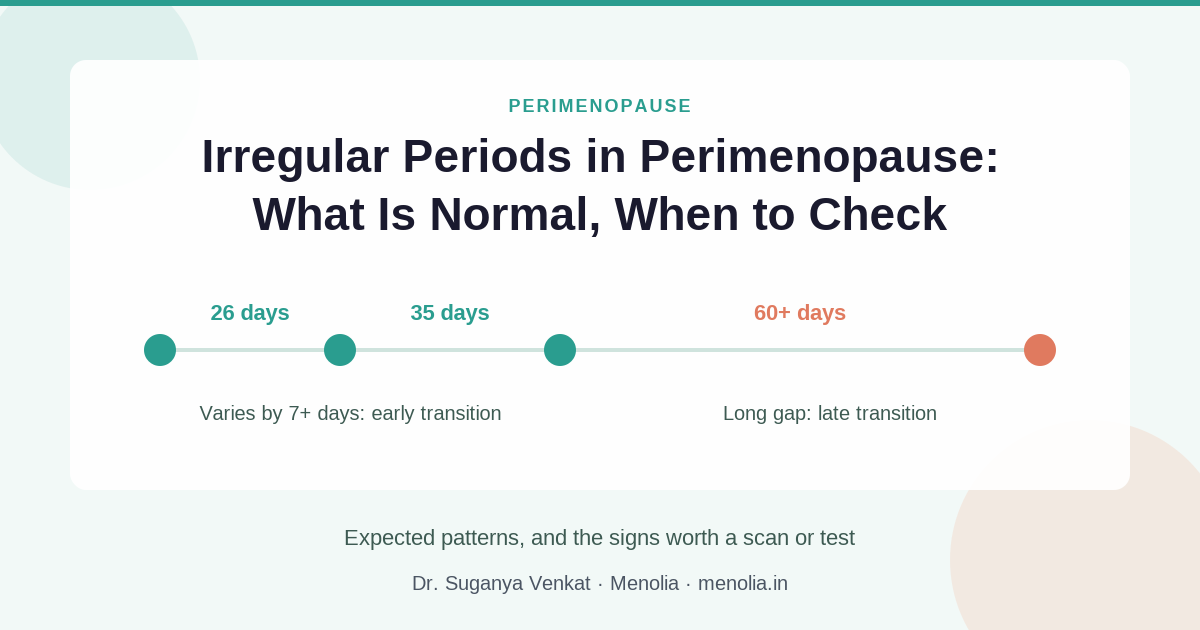
For the menopause years specifically, doctors use a staging system called STRAW+10 (Harlow SD et al., Climacteric, 2012, PMID 22338612). It gives two simple bleeding markers:
- Early menopause transition: the length of your cycle varies by 7 days or more from one cycle to the next, and this keeps happening. A 26-day cycle followed by a 35-day one is an example.
- Late menopause transition: a gap of 60 days or more without a period.
Menopause itself is confirmed only in hindsight, after 12 months in a row with no period at all. Our guide to the stages of menopause walks through each stage in more detail.
Why this happens
As the supply of follicles in the ovaries falls, the hormone signals between the brain and ovaries become less steady. FSH rises and swings from cycle to cycle, and ovulation becomes unpredictable rather than absent (Klein NA, Soules MR, Clin Obstet Gynecol, 1998, PMID 9917946). In some cycles an egg is released late, in some not at all. A study comparing women at different reproductive stages, each sampled over a single menstrual cycle, found the most cycles without ovulation in the late transition, and lower average luteal progesterone at later stages (Hale GE et al., J Clin Endocrinol Metab, 2007, PMID 17550960). A cycle without ovulation often means a late period, and sometimes a heavier one when it comes.
Patterns That Are Usually Expected
If you are in your forties, these patterns, on their own, are common in perimenopause:
- Cycle lengths that differ by a week or more from month to month.
- A skipped period now and then, with the next one arriving after 6 to 9 weeks.
- Gaps that slowly grow longer over a year or two, including gaps of 60 days or more, the marker of the late transition.
- Some months a little heavier or lighter than before, within what you can manage with your usual pads or cups.
- A short spell of spotting a day or two before a period begins.
The common thread is that the change is gradual, the bleeding stays manageable, and you feel otherwise well.
When It Is Worth Getting Checked
Irregular does not mean unwell. But the same “my periods are all over the place” feeling can come from a few treatable causes, so I suggest a consultation if any of these apply:
- A gap of 60 days or more if you are under 45, or if the pattern changed suddenly after years of steady cycles. At this age it is worth confirming that perimenopause is the reason and nothing else is involved.
- Bleeding that lasts more than 8 days, or flow heavy enough to soak a pad every hour or two.
- Bleeding between periods or after sex. These need their own assessment, whatever the cycle length.
- Periods closer together than 21 to 24 days for three months or more.
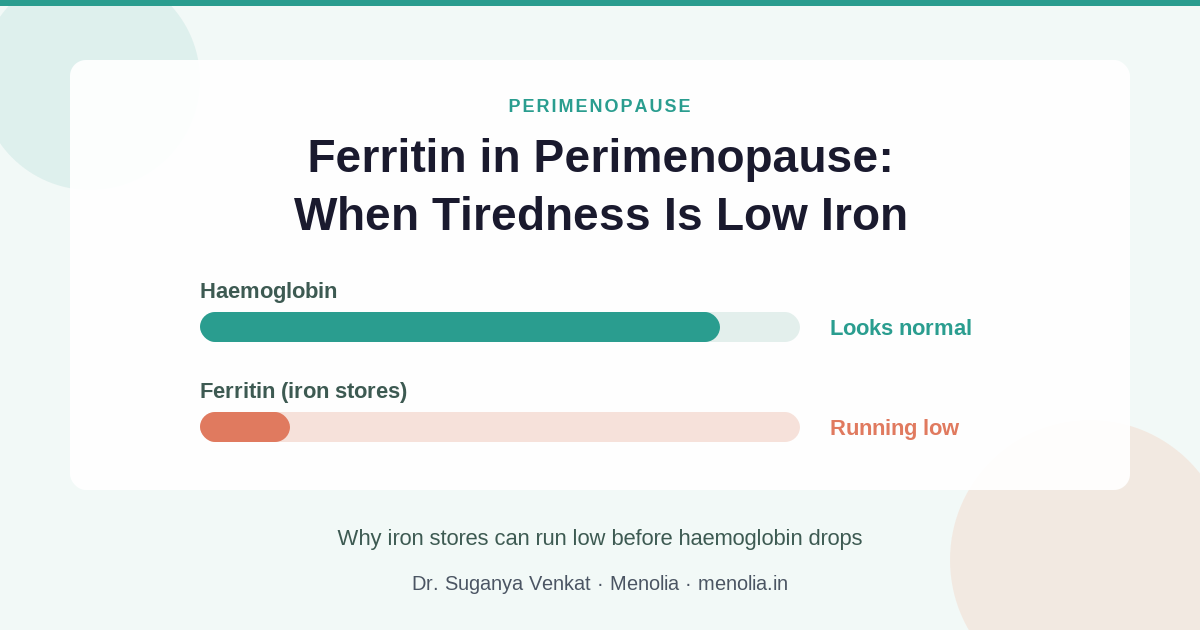
- Tiredness, breathlessness on stairs, dizziness or a racing heart, which can point to low iron from heavy bleeding. Our guide to ferritin and low iron in perimenopause explains what to test.
- Weight change, feeling unusually hot or cold, tremor or hair thinning alongside irregular cycles, which can point to the thyroid.
- You are on HRT or another hormone treatment and your bleeding pattern changes.
- Any bleeding after 12 months with no period. Once you have reached menopause, any bleeding is a reason to see a doctor, even a single spot. Our post on bleeding after menopause explains why it is checked and what usually turns up.
Go to the nearest hospital emergency department straight away if you are soaking through a pad every hour for several hours in a row, or if bleeding comes with fainting, chest pain or severe breathlessness.
Not sure whether your gaps and late periods are perimenopause or need a scan? We can go through your dates and symptoms together over a video call. Message Dr. Suganya on WhatsApp for a ₹399 video consultation.
What a Check-Up Usually Involves
Your doctor will choose what fits you. These are the steps that most often help.
A pregnancy test, if there is any chance. Ovulation in perimenopause becomes irregular, not impossible, so a late period can still be a pregnancy. It is a quick test and it settles the question first. Our guide on getting pregnant in perimenopause covers this in more detail.
Thyroid tests (TSH, sometimes free T4). Both an underactive and an overactive thyroid can disturb the menstrual cycle (Krassas GE et al., Endocr Rev, 2010, PMID 20573783). Our post on thyroid changes around menopause explains which tests help.
A blood count and ferritin, if the bleeding has been heavy or you feel run down.
A transvaginal ultrasound. This looks at the lining of the uterus and checks for fibroids or polyps. It is most useful when bleeding is heavy, prolonged, between periods or after a long gap.
Sometimes a sample of the lining (endometrial biopsy). The FIGO review gives the example of a 49-year-old with irregular bleeding who may need imaging and a sample of the lining, while a teenager with the same history usually would not (Jain V et al., 2023). Age, weight, diabetes, the scan findings and how long the pattern has lasted all feed into this decision. If it is suggested, it is a careful step to confirm the lining is healthy.
FSH alone rarely settles the question. FSH can be high one month and normal the next during perimenopause, so a single value does not confirm or rule out much. Our guide to menopause blood test results explains why.
What to Track Before Your Consultation
A short record makes the consultation faster and the advice more precise. For three to six months, note:
- The first day of every period. This is the most important number.
- How many days the bleeding lasts.
- How heavy it is, for example how many pads a day on the heaviest day, and whether you pass clots.
- Any spotting between periods or after sex, with the date.
- How you feel: tiredness, hot flushes, poor sleep, mood changes, palpitations.
- Any medicines, including hormone tablets, thyroid tablets and supplements.
A notes app or a paper calendar works perfectly well. Bring it, or a photo of it, to your appointment.
What Can Help Day to Day
Irregular cycles in perimenopause are usually managed rather than “fixed”, and the plan depends on what is bothering you most.
- Keep a small kit ready (pads, a spare pair of underwear) in your bag, since a late period can arrive without warning.
- Look after your iron if periods are heavy. Iron-rich Indian foods such as ragi, rajma, chana, green leafy vegetables like murungai keerai, and jaggery in small amounts help, alongside any supplement your doctor advises.
- Steady sleep, regular meals and daily movement do not regulate the cycle on their own, but they help with the fatigue and mood swings that often travel with it.
- Treatment, when needed, can range from medicines that reduce heavy bleeding to hormone-based options that make bleeding more predictable. This is a conversation to have with your gynaecologist, based on your own symptoms and health history.
What It Is Called in Tamil and Hindi
Many women describe this in their own language, when they search or when they talk to family:
| Language | How it is often said |
|---|---|
| Tamil | Maadhavidaai (மாதவிடாய்) is the period; maadhavidaai thallippogudhu is often said for a delayed period |
| Hindi | Maasik dharm (मासिक धर्म) is the period; women often say “period time pe nahi aa raha” for periods that do not come on time |
Whatever words your family uses, the same simple log of start dates is the most useful thing to bring to your doctor.
Practical Takeaways
- Count your cycle from the first day of one period to the first day of the next.
- Cycles that vary by a week or more, and occasional skipped periods, are common in perimenopause.
- A gap of 60 days or more usually marks the later part of the transition. Menopause is confirmed after 12 months with no period.
- Get checked for very heavy or long bleeding, bleeding between periods or after sex, signs of low iron, sudden changes under 45, or any bleeding after menopause.
- Rule out pregnancy first if there is any chance.
- Bring three to six months of start dates to your consultation.
Frequently Asked Questions
Is it normal to skip periods in perimenopause?
Yes, for most women. As ovulation becomes less regular, some cycles are much longer and some periods are skipped. If the rest of your health is fine and the bleeding, when it comes, is manageable, this is usually part of the transition. Do a pregnancy test if there is any chance, and see a doctor if you are under 45 or the pattern changed suddenly.
I have not had a period for two months at 45. Should I worry?
A gap of 60 days or more is the usual marker of the late menopause transition, so at 45 it is often expected. Rule out pregnancy first. If you also have heavy bleeding when periods return, bleeding between periods, or symptoms like weight change or palpitations, book a consultation.
How long do irregular periods last before menopause?
It differs from woman to woman. Some women have a few irregular months, others have irregular cycles for several years. Menopause is confirmed once you have gone 12 months in a row with no period.
Can I still get pregnant if my periods are irregular?
Yes. Ovulation becomes unpredictable in perimenopause, but it can still happen. If you do not want a pregnancy, keep using contraception until your doctor advises it is safe to stop.
Which tests are done for irregular periods after 40?
Commonly a pregnancy test, thyroid tests, a blood count with ferritin if bleeding is heavy, and a transvaginal ultrasound. Some women may need a sample of the uterine lining, depending on age, risk factors and the scan. A single FSH test is rarely enough to decide anything on its own.
Is a heavy period after a long gap normal?
It can happen, because a cycle without ovulation can let the lining build up for longer before it sheds. If the bleeding lasts more than 8 days, soaks a pad every hour or two, or leaves you tired and dizzy, see a doctor. If you soak a pad every hour for several hours, go to an emergency department.
When is bleeding not normal at all?
Any bleeding after you have gone 12 months without a period should be checked by a doctor, even if it is light or happens once.
Want someone to look at your cycle pattern with you? Share your dates and symptoms, and we will work out together whether it is perimenopause or something worth a scan. Consultations are online, over video, from anywhere in India.