You sleep seven hours and still wake up tired. By four in the afternoon you are running on tea. The stairs up to the terrace leave you a little out of breath, and more hair seems to come out in the comb than it used to. Everyone around you, and probably you too, has decided it is the hormones. You are in your forties, after all.
Sometimes it is the hormones. But one of the most common and most fixable reasons for this kind of tiredness in Indian women in their forties is low iron, and it hides well. Your blood report can show a “normal” haemoglobin while your iron stores are close to empty. The test that shows those stores is called ferritin.
I’m Dr. Suganya Venkat, an OB-GYN (DNB, GKNM Hospital) who also holds an MD in Pathology from CMC Vellore, and that pathology training is why a blood report is one of the first things I ask to see when a woman tells me she is exhausted. This post explains why perimenopause drains iron, why haemoglobin can look fine when your stores are low, which ferritin numbers mean what, what to eat and what to take, and why iron behaves differently once your periods stop.
If you want the wider list of reasons women feel drained at this age, from sleep to thyroid, our guide to menopause fatigue covers that ground. This post stays with iron.
Why Perimenopause Can Drain Your Iron
Blood is rich in iron, so every period takes some iron with it. Perimenopause can increase that loss in two ways.
Periods can get heavier. In some perimenopausal cycles you do not ovulate, so no progesterone is made, and the lining can keep building up before it sheds as a heavier bleed. Our guide to why your cycle changes in perimenopause walks through how this happens. The FIGO review of abnormal uterine bleeding, written for gynaecologists worldwide, notes that heavy menstrual bleeding is the type of abnormal bleeding that contributes most to iron deficiency and anaemia, and that it is still underrecognised and underreported (Jain V et al., Int J Gynaecol Obstet, 2023, PMID 37538019).
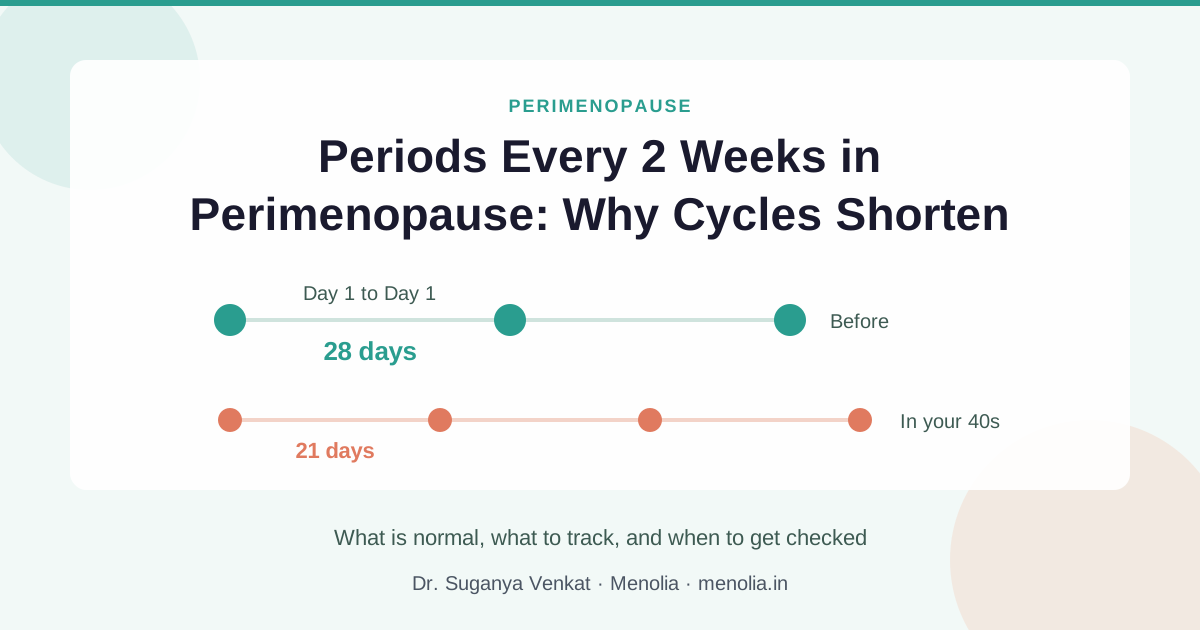
Periods can come closer together. A cycle that shrinks from 28 days to 21 means more bleeding days in a year, usually with no change in how much iron you eat. If that is your pattern, our post on periods every two weeks in perimenopause explains why cycles shorten.
Many Indian women also start their forties with small reserves. India’s National Family Health Survey (NFHS-5, 2019-21, India Report by IIPS, rchiips.org/nfhs) found that 57 percent of women aged 15 to 49 were anaemic. The type of diet matters too. One review estimated that people with no iron stores absorb about 14 to 18 percent of the iron in a mixed diet, but only 5 to 12 percent of the iron in a vegetarian diet (Hurrell R, Egli I, Am J Clin Nutr, 2010, PMID 20200263). Add tea or coffee with meals, and the iron used up by past pregnancies and breastfeeding, and many women reach perimenopause with very little iron in the bank.
Haemoglobin and Ferritin Measure Different Things
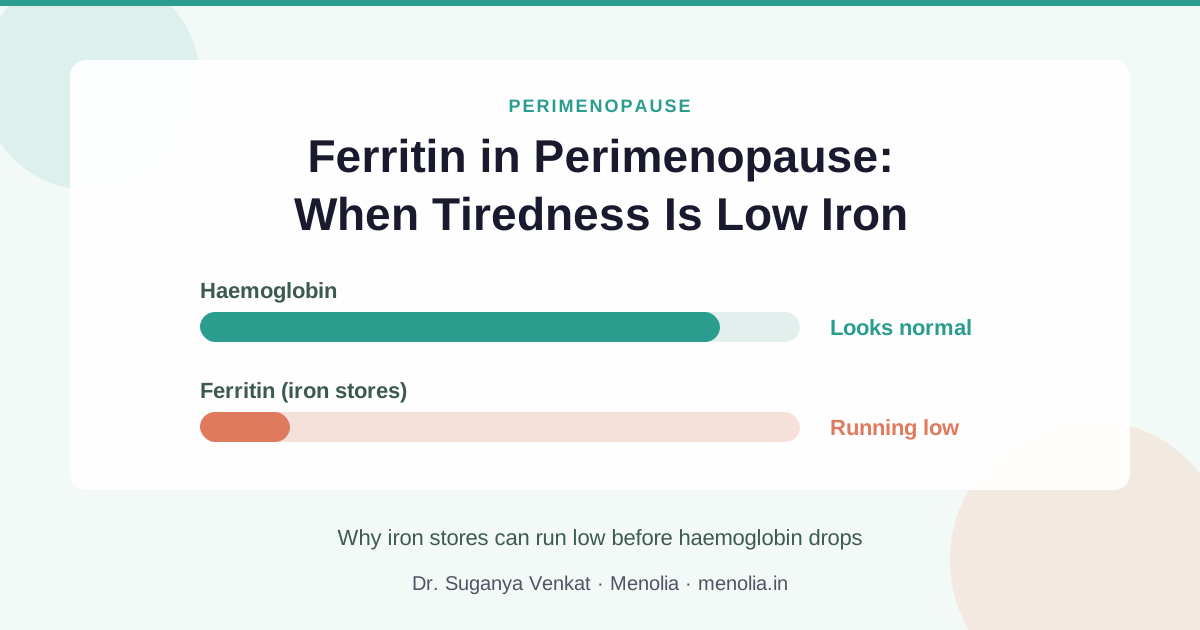
Think of iron like household money. Ferritin is your savings account: it reflects how much iron your body has stored. Haemoglobin is the money you spend every day: the iron-carrying protein in red blood cells that delivers oxygen around your body.
When you lose more iron than you take in, your body draws on its savings first, so that haemoglobin can stay steady. Ferritin falls, sometimes for months, while haemoglobin stays in the normal range. Only when the savings run out does haemoglobin start to fall, and that is when a report finally says “anaemia”.
This is how a woman can have a normal haemoglobin and still be iron deficient. A review of iron deficiency in The Lancet points out that its clinical and functional effects can occur without anaemia (Pasricha SR et al., Lancet, 2021, PMID 33285139).
Does it change how you feel? Two randomised trials tested this in women with unexplained tiredness who were not anaemic:
- In Switzerland, 144 women aged 18 to 55 took iron or a placebo for four weeks. Fatigue scores fell by 29 percent with iron and 13 percent with placebo, and only women with a ferritin of 50 µg/L or lower improved (Verdon F et al., BMJ, 2003, PMID 12763985).
- In France, 198 women aged 18 to 53 with a ferritin below 50 µg/L and haemoglobin above 12 g/dL took iron or a placebo for twelve weeks. Fatigue scores fell by 47.7 percent with iron and 28.8 percent with placebo, though iron did not change quality of life, depression or anxiety scores (Vaucher P et al., CMAJ, 2012, PMID 22777991).
The placebo groups felt better too, which is a reminder that tiredness has many threads. But iron made a measurable difference for women with low stores. That is why I check ferritin in a tired woman even when her haemoglobin looks fine, and why, when ferritin is comfortably above 50, I start looking for other reasons for her tiredness.
What Ferritin Number Counts as Low?
This is where many women get confused. Your lab report prints its own reference range, and a result inside that range can still mean your stores are low. Ferritin is reported in µg/L or ng/mL, and the two units give the same number.
Here is a rough guide to reading the result with your doctor:
| Ferritin (µg/L or ng/mL) | What it usually means |
|---|---|
| Below 15 | Iron stores are essentially empty. This is the World Health Organization’s cut-off for iron deficiency in healthy adults. |
| 15 to 30 | Low stores for most women. In one study, a cut-off of 30 or below picked up 92 percent of iron deficiency in anaemic patients, with 98 percent specificity. |
| 30 to 50 | Borderline. Both fatigue trials above included women in this range. |
| Above 50 | Low iron is less likely to explain tiredness, unless inflammation is pushing ferritin up. |
| Above 150 | Higher than expected in a healthy woman. The WHO uses this as a flag for possible iron overload, and inflammation or infection can also raise it. Discuss it with your doctor. |
The cut-offs of 15 and 150 come from the WHO’s 2020 guideline on using ferritin to assess iron status (who.int, WHO guideline on use of ferritin concentrations, 2020). The figure of 30 comes from a study comparing ferritin against bone marrow iron and response to iron treatment (Mast AE et al., Clin Chem, 1998, PMID 9550557).
Ferritin can look falsely reassuring. Ferritin is also an acute-phase protein, which means it rises with inflammation and infection whatever your iron stores are doing (Garcia-Casal MN et al., Cochrane Database Syst Rev, 2021, PMID 34028001). The same WHO 2020 guideline (who.int) says that in adults with infection or inflammation, a ferritin below 70 µg/L may indicate iron deficiency, and it recommends measuring inflammation markers such as CRP alongside ferritin where infection or inflammation is common. If you have arthritis, a recent fever or another inflammatory condition, your doctor may add a CRP or a transferrin saturation test to read your ferritin correctly.
One more report detail: iron deficiency tends to make red blood cells smaller (a low MCV), while B12 deficiency makes them larger, so when both are present the MCV can look normal. Our guide to B12 deficiency after 40 explains why it is worth checking both together.
Is It Perimenopause or Low Iron?
Both can cause tiredness and several of the same symptoms, and many women have both at once. You cannot reliably tell them apart by how you feel, but the pattern gives clues.
| Symptom | Perimenopause can cause it | Low iron can cause it | What helps sort it out |
|---|---|---|---|
| Tiredness that sleep does not fix | Yes, often through broken sleep and night sweats | Yes, even before anaemia | Ferritin and a blood count |
| Breathless on stairs or a short walk | Less typical | Yes, especially once haemoglobin falls | Blood count |
| Racing or pounding heart | Yes | Yes, with anaemia | Blood count, then a doctor’s review |
| Hair shedding | Yes | Possibly, the research is mixed | Ferritin and thyroid tests |
| Restless, crawly legs at night | Possibly, it often worsens around menopause | Yes, low ferritin is linked to restless legs | Ferritin |
| Spoon-shaped nails, craving ice | Not typical | Yes | Ferritin |
| Hot flushes and night sweats | Yes | No | Your cycle and symptom history |
| Poor concentration, brain fog | Yes | Yes | Worth checking both |
Our guides to heart palpitations in menopause, hair thinning and leg cramps and restless legs at night go into each of these in more detail. If your periods have been heavy or frequent and two or three rows of the iron column sound familiar, a ferritin test is worth doing before everything is put down to hormones.
When to Ask for a Ferritin Test
Ask your doctor about a blood count and ferritin if:
- Your periods have been heavier, longer or closer together for three months or more. Our guide to heavy and abnormal bleeding in perimenopause explains how that bleeding is assessed and treated.
- You are tired most days, even with reasonable sleep.
- You get breathless, or your heart races, on stairs or a short walk.
- You are vegetarian, or you drink tea or coffee with most meals.
- You have restless legs at night, new hair shedding, spoon-shaped nails or a craving for ice.
- You have been anaemic before, or you were given iron tablets and stopped them early.
- You are about to start iron tablets on your own. A test first tells you whether you need them and gives a baseline to compare against later.
Tiredness at this age has other common, checkable causes, so it often makes sense to test a few things together: thyroid function (see our guide to thyroid changes around menopause), vitamin B12 and blood sugar. Our guide to menopause blood tests explains which tests tend to tell you more than an FSH level.
Go to the nearest hospital emergency department straight away if you are soaking through a pad every hour for several hours in a row, or if heavy bleeding comes with fainting, chest pain or breathlessness at rest.
Tired for months, periods heavier than before, and not sure whether it is hormones or iron? Send your recent blood reports and we can go through them together over a video call. Message Dr. Suganya on WhatsApp for a ₹399 video consultation.
What Helps When Ferritin Is Low
Find the reason as well as the fix. In perimenopause, the usual reason is heavier or more frequent bleeding, so taking iron without looking at the bleeding is like filling a bucket with a hole in it. Heavy bleeding has good treatments, and Chellammal’s story shows how one woman’s plan dealt with her bleeding and her iron at the same time.
Iron tablets, as your doctor advises. Oral iron is the first-line treatment in most cases (Pasricha SR et al., 2021). The most common complaint is the stomach: in a pooled analysis of 43 trials, ferrous sulfate more than doubled the odds of gastrointestinal side effects compared with placebo (Tolkien Z et al., PLoS One, 2015, PMID 25700159). If tablets upset you, tell your doctor rather than stopping quietly, because there are other options.
Alternate days may suit some women. Oral iron raises hepcidin, a hormone that limits how much iron the gut absorbs, which makes high doses less efficient (Pasricha SR et al., 2021). In a study of iron-depleted women aged 18 to 40, fourteen doses taken on alternate days were absorbed better than fourteen doses taken on consecutive days, and the researchers noted this still needs confirming in women who are already anaemic (Stoffel NU et al., Lancet Haematol, 2017, PMID 29032957). Ask your doctor which schedule suits you.
Intravenous iron when tablets are not enough. If tablets cause too many side effects, do not work, or your levels are very low, your doctor may suggest an iron infusion. Modern intravenous iron allows the full replacement dose to be given quickly and safely (Pasricha SR et al., 2021).
Recheck rather than guess. In the French trial, the researchers suggested checking blood markers after six weeks of treatment to see whether iron is working (Vaucher P et al., 2012). If your ferritin does not rise as expected, that is useful information, and your doctor may look at how well you absorb iron. Coeliac disease, which affects the part of the gut where iron is absorbed, is one cause worth considering, and our post on menopause and coeliac disease explains when.
Iron-Rich Indian Foods, and How to Absorb More
Food is slow to refill stores that months of heavy periods have emptied, which is why your doctor may suggest tablets as well. But food keeps your stores topped up once they are back, and a few habits make a real difference to how much you absorb.
Vegetarian sources: murungai keerai (drumstick leaves), ragi, kollu (horse gram), rajma, kala chana, ellu (sesame seeds), garden cress seeds (halim or aliv), dates and jaggery.
Non-vegetarian sources: eggs, fish, chicken, mutton and liver. The haem iron in meat and fish is well absorbed and less affected by the rest of the meal than iron from plant foods (Lynch SR, Cook JD, Ann N Y Acad Sci, 1980, PMID 6940487).
Three habits that help:
- Add vitamin C to plant iron. A squeeze of lemon over your keerai poriyal, a piece of amla, guava or tomato in the meal. Vitamin C is a powerful enhancer of plant iron absorption and can reverse some of the blocking effect of tea and calcium (Lynch SR, Cook JD, 1980).
- Move tea and coffee away from meals. In absorption studies, black tea taken with a meal cut the iron absorbed from that meal by 79 to 94 percent, coffee also reduced it, and adding milk made little or no difference (Hurrell RF et al., Br J Nutr, 1999, PMID 10999016). You do not need to give up your chai. Have it between meals instead of with breakfast and lunch.
- Ask about timing iron and calcium tablets. Many women in their forties take calcium too, and calcium can reduce iron absorption (Lynch SR, Cook JD, 1980). Your doctor or pharmacist can tell you how to space them.
After Your Periods Stop, Iron Usually Rises
Once periods end, the monthly loss stops and iron stores tend to build up. Serum ferritin rises two- to threefold from before menopause to after it (Jian J et al., Antioxid Redox Signal, 2009, PMID 19527179). Two practical points follow.
Avoid taking iron “just in case”. After menopause, more iron is not better. Take iron when a test shows you need it, and recheck when your doctor advises.
New low iron after menopause needs a reason. With periods gone, the usual explanation is gone too, so doctors look for where iron is being lost or why it is not being absorbed. The British Society of Gastroenterology’s guideline describes examining the upper and lower gut by endoscopy as the standard approach (Snook J et al., Gut, 2021, PMID 34497146), and the Lancet review recommends considering a coeliac screen routinely and an endoscopy for postmenopausal women with iron deficiency anaemia (Pasricha SR et al., 2021). This is a routine, careful step, and finding the source is what fixes the iron for good. While you still have periods, heavy bleeding usually explains low iron, and your doctor will decide whether anything further is needed.
What It Is Called in Tamil and Hindi
Many women describe low iron in their own language, at home and when they search:
| Language | Term | Meaning |
|---|---|---|
| Tamil | Irumbuchathu (இரும்புச்சத்து) | Iron, as a nutrient |
| Tamil | Irumbuchathu kuraipaadu (இரும்புச்சத்து குறைபாடு) | Iron deficiency |
| Tamil | Ratha sogai (ரத்த சோகை) | Anaemia |
| Tamil | Sorvu (சோர்வு) | Tiredness |
| Hindi | Iron ki kami (आयरन की कमी) | Iron deficiency |
| Hindi | Khoon ki kami (खून की कमी) | Anaemia, literally “shortage of blood” |
| Hindi | Thakaan (थकान) | Tiredness |
Whether your family says “blood is low” or “iron kammiya irukku”, ask for the actual ferritin number on your report, not only the haemoglobin.
Practical Takeaways
- Ferritin shows your iron savings. Haemoglobin can stay normal for months while ferritin falls.
- Heavier or more frequent periods are the usual drain in perimenopause, on top of low reserves that are common in Indian women.
- Look at the ferritin number itself. Below 15 is empty, up to 30 is low for most women, and under 50 with tiredness is worth discussing.
- Inflammation can hide low iron by pushing ferritin up.
- Treat the bleeding and the iron together, and recheck to make sure treatment is working.
- Pair plant iron with lemon or amla, and drink tea and coffee between meals.
- After menopause, ferritin usually rises. Do not take iron without a test, and new low iron deserves a look for the cause.
Frequently Asked Questions
What is a normal ferritin level for a woman in her 40s?
Lab reference ranges vary, so look at the number rather than the “normal” flag. The WHO treats a ferritin below 15 µg/L as iron deficiency in healthy adults, a cut-off of 30 or below picks up most iron deficiency, and in trials, tired women with a ferritin under 50 often felt better with iron. If you have inflammation, a ferritin under 70 can still mean low iron.
Can low ferritin cause tiredness even if my haemoglobin is normal?
Yes. Your body uses up its stored iron first to keep haemoglobin steady, so ferritin can be low for months before anaemia shows up. In a French trial of non-anaemic women with a ferritin below 50, iron reduced fatigue more than placebo did.
How can I tell whether my tiredness is perimenopause or low iron?
Not reliably by symptoms alone, because the two overlap and often occur together. Hot flushes and night sweats point to hormones, while breathlessness on stairs, spoon-shaped nails or craving ice point towards iron. Restless legs can come from either. A blood count and ferritin test settle the iron question quickly.
Perimenopause me iron ki kami kyun hoti hai? (Why does iron deficiency happen in perimenopause?)
Mostly because periods often become heavier or come closer together in perimenopause, so you lose more iron each year. Many Indian women also start with low reserves because of a mainly vegetarian diet, tea or coffee with meals, and past pregnancies. A ferritin test shows how much iron you have stored.
How long does it take for ferritin to go up?
It depends on how low it started, the cause and the treatment. In the French trial, researchers suggested checking blood markers after six weeks of iron, and after twelve weeks ferritin had risen by about 11 µg/L more than with placebo. If heavy bleeding continues, stores refill slowly, which is why treating the bleeding matters.
Should I take iron tablets just in case during menopause?
No. Once periods stop, iron stores usually rise, so most women do not need extra iron. Take iron when a blood test shows you need it, and recheck as your doctor advises.
Does ferritin go up after menopause?
Yes. Without monthly bleeding, iron builds up, and serum ferritin typically rises two- to threefold from before menopause to after it. That is why a new low ferritin after menopause is worth investigating for its cause rather than simply treating.
Tiredness in your forties is worth checking properly, and low iron is one of the easiest causes to find and fix. A blood count and a ferritin test are simple, and if your stores are low, treating both the iron and the bleeding behind it can give you back energy you had put down to age. If you would like help reading your reports and deciding what to test or treat next, working alongside your own doctor, I see women across India online over video consultation. You can also read about Menolia’s perimenopause program.